
Top Local Pros for land clearing services near me
- Mike Walker
- Nov 18, 2025
- 17 min read

If you've been searching for "land clearing services near me" in Central Florida, you know you need more than just a phone number—you need a solid plan. This guide is here to give you a straightforward look at the most common ways to clear land, so you can quickly get a handle on the best path forward for your property.
Your Guide to Reclaiming Central Florida Property
Turning an overgrown, tangled mess of a lot into a clean slate is the very first step toward making your vision a reality. It doesn’t matter if you're getting ready to build your dream home, carve out a pasture for horses, or just want to boost your property's value—knowing your options is absolutely essential. Think of this guide as the blueprint for your project, designed to walk you through every critical stage.
We'll kick things off by comparing the main land clearing methods used right here in our corner of Florida. This overview will help you wrap your head around the different approaches before we get into the nitty-gritty of each one. Making the right call from the start saves a ton of time and money down the road, ensuring the technique you choose actually fits your land and your goals.
A First Look at Your Options
Before you can even think about getting an accurate quote from a local land clearing company, it helps to speak the language. Each method has its own set of pros and cons, and each is best suited for different situations—from eco-friendly techniques that enrich the soil to old-school methods built for speed and scale.
Choosing the right clearing method isn't just about getting rid of trees and brush. It's about setting the foundation for your property's future. The choice you make will directly impact your soil health, your project timeline, and your overall budget.
To keep it simple, let's start with a quick side-by-side look at the most common techniques you’ll come across.
Quick Guide to Common Land Clearing Methods
Understanding the basic differences between clearing methods is the first step toward a successful project. The table below breaks down the three most popular options in Central Florida, giving you a snapshot of what each one does best.
Method | Best For | Pros | Cons |
|---|---|---|---|
Forestry Mulching | Environmentally sensitive projects; preserving topsoil; moderate vegetation density. | Leaves a nutrient-rich mulch layer, prevents soil erosion, and often requires no hauling permits. | Can be slower on extremely dense land with large hardwood trees; may not remove stumps completely flush. |
Bulldozing | Large-scale commercial projects; removing all vegetation and stumps; speed is a priority. | Extremely fast and effective for clearing vast areas completely, including large stumps and roots. | High potential for soil disturbance and erosion; often requires costly debris hauling and disposal. |
Manual Clearing | Small or highly sensitive areas; selective tree removal; steep or inaccessible terrain. | Precise control over which plants are removed, minimal impact on surrounding vegetation and roots. | Very labor-intensive and slow, making it cost-prohibitive for properties larger than an acre. |
As you can see, there’s no single "best" method—it all comes down to what you're trying to accomplish. Are you looking to selectively thin out underbrush while protecting mature oaks? Forestry mulching is likely your answer. Need to wipe a 10-acre lot clean for a new commercial building? A bulldozer might be the only practical choice. Now, let's explore these options in more detail.
Why Land Clearing Is More Than Just Pushing Over Trees
When most people picture "land clearing," they imagine a bulldozer flattening everything in its path. While heavy machinery is definitely part of the job, that image barely scratches the surface of what professional land clearing is all about. It’s less about brute force and more about a strategic, thoughtful process of transforming an unusable plot into a valuable, ready-to-use asset.
Think about it like renovating an old, cluttered house before you move in. You can't just start knocking down walls. You need a plan to sort through the junk, make structural repairs, and prep the space for its new life. Land clearing works the same way—it's a series of deliberate steps to get the ground ready for whatever you have planned next, whether it's a new home, a pasture, or just a safer, more beautiful backyard.
It All Starts With Your Goal
The reasons Central Florida landowners start searching for land clearing services near me are as diverse as the properties themselves. Every goal demands a different approach, a unique set of tools, and a specific final outcome. The "why" behind your project is the single most important factor that shapes the "how."
Here are a few of the most common objectives we see:
New Construction Prep: This is about creating a clean, stable, and perfectly graded foundation for a home, barn, or commercial building.
Agricultural Use: Maybe you're reclaiming overgrown fields for crops, turning wooded areas into pasture for livestock, or preparing a plot for an orchard.
Enhanced Usability and Aesthetics: Sometimes, the goal is simply to make a property more accessible, visually appealing, and useful for recreation or future landscaping projects.
Wildfire Prevention: A critical one here in Florida. This involves creating firebreaks by removing flammable underbrush and establishing a defensible space around your home and other structures.
This initial goal is the blueprint for the entire project. Clearing land for a future home site, for instance, requires meticulous stump and root removal to guarantee a solid foundation. But if you're just creating a simple hunting trail, you might only need to clear a narrow path while leaving the surrounding habitat intact.
The Comprehensive Clearing Process
So, what does a full-scale land clearing project really involve beyond just taking down trees? It’s a multi-stage operation designed to prepare your site from the top down and from the ground up. A professional crew doesn't just clear what’s visible; they tackle what’s on the surface and what lies beneath to head off future problems like soil erosion, drainage nightmares, or stubborn regrowth.
Land clearing isn’t an expense; it’s an investment in your property's future. Proper site preparation prevents costly foundational issues, drainage problems, and endless maintenance headaches down the road. It turns raw land into a ready-to-use asset.
A complete service usually involves several key stages, each one vital for a successful outcome:
Underbrush and Vegetation Removal: This is always the first step. We have to tackle the dense layer of shrubs, tangled vines, and small saplings that make a property impassable and hide what's underneath.
Tree Removal and Thinning: This can be selective—saving mature, healthy oaks while removing invasive species—or it can be a complete clear-cut for new construction.
Stump Grinding or Removal: Just cutting a tree down leaves a hazardous stump behind. Grinding it below the surface or completely digging it out is crucial for creating a smooth, buildable, and safe surface.
Debris Hauling and Disposal: After everything is down, all that organic material has to be managed. This could mean hauling it away, burning it (with the proper permits, of course), or mulching it right on-site to enrich the soil.
Grading and Soil Stabilization: This is the final, critical step. The land is shaped to ensure proper water drainage away from future structures and to create a level, stable base for building or planting.
Understanding this full process helps you see that you’re not just hiring someone to knock down a few trees. You’re partnering with a team to strategically sculpt and prepare your land for its next chapter, making sure it’s safe, stable, and ready for your vision.
Choosing the Right Land Clearing Method
Once you know why you’re clearing your land, the next big question is how. This isn’t just about picking the biggest machine for the job. It’s a strategic choice that directly impacts your project’s budget, timeline, and the long-term health of your property.
Think of it like a carpenter choosing between a sledgehammer and a finishing nailer—the right tool depends entirely on what you're trying to build.
Finding the best approach among local land clearing services near me means matching the method to your specific goals for that particular piece of land. A one-size-fits-all approach just doesn't cut it in Central Florida. The dense palmetto scrub you'd find in Osceola County requires a totally different game plan than the sandy, pine-dotted lots in Volusia.
This infographic breaks down the main reasons people clear land, helping you figure out which path makes the most sense for your project.
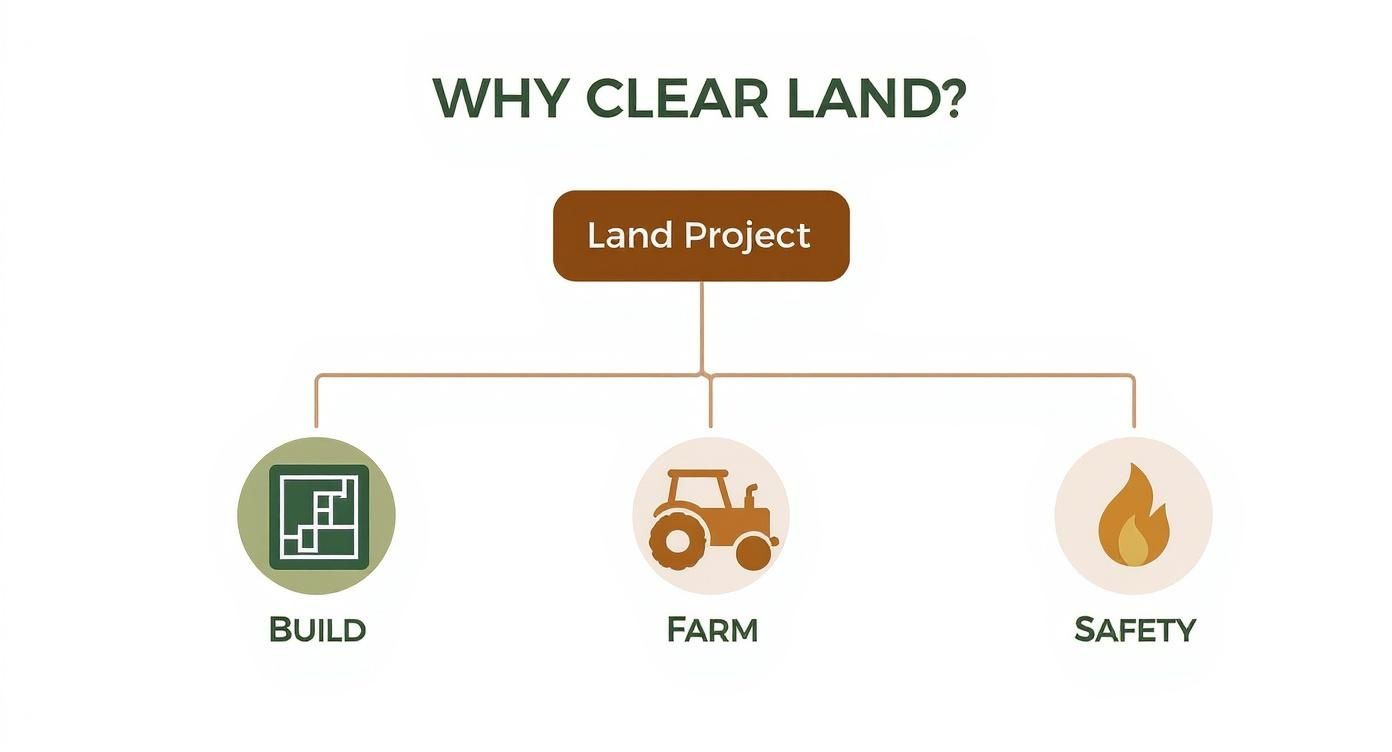
As you can see, your objective—whether you’re prepping for construction or just improving safety—is the key to picking the right technique.
Forestry Mulching: An Eco-Conscious Approach
Forestry mulching has quickly become a go-to option for many Central Florida landowners, and for good reason. Instead of scraping the land bare, this method uses a single machine to shred trees, brush, and other vegetation right where it stands. The result is a protective blanket of natural mulch spread across the soil.
This process has some serious advantages:
Soil Health: That layer of mulch is fantastic for holding in moisture, preventing our heavy Florida rains from washing away topsoil, and slowly breaking down to feed nutrients back into the ground.
No Hauling or Burning: Because everything is processed on-site, you can often sidestep the extra costs and permit hassles that come with hauling debris away or doing a prescribed burn.
Selective Clearing: A skilled operator can dance a mulcher around mature live oaks and other desirable trees, clearing out only the unwanted undergrowth and invasive species.
This technique is a perfect fit for projects focused on conservation, cutting new recreational trails, or prepping a homesite without tearing up the ground. If you want to see how it works, check out our detailed guide on what forestry mulching is and how it works.
The demand for this sustainable method is growing. The global market for forestry mulching machinery was valued at $531 million in 2024 and is projected to hit $771 million by 2031, thanks to an increase in development that requires more responsible land prep. You can read more about the forestry mulching machine market projections to understand the factors behind its growth.
Traditional Dozing: The Power Option
When you need it done fast and you're clearing a large area, traditional bulldozing and root-raking is still the king. This is the classic "clear and grub" approach where heavy equipment pushes over trees, yanks out stumps, and scrapes the land clean.
Bulldozing is the fastest way to get from a dense forest to a perfectly flat, build-ready pad. It’s ideal for large commercial sites or new subdivisions where complete and total clearing is the objective.
But all that power comes with trade-offs. The process churns up the topsoil, leaving the land exposed to erosion until you can get it stabilized or start building. It also creates massive piles of debris that have to be either burned or hauled off, which adds another layer of cost and complexity to the project. This method is really best for large-scale construction where the whole landscape is about to be reshaped anyway.
Manual and Selective Clearing
For smaller, more delicate jobs, nothing beats the precision of clearing by hand. This involves crews using chainsaws, brush cutters, and other hand tools to selectively remove specific trees or vegetation. It's definitely the most labor-intensive and slowest method, so it isn't practical for clearing whole acres.
However, it’s the perfect solution for sensitive areas. Think clearing around a protected wetland, thinning trees on a steep slope where heavy machinery can't go, or carefully weeding out invasive plants from a prized garden without disturbing anything else.
Navigating Florida Permits and Environmental Rules
Here in Central Florida, what you don't know about local regulations can bring your entire project to a screeching halt. Before the first engine ever roars to life, it’s critical to understand that clearing land isn’t just a physical job—it’s a legal one, too. Skipping this step can lead to hefty fines and frustrating delays that throw your whole timeline off track.
Think of it like getting a permit to build a house. You wouldn’t dream of pouring a foundation without an approved plan, and you shouldn’t clear land without the county’s green light. This is especially true in places like Orange, Seminole, and Osceola counties, where local ordinances are specifically designed to protect Florida's unique natural character.
Why Permits Are Not Optional
The main reason for permits is to manage development responsibly and protect our local environment. Florida’s ecosystems are as fragile as they are beautiful, and unregulated clearing can trigger serious problems like soil erosion, water runoff issues, and the loss of vital wildlife habitats. Local governments use the permitting process to make sure your project aligns with their long-term conservation goals.
These rules often zoom in on specific types of trees. For example, trying to remove a protected species like a mature live oak or a historic cypress tree without a permit is a serious violation. You might be required to get an arborist's report to justify its removal, and sometimes, you'll even need to plant new trees to make up for the ones you take down.
Navigating the permit process isn't just about dodging fines; it’s about being a good steward of the land. A professional contractor who knows the local rules is your most valuable ally, ensuring your project is both legal and responsible from day one.
Florida's Environmental Gatekeepers
Beyond your local county office, state-level agencies play a huge role. These organizations are the guardians of Florida's larger ecosystems, and your project might fall under their jurisdiction—especially if it’s on or near sensitive land.
Here are the key players you need to know:
Florida Department of Environmental Protection (FDEP): This is the big-picture agency for Florida's natural resources. Their regulations are in place to protect air quality, water sources, and critical habitats all across the state.
Water Management Districts (WMDs): Florida is divided into five WMDs, including the St. Johns River and South Florida districts. If your property has wetlands or is near a significant body of water, you will almost certainly need their sign-off before you clear.
Florida Fish and Wildlife Conservation Commission (FWC): This commission is all about protecting native animal species. Their involvement becomes crucial if your land is home to any protected wildlife.
This web of regulations is exactly why working with experienced land clearing services near me is so important; they know who to call and what paperwork to file. For a closer look at how this applies to building projects, check out our guide on clearing land for construction in Florida.
Wildlife and Wetland Considerations
Two of the most common—and critical—environmental hurdles in Central Florida are protected wildlife and wetlands. The gopher tortoise, a threatened species, is a perfect example. If a survey turns up gopher tortoise burrows on your property, all clearing work must stop until the animals are safely and legally relocated by a licensed professional. That’s a separate process with its own costs and timeline.
Wetlands are just as heavily protected. An area might only look a bit marshy after a big rain, but if it's classified as a wetland, you’ll need special permits and will likely have to maintain a buffer zone where no clearing can happen. This careful oversight is part of a much larger global effort to preserve vital ecosystems. While deforestation is still a major global issue, with roughly 10.9 million hectares lost each year between 2015 and 2025, it's encouraging that more than half of the world's 4.14 billion hectares of forests are now under long-term management plans. You can discover more insights about declining global deforestation on eco-business.com. This context shows why local Florida regulations are a critical piece of a worldwide conservation movement.
Understanding Land Clearing Costs in Central Florida
When you start looking for land clearing services near me, one of the very first questions that pops into your head is, "How much is this going to cost?" The truth is, there's no simple flat rate. It’s a lot like getting a quote to paint your house—the final price depends on the size, its current condition, and the quality of paint you choose. Land clearing is exactly the same; the final cost is custom-fit to the unique character of your property.
Several key variables come together to shape your final quote. Getting a handle on these factors will demystify the pricing process, helping you see exactly what you're paying for and why one quote might be different from another.
Key Factors Influencing Your Quote
Every piece of land in Central Florida has its own personality, and each project brings its own set of challenges. A professional contractor will walk the property with you and assess these elements before they can give you an accurate, solid estimate.
Here are the primary drivers that will determine the cost of your project:
Acreage and Size: This is the most straightforward factor. Clearing five acres will naturally cost more than clearing one. The good news is that the price per acre often comes down on larger projects because of the efficiencies of working at scale.
Vegetation Density: A lot with just some sparse underbrush and a few small pines is far easier and faster to clear than a parcel completely choked with dense palmettos, thick vines, and mature oak trees. The thicker the growth, the more time and machine power it’s going to take.
Terrain and Accessibility: Is your property flat and easy for heavy equipment to get to? Or is it sloped, swampy, or full of hidden obstacles? Tough terrain requires more skilled operators and can slow down the work, which adds to the overall cost.
Chosen Clearing Method: Like we've talked about, forestry mulching, bulldozing, and manual clearing all come with different price tags based on the machinery, labor, and time involved.
Hourly Rates Versus Flat Project Fees
You'll find that contractors typically price their services in one of two ways: by the hour or with a flat fee for the whole job. An hourly rate might seem attractive for smaller, very simple jobs. However, for most projects, a flat project fee is often the better way to go for the landowner.
A flat-rate quote gives you complete peace of mind. You know the total cost upfront, with no surprises if the job takes a bit longer than expected because of unforeseen obstacles like buried debris or stubborn root systems.
This pricing structure means the contractor is the one who assumes the risk for any minor delays, giving you a predictable budget you can work with from start to finish. For a deeper dive into how these factors break down, you can explore our guide to the cost to clear an acre of land in Florida.
Estimated Cost Ranges Per Acre
To give you a clearer picture, let's look at some typical cost scenarios. The equipment used in these services, especially high-powered forestry mulchers, represents a huge investment and a growing global industry. The market for forestry mulchers is valued at around $850 million in 2025 and is expected to keep climbing, which just shows how high the demand is for efficient land management. You can learn more about the expanding forestry mulcher market to see how these technology trends impact service costs.
To help you get a ballpark idea for budgeting, here are some sample cost ranges based on what we typically see in Central Florida. Just remember, these are estimates; only a professional site assessment can lock in a precise quote for your specific property.
Estimated Land Clearing Costs Per Acre in Central Florida
Land Condition | Clearing Method | Estimated Cost Per Acre |
|---|---|---|
Lightly Overgrown (grass, weeds, few saplings) | Forestry Mulching | $800 - $2,000 |
Moderately Wooded (dense brush, small to medium trees) | Forestry Mulching or Dozing | $2,000 - $4,500 |
Heavily Wooded (large hardwoods, dense understory) | Bulldozing & Root Raking | $4,500 - $7,000+ |
These ranges really show how the density of your land and the method used to clear it directly impact your investment. By understanding these variables, you can confidently evaluate the bids you receive and choose the right service for your Central Florida property.
How to Hire the Right Land Clearing Contractor
Choosing the right partner is hands-down the most important decision you'll make when you start searching for land clearing services near me. A skilled, reputable contractor can make a complex project feel easy and successful. On the flip side, an inexperienced one can cause costly delays, damage, and a whole lot of headaches.
Your goal isn't just to find someone with the right equipment. You need a professional who truly understands Central Florida’s unique terrain, soil types, and local regulations. Think of this vetting process as your project's insurance policy. It's about finding the best value—not just the lowest price—and getting the job done safely, legally, and correctly the first time.
Verify Their Credentials First
Before you even get into the details of your project, there are a few non-negotiables you must confirm. These credentials protect you from liability and prove the company operates above board. This is the essential background check before you let anyone start work on your property.
Always ask for proof of:
General Liability Insurance: This is what covers any accidental damage to your property or a neighbor's. Without it, you could be left footing the bill for expensive repairs.
Workers' Compensation Insurance: This one is absolutely critical. It protects you from being held financially responsible if a worker gets injured on your land during the clearing process.
State and Local Licenses: Make sure they are licensed to operate in your specific Florida county. This confirms they meet the required standards for doing business here.
A professional company will have no issue providing you with copies of their insurance certificates. If a contractor hesitates or gives you excuses, that’s a major red flag. Just move on.
"A contractor's willingness to provide proof of insurance and licensing is a direct reflection of their professionalism and commitment to protecting their clients. Never skip this step—it’s the foundation of a safe and successful project."
Dive into Their Experience and Reputation
Once you've confirmed the basics, it’s time to dig into their track record. You want a team that has successfully handled projects similar to yours right here in Central Florida. That local experience with our soil, native plants, and environmental rules is invaluable.
Ask for local references and actually call them. A quick conversation can tell you volumes about the contractor’s communication, punctuality, and the quality of their finished work. You should also ask to see a portfolio of recent projects. Good before-and-after photos will give you a clear idea of what they're capable of and the standards they keep.
Key Questions to Ask Every Contractor
To properly compare your options, you need to ask every potential contractor the same set of detailed questions. This structured approach helps you evaluate everyone on a level playing field and see who really stands out.
Here are the essential questions to get you started:
Experience: How many years have you been providing land clearing services in Central Florida?
Specialization: Do you have specific experience with projects like mine, whether it’s residential site prep or clearing a pasture?
Equipment: What kind of equipment do you use, and why is it the right fit for my property?
Permitting: Can you help with the local permitting process or at least provide guidance on what’s needed?
Subcontractors: Will you be using any subcontractors for this job? If so, are they also fully insured?
Timeline: What is your estimated start date, and how long do you expect the project to take?
Debris: How will you handle all the cleared brush and trees? Is hauling and disposal included in your quote?
Contingencies: How do you handle unexpected issues, like discovering protected wildlife or finding buried obstacles?
Arming yourself with this checklist allows you to interview candidates with confidence. You'll know exactly what to look for to find a top-tier land clearing partner who will get the job done right.
Frequently Asked Questions About Land Clearing
When you're getting ready to kick off a new project, a few practical questions always pop up. Here are some straightforward answers to the things we hear most often from property owners across Central Florida who are searching for land clearing services near me. We want to give you the clarity you need to move forward with confidence.
How Long Does It Take to Clear One Acre of Land?
The honest answer? It really depends. Clearing a single acre can take anywhere from a single day to a full week. The final timeline comes down to a few key factors: the density of the growth, the type and size of the trees, the equipment we use, and even the weather.
A lightly overgrown lot with mostly brush and small saplings, for instance, might be completely mulched in just a day or two. But if you have a heavily forested acre packed with huge, mature hardwoods that need full stump removal and hauling, that’s a different story. That kind of intensive work could easily take several days to get done right. Any professional contractor will give you a solid timeline, but only after they've walked the property with you.
Do I Need to Be On-Site During the Clearing Work?
You definitely don't have to hang around for the entire project, but we highly recommend being there for the key moments. It's especially important to be on-site for the initial walkthrough. This is when we can confirm property lines, lock down the scope of work, and you can point out any specific trees you want to save.
Your presence at the beginning and end of the job is crucial. It makes sure our crew knows exactly what you want from day one and allows you to confirm the work meets your expectations before we pack up. It’s the best way to prevent any misunderstandings.
Being there for the final inspection is also a smart move. It’s your chance to walk the property with the crew leader and make sure everything is perfect before the team demobilizes.
What Happens to All the Cleared Trees and Brush?
What we do with all the debris depends entirely on the clearing method you go with and what's spelled out in your contract. This is a critical detail to get straight from the beginning so you don't run into any surprise costs or leftover piles you didn't plan for.
Forestry Mulching: This is the "leave it in place" option. The machine grinds up trees and brush right on-site, turning it into a nutrient-rich layer of mulch that breaks down naturally and improves your soil.
Traditional Clearing: When we use dozers, the debris usually gets pushed into large piles. From there, we can haul it away, run it through a chipper, or burn it on-site. Just remember, on-site burning always requires a specific permit and is subject to local burn bans.
Can Land Clearing Actually Increase My Property Value?
Absolutely. Taking an overgrown, unusable piece of land and turning it into a clean, build-ready lot or a functional pasture can dramatically increase its market appeal and overall value. You're essentially removing a huge roadblock for a potential buyer or developer, turning what was a liability into a prime asset. In a hot real estate market like Central Florida's, the return you see from professional land clearing is often pretty substantial.
Ready to transform your property? The team at Palm State Clear Cut has the expertise and equipment to handle any land clearing project in Central Florida. Get your free quote today
Comments