
Pruning Young Trees - pruning young trees in Florida for hurricane-ready growth
- Mike Walker
- Jan 25
- 14 min read

Pruning a young tree is one of the most powerful things you can do for its future health, but it's an area I see overlooked all the time. This isn't just about snipping a few branches here and there; it's a strategic investment in building a strong, resilient tree from the day you plant it.
Truthfully, a few small, smart cuts in the first couple of years can save you from massive, expensive headaches down the line.
Why Pruning Young Trees Is Your Best Investment
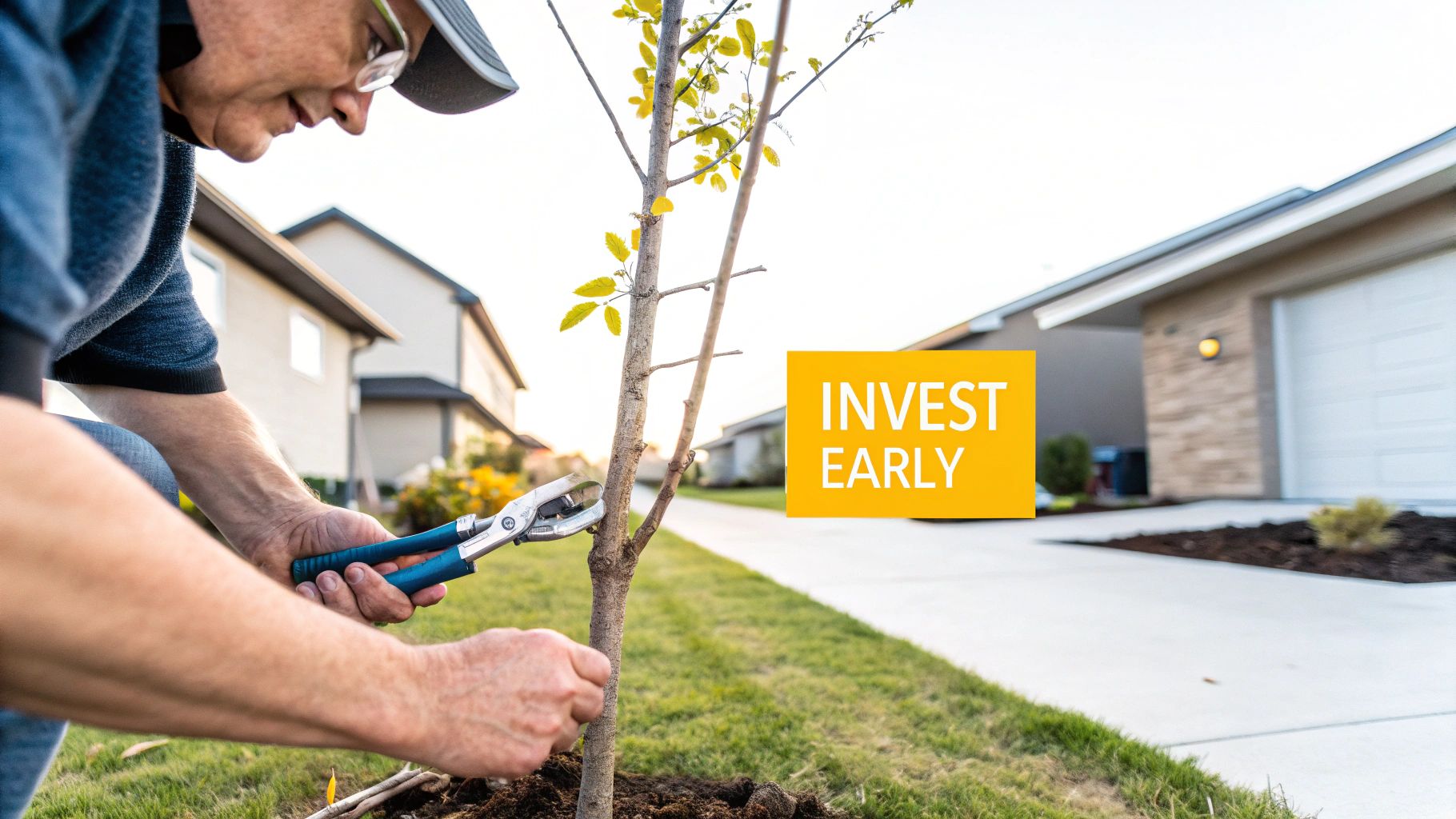
There’s a common myth that you should let a new tree "get established" for years before touching it. In reality, the exact opposite is true. The most critical time for structural pruning is within the first one to three years after planting. This is your golden window.
Think of it like laying the foundation for a house. You wouldn't build on shaky ground, so why let a tree develop a weak, hazardous structure? Early pruning is all about guidance—teaching the tree where to put its energy. You're encouraging a strong central leader and creating a framework of well-spaced, sturdy branches that will define its shape for life.
The Logic of Early Intervention
Waiting until a tree is mature to fix major structural problems is a recipe for disaster. By that point, those flawed branches are huge, heavy, and a serious risk. Removing them requires large, damaging cuts that leave the tree vulnerable to pests and disease, sometimes compromising its entire system.
On the other hand, making small, precise cuts on a young tree is a minor event. The wounds are tiny and heal fast, letting the tree get right back to growing strong. It's the difference between minor outpatient surgery and a major, invasive operation. This proactive mindset is the perfect follow-up after any initial land clearing, ensuring your new landscape grows with purpose.
To really drive this home, let's look at the two paths your young tree can take.
Early Pruning Benefits vs The Risks of Neglect
Attribute | With Early Pruning | Without Early Pruning (Neglect) |
|---|---|---|
Structure | Develops a strong central leader and well-spaced branches. | Often grows weak, co-dominant stems and narrow branch angles. |
Storm Resilience | Built to withstand hurricane-force winds and heavy rain. | High risk of catastrophic failure, falling limbs, and property damage. |
Long-Term Cost | Minor upfront effort saves thousands in future corrective pruning or removal. | Leads to expensive, high-risk removal of large, hazardous limbs. |
Tree Health | Small cuts heal quickly, minimizing stress and risk of disease. | Large wounds on mature trees invite pests and decay. |
Safety | Creates a stable, predictable tree that's an asset to your property. | Becomes a potential liability with weak branches over walkways or homes. |
Aesthetics | Matures into a beautiful, well-formed tree with a balanced canopy. | Can become misshapen, lopsided, or overgrown. |
The takeaway here is pretty clear. A little bit of smart work now pays off in a huge way for decades to come.
Pruning young trees is not about removal; it's about formation. Your goal is to prevent future headaches by establishing a robust framework that can withstand Florida's challenging weather, from intense summer sun to hurricane-force winds.
That small task today directly translates into major savings and a much safer property tomorrow. By guiding its growth early on, you cultivate a tree that adds real value instead of becoming a liability just waiting for the next big storm.
The Right Tools for Clean and Healthy Cuts
Using the right equipment isn't just about making your job easier; it's absolutely fundamental to the tree's health and your own safety. I’ve seen it countless times: the wrong tool can crush delicate wood tissue, creating a ragged, torn wound that’s just an open invitation for pests and diseases.
Clean, precise cuts, on the other hand, are the secret to a quick recovery. They heal faster and cleaner, getting your tree back to focusing on healthy growth. Your essential toolkit for training young trees is surprisingly simple, too. You don't need a shed full of gear, just three core items that are sharp, clean, and right for the job.
Your Pruning Essentials
For the vast majority of your work on young trees, these three tools will handle pretty much everything you throw at them.
Bypass Hand Pruners: These will be your go-to for small branches, usually anything up to ¾-inch in diameter. Unlike anvil pruners that crush one side of the stem, bypass pruners work just like a pair of scissors. They make a clean slice that heals fast, making them perfect for detailed shaping and nipping off small, problematic growth.
Bypass Loppers: Think of these as hand pruners on steroids. The long handles give you the leverage needed to cut through branches from ¾-inch up to about 1.5 inches thick. Loppers are a must-have for removing slightly larger competing stems or lower branches without a struggle.
Pruning Saw: When a branch is too thick for your loppers, it’s time to bring out the pruning saw. Its sharp, curved blade is specifically designed to cut smoothly on the pull stroke. This gives you way more control and helps prevent accidental damage to the branch collar.
A dull blade is a tree's worst enemy. It doesn't cut—it tears. This tearing action shreds the tree’s vascular tissues, slams the brakes on the healing process, and practically rolls out the welcome mat for fungal infections and insect infestations.
The Non-Negotiable Step: Sanitation
Just as critical as sharpness is sanitation. It's so easy to forget, but your tools can quickly transfer nasty diseases like oak wilt or fire blight from one tree to another. Before you start pruning and especially when you finish, always clean your blades. For bigger jobs with thicker branches, you might find some useful tips in our guide on safely removing tree limbs.
It doesn’t take much. A simple solution of one part bleach to nine parts water, or even a 70% isopropyl alcohol spray, is all you need. Just wipe down the blades and let them air dry before you make your next cut.
This simple habit is one of the biggest differences between amateur gardeners and professional arborists. It's a small step that makes a massive difference in responsible tree care.
Mastering the Art of Structural Pruning
This is where we get to the heart of the matter—shaping your young tree for a long, strong life. Structural pruning isn't about just snipping away at random. It’s a deliberate process of making small, strategic cuts now to prevent massive, dangerous problems down the road.
Think of yourself as a guide for the tree's growth. Your mission is to establish a single, dominant central stem and encourage branches that attach to the trunk at strong, wide angles.
Imagine a young oak tree. If you let two main stems compete for dominance, they'll form a weak, V-shaped union. That "V" is practically guaranteed to split during a Florida hurricane. A few simple cuts in its early years can prevent this entirely, training it to grow with one solid trunk. That’s the core philosophy behind pruning young trees.
Identifying Your Primary Targets
Before you even pick up your tools, step back and take a good look at the tree's overall structure. You’re on the hunt for a few key things that need correcting.
Your hit list should prioritize branches that are:
Dead, Damaged, or Diseased: These are always the first to go. Removing them not only cleans up the tree's appearance but also gets rid of potential entry points for pests and decay. It also gives you a much clearer view of the healthy structure you have to work with.
Crossing or Rubbing: Branches that rub against each other create wounds, which are an open invitation for infection. You'll need to choose the stronger, better-placed branch and remove the other one. This allows for open, healthy growth without interference.
Growing Inward: Any branch growing back toward the center of the tree is a problem. It disrupts airflow and will eventually get in the way of other limbs. Prune these out to maintain a more open, airy canopy.
Once you’ve cleared out these obvious problems, you can zero in on the most important part of the process—establishing a strong, lasting framework.
The Central Leader and Branch Structure
Your main goal is to establish and maintain a single central leader. This is the main upright stem that forms the very top of the tree. If you see two stems competing for that top spot (we call these co-dominant stems), you have to make a choice. Pick the stronger, straighter one and remove the other.
Next, shift your focus to the scaffold branches—the main limbs growing from the trunk. You want to encourage branches that have a wide angle of attachment, ideally between 45 and 90 degrees from the trunk. Those narrow, V-shaped unions are incredibly weak points just waiting to fail.
The most common and damaging mistake I see is cutting a branch flush against the trunk. Always locate the branch collar—the slightly swollen ring of tissue where the branch meets the trunk—and make your cut just outside of it. This collar contains specialized cells that will quickly heal over the wound.
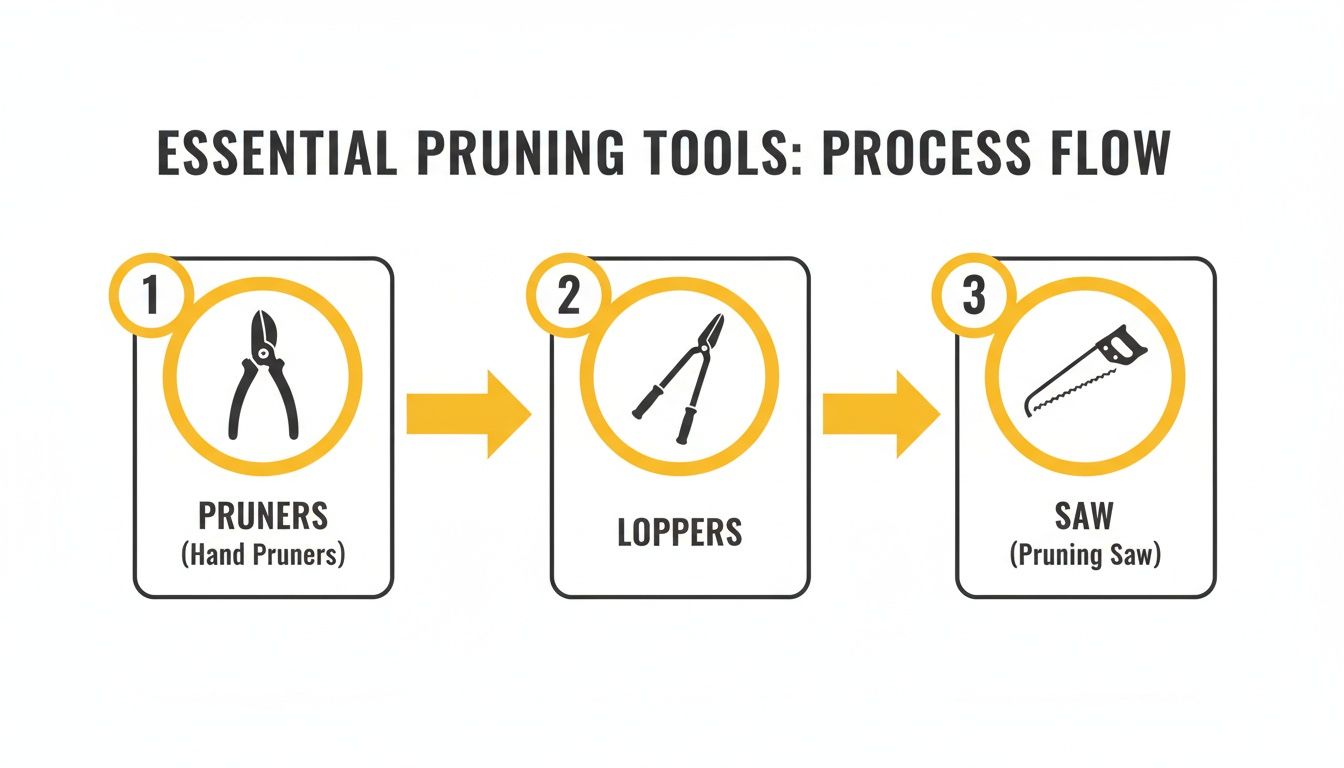
This visual guide shows that as the branch diameter increases, so does the power you'll need from your tool. Understanding these structural pruning fundamentals is key, and the principles can be applied to specific varieties. For instance, a good guide to caring for Japanese Maple trees will often include detailed pruning advice tailored to their unique, delicate growth habits.
Properly executed structural pruning, performed every one to two years, is proven to drastically reduce the risk of tree failure during major storms. As a rule of thumb, experts recommend removing no more than one-fourth of the tree's crown in a single year to avoid stressing it out. By making these thoughtful cuts early on, you are building a resilient, storm-ready tree from the ground up.
Florida-Specific Timing: When to Prune and When to Wait
Down here in Florida, our trees don't really play by the same seasonal rules you'd see up north. Timing your pruning cuts on young trees is less about what the calendar says and more about understanding our unique growth cycles, especially with those long, humid summers and the constant threat of hurricanes looming.
The absolute sweet spot for major structural pruning is in late winter, usually from the end of January through February. This is our version of a dormant period. Deciduous trees have dropped their leaves, giving you a perfect, unobstructed view of the tree's entire framework. Making those important corrective cuts now is far less stressful for the tree, allowing it to pour all its energy into healing just as that big spring growth spurt kicks in.
Of course, Florida landscaping is a year-round job. Lighter trimming is not only possible but often necessary during the summer to keep up with the explosive growth our climate fuels. This is the ideal time to snip out any dead, damaged, or diseased wood, or to lightly shape new growth that's getting a little wild.
Getting Ready for Hurricane Season
One of the most critical parts of timing your pruning in Florida is preparing for hurricane season, which officially runs from June 1st to November 30th. Your goal should be to have all major structural work wrapped up well before that window opens. A young tree with a strong, well-balanced structure is infinitely more resilient against high winds.
By finishing your main pruning in late winter or very early spring, you give the new growth plenty of time to harden off, creating a more stable and wind-resistant canopy. You want to avoid any significant pruning right before or during the peak of storm season. This can trigger a flush of weak, leggy shoots that are prime targets to be ripped off by strong gusts. Proper timing is a huge factor in tree safety, a topic we cover in-depth in our guide on the best time of year to remove trees in Central Florida.
What to Avoid at All Costs
There are two periods when you should absolutely put the loppers and saw away for any heavy pruning in Florida: mid-spring and late fall.
Mid-Spring: This is when trees are pushing out new leaves and flowers, a process that drains their energy reserves. Making large cuts at this time can put the tree under severe stress and practically sends an open invitation to pests.
Late Fall: Pruning too late in the year can stimulate a burst of new growth that won't have a chance to mature before a potential frost hits, leading to dieback and damage.
Since our trees grow so fast, staying ahead with preventive pruning is key to avoiding major problems down the road. It helps you avoid the need for severe cuts later on, which can create large wounds that invite decay.
Pro Tip: Never, ever remove more than 25% of a tree’s living canopy in a single year. Over-pruning is one of the most common and damaging mistakes. It can shock the tree, stunt its growth, and leave it vulnerable to pests and disease.
To give you a clearer picture, here’s a simple seasonal guide to help plan your pruning tasks for young trees here in Central Florida.
A Central Florida Pruning Calendar
This calendar breaks down the primary goals and actions for each season, tailored to our unique climate.
Season | Primary Pruning Goal | Recommended Actions | What to Avoid |
|---|---|---|---|
Late Winter (Jan - Feb) | Structural Correction & Training | Make major cuts to establish a strong central leader and scaffold branches. Remove crossing or weak limbs. | Heavy pruning on flowering trees that bloom on old wood (e.g., azaleas) until after they flower. |
Spring (Mar - May) | Post-Bloom Shaping & Damage Removal | Prune spring-flowering trees right after they finish blooming. Remove any frost-damaged wood. | Large structural cuts; the tree's energy is focused on new growth. |
Summer (Jun - Aug) | Maintenance & Directional Pruning | Lightly trim to control vigorous growth, direct new shoots, and remove dead, damaged, or diseased wood. | Removing more than 10-15% of the canopy; this can cause sunscald and stress during peak heat. |
Fall (Sep - Nov) | Minimal Cleanup | Remove any storm-damaged branches or deadwood. Prepare for dormancy. | Stimulating new growth with heavy cuts; new shoots won't harden off before potential cold snaps. |
This schedule helps you work with your tree's natural cycles, not against them, promoting strong, healthy development for years to come.
While this guide is built for Florida, the core principles apply everywhere. You can learn more about general seasonal timing and the best time to prune trees in different climates, which shows how the concepts of dormancy and growth spurts are universal, even if the timing changes.
Common Pruning Mistakes Florida Homeowners Make
Even with the best intentions, a few wrong cuts can do more harm than good. When you're pruning young trees, knowing what not to do is just as important as knowing the right techniques. I’ve seen it time and again—well-meaning homeowners accidentally setting their trees up for future failure, especially in Florida's tough climate.
Learning from these common mistakes is a shortcut to becoming a better caretaker for your landscape. A few key errors pop up over and over, from aggressive topping to leaving stubs that invite disease.
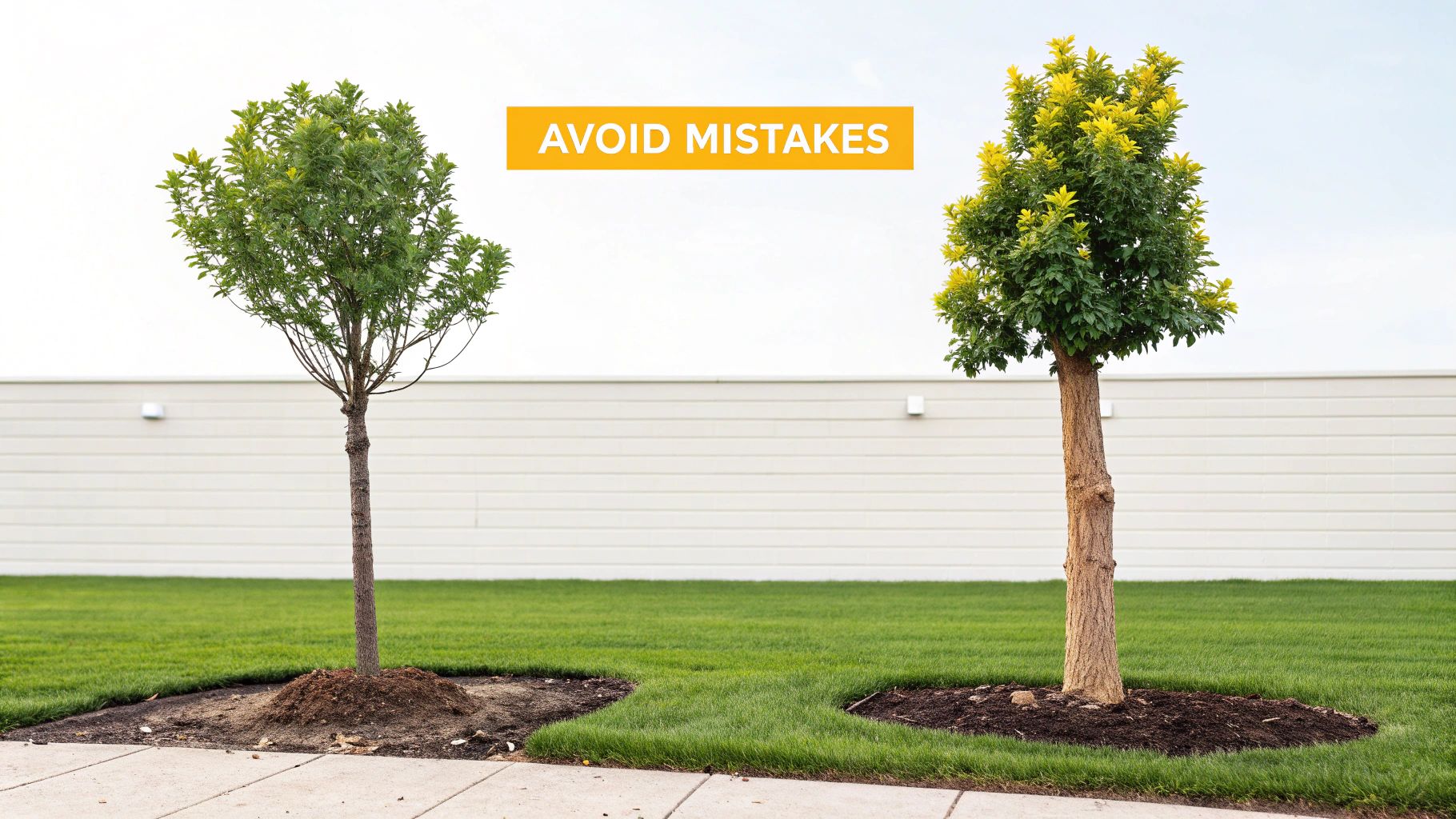
The Disaster of Tree Topping
If there's one practice to avoid at all costs, it's tree topping. This is where the main vertical stem and upper branches are just lopped off, leaving ugly stubs. People often do this thinking it will control a tree's height, but it actually sends the tree into a panic.
The tree responds by rapidly sending out a dense cluster of weak, upright shoots just below each cut. These new shoots, often called "watersprouts," are poorly attached and far more likely to snap off in a storm. Topping completely destroys a tree's natural structure, creating a long-term maintenance nightmare and a serious safety hazard.
Leaving Stubs and Cutting the Collar
Two other frequent slip-ups happen right at the cut itself.
Leaving Stubs: When you cut a branch too far from the trunk, you leave a dead stub. The tree can't properly seal this wound, turning it into an open invitation for wood-boring insects and decay fungi that can rot the tree from the inside out.
Damaging the Branch Collar: On the other hand, cutting a branch perfectly flush against the trunk is just as damaging. This removes the branch collar—that slightly swollen ring of tissue where the branch meets the trunk. This area contains specialized cells that are critical for closing wounds. A flush cut creates a large gash that the tree struggles to heal, leaving it vulnerable.
A proper pruning cut is made just outside the branch collar, leaving it completely intact to do its job. This allows the tree to form a protective "donut" of callus tissue over the wound, sealing it off from pests and disease.
The Problem of Over-Pruning
Sometimes a little too much enthusiasm leads to removing way too much at once. A good rule of thumb is to never remove more than 25% of a tree's live canopy in a single year. Any more than that can shock the tree, stunt its growth, and cripple its ability to photosynthesize.
Interestingly, research in the commercial ag world shows that less is often more. Studies on young walnut trees, for example, revealed that heavy pruning actually led to smaller trees and lower fruit production early on. The unpruned trees were healthier and more productive in their first few years. You can see these findings on farmprogress.com to learn more about how over-pruning can backfire.
The takeaway here is powerful: make deliberate, strategic cuts. Your goal is guidance, not amputation. A few thoughtful snips each year are far more effective than one drastic and damaging hack job. By steering clear of these common errors, your pruning efforts will help your young trees grow strong and healthy for decades to come.
Common Questions About Pruning Young Trees
Even with the best guide, you'll still have questions when you’re standing in the yard, pruners in hand. It’s only natural. Let's walk through some of the most common things Florida homeowners ask about, so you can make your cuts with confidence.
What Should I Do Right After Pruning?
Once the cuts are made, the most important thing to do is… step back and let the tree do its work. It's tempting to want to "help" it heal, but you need to resist the urge to apply pruning paint or wound sealant.
Decades of research have shown that these products can actually do more harm than good, often trapping moisture and slowing down the tree's natural defense mechanisms.
A clean, sharp cut just outside the branch collar is designed to heal itself. The tree will naturally form a protective layer of callus tissue over the wound. All you need to do is:
Clean Up: Get all the pruned branches and debris out of the area. This prevents pests or diseases from setting up camp near your tree.
Water Well: Give the tree a good drink, and make sure it has enough water for the next few weeks, especially if it’s dry. Proper hydration fuels the healing and growth process.
Keep an Eye on It: Watch your tree for any signs of stress, like yellowing leaves. If you're concerned, it helps to know if your tree is dead or dormant before making any other moves.
How Do I Prune Young Live Oaks and Magnolias?
Live oaks and southern magnolias are two of Florida's most beloved trees, and they both respond best to a patient, long-term approach. Your goal is to use structural pruning when they're young to build a sturdy, resilient framework for life.
With a young live oak, your main job is to establish a single, dominant central leader. You’ll also want to gradually remove the lowest branches over several years to raise the canopy. Don't get carried away and remove too much at once—this can stunt its growth.
For a young southern magnolia, the objective is similar. Focus on maintaining that strong central leader and preserving its natural, cone-like shape. Snip off any competing leaders and trim lower limbs that might eventually block a sidewalk. The best time is right after it finishes flowering in the spring or summer, so you don't accidentally remove next year's blooms.
For both of these classic Florida trees, think small and strategic. A few thoughtful cuts each year will build a much stronger, more beautiful tree than one major, drastic pruning session down the road.
When Is It Time to Call a Professional?
Knowing your own limits is one of the most important skills in tree care. While shaping a small, young tree is a perfectly fine DIY project, some situations absolutely demand a certified arborist.
It's time to put down the loppers and pick up the phone when:
You Need a Ladder: The minute your feet have to leave the ground, the risk of a serious fall skyrockets. Professionals have the training and safety gear for elevated work.
The Branches Are Big: If you're looking at a limb thicker than your wrist, you need a pro. They have the right saws and techniques to remove it safely without tearing the bark or damaging your property.
Power Lines Are Nearby: Never, ever try to prune branches that are close to utility lines. This is a job only for specially trained and certified line-clearance arborists.
You’re Just Not Sure: Feeling uncertain? There's no shame in that. An arborist can perform the initial structural pruning for you, setting your tree up for a long, healthy life and giving you a clear path for future maintenance.
For bigger projects that go beyond basic pruning, like dealing with large, mature trees or clearing an entire property, professional expertise is a must. Palm State Clear Cut offers expert land clearing and tree services throughout Central Florida to handle the jobs you can't. Get a free quote today!
Comments