
That leafless tree in your yard can be a real worry. But bare branches don’t always mean the worst. More often than not, the tree is just dormant—basically, a state of rest similar to hibernation that gets it through the winter. Figuring out the difference is the first real step to knowing what’s going on with its health.
Your Quick Guide to Tree Health Diagnosis
When you glance outside and see bare branches, that first thought—”is my tree dead or just sleeping?”—can be unsettling. Before you jump to conclusions, just take a second to look at the big picture from a distance.
A tree that’s heading into dormancy will usually lose its leaves pretty evenly across the whole canopy. That’s a completely normal, healthy response to the changing seasons.
On the other hand, a dying tree often looks a lot more chaotic. You might see patchy dieback, where whole sections of the tree are bare while other parts are still clinging to green leaves. This kind of uneven pattern points to a health problem, not a natural cycle. Another huge red flag is when you see large branches breaking off when there hasn’t even been a storm.
Here in Central Florida, our mild winters can make these signs a little harder to spot, since some of our trees never go fully dormant. You have to pay close attention to these high-level visual clues, as they give you the first pieces of evidence to investigate further. Think of it as a preliminary check-up before you get your hands dirty.
Dead vs Dormant Tree At a Glance
To help you make a quick first assessment, here’s a simple side-by-side comparison of the most common signs. It’s a great starting point to build some confidence in what you’re seeing.
| Symptom | Dormant Tree Sign | Dead Tree Sign |
|---|---|---|
| Leaf Loss | Leaves drop evenly from all branches in fall. | Leaves brown and cling to branches, or drop from isolated sections. |
| Buds | Small, plump buds are visible on branch tips. | Buds are dry, shriveled, brittle, or completely absent. |
| Branches | Twigs are flexible and bend without snapping. | Branches are brittle and snap easily under pressure. |
| Bark | Bark is firm and intact on the trunk. | Large patches of bark are peeling away or missing. |
This table gives you a solid foundation, but the next step is getting up close and personal with the tree to confirm what’s really happening beneath the surface.
Performing Hands-On Health Checks
Once you’ve given the tree a good look from a distance, it’s time to get up close and personal. A couple of simple, hands-on tests can give you a surprisingly clear answer to the “dead or dormant?” question.
Think of these as your go-to methods for confirming what you suspect from afar. You don’t need any fancy tools—just a minute of your time and a gentle touch. By checking the tissue just under the bark and the flexibility of a twig, you’ll get a direct line into the tree’s current state.
The Simple Scratch Test
This is probably the most reliable trick in the book. Find a young twig, about the size of a pencil, that you can easily and safely reach. Now, use your fingernail or a small pocketknife to gently scratch off a tiny piece of the outer bark.
What you’re looking for is the layer underneath. A healthy, living tree—even when it’s dormant for the winter—will have a moist, bright green layer called the cambium. This is the lifeblood of the tree, its vascular system that moves water and nutrients around.
If all you see is dry, brown, or brittle wood, that particular branch is dead. Be sure to try this in a few different spots around the tree. It’s entirely possible for a tree to have several dead branches while the rest of it is perfectly fine.
Key Takeaway: Green under the bark means life. Brown and dry means that part of the tree is dead. This simple test cuts through the guesswork and gives you a direct sign of health.
The Flexible Bend Test
Next up is the “bend test.” This one works great right after the scratch test to double-check your findings. Once again, pick a small, thin twig that’s within easy reach.
Gently take the twig and try to bend it. A living branch, even in the dead of winter, will feel supple and bendy. You should be able to flex it to at least a 45-degree angle without it snapping.
A dead branch, on the other hand, will be stiff and brittle. When you try to bend it, it’ll snap almost immediately, often with a dry cracking sound. That lack of moisture is a dead giveaway.
- Safety First: Only test small twigs you can reach without climbing or straining.
- Avoid Large Limbs: Never try to bend or break larger branches. It’s dangerous and can seriously damage the tree if the limb is actually alive.
This visual guide can help you quickly decide which path your diagnosis is taking.
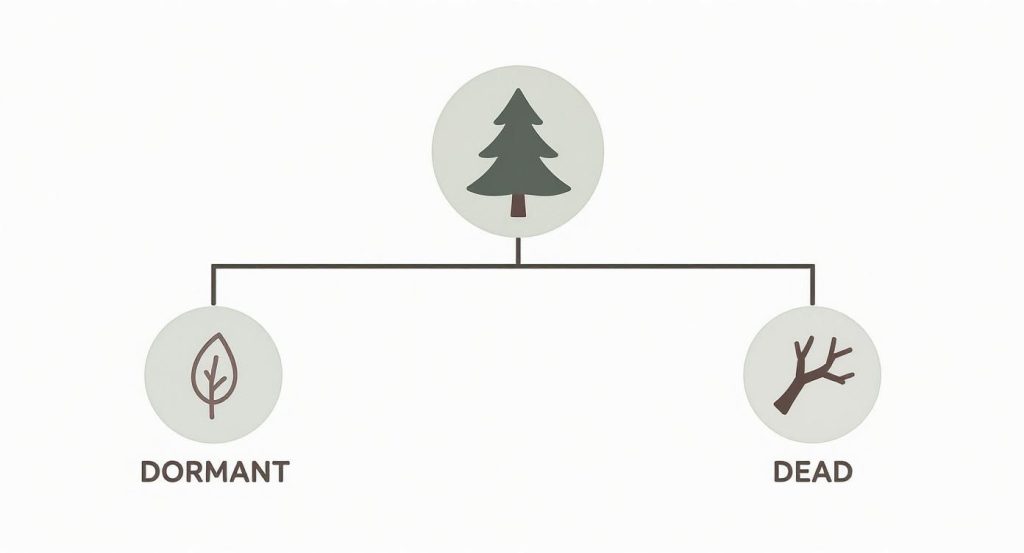
This decision tree simplifies things—a tree with live buds is likely dormant, while one with brittle branches is probably dead.
If your tests reveal a good number of dead branches, it’s time to think about pruning. You can learn more about the essential methods for trimming limbs on trees to make sure you’re doing it safely and correctly. Cleaning out the dead wood not only makes the tree look better but also cuts down the risk of falling branches and can stop decay from spreading to healthy parts of the tree.
Inspecting Buds and Bark for Clues
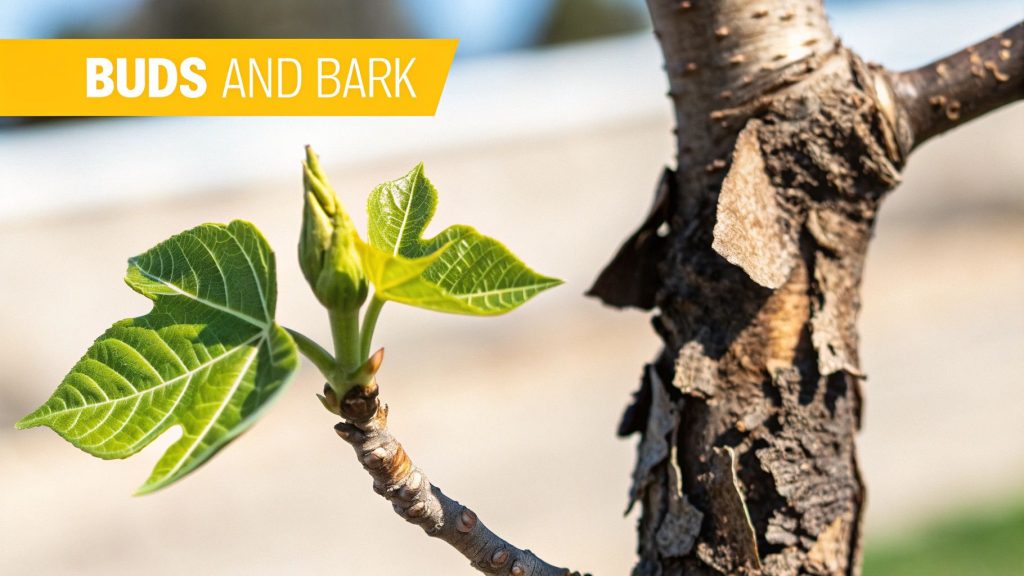
While the scratch and flex tests are great for understanding what’s happening inside the tree, the exterior tells a story all its own. The buds and bark offer some of the most obvious clues, and they’re often hiding in plain sight.
Think of it like being a detective. You’re gathering all the pieces of evidence—the internal and external signs—to build a complete picture of your tree’s health. Taking a moment to examine these surface-level details can often confirm what the hands-on tests already suggested, giving you much more confidence in your final call.
Reading the Story of the Buds
A tree’s buds are its promise of new life for the coming season. You’ll want to get up close to the tips of a few smaller branches and take a really good look.
A healthy, dormant tree is already preparing for its next growth spurt. You should be able to spot well-formed, plump leaf buds. They might be tiny, but they’ll look alive and ready to burst open as soon as the weather gives them the green light. Seeing this is one of the most reassuring signs you can find.
On the other hand, a dead or dying tree will have buds that are shriveled, dry, or even missing entirely. If you can gently touch a bud and it just crumbles or flakes off, that’s a clear signal that no new growth is coming from that branch.
- Living Buds: Will feel firm and look plump, even when they’re small.
- Dead Buds: Appear brittle and dry. They might be discolored or completely absent from the branch tip.
This simple observation can be incredibly telling, especially in late winter or early spring when you’re anxiously waiting for any sign of life.
What the Bark Is Telling You
Next, shift your attention from the small branches to the main trunk and larger limbs. The bark is essentially the tree’s protective skin, and its condition is a direct reflection of the tree’s overall vitality.
Now, some peeling is perfectly normal. Certain species we have here in Florida, like Crepe Myrtles or River Birches, naturally exfoliate their bark in beautiful, papery sheets. That’s a sign of healthy growth, not a problem. What you need to watch for is bark falling off in large, unnatural patches, exposing the bare wood underneath.
This condition is often called bark sloughing. It can signal that the vital cambium layer right beneath the bark has died. When this critical system for transporting water and nutrients fails, the outer bark loses its connection to the tree and starts to peel away.
Also, keep an eye out for deep, vertical cracks that go beyond the surface layer. Minor surface cracking can be normal as a tree grows, but significant fissures can point to structural weakness or internal decay. Another major red flag is the presence of fungi or mushrooms growing on the trunk, especially near the base. This often indicates advanced internal rot that has already compromised the tree’s stability.
When you combine these visual cues with what you learned from the hands-on tests, you’ll get a much clearer answer to the question, “is my tree dead or just dormant?”
Why Your Tree Is Struggling
Figuring out the ‘why’ behind a struggling tree is the first step toward protecting the rest of your landscape. Trees almost never die overnight. Their failure is usually a slow burn, the result of compounding stress factors that chip away at their natural defenses over weeks, months, or even years.
I like to think of a tree’s health like a bank account. Every stressor—a nasty dry spell, a bug infestation, or even a wound from a lawnmower—is a withdrawal. A healthy, robust tree has plenty in its reserves to handle these hits. But when the withdrawals start happening faster than the deposits, its health begins to spiral.
Common Stressors in Central Florida
Here in Central Florida, our trees face a very specific set of challenges. The intense summer heat and those long, punishing droughts are incredibly taxing. They make it tough for trees to get the water they absolutely need to thrive, leaving them stressed and vulnerable.
Then come the pests. Damaging infestations are a huge problem, with culprits like borers, beetles, and scale insects ready to overwhelm a tree that’s already weakened. A vigorous, healthy tree can often fend off these invaders, but a stressed one becomes an easy meal. These problems often work in tandem, turning a minor issue into a fatal one.
Stressors stack up. A tree weakened by drought is far more susceptible to a pest infestation, which then opens the door for fungal diseases. It’s this combined effect that often leads to a tree’s demise.
The Broader Environmental Impact
This isn’t just about one tree in one yard; it’s part of a much bigger global picture. Environmental shifts are putting immense pressure on forests all over the world. That means homeowners like you play a critical role in preserving the green canopy right in your own backyard.
Across the globe, climate change is speeding up tree mortality rates at an alarming pace. Some estimates suggest that between 10% and 50% of observed tree deaths can be linked directly to climate-induced stressors like heatwaves and pest outbreaks. A clear example is happening in European forests, where rising temperatures have weakened Norway spruce trees, making them highly vulnerable to bark beetle attacks that threaten their very existence in the region. You can learn more by exploring the research on global tree mortality.
Invasive species also play a major role, stressing our native trees by outcompeting them for sunlight, water, and nutrients. Identifying and managing these unwelcome guests is a crucial part of protecting your property’s ecosystem. Learning how to remove invasive plants can make a huge difference in the health of your desirable trees.
By recognizing these threats—from local pests to broader climate trends—you can get a much better handle on why your tree is struggling and take the right steps to protect your landscape for the future.
When to Wait and When to Call an Arborist
So you’ve done the scratch and bend tests, but the results are a mixed bag. Maybe you found a hopeful sliver of green tissue, yet the tree is still stubbornly bare while everything else is leafing out for spring. This is that tricky gray area where knowing what to do next gets tough.
When you see some signs of life, but the tree is slow on the uptake, patience is often the best approach. It can be worth waiting until mid-summer, especially after a rough winter or a dry spell, to see if it makes a comeback. A tree’s recovery timeline doesn’t always line up with ours.
But some situations simply can’t wait. You have to balance that patience with a clear-eyed look at any potential danger the tree might pose to your property or family.
Red Flags That Demand Immediate Action
Some symptoms go beyond poor health—they’re straight-up warning signs of potential failure. If you spot any of the following, it’s time to put down your diagnostic tools and pick up the phone. Waiting could lead to serious damage or, worse, injury.
These aren’t subtle clues; they are clear and present dangers:
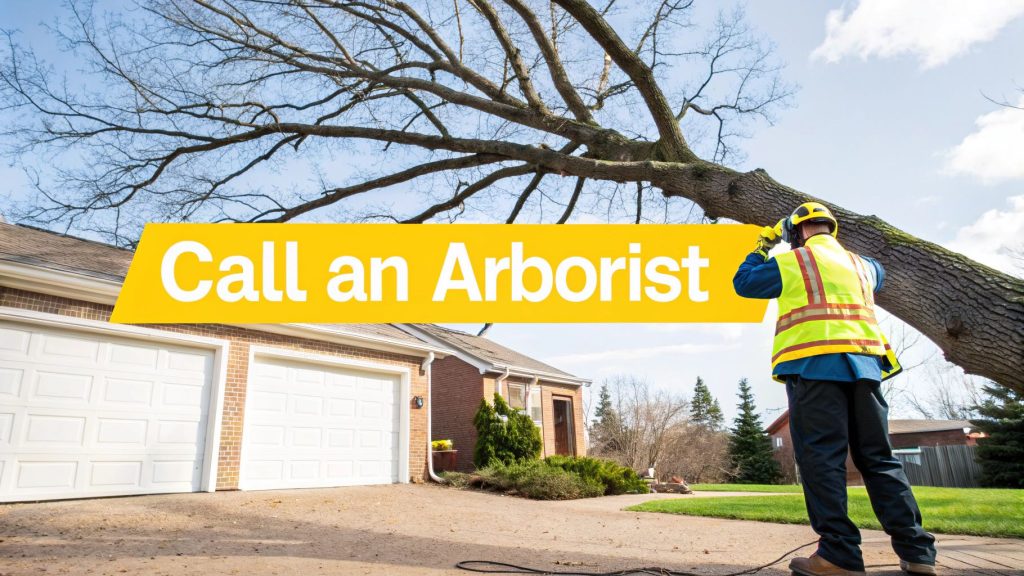
- Large, Dead Branches: Any major limbs that are obviously dead and looming over your roof, driveway, or patio are a huge risk. They’re called “widow-makers” for a reason.
- A Sudden Lean: If a once-straight tree is now leaning, particularly after a storm, its root system could be failing. That’s a critical sign of instability.
- Fungal Growth on the Trunk: Seeing mushrooms, conks, or other fungi on the trunk or at the base is a classic sign of advanced internal rot. The tree might seem solid, but its core could be rotted out and dangerously weak.
- Major Trunk Damage: Look for deep cracks, large cavities, or big patches of missing bark on the main trunk. These all compromise the tree’s structural integrity.
Safety First: Never try to tackle large, hazardous limbs yourself. A professional arborist has the training, insurance, and specialized equipment to handle these dangerous jobs safely and efficiently.
The Role of a Certified Arborist
When you’re caught wondering, “is my tree dead or dormant?” a certified arborist can give you a definitive answer. Think of them as a tree doctor. They can perform a professional risk assessment that goes way beyond what a homeowner can spot from the ground.
An arborist will evaluate the tree’s species, age, and overall condition to provide a clear, expert recommendation. They can determine if the tree can be saved with treatments like strategic pruning or fertilization, or if removal is the safest and most practical choice.
This kind of expert consultation takes the guesswork out of the equation and gives you the confidence to make the right call. If removal is the answer, timing is the next big thing to consider. You can learn more about the best time of year for tree removal in Central Florida to make sure the process goes as smoothly as possible.
After you’ve gone through the diagnostic checks, it’s only natural to be left with a few more questions. Let’s be honest, every tree is different, and the signs aren’t always black and white.
Here, we’ll dig into some of the most common head-scratchers homeowners face after looking over their trees. Think of it as a practical guide to help you figure out what to do next.
My Palm Tree Fronds Are All Brown. Is It Dead?
Not necessarily. With most palms here in Central Florida, the fronds aren’t the real story. The true indicator of life is the central bud at the very top—what many people call the “heart.” That core’s health is what really determines if the palm can make it.
Go take a look at the new spear leaf that should be emerging right from the center of the crown. If that spear is still green, feels firm, and looks like it’s trying to grow, your palm is probably alive. It has a good shot at bouncing back from whatever stress or frost damage it’s dealing with.
On the other hand, if that central spear is brown, feels mushy to the touch, or comes right out with a gentle tug, the palm is almost certainly dead. That means the heart has rotted, and unfortunately, there’s no coming back from that.
Can a Dead Tree Come Back to Life?
The short answer is no. A tree that’s completely dead is gone for good. Once its cambium layer—the thin, life-sustaining system right under the bark that moves water and nutrients—has died, its life support has been shut off permanently.
The confusion usually comes from trees that are just severely stressed. They might look dead, but they’re still hanging on by a thread. For instance, a tree might drop every single leaf it has during a bad drought to conserve water, but still have living tissue in its trunk, branches, and roots.
This is exactly why a proper diagnosis is so critical before you bring out the chainsaw. A tree that seems lifeless might just be dormant or in survival mode, and with the right care, it could absolutely make a comeback.
How Long Should I Wait Before Removing a Tree?
Patience can be a good thing, but not at the expense of safety. How long you should wait really boils down to the tree’s condition and, most importantly, where it’s located.
- If there’s no immediate risk: Let’s say a tree failed to leaf out this spring but the scratch test still showed some green. It’s reasonable to give it until mid-summer to see what happens. That’s plenty of time for it to push out new growth if it has any life left in it.
- If the tree is a hazard: Don’t wait. If you see large, dead branches hanging over your roof, driveway, power lines, or your kids’ play area, it’s time to call a certified arborist for a risk assessment immediately. Other red flags that demand urgent attention include a sudden lean or the appearance of mushrooms on the trunk.
You should never procrastinate when a tree poses a clear and present danger to people or property.
When you need a professional eye to assess a questionable tree or require safe, efficient removal, the team at Palm State Clear Cut is here to help. We offer expert land clearing and vegetation management services throughout Central Florida. Contact us today for a free quote.