
A Guide to the Best Equipment for Land Clearing in Florida
- Mike Walker
- Jan 13
- 17 min read

When you're staring at an overgrown Florida lot, it's easy to feel overwhelmed. But here's the secret: the best equipment for land clearing is simply the one that's a perfect match for your specific piece of land. For that classic Florida jungle of dense underbrush, a forestry mulcher or brush mower is your go-to. If you’re up against massive stumps and mature trees, you’ll need the raw power of an excavator or dozer.
Getting this choice right from the get-go is the difference between a smooth project and a frustrating, expensive mess.
Choosing the Right Tool for the Job
Think of your equipment options like a mechanic's toolbox. You wouldn't try to hammer a nail with a screwdriver, right? In the same way, bringing a small brush mower to a fight with decades-old oak stumps is a recipe for failure. Every piece of heavy machinery is engineered for a very specific purpose, and understanding those strengths is the first step to clearing your land efficiently.
The whole game is about matching the machine's power to your property's problem. Is your main headache a sea of tangled palmettos? Or are you dealing with the aftermath of construction, littered with debris and a few stubborn, deep-rooted stumps? Answering these questions will quickly narrow down the field from a confusing list of heavy equipment to just a few logical choices.
A Quick Decision Guide
To make this even simpler, just think about the scale of what you need to remove. This quick decision tree shows how different challenges call for different kinds of muscle.
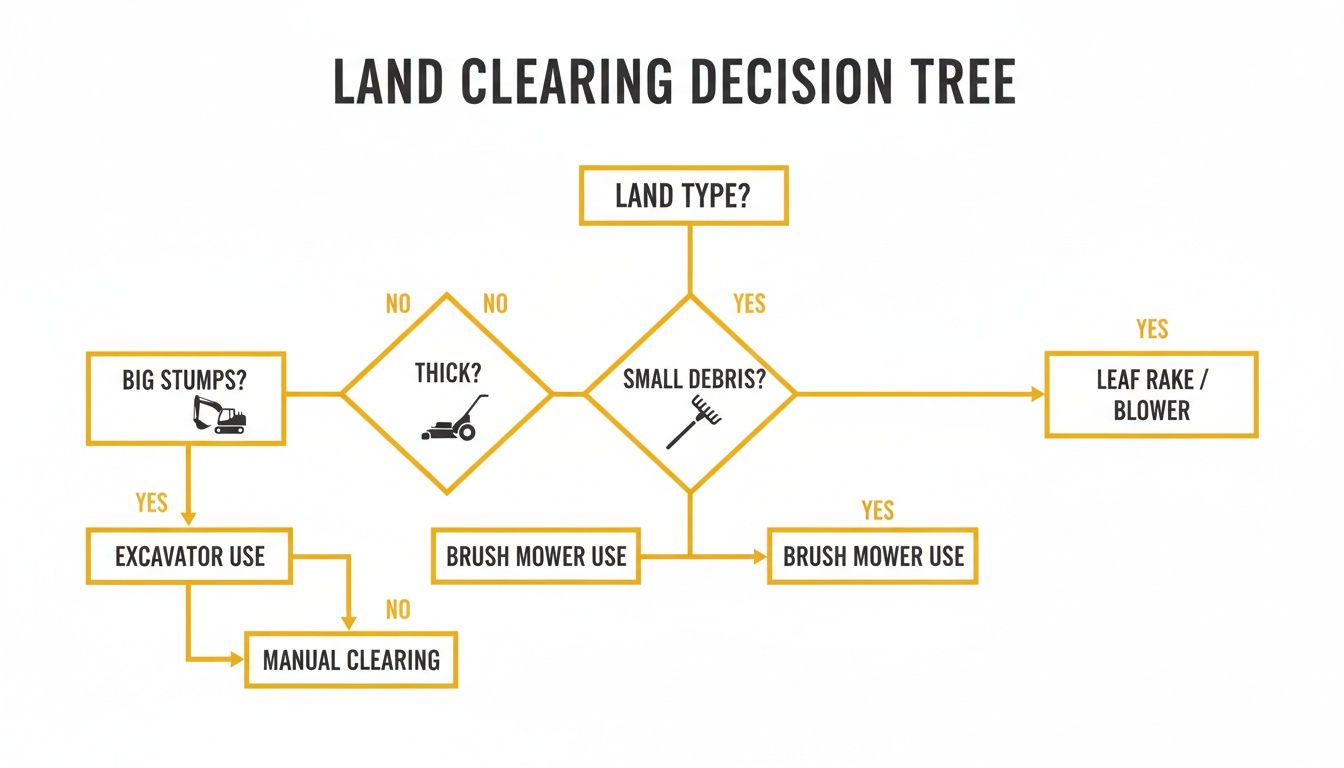
As you can see, the type of vegetation you're facing—from light debris to thick brush and big stumps—directly points you to the right class of equipment.
Before we get into the nitty-gritty of each machine, this high-level view helps you pinpoint which tools are actually relevant to your project. Use this table as a quick reference to connect your clearing needs with the most common and effective solutions we use out in the field.
Pro Tip: Don't just focus on the vegetation you can see. Think about what's happening underground. The deep, stubborn root systems from palmettos or oaks often demand more power than you'd expect, which is why an excavator can be invaluable even when the visible growth seems manageable.
Quick Guide to Matching Equipment with Your Land Clearing Task
Here’s a straightforward table to help you quickly match common Central Florida land clearing challenges with the right machinery.
Common Land Clearing Challenge | Primary Equipment Solution | Best For... |
|---|---|---|
Dense underbrush and palmettos | Forestry Mulcher or Brush Mower | Quickly turning thick vegetation into soil-enriching mulch without hauling debris away. |
Large tree and stump removal | Excavator with Grapple/Thumb | Uprooting and moving heavy stumps, logs, and boulders with precision. |
Leveling ground and final grading | Bulldozer or Skid Steer | Creating a smooth, buildable surface after primary clearing is complete. |
Processing felled trees and limbs | Wood Chipper | Reducing large wood debris into manageable chips for easy removal or landscaping. |
Removing all cleared materials | Haul Truck and Loader | Efficiently transporting debris, soil, or mulch off-site to leave a clean slate. |
This table serves as a great starting point, but always remember that every property has its own unique quirks.
A Deep Dive Into Primary Land Clearing Machinery
Once you have a good sense of your project's scale, it’s time to meet the titans of the trade. Choosing the best equipment for land clearing isn't just about raw power; it’s about using the right kind of force in the most efficient way. Think of it as the difference between swinging a sledgehammer versus using a surgical scalpel—both are powerful, but they solve very different problems.
Picking the right machine can slash your project time, cut costs, and even improve the health of your soil. Let’s walk through the heavy-duty machinery that does the real work, breaking down what each one does best, especially in the unique conditions we see across Florida.
Forestry Mulchers: The Eco-Friendly Powerhouses
For tackling the dense vegetation we have here in Florida, a forestry mulcher is arguably one of the most effective tools in the shed. Imagine a super-powered lawnmower built for trees and thick brush. Instead of just cutting everything down and leaving a mess, a mulcher grinds it all—from palmettos to small and medium-sized trees—into a fine layer of mulch right on the spot.
This single-step process is its biggest advantage. You skip the separate steps of cutting, stacking, and hauling debris away. The machine simply moves through the property, erasing unwanted growth and leaving behind a protective blanket of organic material. This natural ground cover helps stop soil erosion, holds moisture, and returns vital nutrients to our sandy Florida soil. To get a closer look at these machines in action, check out our complete guide to land clearing mulchers.
Key Insight: Forestry mulching is what we call a "selective" clearing method. A skilled operator can maneuver the machine to take out invasive species like Brazilian Pepper while carefully leaving desirable native oaks and pines untouched. It’s more like sculpting the landscape than just bulldozing it.
Excavators: The Precision Heavy Lifters
While a mulcher is the master of shredding vegetation, an excavator is the undisputed champion of brute force and precision lifting. When your project involves large, mature trees, deep-rooted stumps, or buried boulders, an excavator is an absolute must. Its long hydraulic arm gives it the kind of reach and power that other machines just can't compete with.
Fitted with a grapple or thumb attachment, an excavator can pluck a massive oak stump right out of the ground like it’s a weed in a garden. That level of control is crucial for safely moving heavy logs and debris without damaging nearby buildings or trees you want to keep. Plus, its tracked undercarriage provides superior stability on the uneven, and often soft, terrain we find all over Central Florida.
It's really interesting to see the various ways an arborist uses an excavator for jobs that need both immense strength and a delicate touch.
When to Choose an Excavator over a Mulcher
Massive Stumps: If you need a perfectly clean slate for a building foundation, those stumps have to go. An excavator is the only machine that can really dig out and remove large root balls.
Large Debris Removal: For clearing lots that already have junk on them—like old concrete, logs, or boulders—the grapple attachment is invaluable for sorting and loading materials into haul trucks.
Digging and Trenching: If your project also involves digging for utilities, a pond, or foundations, an excavator can handle those tasks right after the initial clearing is done, making it incredibly versatile.
Skid Steers: The Versatile Problem-Solvers
If excavators and mulchers are the specialists, then the skid steer is the ultimate generalist. Its compact size and incredible maneuverability make it perfect for smaller residential lots or tight spaces where the big machines just can’t fit. The real magic of a skid steer, though, is its ability to use a huge range of attachments.
With a quick change of its front-end tool, a single skid steer can become a completely different machine. This adaptability makes it a very cost-effective choice for projects with varied tasks.
Common Skid Steer Attachments for Land Clearing
Brush Cutter Head: This is basically a smaller version of a forestry mulcher, perfect for clearing thick underbrush and saplings up to a few inches in diameter.
Grapple Bucket: Ideal for picking up, carrying, and loading smaller logs, brush piles, and other debris.
Stump Bucket: A specialized tool with sharp teeth designed to dig around and pry out smaller stumps.
Dozer Blade: Great for light grading, leveling out the soil, and spreading topsoil after the heavy clearing is finished.
Dozers: The Ground-Leveling Force
When the trees and brush are gone and it’s time to reshape the land itself, the bulldozer (or dozer) takes center stage. A dozer’s main job is to push massive amounts of soil, rock, and debris with its heavy front blade. This makes it the go-to machine for final grading and site prep.
After an excavator has pulled the stumps, a dozer moves in to fill the holes, level the entire site, and create a smooth, compacted surface that’s ready for construction. They are simply unmatched in their ability to move earth and establish the proper slope for drainage—a critical step for preparing any Florida property for building. For large projects, a dozer is often the last piece of heavy machinery on-site, ensuring the ground is perfectly prepared for whatever comes next.
Specialized Tools for Final Site Preparation
Once the heavy hitters like forestry mulchers and excavators have done their part, the job still isn't over. It’s a lot like building a house—after the frame is up, all the detailed finish work has to begin. This final stage is what takes a roughly cleared lot and turns it into a genuinely clean, usable, and build-ready property. This is where specialized land clearing equipment comes in to handle the crucial finishing touches the bigger machines can't.
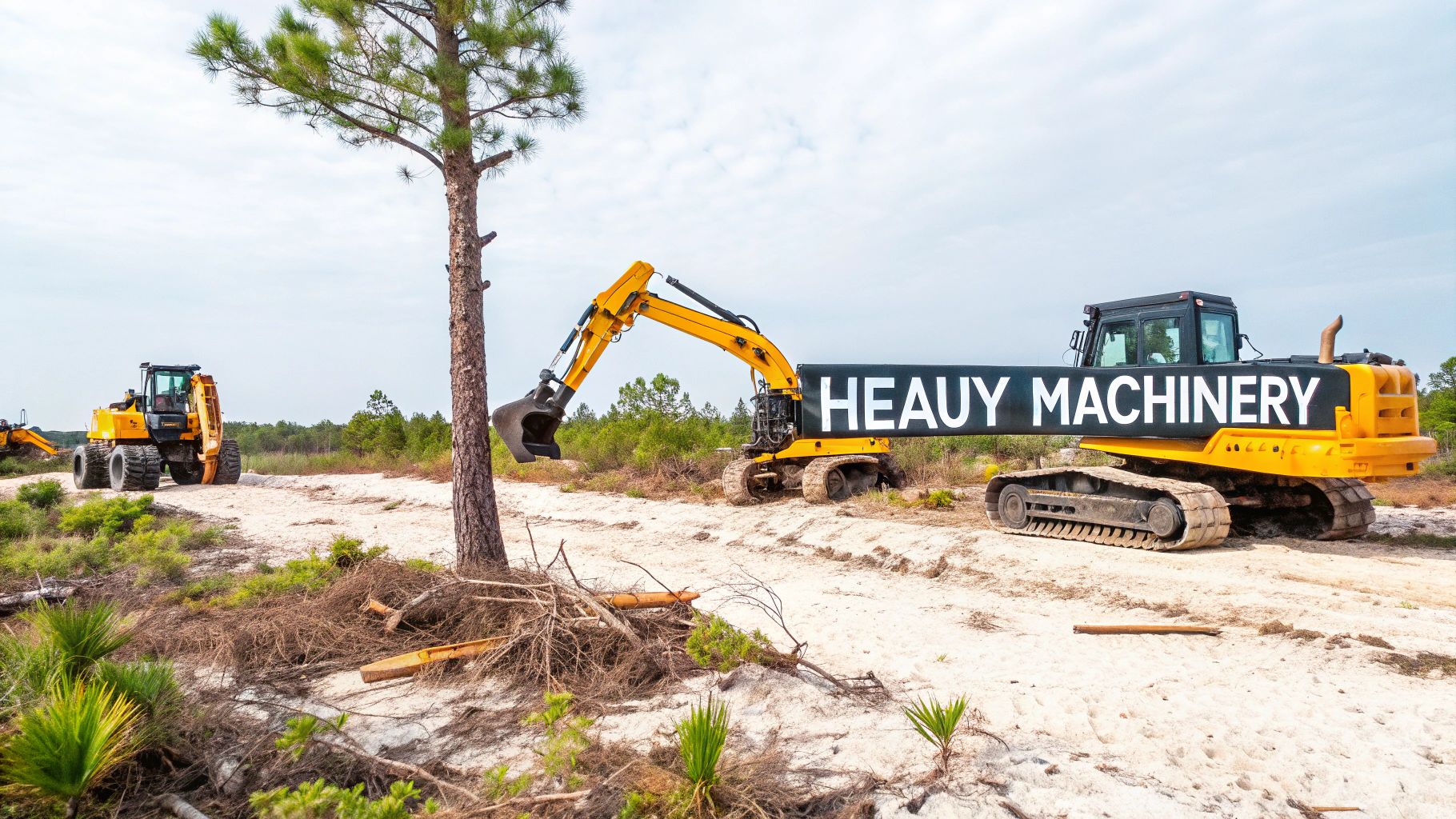
These tools are not just an afterthought; they are absolutely essential for a polished, professional result. They take care of everything from low-lying brush and stubborn stumps to the massive piles of debris left behind. Without this final pass, you're left with a site that’s only halfway ready for whatever comes next.
Brush Mowers: The Undergrowth Experts
While forestry mulchers are busy with trees and saplings, brush mowers are designed to conquer the dense, low-lying vegetation that carpets so many Florida properties. Think of a super heavy-duty, reinforced lawn mower that can chew through thickets of gallberry, saw palmetto regrowth, and tangled vines that would instantly stop a regular mower.
Often used as an attachment on a skid steer, these mowers are perfect for carving out clean fence lines, clearing pathways, or just maintaining large acreages. They make sure every inch of the property is cut down to size, leaving a tidy appearance and getting rid of habitats for pests.
Stump Grinders: Erasing the Last Traces of Trees
Taking down a tree is one thing, but dealing with the stump is a whole different ballgame. Leaving stumps scattered around isn't just ugly—it can attract pests, create serious tripping hazards, and get in the way of future construction or landscaping. A stump grinder is the surgical tool built to solve this problem for good.
Unlike an excavator that yanks the entire root ball from the ground, a stump grinder uses a powerful, high-speed cutting wheel with sharp teeth to methodically chip away at the stump. It grinds the wood down several inches below the surface, basically erasing it. The leftover wood chips just mix into the soil, and you can immediately cover the spot with topsoil and seed it for grass.
Key Takeaway: Stump grinding is essential for creating a smooth, level surface. It's a non-negotiable step if you plan to lay a foundation, install a driveway, or plant a lawn where a tree once stood.
Wood Chippers: Processing Debris Efficiently
After clearing several trees, you're looking at a mountain of limbs, branches, and logs. This is where a wood chipper becomes your best friend. This machine pulls wood into a hopper, where a powerful shredding mechanism turns it into small, uniform chips in seconds.
This process gives you two huge advantages:
Drastic Volume Reduction: Chipping can shrink a massive brush pile by a factor of 10 to 1, which makes the debris much easier and cheaper to haul away.
Material Repurposing: The wood chips you create can be used as natural mulch for garden beds, pathways, or erosion control, turning waste into a valuable resource.
Haul Trucks: The Unsung Heroes of Debris Removal
Finally, every piece of debris that isn't mulched or chipped right there on-site has to go somewhere. Haul trucks, like dump trucks, are the workhorses that make that final, clean sweep possible. Paired with a loader or skid steer, these trucks efficiently move logs, stumps, and excess soil off the property, leaving you with a truly clean slate.
Without reliable hauling, even the best clearing job will feel incomplete. The need for this kind of efficiency is growing everywhere; the global market for land clearing attachments is expanding rapidly, a trend driven by urbanization and the need for better vegetation management. You can discover more insights about the growing land clearing market and its impact on equipment choices.
How to Choose the Right Equipment for Your Florida Property
Picking the right equipment for a land clearing job isn’t as simple as grabbing the biggest machine on the lot. Here in Florida, our unique landscape throws a few curveballs that demand a smarter approach. A piece of heavy equipment that works wonders out in dry, rocky terrain might get completely bogged down in Central Florida’s sandy soil, tangled palmetto roots, and protected wetlands.
The real key is matching the machinery to the specific personality of your land.
Think of it like a doctor treating a patient. You wouldn't get the same prescription for a headache as you would for a broken arm, right? In the same way, a professional land clearing service first diagnoses your property’s unique conditions—the soil, the vegetation, the lay of the land—before ever recommending a plan of attack. This ensures the job gets done right: efficiently, legally, and without scarring your property for years to come.
Assessing Your Land’s Unique Characteristics
Before a single engine roars to life, you have to walk the property. A thorough site assessment is non-negotiable, and it goes way beyond just sizing up the trees. It’s about understanding the ground under your feet, knowing what you’re up against vegetation-wise, and respecting the legal lines you can't cross.
Several key factors will point you toward the right machines for your project:
Soil Composition: While Central Florida is famous for its sandy soil, you'll find pockets of dense clay and organic muck all over the place. Sand drains well, but it can be a nightmare for wheeled machines like skid steers to get a grip. Tracked equipment like excavators or compact track loaders are often the better bet, as they distribute their weight and give you the stability you need to avoid getting stuck.
Presence of Wetlands: Florida takes its wetlands seriously, and for good reason. Clearing anywhere near these protected zones usually requires special permits and a delicate touch. You’ll want to lean on low-impact machinery. Forestry mulchers on tracks are a favorite here because they shred vegetation in place, minimizing the deep ruts a dozer would leave behind.
Invasive Species: Is your property choked out by Brazilian Pepper, Australian Pine, or other aggressive non-native plants? Tackling these requires a specific strategy. A forestry mulcher can tear through them, but their stubborn root systems often demand follow-up herbicide treatments to make sure they don’t come roaring back.
Important Note: Always, always, always double-check local and state regulations before you start clearing, especially near water. The fines for unpermitted work in protected areas are steep. A good professional contractor will handle all that permitting for you.
To help you get started, we've put together a simple checklist. Walk your property with this in hand to get a clearer picture of what your project will demand.
Florida Land Clearing Checklist
Consideration Factor | What to Look For | Impact on Equipment Choice |
|---|---|---|
Soil Type | Is it mostly sand, clay, or muck? Is it wet or dry? | Sandy or wet soil favors tracked machines (excavators, CTLs) over wheeled ones to prevent sinking. |
Vegetation Density | Light brush, dense palmettos, or mature hardwood trees? | Thick brush may require a forestry mulcher, while large trees necessitate a dozer or excavator. |
Invasive Species | Identify any Brazilian Pepper, cogon grass, or Australian Pine. | May require a mulcher plus a follow-up plan for root control (stump grinding, herbicides). |
Topography & Slope | Is the land flat, gently rolling, or steeply sloped? | Slopes require tracked equipment for stability and safety; steep grades may limit machine size. |
Wetlands/Waterways | Are there any swamps, ponds, streams, or protected areas nearby? | Demands low-impact machinery (mulchers) and adherence to strict permitting and regulations. |
Lot Size & Access | Is it a small residential lot or a large rural tract? Is access wide or narrow? | Small, tight lots need compact, maneuverable equipment. Large tracts benefit from bigger, more efficient machines. |
Project Goal | Are you building a house, creating pasture, or just clearing trails? | Home sites need total clearing (excavators, stump grinders). Pastures are perfect for forestry mulching. |
This checklist gives you a solid foundation for discussing your project with a professional and understanding why they recommend certain tools for the job.
Factoring in Property Size and Project Goals
The size of your property and your ultimate goal for it are just as critical as the land itself. You wouldn't use the same tools to clear a one-acre suburban lot as you would a 50-acre tract destined for commercial development.
Lot Size and Accessibility
For smaller residential lots, especially those with fences or existing buildings, maneuverability is everything. A compact track loader with a brush cutter can slip into tight spots a big excavator could never dream of reaching.
On the flip side, for wide-open acreage, it’s all about efficiency. Bringing in a full-sized dozer or a dedicated forestry mulcher is far more cost-effective. These beasts can clear multiple acres a day, turning a weeks-long job into a weekend project. And don’t forget about access—if the only way in is a narrow dirt path, your equipment options just got a lot smaller.
Project Goals
What you plan to do with the cleared land will dictate how thoroughly it needs to be cleared.
Building a Home: This is the most intensive level. You need total removal of trees, stumps, and root systems where the foundation will sit. An excavator is almost always a necessity for digging out deep roots to ensure the ground is stable.
Creating Pastureland: Here, the goal is to get rid of unwanted brush and invasive trees while maybe leaving some nice oaks for shade. Forestry mulching is a perfect fit, as it shreds the vegetation and returns the nutrients right back into the soil.
Selective Clearing: Maybe you just want to carve out some walking trails or thin out the underbrush to give your mature trees room to breathe. A smaller mulcher or a skid steer with attachments offers the precision you need for this kind of surgical work.
If you’re mostly dealing with brush and smaller trees, our landowner’s guide to brush and small tree clearing has even more targeted strategies.
The Real Deal on Land Clearing Costs and Timelines
Before you break ground, it’s crucial to get a handle on the real investment—both in time and money. A smart budget looks past the daily rental fee for a machine. It's about seeing the whole picture: all the related expenses and a realistic idea of how long the job will actually take.
So, what drives your total project cost? A few key things. The most obvious are the size of your lot and how thick the vegetation is. Clearing a one-acre patch of light brush is a world away from wrestling with ten acres of mature pines and stubborn palmettos. Other major costs that can sneak up on you include equipment transport fees, fuel, and what to do with all the debris if you aren't mulching it on-site.
Renting Equipment vs. Hiring a Professional
The DIY route of renting equipment looks good on paper, but it's often a fast track to hidden costs that can blow your budget. You're on the hook for more than just the rental fee; think fuel, transport, and insurance. And if that machine breaks down or gets damaged on your watch? That's your problem, too.
A professional service rolls the equipment, fuel, transport, insurance, and an experienced operator into one, predictable price. This route takes the guesswork out of the equation and puts the job in the hands of someone who knows the machinery and the local terrain inside and out.
The right machinery makes an incredible difference. Think about it: before modern equipment, clearing land was a painfully slow process. When tractors hit the scene, things changed fast—we went from just 20,000 units in 1916 to over 1 million by 1935. It proved that investing in the right tools pays off massively in speed and labor savings. That same principle is even more true today.
Breaking Down the Hidden Costs of DIY
Deciding to rent and run heavy equipment yourself opens the door to a few financial risks that are easy to miss upfront.
Fuel and Fluids: These machines are thirsty. A full day of work can easily burn through hundreds of dollars in diesel fuel alone.
Maintenance and Repairs: A flat tire or a busted hydraulic hose doesn't just stop the work; it adds a repair bill you weren't expecting. An ultimate heavy equipment maintenance checklist is a good start, but unexpected issues are always a risk.
The Learning Curve: There's a steep learning curve to running heavy machinery well. An inexperienced operator isn't just slower—they're a lot less safe.
For a deeper dive into how these costs stack up on actual projects, take a look at our guide on how much land clearing costs per acre.
Realistic Project Timelines
The time it takes to clear a piece of land can vary wildly depending on the job. A smaller, one-acre residential lot with some light-to-medium brush might get knocked out in a single day with a good forestry mulcher.
On the other hand, a ten-acre commercial site choked with thick, mature trees could easily take a full week or more. That kind of job often needs a whole crew and a fleet of machines—excavators, dozers, and haul trucks—working together to get it done.
Safety and Regulations for Florida Land Clearing
Land clearing is about so much more than just picking the right equipment. It’s a serious operation that demands a sharp focus on safety and a solid understanding of the rules. Cutting corners on either can lead to dangerous accidents, hefty fines, and frustrating project delays. Before a single engine ever turns over, safety has to be the first thing on everyone's mind.
The absolute first step, before any dirt is moved, is finding and marking all underground utilities. One wrong move with an excavator bucket or stump grinder can hit a power, water, or gas line, creating a dangerous and expensive emergency in an instant. Always, always call 811 to have public utilities located and marked—it’s a free service, and more importantly, it's the law.
Protecting People and Property
On a land-clearing site, Personal Protective Equipment (PPE) is completely non-negotiable for anyone in the vicinity. This means hard hats, safety glasses, steel-toed boots, and high-visibility clothing are a must. Operators also have to follow strict procedures, like keeping a safe distance from other workers and never pushing a machine past its limits, especially on the uneven terrain we often see here in Florida.
Remember, the most powerful piece of equipment on any job site is a well-trained, safety-conscious operator. Experience prevents accidents far more effectively than any machine feature.
Navigating Florida’s Environmental Rules
Florida’s unique ecology means land clearing is governed by a specific set of environmental regulations you simply can’t afford to ignore. These rules exist to protect our natural resources, and they can change quite a bit from one county to the next.
A few of the big ones to watch out for include:
Wetland Protection: If your project is anywhere near designated wetlands, you will almost certainly need permits from agencies like the Florida Department of Environmental Protection (FDEP) or your local water management district.
Erosion Control: You're responsible for keeping soil from washing off your property and into nearby waterways. This usually means putting up silt fences or other erosion control measures before the work starts.
Tree Ordinances: Many counties have rules that protect certain types or sizes of trees, particularly heritage oaks. Removing them often requires a special permit.
Getting a handle on these local and state guidelines is crucial. A professional land clearing company will already know these requirements inside and out, making sure your project is done safely, legally, and with the proper respect for Florida’s environment.
Frequently Asked Questions About Land Clearing Equipment
When you start digging into the world of land clearing, it’s natural for a lot of questions to pop up. Here are some of the most common ones we hear from Florida property owners, with straightforward answers to help you make the right call.
What Is the Most Versatile Equipment for a Small Lot?
For most residential lots under two acres with a mix of brush, small trees, and general overgrowth, a skid steer with multiple attachments is easily the most versatile tool for the job. You can think of it as a Swiss Army knife for land clearing.
By swapping out attachments like a forestry mulcher head, a grapple bucket, or a brush cutter, one machine can tackle a huge range of tasks. This saves you the headache and cost of bringing in several large machines, which often won't even fit on a smaller property anyway. Its adaptability truly makes it the go-to equipment for land clearing on a smaller scale.
For most projects, hiring a professional service is safer, more efficient, and often more cost-effective in the long run. Professionals carry the necessary insurance, understand local regulations, and have the right equipment to complete the job correctly.
Is Forestry Mulching Better Than Traditional Clearing?
Forestry mulching is often a superior approach because it’s a single-step process. It completely eliminates the need to haul away or burn debris, which saves a ton of time and money. Plus, the mulch layer it leaves behind is fantastic for the land—it prevents soil erosion, helps the ground retain moisture, and puts valuable nutrients back into the soil.
But that doesn't mean traditional methods are obsolete. If you're preparing a site for a building foundation, you'll need deep root removal, and that’s a job for traditional clearing with an excavator. In many cases, the best strategy is actually a combination of both methods to get the site perfectly prepped.
Should I Rent Equipment or Hire a Professional Service?
This is a big one, and it really comes down to your experience level, the size of your project, and your timeline. Renting a machine might look cheaper on paper, but you have to account for all the other costs: fuel, transportation, potential damage to the equipment, and the value of your own time.
Operating heavy machinery safely isn't something you pick up in an afternoon; it has a steep learning curve. An inexperienced operator is not only slow but can be a real safety risk to people and property. This is exactly why we recommend hiring a professional for the vast majority of landowners.
Ready to clear your land the right way without all the guesswork? Contact Palm State Clear Cut for a free, no-obligation quote and let our experienced team handle the heavy lifting for you. Get Your Free Quote Today!
Comments