
A Landowner's Guide to Brush and Small Tree Clearing
- Mike Walker
- Nov 7, 2025
- 14 min read

When you first look at an overgrown piece of property, it's easy to feel overwhelmed. But clearing out that unwanted brush and those small trees is more than just a big chore—it's the foundational step in bringing your vision for the land to life.
Reclaiming Your Land: A Practical Overview
Think of brush and small tree clearing as hitting the reset button on your property. Whether you're dealing with a half-acre lot choked out by invasive species or a massive multi-acre parcel you can barely walk through, clearing the slate is the only way to move forward.
The reasons landowners decide to take on a clearing project are as varied as the land itself. For many of us, especially in areas with long, dry seasons, it comes down to safety. Clearing out dense undergrowth and small, scraggly trees is the single best way to create a defensible space and dramatically reduce wildfire risk.
Defining Your Project Goals
For others, the motivation is purely practical. Clearing a section of land can suddenly open up new possibilities for agriculture, giving you usable pasture for livestock or fertile ground for a new crop. And of course, if you’re planning any kind of new construction—from a simple shed to your dream home—this process is absolutely non-negotiable.
It's so important to set clear, realistic expectations right from the start. What you're trying to achieve will directly shape the methods you use, the costs involved, and how long the project will take. Before a single engine fires up, take a minute to ask yourself what a successful outcome really looks like.
Improved Accessibility: Are you just trying to cut some simple paths, trails, or clear a fence line?
Enhanced Aesthetics and Value: Is the main goal to open up the views, boost curb appeal, and increase the property's market value?
Habitat Restoration: Are you focused on removing invasive species to let native plants thrive again?
Construction Preparation: Do you need a completely cleared, graded site that's ready for a foundation to be poured?
Understanding your "why" is the blueprint for the entire project. It's what tells you whether a selective thinning will do the job or if you need a more heavy-duty approach like forestry mulching to get the result you want.
This guide is here to walk you through every stage, from that first walk-through assessment to managing the site long after the machines have left. We'll give you the practical, real-world knowledge you need to make smart decisions, whether you're tackling this yourself or bringing in professionals like our team at Palm State Clear Cut.
Getting Started: How to Plan Your Clearing Project from Assessment to Permits
Jumping into a brush and small tree clearing project without a solid plan is like trying to build a house without a blueprint—things get messy, expensive, and frustrating fast. Taking the time to plan isn't just about being efficient; it's about staying safe, following the law, and making sure you don't run into nasty surprises later.
It all starts with a thorough site assessment.
Conducting a Thorough Site Walkthrough
Get out there and walk your property with a critical eye. First things first: know exactly where your property lines are. The last thing you want is to clear a patch of your neighbor's land by mistake.
Next, and this is crucial, you need to locate any underground utilities. Just call 811 before you even think about digging. Hitting a buried power line or water main will turn your weekend project into a dangerous and costly emergency in a heartbeat.
As you walk, keep an eye out for environmentally sensitive spots. You'll want to flag things like:
Steep Slopes or Hillsides: These areas can become a major erosion problem once the vegetation holding the soil in place is gone.
Wetlands or Waterways: Most places have strict rules about disturbing these natural features, so you need to know exactly where they are.
Significant Trees: Are there any beautiful, healthy, mature trees you want to keep? Mark them clearly so they don't get taken out by accident.
This walkthrough will give you a real-world picture of what you're up against, which directly impacts your budget and timeline. For example, finding a steep, rocky hill might mean the skid steer you planned on renting won't cut it. Knowing these details early helps you build a realistic financial plan. For a deeper dive into budgeting, our guide on the cost of forestry mulching per acre is a great resource.
Navigating Permits and Local Rules
Once you have a good handle on your property's layout, it's time to tackle the paperwork. Never assume you can just start clearing land without checking with your local authorities. Many counties and cities have specific rules about tree removal, land disturbance, and even how you can dispose of the debris.
A quick call to your local planning, zoning, or environmental protection department is one of the most important things you can do. It can save you from hefty fines and stop-work orders that could bring your entire project to a screeching halt.
When you call, be ready with specific questions. Ask about limits on tree removal, what they require for erosion control, and if there are any protected species in your area you need to be aware of.
This step is about more than just avoiding trouble; it’s about being a responsible land steward. Historically, an estimated 1.5 billion hectares of forest have been cleared worldwide over the past 300 years—that’s an area 1.5 times the size of the United States. You can discover more about global deforestation trends to see how modern regulations are trying to create a more balanced approach. By doing your homework, you ensure your project improves your property while respecting the local environment.
Choosing Your Clearing Method: A Comparative Guide
Deciding on the right approach for your brush and small tree clearing project is probably the most critical decision you'll make. It’s a choice that directly impacts the cost, the time it'll take, and what your property will look like when it's all said and done. Honestly, there's no single "best" way—the ideal choice comes down to your specific goals and the reality of your land.
Let's walk through the most common methods, looking at their strengths and weaknesses from a real-world perspective.
Forestry Mulching for Soil Health and Efficiency
Instead of creating massive piles of debris you have to haul away or burn, everything gets processed on-site. This natural blanket of mulch is a game-changer; it helps prevent immediate soil erosion, holds onto precious moisture, and does a great job suppressing the regrowth of weeds and new brush. Over time, that mulch breaks down, feeding valuable nutrients back into the soil.
This approach is perfect if you're trying to reclaim overgrown fields, carve out new trails, or thin out dense woods without tearing up the ground. It's an all-in-one solution that pairs clearing with built-in erosion control.
Mechanical Clearing for a Clean Slate
Sometimes, you need a completely clean slate. If you're prepping for a building foundation, a new driveway, or a large garden plot, traditional mechanical clearing is usually the way to go. This is the heavy-duty option, involving equipment like skid steers with grapple attachments, bulldozers, or excavators to push over trees, rip out stumps, and scrape the land clean.
This method is incredibly effective for total vegetation removal, but it comes with a couple of significant trade-offs you need to be aware of.
Debris Management: You'll end up with large piles of trees, roots, and brush. All that material has to be dealt with, which means hauling it off, chipping it, or getting a permit for a controlled burn.
Soil Disturbance: The heavy equipment and the process of pulling out massive root balls can seriously disturb the topsoil. This leaves the area vulnerable to erosion if you don't take immediate steps to stabilize it.
This visual guide helps simplify the initial planning stages for your brush and small tree clearing project.As this decision tree shows, a successful project always kicks off with a detailed site assessment and a solid understanding of local rules before a single machine starts up.
Picking the Right Tool for the Job
To help you visualize which method might fit your project, here’s a quick comparison of the most common approaches.
Comparison of Brush Clearing Methods
Method | Best For | Pros | Cons |
|---|---|---|---|
Forestry Mulching | Reclaiming overgrown areas, thinning woods, creating trails, and firebreaks. | Fast, single-step process. Excellent for soil health and erosion control. No debris piles to manage. | Not ideal for construction prep where bare soil is needed. Can be more expensive upfront than other methods. |
Mechanical Clearing | Preparing land for construction, agriculture, or driveways. Complete vegetation removal. | Highly effective for clearing down to bare earth. Removes stumps and roots completely. | Creates large debris piles that require disposal. High potential for soil disturbance and erosion. |
Manual Clearing | Small lots, sensitive areas, selective tree removal, and steep terrain. | Unmatched precision and control. Minimal impact on surrounding landscape. | Extremely labor-intensive and slow. Not practical for large-scale projects. |
Chemical Treatment | Controlling invasive species and preventing stubborn regrowth after clearing. | Highly effective for targeted plant removal. Minimal soil disturbance. | Requires careful application by professionals. Potential environmental impact if not used correctly. |
Ultimately, the best method often involves a combination of techniques tailored to different parts of your property and your long-term goals.
Precision Methods for Targeted Jobs
Of course, not every project needs a bulldozer. For smaller, more delicate tasks, other methods give you the surgical precision you need.
Manual Clearing
Sometimes, the best tools are the ones you hold in your hands. Using chainsaws, pole saws, and heavy-duty brush cutters is perfect for small lots or tight spots where machinery just can't reach. Think selectively removing a few problem trees, clearing an overgrown fence line, or working carefully around landscape features you want to keep. It's a ton of work, but it offers control you just can't get with big equipment.
Chemical Treatments
Herbicides can be a powerful strategic tool, especially when you're fighting aggressive, invasive species that just won't quit. When used correctly by a licensed professional, targeted chemical applications can eliminate unwanted plants without disturbing the surrounding soil or killing off the vegetation you want to keep. We often see this used as a final step to knock out stubborn regrowth after the main clearing job is finished.
Managing Debris, Stumps, and Long-Term Regrowth
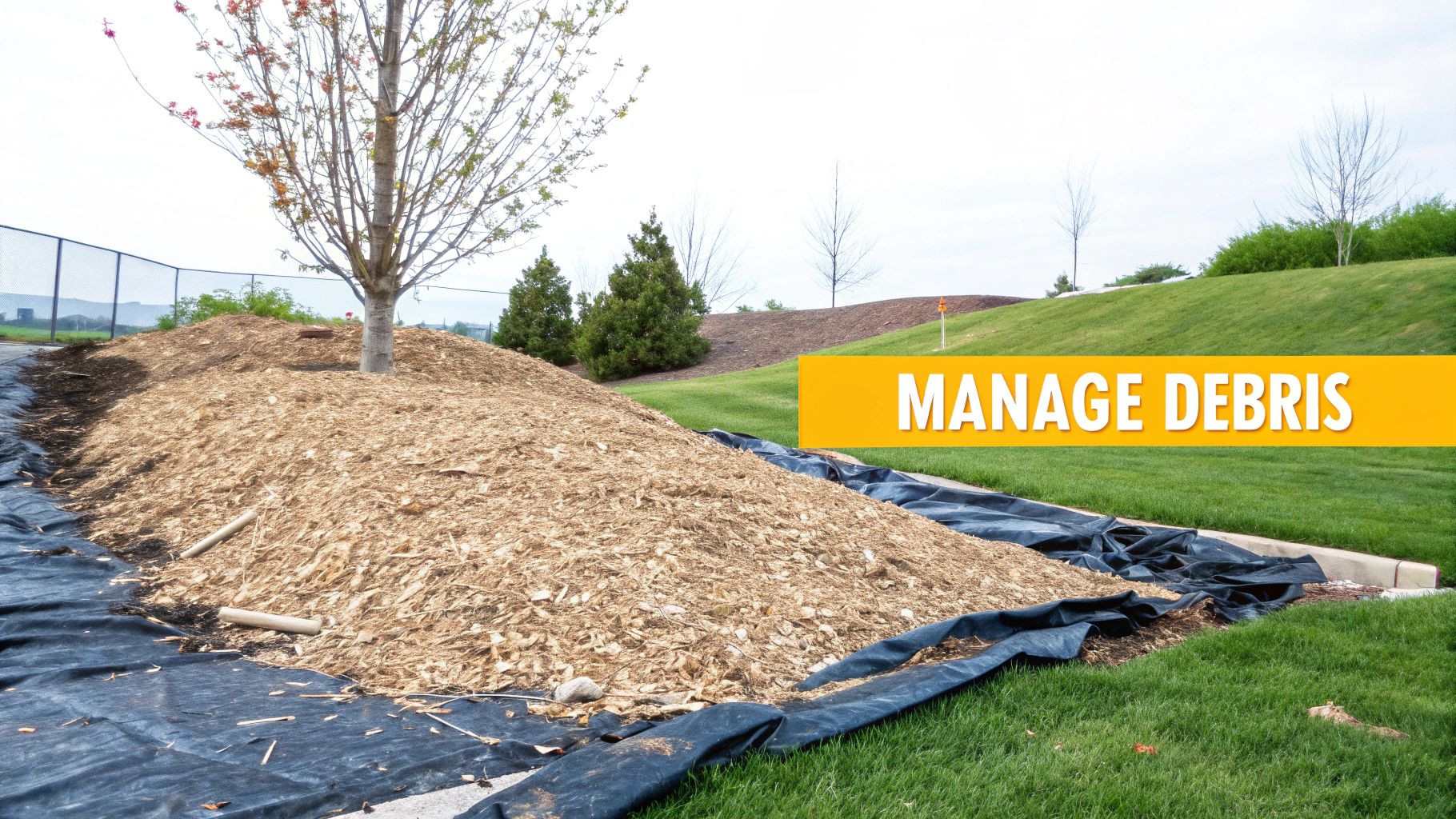
Once the heavy equipment quiets down and the last of the brush is cut, you're left with the aftermath. This next phase—dealing with piles of debris and stubborn stumps—is just as crucial as the initial clearing. If you ignore it, those piles can quickly become a haven for pests or a serious fire hazard.
So, what do you do with all the cut vegetation? You have a few solid options: chipping it into mulch, hauling it off-site, or—if your local regulations allow it—a controlled burn. Chipping is usually the best bet. It turns a waste problem into a valuable resource you can spread in garden beds or use for ground cover.
I've seen it time and again: the most overlooked part of any clearing project is the long-term plan. Clearing the land feels like a huge win, but without a solid strategy for stumps and regrowth, you could be fighting the same battle again in just a few years.
Tackling Stumps Head-On
Stumps are the final boss of any clearing job. They're a real hurdle, and how you deal with them depends on your goals, timeline, and budget.
Stump Grinding: This is the go-to for most situations. A stump grinder essentially chews up the stump, shredding it down several inches below the ground. It's fast, effective, and doesn't tear up your property, leaving you with a nice pile of wood chips to fill the hole.
Full Excavation: If you're prepping a site for a foundation or planting an agricultural field, you need the stump and its root ball gone. Completely. This involves heavy machinery and makes a bigger mess, but it gives you a totally clean slate to work with.
Natural Decay: Feeling patient? The simplest and cheapest route is to cut the stump flush with the ground and let nature do the work. It's a zero-cost option, but be prepared to wait—it can take years for a stump to rot away, and it might attract termites in the meantime.
Preventing Erosion and Unwanted Regrowth
Now that the ground is bare and exposed, your final job is to protect it. You need to stabilize the soil and stop opportunistic weeds and brush from moving right back in.
On any sloped areas, you absolutely need to lay down erosion control blankets or a thick layer of mulch. One good Florida downpour can wash away all your precious topsoil if you don't. To get a better handle on this, check out our guide on the benefits of mulching for sustainable land management.
Your best long-term defense is establishing a good ground cover, like native grasses or clover. These plants put down roots fast, locking the soil in place and crowding out any invasive species trying to get a foothold. This isn't just cleanup; it's responsible land stewardship.
Globally, agricultural expansion is a huge reason for brush and small tree clearing, with about 10 million hectares of forest converted each year between 2015 and 2020. You can discover more insights about global forest trends from the FAO to see the bigger picture.
For your property, a simple maintenance plan—like mowing a couple of times a year—will ensure your newly cleared land stays that way for good.
When to Call in the Pros for Your Land Clearing Project
Look, tackling a brush and small tree clearing project yourself can be incredibly satisfying for those smaller, more manageable jobs. But there comes a point where a weekend chore turns into a major operation, and that's when you need to know when to put down the loppers and pick up the phone.
Recognizing that line between a DIY win and a potential disaster is the key to getting the job done right, safely, and without breaking the bank.
The most obvious clue? Scale. If you’re staring down multiple acres of thick, tangled overgrowth, you're not just looking at a bit of hard work. You're looking at a job that can quickly overwhelm rental equipment and your own physical stamina. A professional crew with a forestry mulcher might knock that out in a day or two. For you, it could mean weeks of back-breaking labor.
Red Flags: When a DIY Project Becomes Too Risky
Certain situations just scream "professional help." These are the scenarios where trying to go it alone isn't just impractical—it's downright dangerous.
Steep or Uneven Terrain: Operating heavy machinery on a slope isn't for the faint of heart. It takes real skill to navigate tricky ground without risking a dangerous rollover or causing serious soil erosion. Pros know how to handle these landscapes safely.
Proximity to Structures and Utilities: This is a high-stakes game. Clearing land right next to your house, outbuildings, or—even worse—power lines leaves zero room for error. One slip-up can lead to catastrophic damage. A professional, insured crew is an absolute must here.
Seriously Dense Vegetation: We're talking about the kind of thick, knotted brush and tightly packed small trees that laugh at consumer-grade equipment. Professionals bring in the heavy hitters, like the powerful mulchers we run at Palm State Clear Cut, which are built to chew through the toughest overgrowth without breaking a sweat.
Presence of Hazardous Trees: Dead or unstable trees, often called "widow-makers," are a huge risk. They can fall without warning and are a leading cause of serious injuries on job sites. It takes a trained eye to spot them and a skilled hand to bring them down safely.
Here's the thing: when you hire a professional, you're not just paying for their big machines. You're paying for their experience with local regulations, their comprehensive insurance that protects you from liability, and their ability to get the job done right—and safely—the first time.
Trying to save a few bucks on a complex clearing job can backfire spectacularly. The potential costs of an accident, equipment damage, or environmental fines can easily eclipse what you would have paid a reputable company. On a global scale, the demand for agricultural and developed land drives significant deforestation. From August 2019 to July 2020, Brazil alone lost over 11,000 square kilometers of forest, much of it from clearing activities. You can discover more about global deforestation statistics to see why responsible, expert-led land management is so vital.
Making the right call protects your property, your wallet, and your well-being.
Gearing Up and Operating Safely
When you’re about to start clearing land, there's absolutely no room to cut corners on safety. The sheer power of modern machinery demands your full respect, and that respect starts with putting on the right personal protective equipment (PPE) before you even think about turning the key.
This isn’t just some box-ticking exercise; it's your first and best defense against serious injury. A falling branch, a rock kicked up by a mower, or a flying piece of wood can cause life-altering damage in a split second.
Your non-negotiable gear list should always include:
A solid hard hat
Full-coverage eye protection or a face shield
Heavy-duty work gloves
Steel-toed boots
Hearing protection (don't underestimate this one!)
Think of your PPE as the most important investment you'll make in your brush and small tree clearing project. The cost is tiny compared to the potential consequences of a preventable accident.
Smart and Safe Equipment Operation
Once you're geared up, your attention needs to shift to the machine itself. It doesn't matter if you’re running a skid steer, an excavator, or a specialized forestry mulcher—safe operation always begins with a pre-use inspection. Every. Single. Time.
Before you fire up the engine, do a quick walk-around. You're looking for anything out of place.
Fluid Leaks: Are there any puddles of hydraulic fluid, oil, or coolant underneath?
Tires or Tracks: Check your tire pressure. If you're on tracks, make sure the tension looks right.
Guards and Shields: Are all the safety guards where they should be and securely fastened?
Attachment Security: Give the attachment a once-over. Is that grapple or mulching head properly connected and locked in?
Knowing your machine's limits is just as crucial. Rollovers are one of the most common and dangerous accidents, so never try to operate on slopes steeper than what the manufacturer recommends. Always keep your head on a swivel, maintaining a safe distance from people, buildings, and especially overhead power lines.
For a deeper dive into different types of equipment, our guide to underbrush clearing machines breaks down the specifics. Making this safety-first mindset a habit is what separates a successful, efficient project from a disastrous one.
Answering Your Top Land Clearing Questions
When you're looking at a piece of overgrown property, it's natural to have a lot of questions. Over the years, we've heard them all. Getting these uncertainties cleared up from the start not only saves you time but also helps you sidestep common mistakes and move forward with confidence.
Let's dive into some of the most frequent questions we get from landowners.
When Is the Best Time of Year to Clear Land?
Timing is everything, and this is probably the number one question we're asked. Hands down, the ideal season for clearing is late fall or winter.
There are a few solid reasons for this. First, the vegetation is dormant, which makes it much easier and safer to cut and handle. The ground is also usually firmer, allowing heavy machinery to work its magic without tearing up your soil or causing excessive compaction.
Perhaps most importantly, clearing in the off-season minimizes our impact on local wildlife, especially avoiding the critical nesting and breeding seasons in the spring.
What Happens to All the Mulch Left Behind?
This one comes up a lot, especially when we talk about forestry mulching. People see the layer of wood chips left on the ground and wonder if it needs to be hauled away.
The answer is a definitive no—in fact, we strongly recommend leaving it right where it is.
That layer of natural mulch is one of the biggest benefits of the process. It acts as a fantastic erosion control blanket, prevents pesky weeds from popping back up, and slowly breaks down to feed vital nutrients back into the soil. It’s a key ecological advantage that leaves your land healthier than it was before.
So, What Does Land Clearing Actually Cost?
Of course, everyone wants to know about the bottom line. The truth is, professional clearing costs can vary quite a bit, typically ranging from $500 to over $2,000 per acre.
What causes such a wide range? It really boils down to the density of the brush and trees, how easy it is to get equipment onto your property, and the specific clearing method we use. For example, forestry mulching is often quoted by the hour, usually falling somewhere between $150 and $300 an hour.
Ready to tackle your land clearing project with an expert team? At Palm State Clear Cut, we have the right equipment and experience to handle any job, big or small. Get your free, no-obligation quote today!
Comments