
How to Cut a Tall Tree Safely A Florida Homeowner's Guide
- Mike Walker
- Jan 23
- 16 min read

Before you even think about firing up the chainsaw, know this: 90% of a safe tree felling job is finished before the first cut is even made. The real work lies in a meticulous site assessment, knowing the local rules, and clearing your work zone so you can control every possible variable.
Your Pre-Cut Safety Checklist
This isn’t just a quick glance around. It’s a systematic evaluation that separates a controlled, predictable tree removal from a potential disaster. Walking through these steps is exactly what we professionals do on every single job to make sure that tree lands precisely where we want it to, every time.
Assess the Tree and Its Surroundings
First thing's first: get to know the tree. I mean really know it. Walk around it a few times and study its natural lean. A tree that already wants to fall in a certain direction is something you can work with. But one leaning awkwardly toward your house, your neighbor's fence, or a power line? That's an immediate red flag.
Next, get up close and inspect the trunk and main branches for any signs of trouble. You're looking for:
Rot or Decay: Keep an eye out for soft spots, fungal growth (like mushrooms popping out of the trunk), or hollowed-out cavities. These are all signs of internal weakness that can make the tree behave unpredictably when you start cutting.
Dead Branches: We call these "widowmakers" for a reason. The vibration from your chainsaw is more than enough to shake them loose, and you don't want to be underneath one when it comes down.
Cracks or Splits: Large fissures running up the trunk seriously compromise the tree’s structural integrity.
Once you’ve given the tree a thorough once-over, turn your attention to the surrounding area. Map out every potential obstacle inside the felling zone—the area where the tree is going to land. This means buildings, fences, cars, sheds, and especially overhead utility lines. Let me be clear: never, ever attempt to fell a tree anywhere near power lines. That is a job exclusively for professionals and the utility company.
Plan Your Felling Zone and Escape Routes
Now it's time for some simple but critical math. A good rule of thumb is to establish a felling zone that is at least 1.5 to 2 times the height of the tree. So, if you're dealing with a 50-foot pine, you need a clear zone of 75 to 100 feet in every direction from the base. Clear this entire area of tools, equipment, patio furniture—anything you don't want crushed.
Your escape route isn’t just a suggestion; it’s your lifeline. The moment you hear that wood start to crack and pop, you don’t have time to think—you just need to move. Having a pre-cleared path is the only thing that guarantees a safe retreat.
You need to plan at least two clear escape routes. These paths need to be completely free of trip hazards like rocks, roots, or low-hanging brush. Your routes should be at a 45-degree angle away from the direction of the fall, on the opposite side of the trunk. This gets you away from both the falling tree and the potential kickback from the stump.
Check Local Regulations and Communicate Your Plan
If you’re working with a helper, a solid communication plan is just as vital as a sharp saw. Agree on clear hand signals and verbal cues before you start the engine. When working in remote or hazardous areas, understanding what gear you need to stay in contact is paramount. You can find more details about effective communication devices to keep your team safe.
Finally, don't get caught up in red tape. Here in Central Florida, many counties and cities have tree ordinances, especially for protecting large heritage oaks. In places like Seminole or Orange County, you might need a permit to take down a tree over a certain diameter. A quick call to your local planning or building department can save you from some hefty fines. And don't forget to check your homeowner association (HOA) rules, as they often have their own set of restrictions.
Choosing the Right Tree Removal Method
So, you’ve scoped out the site. The next big decision is how to get that tree on the ground. This isn't a one-size-fits-all situation, and honestly, picking the wrong approach can turn a project into a nightmare faster than you can say "timber."
You're basically looking at two completely different strategies: the classic directional felling or the more surgical sectional removal. The right choice is dictated by the space you've got, the tree's health, and your own comfort level. Getting this right is the cornerstone of cutting down a tall tree safely.
Directional Felling: The Classic Approach
Directional felling is exactly what it sounds like—you make a few calculated cuts at the base to steer the tree exactly where you want it to fall in one go. It's fast and direct, but it requires one thing you can't compromise on: tons of open space.
You should only even think about this method if you have a clear landing zone that’s at least 1.5 times the height of the tree. This area needs to be completely free of obstacles like:
Houses, sheds, or garages
Fences or property lines
Power lines and other utilities
Prized landscaping or other trees you want to keep
Picture a big lone pine in the middle of an open field out in Osceola County. That’s the perfect textbook case for directional felling. You're letting gravity and a good hinge do the heavy lifting in a predictable way.
Sectional Removal: A Surgical Takedown
When a tree is crammed into a tight spot, sectional removal (or dismantling) is the only game in town. This is the reality for most of us in suburban Central Florida, where houses are close and every square foot of yard counts.
Instead of dropping the whole tree at once, a climber goes up and takes it apart piece by piece, from the top down. They'll often use ropes and specialized rigging gear to lower heavy limbs to the ground with total control, avoiding any damage below.
This is a much more complex and time-consuming process. It's the only safe play when a tree is:
Hanging over your roof or pool cage
Tangled up in utility wires
Surrounded by delicate gardens or hardscaping
Sectional removal is less about brute force and more about precision engineering. Every cut is planned, and every piece is controlled, ensuring nothing comes down unexpectedly. It's the difference between demolition and careful disassembly.
The scale of tree removal is massive. Since 1990, human activity has cleared an incredible 420 million hectares of forests across the globe, often to make way for development or agriculture. You can dig deeper into the drivers of this forest loss over at WRI.org.
Felling vs Sectional Removal: Which Method is Right for You?
Choosing between these methods really comes down to a straightforward risk assessment. If a tall tree is anywhere near something valuable, the high stakes almost always point toward sectional removal—a job that's definitely best left to insured professionals.
This table should help you clarify which path makes the most sense for your situation.
Factor | Directional Felling | Sectional Removal (Dismantling) |
|---|---|---|
Space | Needs a wide-open area with zero obstacles. | Perfect for confined spaces, near homes, fences, or power lines. |
Speed | Very fast. The tree is on the ground in minutes. | Slow and methodical. Can take several hours or even a full day. |
Complexity | Simpler, but still demands precise cutting skills. | Extremely high. Requires advanced climbing, rigging, and teamwork. |
Risk | High risk of property damage if a single thing goes wrong. | Much lower risk to your property because every piece is controlled. |
Ultimately, looking at this comparison makes the decision pretty clear. While the speed of felling is tempting, the safety and precision of sectional removal are essential when you can't afford any mistakes.
Essential Gear and Safety Equipment
Trying to take on a tall tree with the wrong gear is like navigating a Florida swamp without a map—it’s a gamble you just can't afford. The right equipment isn't about working faster; it's the critical barrier between a clean job and a life-altering injury. We're not just talking about having a chainsaw, but the right one, along with all the supporting tools and an absolute commitment to Personal Protective Equipment (PPE).
Heading into a tree-cutting job without this gear is asking for trouble. Every single piece plays a specific role in keeping you in control and, more importantly, keeping you safe.
Choosing Your Primary Tool The Chainsaw
The chainsaw is the heart of the whole operation, so picking the right one requires some thought. Your two main considerations are the engine size, measured in cubic centimeters (cc), and the bar length. For most big residential trees, a saw in the 40-60cc range with an 18- to 24-inch bar gives you a great mix of power and control.
But even the most powerful saw is a liability if the chain is dull. A sharp chain does the work for you, pulling itself through the wood with minimal pressure. A dull one, however, just makes fine sawdust instead of chunky wood chips and forces you to push—dramatically increasing the risk of a dangerous kickback.
Never, ever underestimate your saw's built-in safety features. That chain brake is your best friend, designed to stop the chain in a split second during a kickback. Make a habit of testing it every single time before you start cutting.
Your Non-Negotiable Personal Protective Equipment
Think of Personal Protective Equipment (PPE) as your last line of defense. The numbers don't lie: proper PPE is proven to reduce the severity of injuries from chainsaws, which cause around 36,000 injuries a year in the U.S. alone. This is one area where there is zero room for compromise.
Here’s your essential PPE checklist:
Certified Helmet: Your head needs protection from falling branches, often called "widowmakers," which can break loose from the vibration of the saw.
Eye and Ear Protection: Safety glasses or goggles are a must to shield your eyes from flying wood chips. Likewise, earplugs or muffs will protect your hearing from the deafening roar of the engine.
Chainsaw Chaps: These are lifesavers. They're made with layers of ballistic fibers that will instantly clog a moving chainsaw's sprocket on contact, stopping the chain and preventing a catastrophic leg injury.
Steel-Toed Boots: Good boots give you a solid footing and protect your feet from the saw, falling limbs, and the heavy logs you'll be moving around.
Essential Supporting Tools
Safely felling a tall tree takes more than just a good saw. The pros rely on a handful of other tools to control the process and avoid common mishaps.
Felling Wedges: These simple plastic wedges are absolutely indispensable. You tap them into your back cut to keep the tree's weight from pinching your saw bar and to help steer the tree exactly where you want it to fall.
Ropes and Rigging: If a tree has any kind of lean or you need absolute control over its direction, ropes are a must. They allow a helper, standing safely out of the way, to apply tension and guide the tree down.
Pole Saw: A pole saw is perfect for safely trimming lower branches before you even think about making your main felling cuts. This clears out your work area and your escape routes, preventing tangled limbs from messing with the tree's fall.
For Florida landowners gearing up for bigger projects, our guide on the best equipment for land clearing digs deeper into professional-grade tools. Skipping even one of these items dramatically increases your risk.
Mastering the Notch and Back Cut
Got your safety gear on and a solid plan in mind? Good. Now comes the moment of truth. How you make the first few cuts at the base of the tree is what separates a controlled, predictable fall from a chaotic and dangerous disaster. It all boils down to two critical moves: the directional notch and the back cut.
Think of these two cuts working together to create a hinge of wood. This hinge is your steering wheel, guiding that massive tree exactly where you planned for it to land. Getting this right isn't just a good idea; it's everything. A sloppy cut can send the tree sideways, cause the trunk to split vertically (a terrifying event called "barber-chairing"), or make the butt of the log kick back off the stump.
The Anatomy of the Directional Notch
Your first job is to create the directional notch. This is a wedge-shaped opening you'll cut on the side of the tree facing your drop zone. By physically removing this piece of wood, you're telling the tree which way to fall. While there are a couple of ways to do this, one method is hands-down the safest and gives you the most control.
Conventional Notch: This is the old-school way, with a flat bottom cut and a top cut angled down at 45 degrees. It can work, but the notch tends to close up too early as the tree falls, which means you lose control sooner than you'd like.
Open-Face Notch: This is what the pros use, and for good reason. It’s made with a top cut angled down at a steep 70 degrees and a bottom cut angled up at 20 degrees. This creates a wide "mouth" that lets the hinge function almost all the way to the ground, giving you maximum steering control.
Your notch should only go about 20-25% of the way into the tree's diameter. On a 20-inch trunk, for example, that’s a notch about 4 to 5 inches deep. Pro tip: always make the top cut first, then the bottom cut to meet it. This keeps your chainsaw bar from getting pinched when the wedge of wood comes loose.
Before you even think about starting that engine, a head-to-toe check of your Personal Protective Equipment (PPE) is non-negotiable. This visual guide shows you exactly what's needed.
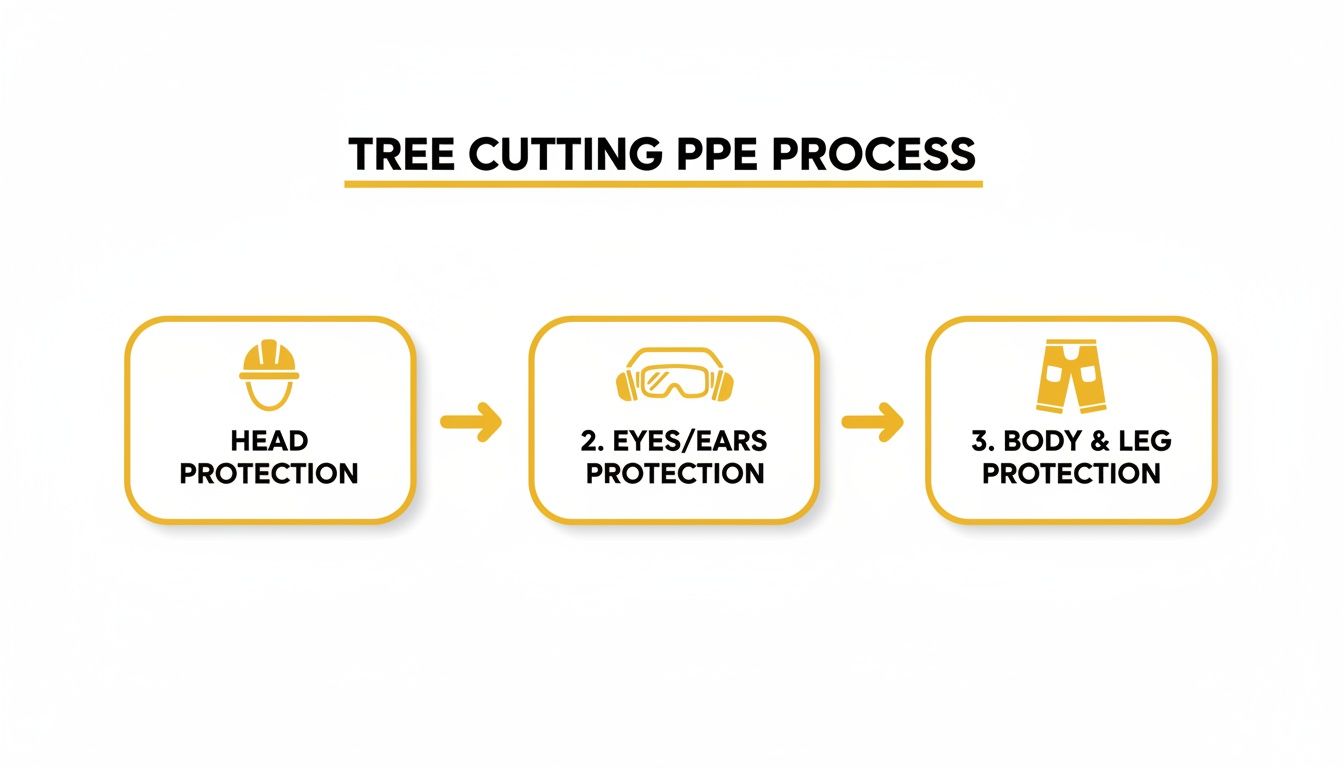
Think of your PPE as a layered defense system. Each piece is there to protect you from the very real and immediate dangers of tree work.
Executing the Perfect Back Cut
With the notch done, you'll move to the opposite side of the tree for the back cut, also called the felling cut. This is the cut that finally releases the tree. The technique is crucial: cut straight in towards your notch, but you must stop before you reach it.
That uncut strip of wood you leave between the back cut and the notch is the hinge. It is, without a doubt, the single most important part of felling a tree.
The hinge is your control mechanism. It's the rudder on your ship. It holds the tree to the stump and steers it down into the felling zone. A hinge that is too thin, too thick, or non-existent means you have zero control over a multi-ton object.
Your back cut needs to be perfectly level and about 1 to 2 inches higher than the corner of your notch. This little step is a critical safety feature that prevents the tree from sliding backward off the stump as it falls. As you're cutting, keep one eye on the treetop and listen for any cracking sounds—that's the tree telling you it's ready to go.
So, how thick should the hinge be? A good rule of thumb is 10% of the tree's diameter. For that same 20-inch tree, you’d want a solid 2-inch hinge running across the entire cut. Never, ever cut through your hinge. The second you see the tree start to lean, that's your cue. Remove the saw, engage the chain brake, and walk—don’t run—down your planned escape path.
Mastering these cuts is essential because the scale of tree removal is massive. In a recent year, the world lost about 25 million hectares of tree cover, a 5% increase from the year before. Much of this involves felling large, mature trees that demand these specialized techniques for safe handling. You can dig into the data on global forest trends at GlobalForestWatch.org. This staggering number highlights why getting the fundamentals right is the only responsible way to approach this task.
Navigating Florida-Specific Tree Challenges
The basic rules of tree cutting apply everywhere, but let’s be honest—Florida plays by its own set of rules. Between our sandy soil and the ever-present threat of hurricanes, knowing how to cut down a tall tree here in Central Florida demands local expertise. The techniques that work perfectly on a northern hardwood can fail spectacularly on a sprawling live oak or a fibrous palm.
Ignoring these regional differences isn't just inefficient; it's downright dangerous. Our unique environment demands a specific approach, considering everything from the tree species to the time of year you make your cuts.
Understanding Florida Tree Species
Not all trees are created equal, especially in the Sunshine State. Each of our common species presents its own unique challenge when it comes time for removal.
Live Oaks: These iconic giants are incredibly dense and heavy, with sprawling, unpredictable limb structures. Their sheer weight is unforgiving, and a single miscalculation can lead to immense property damage.
Pines (Slash, Loblolly): While their fall is often more predictable, tall Florida pines are notorious for rot and disease, especially after a lightning strike. A tree that looks healthy on the outside can have a compromised core, turning it into a serious hazard during felling.
Palms (Sabal, Queen): Cutting a palm is less like sawing wood and more like cutting through a bundle of dense, wet fibers. Their stringy trunks can easily bind up a chainsaw chain if you’re not prepared, and their heavy fronds add unpredictable weight to the top.
This diversity is exactly why a one-size-fits-all cutting plan is doomed from the start. You have to respect the individual characteristics of the tree you’re working with and adjust your notch, back cut, and overall strategy accordingly.
The Hurricane Factor and At-Risk Trees
Hurricane season is a fact of life in Florida, and it completely changes the calculus of tree removal. A tall tree that seems perfectly fine in May can become a catastrophic liability by September. Proactive assessment is your absolute best defense against storm damage.
Before hurricane season really gets going, take a walk around your property to identify at-risk trees. You're looking for weak branch unions (sharp "V" shapes instead of a solid "U"), any signs of root rot, or a significant lean toward your house or other structures. Prioritizing the removal of these hazards is a critical part of your storm prep. If you're wondering about the ideal timing for this work, you can explore our detailed guide on Florida's best time to cut down trees for safety and success.
In Florida, waiting for a tree to become an obvious problem is often waiting too long. Hurricane winds will find the weakest point in every tree on your property, making pre-season removal a vital investment in your home’s safety.
This forward-thinking approach is part of responsible land stewardship. When you look at the bigger picture, it's even more critical. From 2001 to the present, global tree cover loss totaled 520 million hectares—a 13% drop from 2000 levels. With an estimated 15 billion trees cut down annually versus just 5 billion planted, this deficit highlights the need for safe, efficient methods when removal is truly necessary. You can dive into more data on these global forest trends over at Global Forest Watch.
Local Regulations and Invasive Species
Finally, you can't start a project without navigating Florida’s specific legal and ecological landscape. Many counties, from Lake to Brevard, have ordinances protecting "heritage trees," often requiring a permit before you can even think about removal. Always check with your local municipality before you pick up a saw.
On top of that, Florida is in a constant battle with invasive plant species. Trees like the Brazilian Pepper and Australian Pine can quickly overtake native vegetation. While their removal is often encouraged, it has to be done correctly to prevent regrowth. Simply cutting them down can sometimes lead to more aggressive spreading. This is another area where bringing in licensed and insured professionals like Palm State Clear Cut is vital; we know how to manage these specific threats while navigating local regulations, protecting you from liability and ensuring the job is done right the first time.
Knowing When to Call a Professional
While this guide gives you a solid foundation for felling a tree, real wisdom is knowing when to put the chainsaw down and pick up the phone. Some jobs carry red flags that dramatically raise the risk, turning a weekend project into a potential catastrophe.
This is that critical moment to step back and bring in a certified arborist. Recognizing these situations is just as vital as mastering a perfect back cut. It’s about making the smart call to protect your home, your family, and yourself. Think of a professional's fee as a calculated investment in total peace of mind.
Red Flags for DIY Tree Removal
Certain scenarios immediately take a tree-cutting job out of the hands of even the most skilled DIYer. These are the complex situations where only a seasoned professional with specialized gear can safely manage the risk. If your project involves any of the following, it’s time to make that call.
Proximity to Structures: If that tree could even possibly hit your house, your neighbor's garage, a fence, or a shed on its way down, you need professional precision. Period.
Near Power Lines: This one is non-negotiable. Working near utility lines is incredibly dangerous and is strictly a job for insured professionals, who often have to coordinate directly with the power company.
Signs of Advanced Decay: See significant rot, big cavities, or deep cracks? That tree is structurally compromised. It can behave in terrifyingly unpredictable ways once you start cutting, including splitting vertically in a deadly "barber-chair" accident.
Heavy Leans: A tree that's already leaning heavily toward a hazard leaves absolutely zero room for error. An expert knows how to assess the forces at play and use advanced techniques to guide it down safely.
Hiring a professional isn't admitting defeat; it's a strategic move. The potential cost of a mistake—from a crushed roof to a serious injury—far outweighs the expense of having the job done right by an insured and experienced team.
The Professional Equipment Advantage
Beyond skill, professionals show up with an arsenal of specialized equipment that most homeowners simply can't access. This gear completely changes the game in terms of safety and efficiency. For bigger projects, understanding this advantage is key. We cover more on this in our guide on choosing land clearing companies in Central Florida.
Tools like forestry mulchers can turn dense vegetation into mulch in hours, not days. Stump grinders completely erase any sign of the tree, leaving the ground ready for whatever you have planned next.
For sectional removals, arborists use complex rigging systems with specialized ropes, pulleys, and friction devices. This allows them to carefully lower massive sections of the tree to the ground with zero impact. That level of control is flat-out impossible with basic homeowner tools, making a professional service the only safe bet for complex tree removals.
Common Questions About Tree Removal
When you're staring up at a massive tree that needs to come down, a lot of questions pop into your head. Let's tackle some of the most common ones we get from homeowners here in Central Florida.
What's This Going to Cost Me?
There’s no single price tag for tree removal. The final bill can run anywhere from a few hundred to several thousand dollars. The biggest factors are the tree's height, how easy it is to get to, and what's underneath it. A simple felling in an open yard is one thing, but a complex, piece-by-piece removal hovering over your house or power lines? That's a different ballgame, often requiring a crane.
Do I Really Need a Permit to Cut Down a Tree in Florida?
Maybe. Florida passed a law in 2019 that stops local governments from regulating the removal of trees that an arborist has officially deemed dangerous. But don't take that as a free pass. Many counties have their own rules to protect "heritage" or "specimen" trees. Always, always check with your local city or county planning department before you even think about starting your saw.
"Dangerous" isn't just a casual term; it's a specific classification from a certified arborist. If you cut down a protected tree without that official assessment, you could be facing some seriously hefty fines.
Can I Keep the Wood for My Fireplace?
You bet. We're more than happy to leave the wood for you. Just give us a heads-up that you want it, and we can cut it into manageable, firewood-length pieces. It's a fantastic way to get some extra value from the job, but remember you'll be the one doing the splitting and stacking.
When the job feels too big or the questions get too complicated, that's your cue to bring in the pros. For a professional look at your property and a free, no-pressure quote, give Palm State Clear Cut a call. You can reach us through our website at https://palmstateclearcut.com.
Comments