
Florida's Best Time to Cut Down Trees for Safety and Success
- Mike Walker
- Dec 21, 2025
- 16 min read
Let's cut right to the chase. The absolute best time to cut down trees in Central Florida is during their dormant season. We're talking about that sweet spot from late fall to late winter, generally November through February.
Why then? It’s simple. This window sidesteps our notorious hurricane season and the daily summer thunderstorms, making the whole operation significantly safer and more straightforward.
Decoding the Ideal Tree Removal Window
Think about it like planning a big outdoor event. You wouldn't schedule it in the middle of August, right? The same logic holds true for tree removal. Aiming for the dormant season isn't just a casual recommendation; it's a strategic move that works with Florida's weather and the tree's own biology, not against them.
During these cooler, drier months, all the conditions line up for a smooth, controlled, and safe project.
Why Winter Wins for Tree Removal
When a deciduous tree like an oak or maple goes dormant, it's essentially taking a long winter nap. It stops growing and drops its leaves, which makes it a whole lot lighter. For a removal crew, a lighter, leafless tree is far easier and safer to handle.
Plus, with all the leaves gone, we get a crystal-clear view of the entire branch structure. This visibility is critical for making precise, safe cuts, especially when there are homes, power lines, or other obstacles nearby.
The ground is also on our side. From November to February, the soil is typically much firmer and drier. Heavy equipment can move across your property with a much lower risk of getting bogged down in mud or leaving deep, ugly ruts in your lawn. This means less collateral damage to your landscape and no compacted soil choking the roots of your other plants.
Choosing the dormant season is about working with nature, not against it. It leverages the tree's natural cycle and Florida's calmer weather to create the safest possible environment for a high-risk job.
Avoiding High-Risk Seasons
On the flip side, trying to take down a tree during a Florida summer or, even worse, during hurricane season is just asking for trouble. The wet season means daily downpours and soil that's completely saturated. A tree that seems perfectly stable can have its root system dangerously weakened by a week of heavy rain, making its fall unpredictable and chaotic.
The infographic below really puts it into perspective.
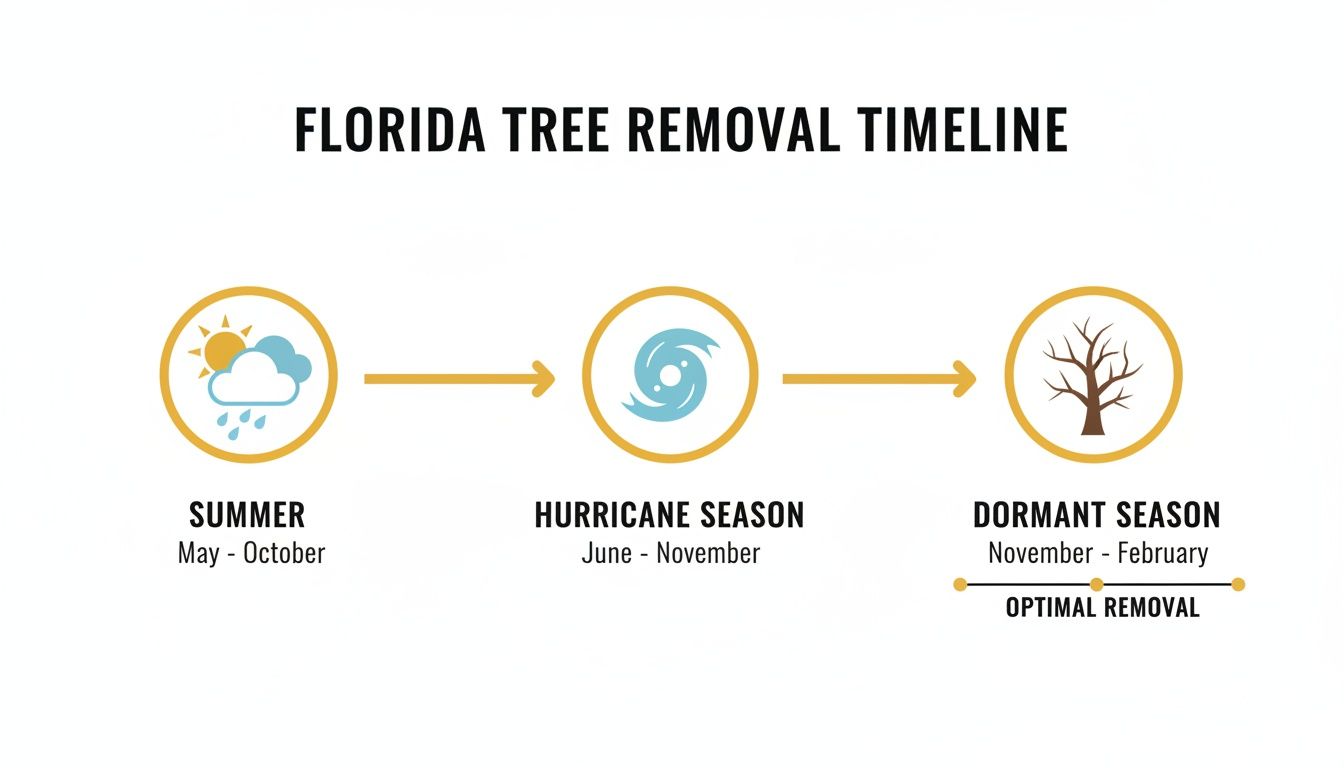
As you can see, there's a clear "green light" for tree work and a definite "red light" period where the risks just aren't worth it.
To make it even clearer, here’s a quick breakdown of what you're up against in each season.
Florida's Seasonal Guide to Tree Removal
Season | Key Advantages | Primary Risks & Disadvantages |
|---|---|---|
Winter (Nov - Feb) | • Dormant trees are lighter and easier to work on.• Firm, dry ground minimizes landscape damage.• Clear visibility of branch structure.• Safest weather conditions. | • Scheduling can be tight as it's the peak season for professional services. |
Spring (Mar - May) | • Weather is still relatively stable and mild.• Ground remains fairly firm before the heavy rains start. | • Trees are budding, adding weight.• Active nesting season for birds and wildlife (potential delays). |
Summer (Jun - Aug) | • Not an ideal time; generally reserved for emergency removals. | • Daily thunderstorms and lightning.• Saturated, unstable soil increases risks.• High heat and humidity are hard on crews. |
Fall (Sep - Oct) | • Can be an option after peak hurricane season passes. | • High risk of hurricanes and tropical storms.• Ground is often still waterlogged from summer rains.• Unpredictable weather patterns. |
This guide shows why professionals overwhelmingly prefer the dormant season. It's not about convenience; it's about minimizing risk for everyone involved—our crew, you, and your property.
Why Seasonal Timing Is Critical for Safe Tree Removal
Figuring out why timing matters is the first real step toward a safe and successful tree removal job. It’s not just about what fits your schedule; it’s about control, safety, and making sure the impact on your property is as small as possible.
The decision really comes down to three things that are especially powerful here in Central Florida: the tree's biological state (is it dormant?), the condition of the ground, and our famously unpredictable weather. Getting the timing right means you're working with nature, not fighting against it. This simple shift in thinking turns your scheduling choice from a minor detail into a core safety strategy.
The Advantage of Dormant Trees
During the late fall and winter, our deciduous trees go into a state of dormancy. You can think of it as a deep hibernation. They stop growing, sap flow slows way down, and most importantly, they drop their leaves. A leafless tree gives a removal crew two massive advantages.
First, visibility is so much better. Without a thick canopy of leaves in the way, an arborist can see the entire branch structure clearly. This lets them spot weak points, map out the most precise cuts, and safely work around tricky limbs, especially the ones hanging over your roof or power lines.
Second, the tree is just plain lighter. A big, mature oak can hold hundreds of gallons of water in its leaves and branches during the spring and summer, adding thousands of pounds of extra weight. When you remove that same tree in the winter, it's bare and much drier. Each section is lighter and more predictable to handle, which dramatically cuts down the risk of accidents.
"A dormant tree is a safer tree. It's lighter, the structure is fully visible, and the lower sap content means less mess. Every factor points to winter as the ideal window for a controlled removal."
This biological edge is the main reason pros will almost always recommend November through February as the best time to cut down trees in our area.
Soil Stability and Landscape Protection
Florida weather is a story of two extremes: the dry season and the wet season. Trying to take down a tree during the summer rainy season brings a big, often overlooked risk—saturated soil. When the ground is completely waterlogged, it loses its structural integrity.
This creates a few serious problems:
Root System Instability: The soil holding the root ball can turn to mud, making the whole base of the tree unstable. A tree that looks solid can suddenly shift or even fall unpredictably once cutting starts.
Heavy Equipment Damage: The sheer weight of machinery like bucket trucks or stump grinders can easily sink into soft, wet ground. This doesn't just tear up your lawn with deep ruts; it can get equipment stuck, leading to long and expensive delays.
Increased Erosion Risk: Pulling a large tree and its roots from wet soil leaves behind a huge, disturbed patch of ground that’s prime for erosion when the next downpour hits.
On the other hand, the firmer, drier ground of the dormant season gives you a stable platform for both the tree and the equipment. It ensures a safer operation from start to finish and saves your surrounding landscape from getting torn up. Picking the right season is as much about protecting your lawn as it is about safely getting the tree down.
Navigating Florida's Hurricane and Rainy Seasons
Here in Central Florida, the weather is more than just conversation starter—it's a force of nature that dictates the success or failure of any major outdoor project. When it comes to tree removal, ignoring our most volatile seasons is a gamble you don't want to take. The period from June through November, covering both the summer rainy season and hurricane season, introduces serious risks that can turn a controlled job into a dangerous mess.
Think about trying to stand on a slippery, wet log. Now imagine that log weighs several tons and is dangling over your house during a major windstorm. That's the kind of chaos you're inviting when you try to schedule tree removal during Florida's wettest, most unpredictable months.
The Dangers of Saturated Soil
Those daily summer downpours do more than just offer a break from the heat; they completely saturate the ground. This waterlogged soil loses its stability, turning what was firm earth into a soft, muddy liability. For a multi-ton tree, this is a huge problem.
A tree’s root system is its anchor, gripping the soil to stay upright. When that soil is soaked, the grip weakens dramatically. This creates a few big hazards:
Unpredictable Stability: The entire root ball can shift without warning under the stress of cutting, sending the tree falling in a completely unintended direction.
Increased Toppling Risk: A tree that looks fine might already be compromised at the roots, making it a toppling hazard before the first cut is even made.
Severe Landscape Damage: The heavy equipment needed for removal can easily sink into the soft ground. This leaves deep, destructive ruts across your lawn and can even damage underground irrigation systems.
This soil instability doesn't just put the crew and your property at risk; it also makes the cleanup a nightmare, often leading to more extensive and costly landscape repairs. For anyone concerned about ground stability after a job, you can explore expert strategies on how to prevent soil erosion on your property.
Hurricane Season: The Ultimate Red Flag
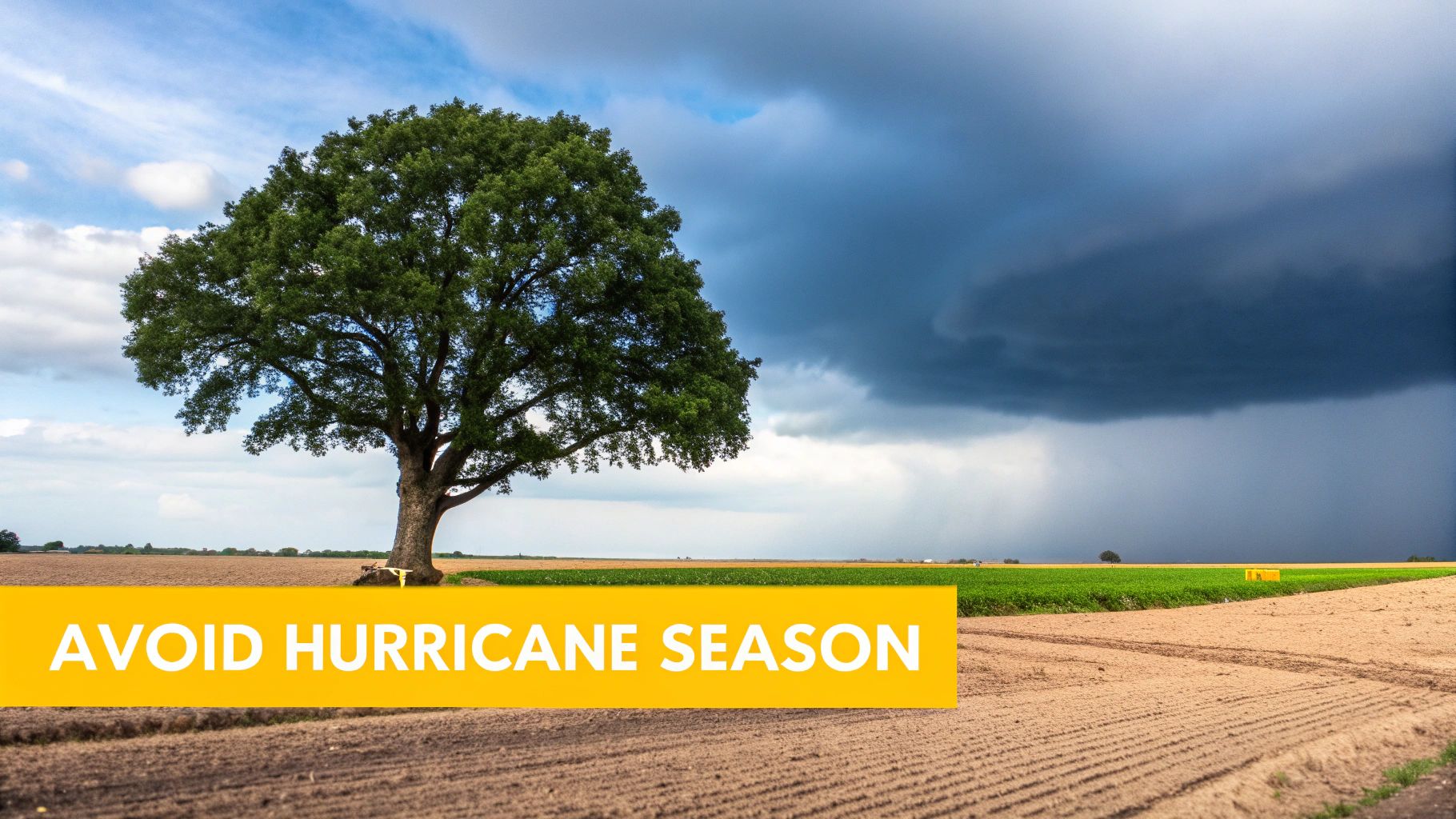
Scheduling a tree removal during hurricane season (June 1 to November 30) is like playing with fire. The threat isn't just about a named storm making a direct hit. It's about the constant potential for sudden, severe tropical storms that pop up with very little warning.
A tree removal job isn't a quick in-and-out operation; it can take hours, sometimes even days. A half-cut tree is incredibly vulnerable. If a storm with high winds rolls in mid-job, that partially dismantled tree can become a catastrophic projectile, threatening your home, your neighbor’s property, and anyone nearby.
Professional tree services see hurricane season as a time for emergency response, not routine scheduling. The risks of unpredictable high winds and torrential rain are simply too high to justify planned work.
It’s also worth noting how seasonal weather patterns impact safety on a larger scale. While Florida’s wet season thankfully lowers the risk of sparks causing fires, aligning tree work with the right weather is a critical safety principle everywhere. For example, clearing land during dry seasons in other parts of the world dramatically increases fire risk. Between 2001 and 2022, fires were responsible for a staggering 12.5 million hectares of tree cover loss in the United States alone, a stark reminder of what can happen when timing and weather are mismatched. You can see more on the global impact of seasonal clearing at Global Forest Watch.
Why Drier Months Equal Safer Operations
The difference between our wet and dry seasons is night and day. From late fall through winter, the ground in Central Florida is typically firm and stable. This provides a secure foundation for the tree to stand on and a solid surface for heavy equipment to maneuver without tearing up your property.
This stability is non-negotiable for a controlled and predictable tree removal. It lets arborists make precise cuts, confidently control the direction of the fall, and move heavy logs without any drama. By choosing the calm, dry window from November to February, you're actively choosing a safer, cleaner, and more predictable outcome for your property.
Species-Specific Timing for Florida Trees
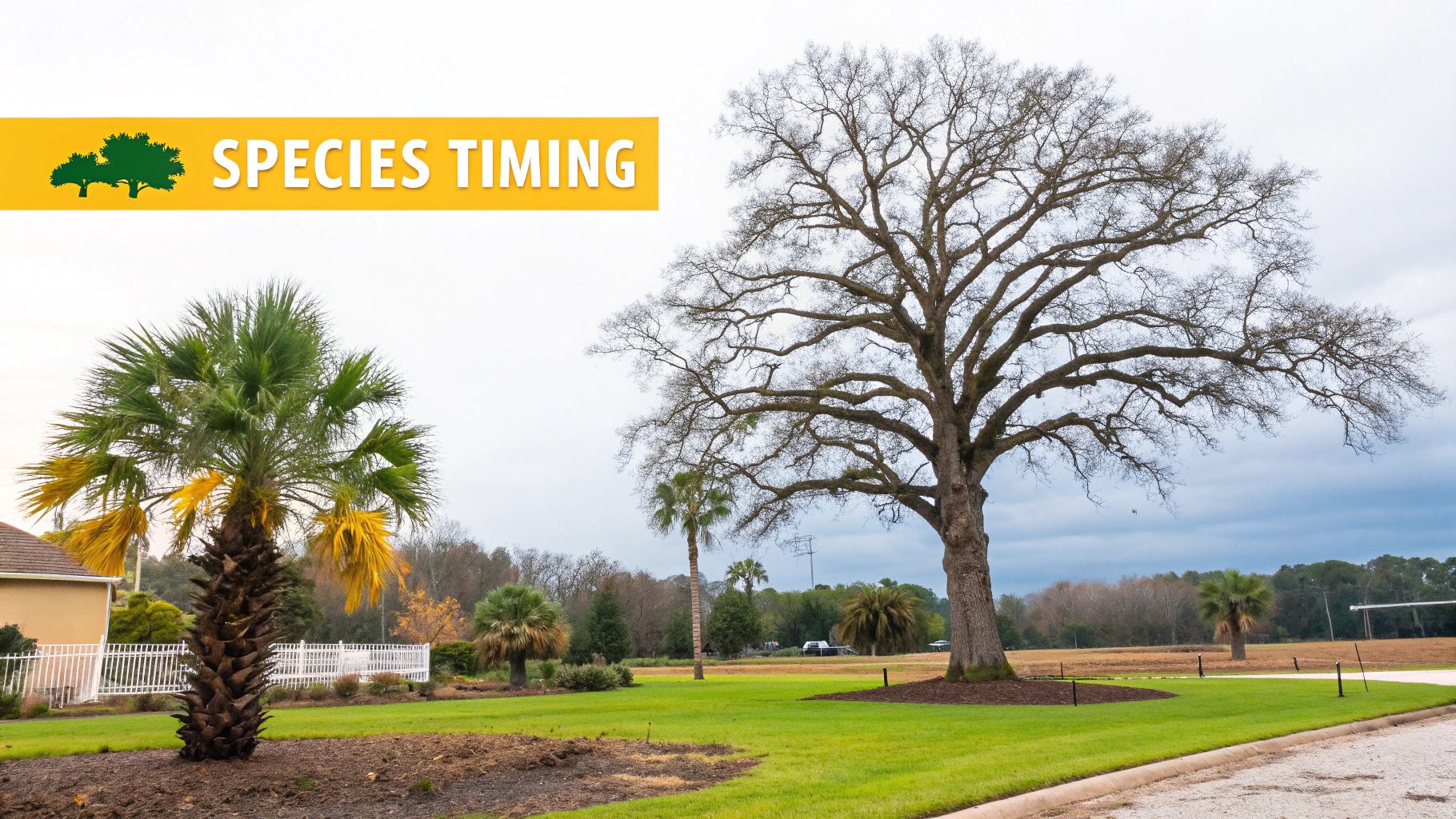
While the dormant season is a great rule of thumb, it's not a one-size-fits-all solution for Florida's diverse trees. Not every tree follows the same biological clock. The best time to cut down trees really comes down to the specific species growing on your property.
Think of it like tending a garden; you wouldn't handle a delicate rose bush the same way you’d care for a hardy fern. Each tree type comes with its own unique characteristics, risks, and ideal windows for removal. Getting to know these differences is the key to a safe and successful project, whether you're dealing with a massive oak, a towering pine, or an iconic palm tree. This targeted approach helps you get ahead of species-specific problems, like pest outbreaks or storm risks, before they start.
Deciduous Trees Like Oaks and Maples
For deciduous trees—the ones that lose their leaves every fall—that late fall to late winter window (November through February) is pretty much non-negotiable. During this dormant period, the trees are significantly lighter. They've dropped all their leaves and aren't circulating as much water through their limbs.
That reduced weight makes the entire removal process safer and more predictable. Crews can dismantle the tree with greater precision, and the bare branches give them a clear line of sight to the entire structure. That’s a huge advantage when you're working around homes or power lines.
Palm Trees: A Pre-Hurricane Priority
Palm trees are a totally different ballgame. They don't have a true dormant season like oaks, so timing their removal is less about leaf drop and more about managing risk. The main goal with a problem palm is simple: get it down before hurricane season kicks off on June 1st.
Palms, especially dead or diseased ones, can turn into dangerous projectiles in high winds. Their fronds can be torn off and cause serious damage, and a weak trunk can snap without warning. Scheduling their removal in the spring (March to May) is a smart, proactive move to neutralize that threat before the summer storms roll in.
Pine Trees and Pest Prevention
Pines bring their own set of challenges, especially when it comes to pests like the Southern pine beetle. These destructive little bugs are most active during the warmer months, from late spring all the way through early fall.
If you cut down a pine tree during their active season, the fresh stump can act like a dinner bell, attracting beetles to your property. Before you know it, they can spread to your other healthy pines, creating a widespread infestation.
To avoid rolling out the welcome mat for these damaging pests, the best time for pine tree removal is during the cooler, dormant winter months. This strategic timing is a powerful preventative measure, protecting your remaining trees from a costly and destructive insect problem.
This isn't just a backyard tip; it's a principle used in large-scale forestry. Timing is everything for sustainability. Globally, logging operations try to avoid high-risk seasons to protect the health of the forest. In fact, data shows that temporary tree cover losses from events like logging and wildfires—which are behind 53% of U.S. tree losses from 2001-2022—often spike in certain seasons, making dormant or wet season work a much safer bet. You can learn more about how timing impacts global forest health and sustainability.
To make it easier, we've put together a quick guide for the most common trees you'll find here in Florida.
Optimal Removal Times for Common Florida Trees
This table breaks down the best windows for removal and the key reasons behind the timing for different local tree species.
Tree Type | Best Removal Season | Primary Reason |
|---|---|---|
Oaks & Maples | Late Fall / Winter (Nov - Feb) | Lighter weight due to dormancy and leafless canopy improves safety and control. |
Palm Trees | Spring (Mar - May) | Removes the risk of the tree becoming a projectile during hurricane season. |
Pine Trees | Late Fall / Winter (Nov - Feb) | Avoids attracting destructive pine beetles that are active in warmer weather. |
Understanding these species-specific needs helps ensure your tree removal project is not just effective, but also responsible and safe for your property.
Understanding Permits, Wildlife, and Environmental Rules
Figuring out the best time to take down trees goes way beyond just looking at the calendar or the weather. Smart, responsible tree removal means you absolutely have to understand and respect the local rules. Before anyone even thinks about starting a chainsaw, it's crucial to get a handle on the legal and environmental landscape to keep your project compliant and considerate of Florida’s one-of-a-kind ecosystem.
Think of it like the prep work for a major home renovation; you wouldn't start swinging a sledgehammer without knowing which walls are load-bearing. The same logic applies here. This means digging into local ordinances, making sure you aren't disturbing native wildlife, and ensuring your project helps the environment rather than causing problems down the road.
Navigating Local Florida Tree Removal Permits
Florida's approach to tree removal permits can feel like a patchwork quilt. The rules change dramatically from one county to the next, and sometimes even between neighboring cities. What's perfectly fine to do in Orange County might land you in hot water in Osceola.
That’s why your very first step should always be a quick call or visit to your local city or county planning office. Don't make assumptions. Certain trees, often called "specimen" or "grand" trees, are protected because of their size, age, or species. Taking one down without the proper paperwork can lead to some seriously hefty fines.
While a state law does allow homeowners to remove trees that pose a danger to their property without a permit, it's not a free-for-all. This usually requires a formal assessment from a certified arborist to be valid.
Your local government's website or a phone call to the planning department is your best friend. This single step can save you from legal headaches and hefty penalties down the road, ensuring your project starts on the right side of the law.
Protecting Nesting Birds and Local Wildlife
Timing your tree removal is also about being a good neighbor to our local wildlife. Florida is buzzing with a vibrant bird population, and their peak nesting time is in the spring, typically from March through late June. It's not just a bad look to remove a tree with an active nest—it's also illegal under the federal Migratory Bird Treaty Act.
This is a huge reason why late fall and winter are often the best time to cut down trees. During these quieter, dormant months, most nests are empty and general wildlife activity is at a low point. Any true professional will be trained to carefully inspect trees for signs of active nests or dens before a single branch comes down. If they find one, the project has to be put on hold until the young have left.
This isn't just a box to check; it’s a core part of responsible land stewardship. Proper vegetation management is about much more than just clearing trees. It’s about making informed choices that strike a balance between your property goals and the health of the local ecosystem. To dive deeper into this, you can read our guide on what vegetation management is and why it matters.
Working around wildlife isn't a hassle—it's a responsibility. It ensures our work doesn't throw the delicate local ecosystem out of whack. By scheduling your project thoughtfully, you can protect vulnerable animal populations and make sure your work is both compliant and conscientious.
When to Call a Professional Tree Service
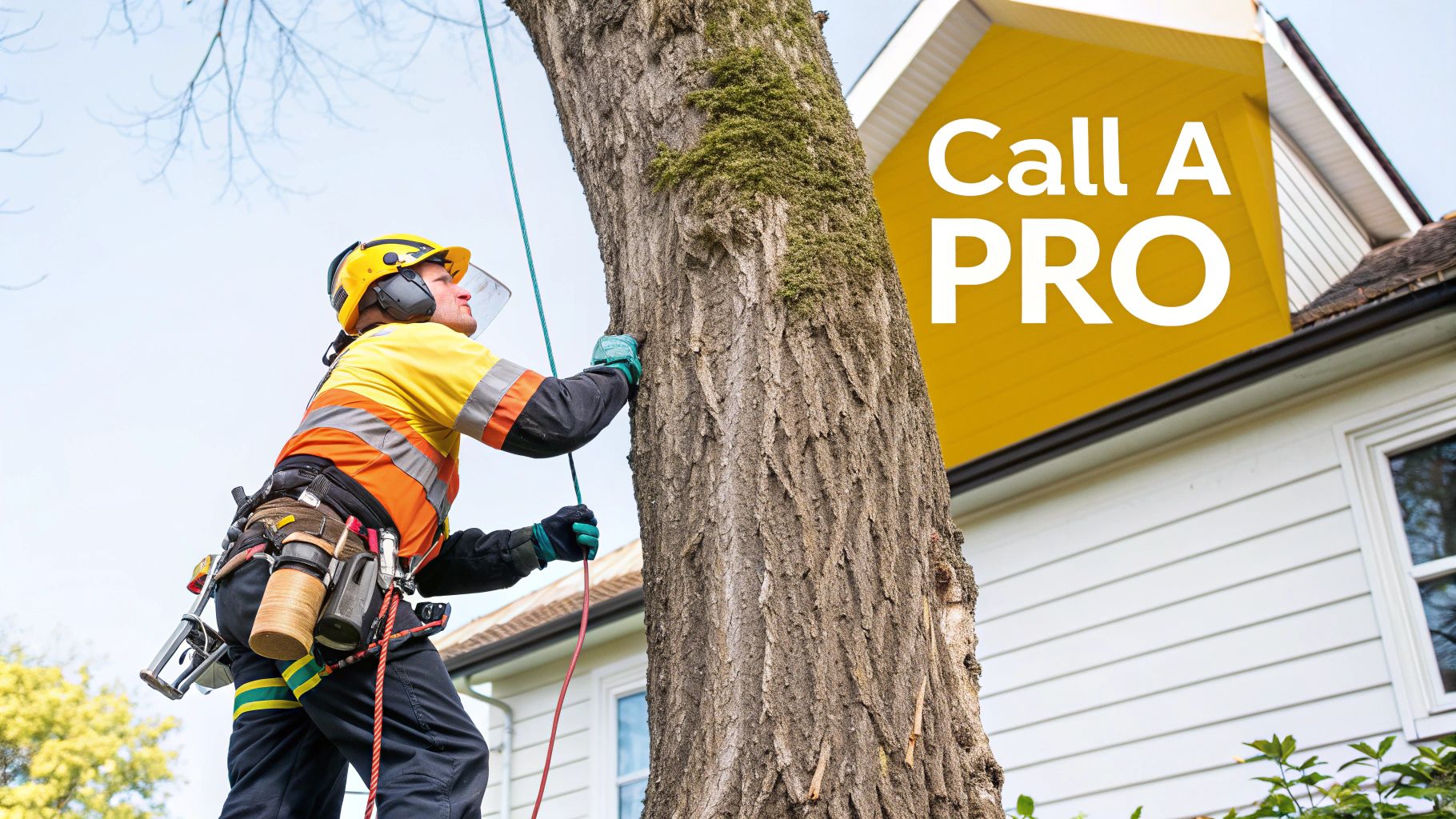
Knowing the best time to cut down trees is a great first step, but the most important decision you'll make is knowing when to put the chainsaw down and call an expert. That small, manageable-looking tree in the backyard can quickly turn from a weekend project into a dangerous gamble.
There’s a clear line where DIY enthusiasm meets serious risk. Understanding the red flags that scream "call a pro" is the key to protecting your property, your neighbor's property, and most importantly, yourself. A professional crew doesn't just show up with more power; they bring years of on-the-ground experience, specialized rigging equipment, and the critical insurance that covers high-risk work. It's an investment in getting the job done right, and safely.
Key Indicators to Hire a Professional
Some situations are just non-negotiable. If your tree removal project has any of the following characteristics, it's time to pick up the phone:
Proximity to Structures or Power Lines: If a tree could even possibly fall on your house, a fence, a neighbor's shed, or—worst of all—power lines, it requires a technical, controlled takedown. This isn't just chopping and dropping; it's a precise process of rigging and lowering sections, something only a pro can do safely.
Large Size and Diameter: Once a tree has a trunk diameter bigger than 10-12 inches or stands taller than 20 feet, the game changes completely. The sheer weight and massive fall radius make it incredibly dangerous for anyone without the right training and equipment.
Visible Signs of Disease or Decay: Spotted fungus growing at the base? See big dead branches in the canopy or deep cracks running up the trunk? These are warning signs that the tree's internal structure is compromised. A sick tree is an unpredictable tree, and it can split or fall in unexpected ways when you start cutting.
The Value of Certified Expertise
A professional service like Palm State Clear Cut brings so much more than just muscle and machinery. They bring a deep understanding of tree biology and physics—something you can only get from experience. A certified arborist can read a tree's lean, calculate its weight distribution, and assess its structural integrity to make sure it falls exactly where they intend it to.
They also understand the bigger picture. For example, a pro knows that scheduling a removal during a tree’s dormant season isn't just a random preference—it aligns with best practices for minimizing stress on the surrounding environment. This is more important than ever, as erratic weather patterns increase risks like wildfires, which contributed to a record surge in tropical forest loss in 2022. By working in cooler, wetter periods, they significantly reduce these risks. You can read more about how seasonal timing impacts global deforestation on TonerBuzz.com.
At the end of the day, hiring a professional is about managing risk. When you're dealing with a large or complicated tree removal, you need the right team on your side. For a more detailed guide on how to choose the best local experts, check out our article on finding a land clearing contractor near you in Central Florida.
Common Questions About Florida Tree Removal
Even after you’ve nailed down the right season for tree work, a few lingering questions always seem to pop up. It's completely normal. Understanding the finer points, from cost to potential red flags, is what turns a good plan into a great one.
Think of this as a quick-reference guide. We’ve pulled together the most common questions we hear from Central Florida property owners to give you clear, straightforward answers.
How Much Does Tree Removal Cost In Central Florida?
The truth is, there's no flat rate. The cost can swing from a few hundred dollars for a small, easy-to-reach tree to several thousand for a massive oak leaning precariously over your roof. The final price tag really depends on a few key things: the tree's size and species, its current health, and exactly where it’s standing.
A professional quote should break everything down, from the felling and removal to hauling away the debris. If you want stump grinding, make sure that’s included, too. A good, comprehensive estimate leaves no room for surprise charges later on.
What Are The Warning Signs Of A Dangerous Tree?
You don't have to be an arborist to spot trouble. Keeping an eye out for signs of structural weakness can help you identify a potential hazard before a storm does. If you see any of these red flags, it’s time to call in a professional for an assessment.
Look for these key warning signs:
Large dead branches, especially high up in the canopy.
Deep cracks or splits you can see in the trunk or major limbs.
Fungus or mushrooms popping up at the base, which is a classic sign of internal rot.
A sudden lean that definitely wasn't there last month.
Can I Legally Cut Down Any Tree On My Property?
Not always. Many cities and counties here in Florida have rules to protect "grand" or "specimen" trees. These are often older, larger trees that are valuable to the local ecosystem. While a state law does allow a homeowner to remove a tree that’s a danger to their property without a permit, you usually need a certified arborist to make that official call.
The smartest first move is always a quick call to your local city or county planning office. Consulting with a professional tree service that knows the local rules is another great step. It’s a simple action that can save you from hefty fines and legal headaches.
It’s always better to be safe than sorry. A little due diligence upfront ensures your project is compliant and helps preserve our beautiful local tree canopy.
When you need to be sure about the best time to handle your trees or require an expert crew for safe removal, Palm State Clear Cut has the local knowledge and professional equipment to get it done right. Contact us for a free, no-obligation quote and get your Central Florida property ready with total confidence.