
Finding Site Preparation Near Me in Central Florida
- seo5698
- 4 days ago
- 17 min read
When you start looking up "site preparation near me," you're really searching for the single most important service that turns a wild, unusable piece of land into a valuable, ready-to-go asset. This is the absolute first step you have to take before a single nail is hammered, a crop is planted, or a restoration project gets underway. Think of it as creating the perfect canvas for whatever you're planning to build.
What Site Preparation Really Means for Your Property
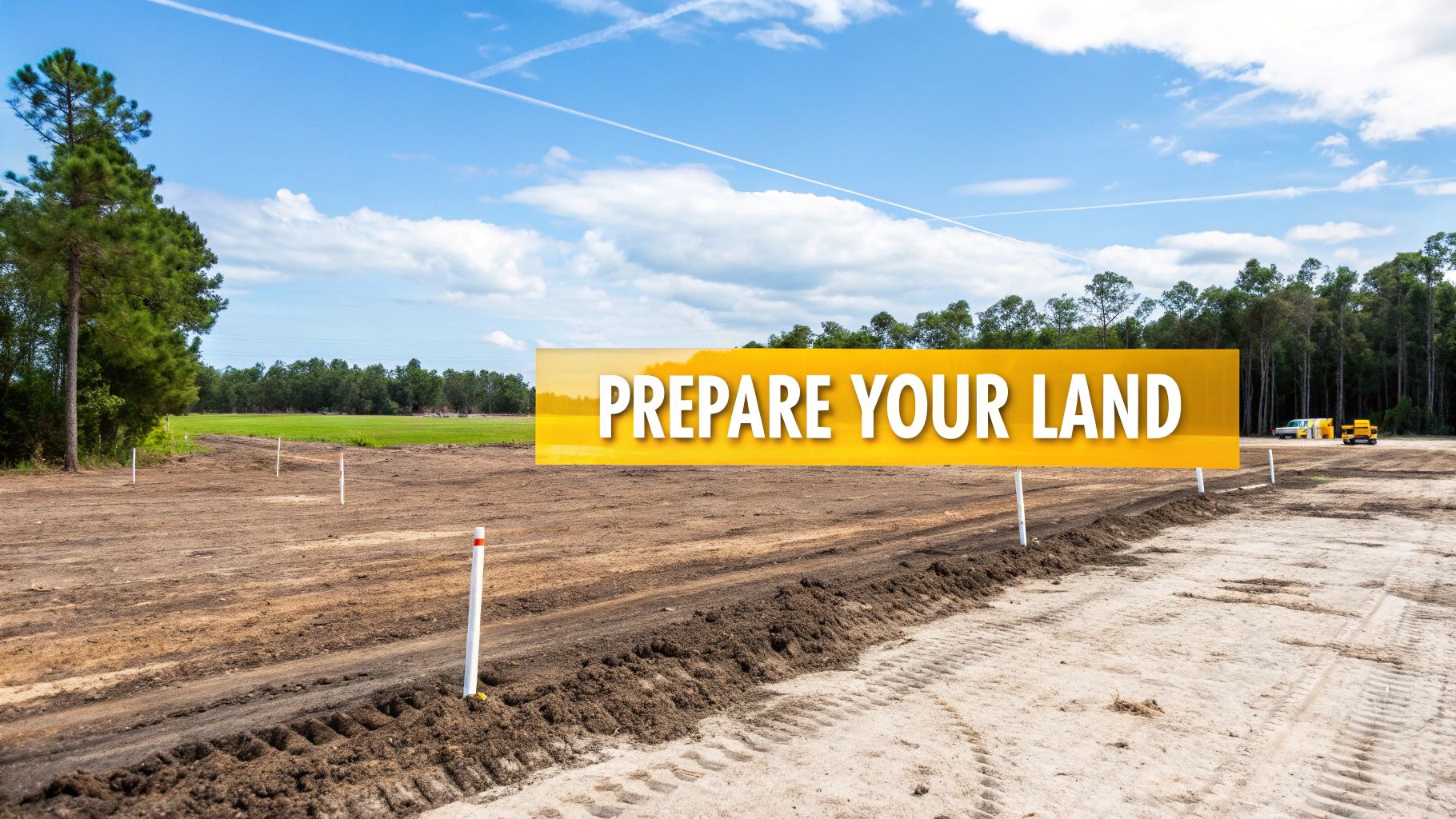
Professional site prep is all about laying the groundwork for success. It’s no different than a painter priming a canvas before starting a masterpiece—getting the land ready ensures the final result is exactly what you envisioned. If you try to cut corners here, you’re just inviting a whole host of expensive problems later on, like drainage issues, an unstable foundation, or a constant battle with invasive plants that just won't quit.
Proper preparation is way more than just knocking down a few trees. It's a strategic process, a series of calculated steps tailored to your specific property and what you want to do with it. Here in Central Florida, that often means wrestling with everything from thick, tangled underbrush to stubborn palmettos, all while keeping our unique sandy soil and local regulations in mind.
The Scope of Professional Land Preparation
A full-scale site prep project isn't just one task; it’s a handful of specialized services that all work together to get your land build-ready. Each step plays a crucial part in creating a parcel that’s clean, stable, and ready for whatever comes next.
To give you a clearer picture, let's break down the main services involved.
Key Site Preparation Services at a Glance
Service | Primary Goal | Best For |
|---|---|---|
Vegetation Removal | Clearing unwanted trees, brush, and invasive plants. | Creating access and a clean slate for development. |
Stump & Root Grinding | Eliminating underground obstacles for a smooth surface. | Preparing land for foundations, driveways, or planting. |
Land Grading & Leveling | Shaping the terrain for proper water runoff and stability. | Ensuring a solid base for any construction or agricultural use. |
Debris Hauling & Disposal | Removing all cleared material from the site. | Leaving the property completely clean and ready for the next phase. |
These services are the building blocks of a properly prepared site. When done right, they create a foundation you can truly count on.
Why It's More Than Just a "Nice to Have"
Investing in professional site preparation is one of the smartest moves a landowner can make. It's not just about making the property look good; it's about preventing massive headaches and protecting the long-term value of your land. Neglecting this crucial step can quickly turn your dream project into a nightmare of structural and environmental issues.
Site preparation is not an expense; it's an investment in risk mitigation. Properly cleared and graded land significantly reduces the chances of foundation failure, water damage, and other construction-related liabilities that can cost tens of thousands to fix later.
As more development happens, the demand for these services keeps growing. The global land clearing equipment market is projected to hit $3,863.5 million in 2025, a clear sign of just how essential this work is becoming. For property owners, this growth means better technology and more efficient options are constantly becoming available. You can dig deeper into the land clearing equipment market trends to see where the industry is headed.
The Essential Site Preparation Services You Need to Know
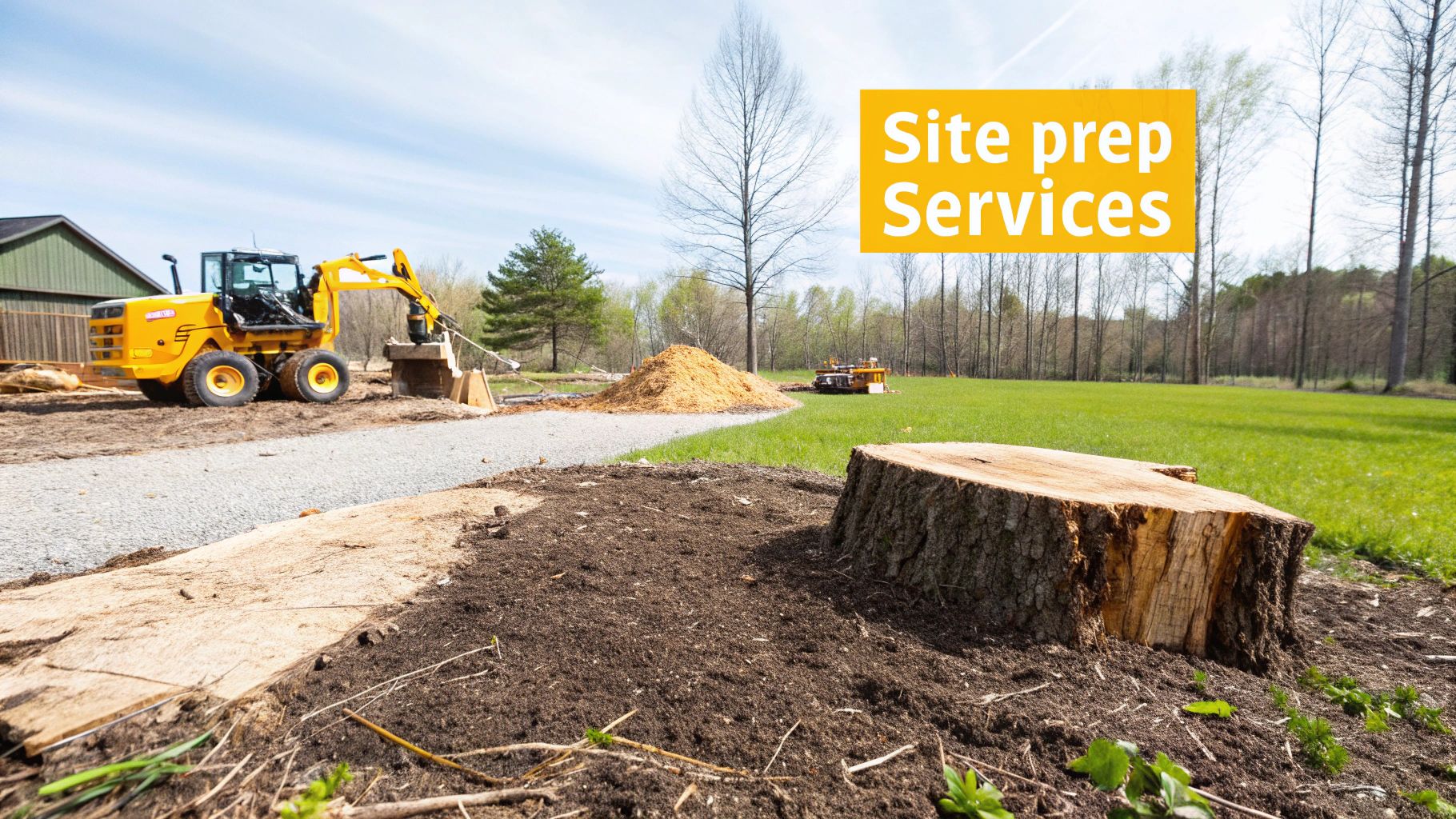
When you first start searching for "site preparation near me," you’ll come across a whole menu of services that can feel a bit technical. But getting a handle on what each one does is the key to making sure your property is ready for whatever comes next. Think of each service as a specialized tool in a contractor's toolbox—all working together to turn an overgrown or unusable plot into a clean, stable foundation.
Let's break down the core services you’ll run into. Each one builds on the last, kind of like following a recipe to get the perfect result.
Forestry Mulching: An Eco-Friendly Clearing Method
Forestry mulching is a seriously efficient, one-and-done process for clearing land. Instead of the old-school method of cutting trees, hauling them away, then grinding stumps, a powerful machine grinds up trees and brush right where they stand. It instantly transforms unwanted vegetation into a natural layer of mulch that blankets the soil.
This approach is a game-changer for a few reasons:
Soil Health: That layer of mulch holds in moisture, stops soil from washing away, and slowly breaks down to feed nutrients back into the ground.
No Hauling: It completely cuts out the cost and hassle of debris removal because everything is processed right on site.
Efficiency: For properties choked with thick undergrowth and small-to-medium trees, it's often the fastest and most budget-friendly way to clear.
This technique has really become a cornerstone of modern land management. The global market for forestry mulching machines hit $531 million in 2024 and is expected to keep growing, which shows just how vital it is. For us here in Central Florida dealing with that thick, stubborn brush, this service is an absolute powerhouse. You can dive deeper into the growth of forestry mulching technology if you're curious about the market trends.
Stump Grinding: For A Flawless Finish
Once the big trees come down, their stumps are left behind like stubborn obstacles. If you leave them, you're asking for trouble with future construction, landscaping, and they’re a major tripping hazard. Stump grinding is the definitive fix for this problem.
A specialized machine with a rotating cutting wheel methodically grinds the stump into small wood chips, usually going 6 to 12 inches below ground level. This makes sure the entire stump and its main surface roots are gone, leaving you with a smooth, level spot ready for anything.
The point of stump grinding isn't just to get rid of the stump; it's to completely obliterate the obstacle. When a stump is ground properly, you’ll never know it was there. You can build, pave, or plant right over the top without worrying about the ground settling later on.
Land Grading: Shaping the Earth for Safety
Land grading is, without a doubt, one of the most critical steps in site prep, especially if you're building something. It’s both an art and a science—sculpting the land to create a specific slope, or "grade." The whole point of this is to control where water goes.
When done right, grading makes sure rainwater flows away from your future foundation, preventing serious water damage, flooded basements, and soil erosion. A pro grading contractor uses precise measurements and heavy equipment like bulldozers to get the contour just right. This creates a stable, reliable building pad that will protect your investment for years to come.
Debris Removal: The Final Polish
The last step is all about making sure your property is completely clean and ready for the next phase. While forestry mulching leaves very little behind, other clearing methods can create piles of large logs, root balls, rocks, and other junk.
Professional debris removal means loading up all that leftover material and hauling it off-site to be disposed of properly. This service gives you a true clean slate, free of any obstructions. A thoroughly cleared site isn't just safer for construction crews; it also gives architects and surveyors a clear, unobstructed view, ensuring the project starts off on the right foot without any frustrating delays.
Handling Central Florida's Unique Land Clearing Challenges
Preparing land here in Central Florida isn't like anywhere else in the country. When you're looking for "site preparation near me" in places like Brevard, Osceola, or Polk County, you absolutely need a contractor who gets our local landscape. It's never just about knocking down trees; it's about tackling a specific set of challenges that can make or break your entire project.
Our local environment throws a unique trio of hurdles at every job: stubborn invasive plants, tricky soil conditions, and a confusing patchwork of local regulations. Getting through this maze takes more than just powerful equipment—it demands genuine, hands-on local experience.
Battling Invasive Vegetation
Central Florida's stunning landscape is, unfortunately, also home to some of the most aggressive invasive plants you'll find anywhere. We're talking about species like Brazilian Pepper, Australian Pine, and Melaleuca. These aren't just ugly weeds; they actively suffocate our native plants, spread like wildfire, and are notoriously difficult to get rid of for good.
Just cutting them down is a short-term fix at best. These plants often have incredibly tough root systems that will come roaring back if they aren't dealt with properly from the start.
A local professional understands that a lasting solution often goes beyond simple mulching. It might mean targeted herbicide use or specific removal methods to guarantee these invaders don't reclaim your land a year later, saving you the headache and cost of a second clearing.
Understanding Our Sandy Soils
The very ground we stand on is another huge factor. Most of Central Florida is built on sandy or sandy loam soils. This type of soil drains water beautifully, but it can also be loose and incredibly prone to erosion once you strip away the vegetation holding it in place.
If the clearing or grading is done incorrectly on our soil, it can lead to some serious headaches:
Erosion: A classic Florida downpour can easily wash away your precious topsoil, carving out gullies and making the whole property unstable.
Compaction Issues: Using the wrong heavy machinery can compact the sand into a concrete-like slab, which kills future drainage and makes it impossible for anything to grow.
Foundation Instability: A building pad has to be perfectly prepared on sandy soil. If it isn't, you're risking a foundation that shifts or settles down the line.
An experienced local crew knows how to work with our soil, not fight against it. They use specific techniques and the right equipment to minimize disturbance, keep the soil structure intact, and build a foundation for long-term stability.
Navigating County-Specific Rules and Regulations
Land clearing isn't the Wild West. Every single county in Central Florida has its own rulebook for tree removal, wetland protection, and how much land you can disturb. These laws exist to protect our natural resources, and ignoring them can lead to massive fines and stop-work orders. For a deeper look into local rules, you can check out our guide on Orlando's land clearing regulations.
A contractor with a solid reputation in the area will already be familiar with the permits and environmental rules specific to your property's zip code. That local knowledge is priceless for keeping your project on the right side of the law and moving forward without delays. Globally, responsible land management is getting more attention. While deforestation is still a problem, the rate has slowed down thanks to smarter practices. These trends really highlight how important it is to do sustainable site prep right here at home. You can learn more about these global forest management findings on the FAO's website. Choosing a team that respects these principles doesn't just protect your investment—it protects the environment we all share.
Your Site Preparation Project From Start To Finish
Ever wonder what actually happens when you hire a professional crew to prep your land? It’s not just about showing up with big machines. A well-run project is a step-by-step process, designed to get you from an overgrown lot to a clean slate, safely and efficiently.
Understanding this roadmap helps you know what to expect. No surprises, just a clear path forward. Let's walk through it.
Step 1: The Initial Consultation And Site Walk-Through
It all begins with a simple conversation. A good contractor will want to know exactly what you’re planning. Are you building your dream home? Clearing out a back pasture for livestock? Maybe cutting some trails for the ATVs? Your end goal shapes every decision that follows.
Next comes the most critical part: the on-site visit. This is where the real assessment happens. We walk the property together, looking at the density of the brush, the lay of the land, soil conditions, and how we can even get the heavy equipment in and out. It’s also our chance to spot potential headaches, like old debris hidden in the weeds or environmentally sensitive spots that need to be protected. This hands-on evaluation is the only way to build an accurate, honest-to-goodness proposal.
Step 2: The Transparent Proposal And Scheduling
After that walk-through, you'll get a detailed proposal. This shouldn’t just be a single number on a piece of paper. It needs to clearly spell out the recommended services, the specific equipment we’ll use, a realistic timeline, and a complete cost breakdown. A professional quote answers your questions before you even think to ask them—no fuzzy math, no gray areas.
Once you give the green light, we get you on the schedule. This part is all about coordination. We’ll work with you to lock in a start date that fits your calendar and then handle all the logistics of getting the right crew and machinery to your property when they’re needed.
Preparing land here in Central Florida isn’t like anywhere else. We’re dealing with a unique trifecta of challenges: our famously sandy soil, stubborn native (and invasive) plants, and a whole host of local regulations.
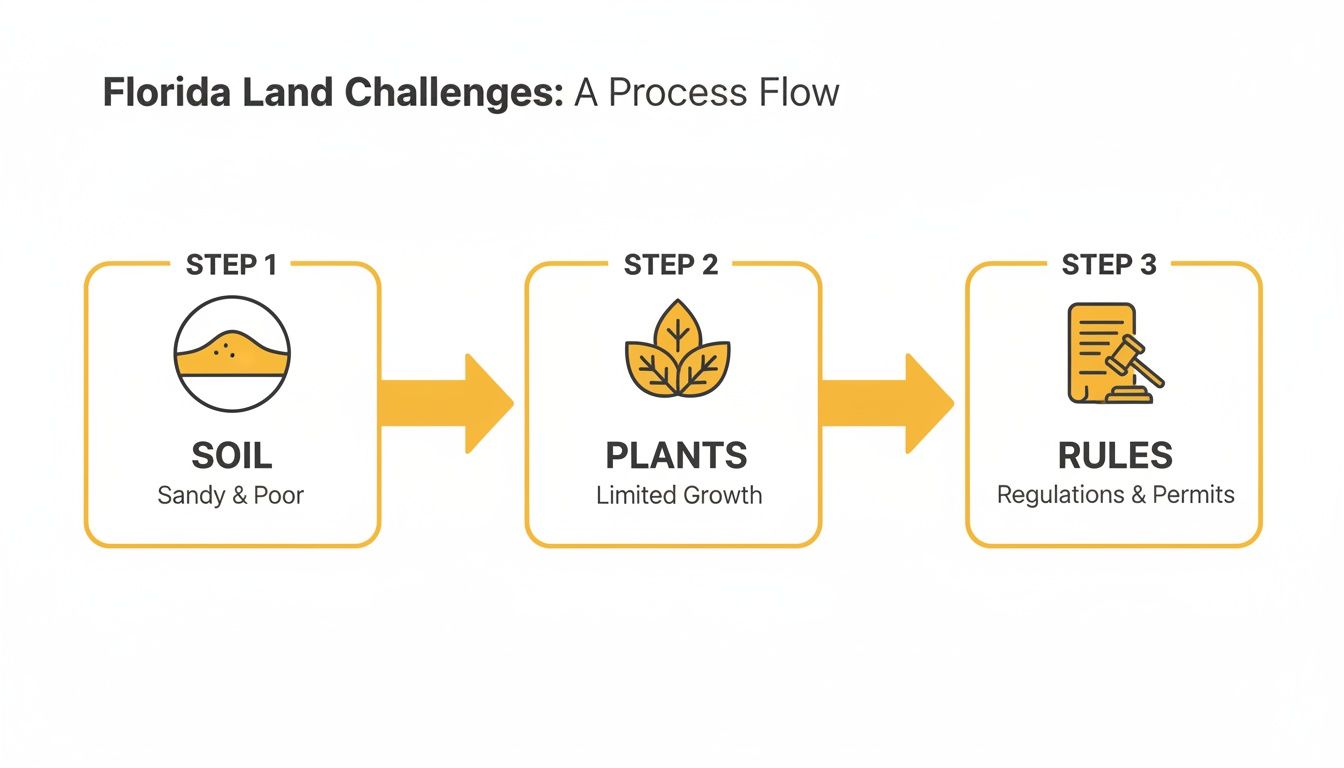
This is the stuff a local expert has to manage every single day to make sure a project is done right and stands the test of time.
Step 3: Execution And Final Cleanup
Now for the main event. Our skilled operators arrive with the heavy hitters—forestry mulchers, grinders, maybe a dozer—and get to work executing the plan we agreed on. Safety is always priority number one. The crew works methodically to clear, grind, and grade your land to the exact specifications needed for your project.
But the job isn't over when the last bit of underbrush is mulched. The final stage is a thorough cleanup and a final walk-through with you.
A project is only truly complete when the client is satisfied and the property is left in a clean, safe, and usable condition. This final inspection ensures the work meets your expectations and the contractor’s standard of quality.
If you're looking at how this all fits into a bigger construction project, this practical guide to starting a house build in Florida is a great resource. It will give you a better sense of where site prep falls in the grand scheme of things and what comes next.
Decoding the Costs of Site Preparation in Florida
When you start searching for "site preparation near me," the first question that pops into your head is almost always about the cost. There's no single answer, because the final price tag isn’t pulled out of thin air. It’s a detailed calculation based on the unique personality of your land. Think of it like a custom build—every property has its own specific needs, which directly shape the final quote.
The biggest drivers of cost are the size of your property and just how thick the vegetation is. It makes sense, right? A one-acre lot with some scattered brush is a completely different ballgame than a five-acre parcel choked with dense, mature trees and stubborn palmettos. Accessibility also plays a huge role; if our heavy machinery can’t easily get to the work area, that adds time and complexity to the job.
Key Cost Factors Breakdown
The scope of work is what truly shapes the estimate. A simple forestry mulching job will have a different price point than a full-scale project that includes grading, stump grinding, and hauling away debris. Each one of those services is its own line item contributing to the total investment.
Here are the main variables that we look at to determine your project's cost:
Acreage: The total square footage or number of acres that need work.
Vegetation Density: What are we up against? Light brush, thick undergrowth, or mature hardwood trees?
Terrain & Accessibility: Steep slopes, swampy areas, or tight access points can require more labor and specialized equipment.
Services Required: The specific mix of mulching, grinding, grading, and debris removal you need.
Understanding these elements is the key to making sense of any quote. A professional estimate should break these factors down clearly, so you can see exactly what you're paying for and why. This transparency is all about avoiding hidden fees and making sure there are no surprises down the road.
For anyone looking to manage their budget from day one, it’s always smart to consider strategies that can reduce construction costs right from the start.
To help visualize how these pieces fit together, here's a quick look at what we consider when building a quote.
Factors Influencing Site Preparation Costs
Cost Factor | Description | Impact on Price (Low/Medium/High) |
|---|---|---|
Project Size | The total acreage or square footage to be cleared. Larger areas often have a lower per-acre cost but a higher total price. | High |
Vegetation Type | Clearing light brush and saplings is much faster and easier than removing mature hardwood trees and deep-rooted stumps. | High |
Vegetation Density | A sparsely vegetated lot requires less machine time than one that is densely overgrown and tangled. | High |
Site Accessibility | Can heavy machinery get to the site easily? Fences, gates, and narrow paths can complicate access. | Medium |
Terrain/Topography | Flat, dry land is straightforward. Steep slopes, rocky soil, or wetlands require more time and specialized techniques. | Medium |
Required Services | A basic mulching job costs less than a full package including stump grinding, grading, and debris hauling. | High |
Permits & Regulations | Some projects may require specific permits or adherence to local environmental regulations, adding administrative costs. | Low |
Debris Disposal | Hauling away debris costs more than mulching it on-site. The distance to a disposal facility also plays a role. | Medium |
This table should give you a solid framework for understanding why one quote might differ from another. It's all about the unique combination of these factors on your specific property.
How Pricing Models Work
Contractors in Central Florida generally use one of two pricing models: per hour or per acre. An hourly rate makes the most sense for smaller, more complex jobs that involve a mix of different tasks. This can range from $175 to $350+ per hour, depending on the machinery we need to bring in.
For larger, more straightforward clearing projects, a per-acre price is common. This gives you a clear, fixed cost for the job, which is great for budgeting. While prices vary quite a bit based on the factors above, you can get a deeper look in our complete guide on how much it costs to clear an acre of land in Florida. This model locks in the price for the defined scope of work, giving you peace of mind.
Ultimately, a detailed, written quote is the best tool for understanding the true value you’re receiving. It should account for labor, equipment, fuel, and any disposal fees, giving you a complete financial picture before we ever start the engines. This ensures you’re making an informed decision for your property.
How to Choose the Right Site Preparation Contractor
Hiring the right team is hands-down the most critical decision you'll make for your entire land clearing project. When you search for "site preparation near me," you’re going to get a long list of options, but the gap between a seasoned pro and a risky operator can be massive.
The right choice protects your investment and sets you up for success. The wrong one? It can lead to nightmare scenarios—costly delays, damage to your property, or even legal trouble. This isn't a decision you can base on price alone. You're literally trusting a contractor with the foundation of your property, so you need to know exactly what to ask and what to look for.
The Non-Negotiable Credentials
Before you even start talking about the project itself, every legitimate contractor must have a few baseline qualifications. Think of these as the absolute bare minimum—if a company can't produce them on the spot, they shouldn’t even be in the running.
These core credentials are your first and best defense against shoddy work and personal liability.
Licensing: Is the contractor properly licensed to perform site preparation work in your specific county and across Florida? This proves they’ve met the official standards and aren't just some guy with a machine.
Insurance: This is a big one. They absolutely must carry both General Liability and Worker's Compensation insurance. Ask them for a Certificate of Insurance (COI) to verify their coverage is active. This is what protects you if an accident happens on your property.
If a contractor hesitates to provide these two documents, it's a major red flag. A reputable company will have them ready to go.
Evaluating Their Equipment and Expertise
Once you've confirmed the essentials, it's time to dig a little deeper into their capabilities. The equipment a company owns and maintains speaks volumes about their professionalism and efficiency. A contractor who has invested in modern, well-serviced machinery is far less likely to have breakdowns that cause delays.
Ask specific questions about their fleet. Do they have the right size forestry mulcher for your acreage and terrain? Do they use low-impact machinery to minimize soil disturbance on Florida’s notoriously sandy ground? The right tools for the job always lead to a better, faster, and cleaner result.
Experience isn't just about how many years they've been in business. It's about relevant, local experience. A contractor who has successfully cleared hundreds of acres right here in Central Florida knows how to handle our unique challenges, from stubborn saw palmettos to navigating local environmental rules.
This local knowledge is priceless. They understand the nuances of the soil, the behavior of invasive species like Brazilian Pepper, and the permitting process in counties like Osceola, Brevard, and Polk.
The Vetting Checklist: Questions to Ask Every Contractor
To properly compare your options, you need to ask every potential contractor the same set of questions. This helps you evaluate each company on an even playing field.
Can you provide a few recent, local references? Talking to past clients is one of the best ways to get a real feel for their reliability and the quality of their work.
What’s your safety record and on-site protocol? A professional crew will have a clear safety plan they follow on every single job.
How do you handle surprises? What happens if they discover buried debris or run into unexpected soggy ground? A pro has a plan for the unexpected.
Will you provide a detailed, written estimate? The proposal should clearly break down the scope of work, a realistic timeline, and a full cost breakdown—no vague, fuzzy numbers.
Who will be my point of contact on-site? Good communication is the key to a smooth project, so knowing who is in charge is essential.
By asking these questions, you cut through the sales pitch and get to the core of what truly matters: competence, reliability, and professionalism. For a deeper look into the hiring process, you might find our guide on finding a land clearing contractor near you in Central Florida helpful.
Choosing the right partner is about making sure your land is prepared correctly the first time, setting your project up for success from the ground up.
Still Have Questions About Prepping Your Land?
It's completely normal. Even after you've done your research, a few questions always pop up before you're ready to get started. When you're looking up "site preparation near me," you want straight answers, not guesswork. I've put together this little Q&A to tackle the most common things property owners here in Central Florida ask us.
My goal is to clear up any last-minute uncertainties so you can move forward on your project with total confidence. Let’s get into it.
How Long Does Site Preparation Usually Take?
This is the big one, and the honest answer is: it really depends on your specific piece of land. I've seen small, half-acre residential lots with just some light brush cleared and ready in a single day. On the flip side, a dense, 10-acre parcel choked with mature trees and stubborn stumps could easily take a week or more.
It all boils down to a few key things:
Property Size: This one's a no-brainer. More acreage simply takes more time.
Vegetation Density: A thick, overgrown jungle of a property is a much bigger job than a lightly wooded area.
Services Needed: A straightforward forestry mulching job is quick. But if you need us to do extensive grading and haul away truckloads of debris, that adds time to the clock.
Weather Conditions: You know how Florida summers are. Heavy rain can turn the ground into a swamp, making it impossible to run heavy machinery safely and causing delays.
Any professional contractor worth their salt will give you a solid, realistic timeline in their proposal after walking the property with you.
Do I Need A Permit for Land Clearing?
The short answer is: it depends. This is a tricky one because the rules can change dramatically from one county to the next here in Central Florida. Some smaller jobs on private land might not need a permit at all. But many do, especially if you're taking down protected trees, working near wetlands, or clearing a larger area.
It's crucial to never assume you don't need a permit. Pushing forward without one can land you with some eye-watering fines and a stop-work order that brings your whole project to a grinding halt. An experienced local crew will know the ins and outs of the regulations in your specific county—whether it's Osceola, Brevard, or Polk—and can walk you through the entire permitting process.
Can I Keep Some of the Trees on My Property?
Absolutely! This isn't about just bulldozing everything flat. Selective clearing is one of the most common things we do. During our first visit, you can walk the property with us and point out exactly which trees you want to keep. We'll mark them, and they won't be touched.
This is the perfect way to:
Save those gorgeous, mature oak trees that provide shade and character.
Leave a natural line of trees as a privacy screen from the neighbors.
Clear out all the tangled underbrush while preserving that beautiful, healthy tree canopy.
A skilled equipment operator knows how to maneuver their machine with precision, protecting the trees you want to save and making sure the final result is exactly what you pictured. That level of care is a huge part of what you're paying for when you hire an experienced team.
What Happens to All the Cleared Debris?
You've got a couple of great options here, and it usually depends on the clearing method we use.
If you go with forestry mulching, there’s practically no debris to deal with. The machine grinds up all the vegetation into a nutrient-rich layer of mulch that we leave right on the ground. It’s fantastic for the soil.
If we're doing more traditional land clearing that leaves behind logs, stumps, and big root balls, we can haul everything off-site to a proper disposal facility. This leaves your property completely clean, a blank slate ready for whatever you have planned next.
Ready to transform your property with professional site preparation? The team at Palm State Clear Cut has the local expertise and state-of-the-art equipment to handle any land clearing challenge in Central Florida. Get a free, no-obligation quote by visiting https://palmstateclearcut.com today.
Comments