So, what’s it really going to cost to clear an acre of land here in Central Florida? The short answer is you can expect to pay anywhere from $2,500 to $7,000 per acre. This is a wide range, and for good reason—every piece of land is different. The final price tag depends heavily on what’s actually on your property, from light, easy-to-manage brush to a dense forest packed with mature trees.
Your Guide to Land Clearing Costs in Central Florida
Before you can break ground on a new home, set up a pasture for your horses, or just take back your yard from nature, you’ve got to start with a clean slate. That first critical step, land clearing, is often the biggest question mark for property owners. You know it has to be done, but figuring out the financial side is essential for planning the rest of your project.
Think about it this way: clearing a sparse field is a bit like tidying a slightly messy room. It’s a quick job that doesn’t require a ton of effort. But tackling a dense, overgrown lot? That’s more like a full-blown home renovation. It demands heavy machinery, careful planning, and a whole lot more time and resources. Each property has its own unique story, and the cost will always reflect how complex that story is.
Breaking Down the Baseline Costs
That initial price range gives you a good starting point, but let’s dig a little deeper into what those numbers actually mean. A job on the lower end, around $2,500 per acre, typically involves land with:
- Light Vegetation: Mostly grass, weeds, and small saplings that are easy to mow down.
- Fewer Trees: Maybe some scattered small pines or other trees that don’t put up much of a fight.
- Minimal Stumps: Very few, if any, large, deep-rooted stumps that would require serious grinding.
On the other hand, a project that creeps up toward the $7,000 per acre mark is going to have some real challenges. We’re talking about things like a thick canopy of mature oaks, a stubborn undergrowth of palmettos, and plenty of big stumps that need powerful equipment to get them out of the ground.
To give you a better idea of what to expect, here’s a quick reference table breaking down costs by land condition.
Estimated Cost to Clear One Acre in Central Florida
| Land Condition | Typical Vegetation | Estimated Cost Range Per Acre |
|---|---|---|
| Lightly Wooded | Light brush, scattered small trees (under 8″ diameter), minimal stumps. | $2,500 – $4,000 |
| Moderately Wooded | Medium-density brush, a mix of small to medium trees, some stumps. | $4,000 – $5,500 |
| Densely Wooded | Thick undergrowth, numerous large, mature trees (oaks, pines), large stumps. | $5,500 – $7,000+ |
As you can see, the denser the vegetation and the larger the trees, the more you can expect the cost to climb. This table should help you place your own property within a realistic budget range.
National Averages Versus Local Reality
It’s always a good idea to see how local prices stack up against the national picture. Across the U.S., clearing a single acre of mixed brush and small trees can cost anywhere from $500 to $5,600, with the national average sitting around $3,779 per acre. Contractor labor rates usually hover between $110 and $250 per hour, and extra tasks like stump grinding and hauling away debris will add to the final bill.
This is exactly why getting a local quote is so important. A local expert understands Florida-specific challenges—like our sandy soil, tough palmettos, and unpredictable weather—that national averages just can’t account for.
The two biggest factors that will drive your land clearing quote are the density of the vegetation and how you get rid of the debris. A single massive, mature oak tree can cost more to remove than an entire acre of light brush.
A huge chunk of any land clearing budget goes to waste removal. Dealing with all the trees, stumps, and brush is a major logistical hurdle. That’s why understanding how much skip hire costs can be really helpful for budgeting your project, especially if you go the traditional route of hauling everything away instead of mulching it on-site. This guide will walk you through all these factors, helping you see your property through an expert’s eyes so you can plan with total confidence.
Decoding Your Quote: Key Factors That Drive Land Clearing Costs
Ever get two different quotes for what looks like the same job and scratch your head? It’s a common scenario. You might wonder why clearing one acre costs $3,000 while the seemingly identical acre next door is quoted at $6,000. The answer isn’t in the size of the property but in the specific, nitty-gritty details of the land itself—details every professional contractor has to size up before they can give you an honest price.
Understanding these variables is the key to reading your quote like a pro. Think of it like painting a room. A fresh, smooth wall is one price, but a wall that needs wallpaper stripped, holes patched, and primer applied is a completely different project. Both are “painting a wall,” but the prep work, time, and effort are worlds apart. Land clearing works the same way.
The Role of Vegetation Density
The biggest factor driving the cost to clear your land is, without a doubt, the type and thickness of the vegetation. When we look at a property, we don’t just see “trees” and “bushes.” We see hours of machine time, potential equipment challenges, and the sheer volume of material we’ll have to deal with.
Here’s a breakdown of what we’re typically looking at:
- Light Brush and Grass: This is the best-case scenario. If your acre is mostly covered in tall grass, weeds, and a few small saplings, we can often clear it quickly with heavy-duty mowers or light mulchers. Less time and less fuel mean a lower cost for you.
- Mixed Growth: This is classic Central Florida land. You’ve likely got a mix of everything—thick brush, stubborn palmettos, and a handful of small-to-medium trees. Tackling this requires more powerful equipment and a more strategic approach to get it all cleared efficiently.
- Dense Forest: An acre packed solid with mature, large-diameter trees like oaks and pines, plus a thick carpet of undergrowth, is the most complex job. Each big tree is a mini-project in itself, from felling to processing, and the amount of debris is massive.
This visual really helps illustrate how the costs scale up as the property gets more overgrown.
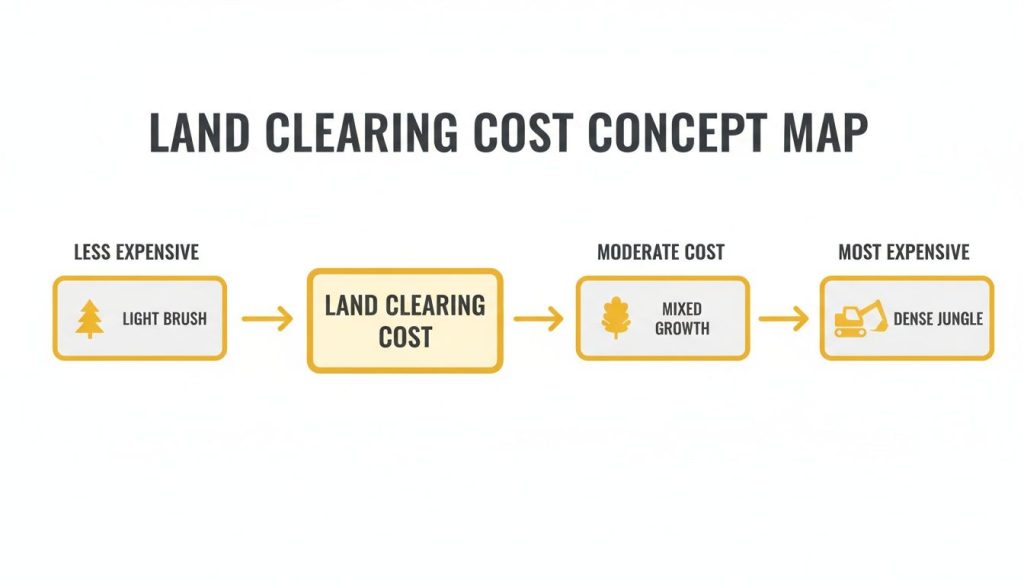
As you can see, going from light brush to a jungle-like environment isn’t just about spending more time on the job. It demands bigger, more specialized machinery, which naturally leads to a jump in the overall project cost.
Terrain and Site Accessibility
After vegetation, the next big thing we look at is the lay of the land. Is your property flat, dry, and right off a paved road? Or are we dealing with slopes, wet spots, or a long, bumpy trail just to get our equipment on-site?
Think about moving a grand piano. Getting it into a ground-floor room with double doors is one thing. Hauling that same piano up three flights of a narrow, winding staircase is a completely different job—it requires more people, special tools, and a much higher fee. Our heavy equipment is no different.
A flat, accessible acre is like a highway for our equipment—we can get in, work efficiently, and get out. A sloped, wet, or remote property is more like a bumpy country road, requiring more time, fuel, and careful maneuvering, which is reflected in the final cost.
Easy access means we can bring in our big, efficient machines like bulldozers and forestry mulchers without a problem. But poor access, steep hills, or soft, swampy ground might force us to use smaller machines, bring in more manual labor, or even lay down special mats to keep our equipment from sinking. All of that adds to the bottom line.
Tree and Stump Removal
While this is related to vegetation density, removing large trees and their stumps is often itemized separately on a quote. Taking down a single massive, mature oak is a significant task on its own. The cost is influenced by the tree’s diameter, its height, and how close it is to any buildings or power lines.
And then there are the stumps—they’re another beast entirely. Just cutting down a tree leaves the whole root system behind. If you plan to build, landscape, or farm, those stumps have to go. Stump grinding is a specialized service, and the cost is usually based on the number of stumps or their diameter. A property littered with dozens of old, large stumps will cost significantly more to prep than one with just a few small ones.
Debris Management: The Haul-Away vs. Mulching Decision
Once everything is cut down, you have to decide what to do with all that material. You’ve got two main options, and your choice here really moves the needle on your final cost.
- Traditional Haul-Away: This is the old-school method. We pile up all the trees, brush, and stumps, load it into massive dump trucks, and haul it off to a landfill or disposal facility. It’s incredibly labor-intensive and comes with hefty disposal fees, making it the more expensive route.
- Forestry Mulching: This is the modern, highly efficient approach. We use a single powerful machine to cut, grind, and spread all the vegetation back onto your property as a natural layer of mulch. It completely eliminates hauling and disposal costs, returns valuable nutrients to your soil, and even helps prevent erosion.
For most landowners here in Central Florida, forestry mulching is the clear winner—it’s more affordable and way better for the land.
A huge part of any land clearing quote is tied to getting the ground ready for whatever comes next. Understanding the need for meticulous site preparation for new structures helps put these initial costs into perspective. When you understand these key drivers, you’re in a much better position to review your quote and have a productive conversation with your contractor about what your project truly needs.
Choosing the Right Approach: Land Clearing Methods Explained
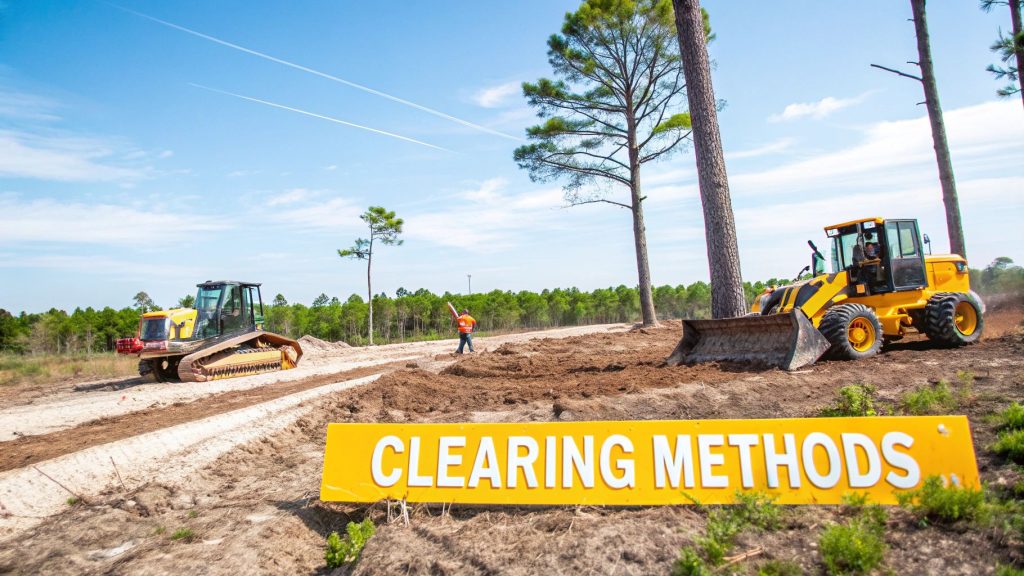
Clearing land isn’t just about raw power; it’s a strategic decision. The method a contractor picks has a massive impact on the project’s timeline, its effect on the environment, and—most importantly—the final price on your quote. Getting this choice right is often the difference between a smooth, affordable project and one plagued by surprise costs and frustrating delays.
Think of it like working on a car. You wouldn’t use a wrench to change a tire when a lug nut gun will do it in a fraction of the time. Every tool has its purpose. In the same way, the best method for clearing your acre depends entirely on what’s growing there now and what you plan to do with the property later. Knowing the options helps you have a smarter conversation with your contractor, ensuring their plan fits your vision and your budget.
The Eco-Friendly Innovator: Forestry Mulching
Lately, forestry mulching has become the preferred method for many Florida landowners, and it’s easy to see why. This technique uses a single, powerful machine—usually a skid steer or tractor with a special grinding head—to cut, shred, and spread vegetation right where it stands. It’s like an all-terrain beast that turns unwanted trees and brush into a natural, protective blanket of mulch in one go.
This approach brings some huge advantages that directly affect how much it costs to clear an acre of land:
- No Hauling Fees: The debris stays on-site as mulch, which means no dumpsters, no convoys of trucks, and no hefty disposal fees. This is often the biggest cost-saver.
- Healthier Soil: That fresh layer of mulch is gold for your land. It prevents erosion, helps the soil hold onto moisture, and slowly breaks down, feeding nutrients back into the ground.
- Speed and Efficiency: With one machine and one operator, the job gets done much faster than a traditional multi-step process. Fewer labor hours mean a lower bill.
Forestry mulching is the perfect fit if you want to clear out undergrowth while keeping your favorite oaks, carve out trails, or prep a site without scraping away the valuable topsoil. If you want to dive deeper, we have a whole guide explaining what forestry mulching is and how it works.
The Heavy Lifters: Bulldozers and Excavators
When a project demands a complete reset of the land, it’s time to call in the heavy equipment. The classic “push and pile” method uses bulldozers to topple trees and scrape the land clean, followed by excavators to dig up stubborn stumps. Everything gets piled up and hauled away. This is the go-to when you need a perfectly bare, graded canvas for a new home foundation, a road, or a large-scale farm.
While it’s incredibly effective, this method is almost always more expensive. You’re paying for multiple machines, a bigger crew, and the very significant cost of loading and trucking away tons of debris. It’s a more disruptive process, but sometimes, it’s the only way to get the blank slate a major construction project requires.
Forestry mulching is like a surgical tool, selectively removing unwanted vegetation while healing the land. Traditional clearing with bulldozers is more like major surgery—necessary for a complete transformation but more invasive and costly.
The Precision Specialist: Manual Clearing
Sometimes, the most advanced tool for the job is a skilled crew with chainsaws. Manual clearing is just what it sounds like—clearing land by hand. It’s the most labor-intensive and slowest of the bunch, but it offers a level of precision that machines just can’t match.
You’ll see this approach used in a few key situations:
- Sensitive Areas: Working near protected wetlands, heritage trees, or existing septic fields where you can’t risk a multi-ton machine.
- Tough Terrain: Clearing steep hillsides or ravines where it’s simply unsafe or impossible to operate heavy equipment.
- Selective Thinning: When you need to carefully pick and choose which trees or invasive plants to remove from a dense area without harming the ones you want to keep.
Because it’s so heavy on labor, manual clearing is usually reserved for small, specific jobs. While it might seem like a budget-friendly option, trying to clear a full acre this way would quickly become far more expensive than bringing in the right machine. In the end, the right method always finds the perfect balance between your goals for the property and the most efficient way to bring them to life.
Seeing the Costs in Action: Real Central Florida Scenarios
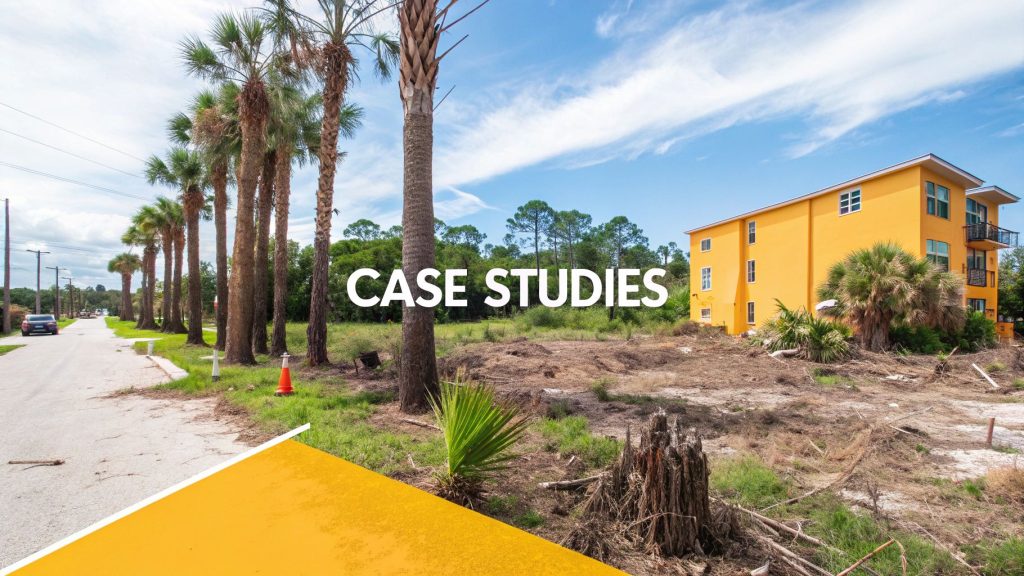
Understanding the individual cost factors is one thing, but seeing how they all come together on a real project is where it all clicks. The best way to really wrap your head around how much to clear an acre of land is to walk through a few familiar Central Florida situations. Every property tells its own story, and the final price tag is just the sum of all its parts—from getting the machines there to the hours they run and what we do with the debris.
Let’s shift from theory to reality. Here are three distinct examples that mirror the kinds of jobs we tackle every day across the region. These stories should help you connect the dots and get a better feel for where your own project might fall on the cost spectrum.
Scenario 1: The Ocala Homesite
Imagine a family just bought five acres of rolling pastureland right outside Ocala. Their plan is to clear a single, one-acre plot for their new custom home, leaving the rest of the land in its natural state. The acre is lightly wooded, mostly covered in tall grass, a few scattered palmettos, and maybe a dozen small to medium-sized pine trees.
Access is a dream—right off a paved county road. This means we can get our heavy equipment on-site without any headaches. Even better, the terrain is flat and dry, which lets us work efficiently.
The Approach:For a job like this, forestry mulching is the perfect fit. It’s fast, incredibly cost-effective, and leaves behind a clean, nutrient-rich layer of mulch that’s fantastic for the soil. A single operator with one of our powerful mulching machines can make short work of this kind of light vegetation.
Itemized Cost Estimate (One Acre):
- Mobilization & Setup: $400 (Covers transporting our equipment to the site)
- Forestry Mulching: $2,800 (Estimated hours for one machine and operator)
- Stump Grinding (Optional): $600 (To take care of the few larger pine stumps)
- Debris Management: $0 (Mulching completely eliminates hauling costs)
Total Estimated Cost for One Acre: $3,800
This project lands squarely on the lower end of the price range. The combination of easy access, light vegetation, and using an efficient method like mulching keeps the cost down. It’s a textbook example of a straightforward residential clearing job.
Scenario 2: The Kissimmee Backyard Reset
Now, let’s picture a one-acre suburban lot in Kissimmee that’s been left to its own devices for years. The property is completely choked with a dense jungle of overgrown palmettos, thick brush, and several huge, stubborn oak stumps left over from a previous, half-finished clearing attempt. The new owners want a total reset to build a backyard oasis, complete with a pool and garden.
Access is a bit tighter here. There’s a narrow gate and established landscaping on the neighboring properties that we have to navigate carefully. The real challenges are the sheer density of the vegetation and those old, deep-rooted stumps.
The Approach:This one requires a multi-tool approach. We’ll bring in a forestry mulcher first to chew through the dense undergrowth and smaller stuff. After that, we’ll bring in an excavator with a heavy-duty grinding attachment to go to war with those massive oak stumps, which takes a lot more time and power.
Itemized Cost Estimate (One Acre):
- Mobilization & Setup: $550 (A little higher because of the tricky access)
- Forestry Mulching: $3,500 (More hours are needed to push through the dense growth)
- Heavy Stump Grinding: $1,800 (Serious time and muscle required for these tough stumps)
- Debris Management: $0 (The mulcher takes care of almost all the debris)
Total Estimated Cost for One Acre: $5,850
This project is firmly in the upper-middle price range. The cost is driven up by two main factors: the density of the overgrowth and the difficult stump removal. It’s a perfect example of how one challenging acre can cost significantly more than a lightly wooded one of the exact same size.
Scenario 3: The Lake County Pasture Conversion
For our final scenario, let’s head to a ten-acre rural tract in Lake County. The owner’s vision is to convert a five-acre section into a brand new pasture for their horses. The catch? They want to preserve several majestic, mature live oaks scattered throughout the property. The area we need to clear is a mix of dense underbrush, invasive Brazilian pepper trees, and tons of smaller pines.
The property is pretty remote, accessed by a long dirt road, which adds to our mobilization time. The biggest challenge here is the selective nature of the work—we have to clear everything except for those valuable heritage oaks.
The Approach:Precision is the name of the game. We’ll use a combination of forestry mulching for the bulk of the undergrowth and then bring in a ground crew for some careful manual clearing with chainsaws around the base of the protected oaks. This is critical to avoid damaging their sensitive root systems.
Itemized Cost Estimate (Per Acre, for Five Acres):
- Mobilization & Setup: $600 (Higher due to the remote location and multiple types of equipment)
- Selective Forestry Mulching: $3,200 (Requires careful operation around the “keep” trees)
- Manual Clearing (Around Oaks): $700 (Labor cost for the precision chainsaw work)
- Debris Management: $0 (Mulching is the ideal method for pasture conversion)
Total Estimated Cost Per Acre: $4,500
This job shows how specific project goals, like tree preservation, directly influence the method and the final price. While it wasn’t the most overgrown property, the need for selective, careful work added a layer of complexity and labor that you can see reflected in the cost per acre.
Navigating Permits and Environmental Rules in Florida
Before the first engine roars to life or a single branch is touched, there’s a crucial, often overlooked, step in any land clearing project: the paperwork. Clearing land in Central Florida isn’t just about heavy machinery; it’s a legal process that requires navigating a maze of local and state regulations. Trying to skip this part is the fastest way to turn your exciting new project into a costly headache of fines and stop-work orders.
Think of it this way: you wouldn’t just start pouring a concrete foundation for a new house without an approved blueprint and a building permit. Land clearing is no different. You need official permission to ensure the work is done safely, responsibly, and in harmony with local environmental protections.
Understanding the Permit Process
Here in Central Florida, the rules can change just by crossing county lines. A project in Orange County might have different requirements than one just down the road in Osceola or Lake County. Generally, you’ll need a clearing and grubbing permit before any significant work can begin. This is how local authorities review and approve your plans.
On top of that, Florida’s unique landscape means that Water Management Districts often get involved. These agencies are tasked with protecting our water resources, so if your property is near or includes wetlands, their oversight is non-negotiable.
An experienced land clearing company doesn’t just operate the equipment; they’re your guide through this regulatory landscape. A huge part of their service is knowing exactly which permits your specific project needs, saving you the stress and potential legal trouble of figuring it all out on your own.
Critical Environmental Considerations
Florida is home to incredibly sensitive ecosystems and protected species, and there are strict regulations in place to preserve them. A professional assessment of your land is an absolute must. It helps identify potential environmental roadblocks before they blossom into expensive problems.
Here are a few key things we always look for in Central Florida:
- Protected Trees: Many counties have ordinances protecting “heritage” or “specimen” trees, like those beautiful, sprawling old live oaks. Removing one of these without the proper variance can lead to substantial fines.
- Wetlands: Identifying and flagging wetlands is critical. These areas are heavily regulated, and there are strict rules about how close you can clear to their boundaries.
- Gopher Tortoises: The gopher tortoise is a protected species in Florida. If we find active burrows on your property, a state-licensed agent has to safely relocate the tortoises before any clearing can legally start. This process comes with its own timeline and costs that have to be factored into the project.
Handling these environmental factors correctly is vital. The clearing methods we use also play a big role in protecting the land. For instance, forestry mulching can create a natural barrier that helps reduce runoff and soil loss. This is just one of many techniques, and you can learn more about how to prevent soil erosion on your property in our detailed guide.
Hiring a team that knows the ropes ensures your project moves forward efficiently while respecting Florida’s natural treasures and keeping you fully compliant with the law.
Is Clearing Your Land a Smart Financial Move?
When you first get a quote to clear your property, it’s easy to see that number as just another expense. But what if you looked at it as a powerful investment instead? That initial cost is often the very first step toward unlocking serious long-term value, turning a tangled, unusable lot into a prime asset.
Think of it this way: an overgrown, inaccessible property is like a house with boarded-up windows and a locked front door. No one can see the potential inside. By clearing the land, you’re throwing open the windows and unlocking the door, revealing its true value to a much wider audience.
Boosting Property Value and Appeal
A clean, build-ready lot has instant curb appeal. Families dreaming of building a custom home can suddenly visualize their future, and developers see a project site that’s ready for action. This expanded appeal translates directly into a higher market value.
For example, spending $6,000 to clear a challenging acre could easily increase its market value by $10,000 or more. That’s a clear and immediate return on your investment.
This isn’t just a hunch; it’s a recognized market reality. Multiple appraisal studies confirm that making land development-ready can boost its value by double-digit percentages. A common rule of thumb suggests a 10–30% increase in perceived value for rural residential lots after a professional clearing. You can dive deeper into how clearing land adds value on 5kland.com.
Turning an overgrown plot into a clean slate is one of the most effective ways to increase its usability and, therefore, its worth. You’re not just removing trees; you’re creating opportunity.
This initial work is foundational for any future construction. To get the full picture of how a professionally cleared site sets you up for success, it’s helpful to master land preparation for building with key steps.
Ultimately, that upfront clearing cost isn’t just money spent—it’s money invested in your property’s future potential.
Of course. Here is the rewritten section, crafted to sound completely human-written and natural, following the style of the provided examples.
Your Top Florida Land Clearing Questions Answered
To wrap things up, let’s tackle some of the most common questions we get from property owners. Think of this as the final checklist to make sure you’re ready to move forward with total confidence.
How Long Does It Take to Clear an Acre?
The honest answer? It completely depends on what’s on that acre. If we’re talking about a relatively clean plot with just light brush and some smaller trees, we can often get it done in just one to two days, especially using something efficient like a forestry mulcher.
But if your acre is packed with a dense forest of large, mature trees and stubborn stumps, the timeline stretches. That kind of heavy-duty work could easily take three to five days or even more. Things like swampy terrain or needing to carefully work around protected oaks will naturally add time to the project, too.
Do I Need a Permit for Just a Little Clearing?
This is a big one. For minor jobs, like mowing overgrown grass or pulling out a few saplings by hand, you’re usually in the clear. The second you bring in heavy machinery or start taking down established trees, however, the game changes.
In Florida, it’s always smartest to assume you’ll need a permit for any real clearing project. A good contractor will handle this for you, checking local county rules to keep you safe from hefty fines.
Can I Save Money by Doing It Myself?
I get why people ask this. On the surface, renting some equipment and tackling the job yourself seems like a great way to cut costs. But more often than not, it ends up being a more expensive and riskier path.
A professional crew has the experience and the right machinery to work with incredible speed and efficiency, finishing the job in a fraction of the time. Even more important, they carry the proper insurance and know the ins and outs of Florida’s complex permit and environmental laws. One mistake—like accidentally clearing a protected wetland buffer or damaging a grand oak—can trigger fines that cost way more than hiring a pro from the start.
Ready to get a clear, accurate picture of what your project will cost? The team at Palm State Clear Cut is here to help. We offer expert land clearing services across Central Florida, and we pride ourselves on efficiency and transparent pricing. Get your free, no-obligation quote today and take the first real step toward transforming your property. Find out more at https://palmstateclearcut.com.