
A Practical Guide: how to control invasive species for Central FL landowners
- Mike Walker
- Dec 11, 2025
- 16 min read

When you’re staring down an overgrowth of invasive plants on your Central Florida property, the urge to just start ripping and cutting can be strong. But trust me, jumping in without a plan is one of the biggest mistakes landowners make.
Effective control starts with a clear-headed strategy. It’s about assessing the problem, prioritizing the most damaging species, and creating a realistic plan before a single plant is removed. This methodical approach is what separates a successful, long-term fix from a frustrating cycle of endless work.
Your First Steps to Reclaim Your Florida Property
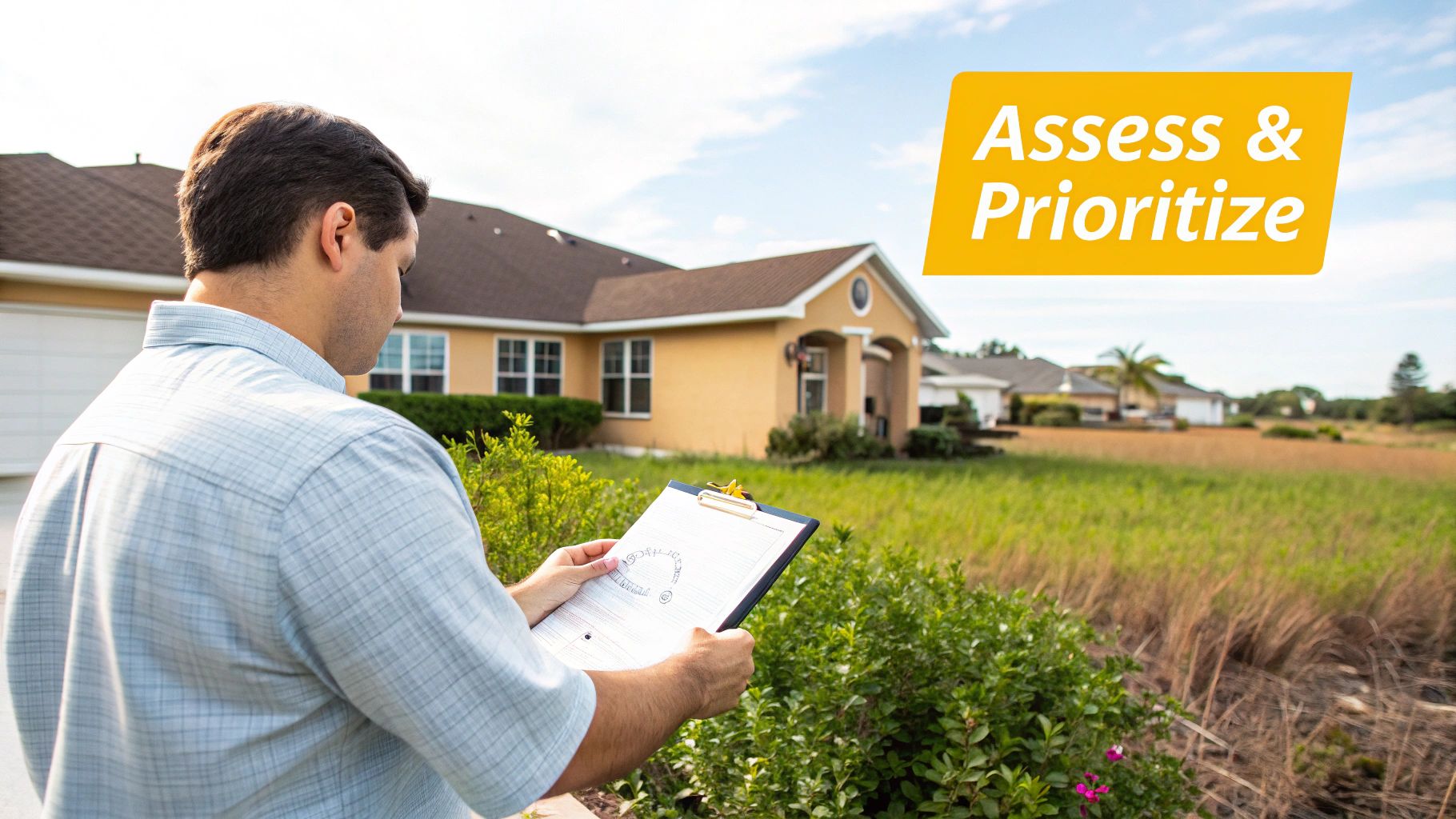
I’ve seen it time and again: someone spends an entire weekend clearing a patch of fast-growing vines, only to see them surge back in a few weeks. Meanwhile, a more destructive tree quietly spreads its seeds across their acreage, creating a much bigger problem for next year.
The key is to work smarter, not just harder.
The whole process kicks off with a simple walk around your property. Grab a notepad or just use your phone. The goal here is to identify and map out what you’re actually dealing with. You don’t need to be a botanist for this initial survey; it's all about getting a baseline understanding of the problem's scale.
Identifying the Primary Threats
Central Florida is a hotspot for some of the state's most aggressive invasive plants. You don’t need to learn every single one, but recognizing the "big offenders" is absolutely crucial for deciding where to start.
Here's a quick-reference guide to some of the worst culprits you're likely to find. Learning to spot these will help you prioritize your efforts effectively.
| Central Florida's Most Common Invasive Plants to Prioritize || :--- | :--- | :--- || Invasive Plant | Primary Threat | Best First Action || Brazilian Peppertree (Schinus terebinthifolia) | Forms dense, impenetrable thickets that shade out and kill all other vegetation. | Cut and treat stumps, or mulch entire thickets if they are dense. || Cogon Grass (Imperata cylindrica) | Creates a serious fire hazard and aggressively chokes out native grasses and groundcover. | Targeted herbicide application is often the most effective initial approach. || Air Potato (Dioscorea bulbifera) | A fast-climbing vine that can completely cover and kill mature trees by blocking sunlight. | Remove the potato-like "bulbils" first to stop new growth, then treat the main vine. || Caesarweed (Urena lobata) | A woody shrub with bur-like fruits that stick to everything, aiding its rapid spread across properties. | Hand-pulling young plants or mowing before they seed can help manage spread. |
Taking photos during your walk and using a plant identification app can be a massive help in confirming what you’ve found. Once you know your enemy, you can build a specific plan of attack for each one.
Creating a Triage System for Your Property
After you’ve identified the invaders, it’s time to prioritize. Not all invasive species pose an equal threat. A triage approach helps you focus your limited time, energy, and money where they will make the most significant difference.
Ask yourself these questions to rank each infestation:
Which species are spreading the fastest? Aggressive invaders like Cogon Grass or Air Potato almost always need immediate attention just to contain them.
Which plants pose the biggest ecological threat? A massive Brazilian Peppertree thicket that’s actively displacing native habitat is a higher priority than a few scattered Caesarweed plants.
Are any species near sensitive areas? Invasives encroaching on a wetland, a property line, or a stand of valuable native oaks should be moved right to the top of the list.
A simple mapping exercise can be a game-changer. Sketch a rough map of your property and mark the locations of different invasive species. Use color-coding for priority levels: red for high-priority, yellow for medium, and green for low. This visual guide will keep you focused and prevent you from getting sidetracked.
As you begin, think about adopting a comprehensive framework like understanding Integrated Pest Management (IPM), which provides a smarter, more permanent solution by combining multiple control techniques. For those facing a truly daunting situation, our guide on how to clear overgrown land offers deeper insights into the equipment and strategies you'll need. This foundational assessment and planning phase is, without a doubt, the most critical part of the entire process.
Choosing Your Tools for Mechanical and Chemical Control
With a solid assessment and a clear priority list, you’re ready to shift from planning to doing. The next big decision is picking the right tools and methods for the job. How you tackle an invasive species depends entirely on the plant you’re up against, how bad the infestation is, and the unique conditions of your property.
For folks managing land here in Central Florida, control methods really boil down to two main categories: mechanical removal and chemical application. Each has its time and place, and frankly, the most successful strategies usually involve a smart combination of both.
The Hands-On Approach: Mechanical Removal
Mechanical control is exactly what it sounds like—physically yanking, cutting, or grinding invasive plants out of the ground. It's often your first line of defense, especially for new or small infestations where you can get the upper hand before things get out of control.
Think of it this way: pulling up a handful of young Brazilian pepper saplings is a quick, satisfying win. It’s a targeted strike that needs minimal gear and has zero chemical footprint. That's the ideal "early detection, rapid response" scenario.
But as infestations grow, you're going to need more muscle.
Hand-Pulling and Digging: This is your go-to for young, shallow-rooted nuisances like Caesarweed or freshly sprouted Brazilian pepper. Pro tip: do it when the soil is damp. It makes it much easier to pull the entire root system out in one go.
Cutting and Mowing: For some non-spreading grasses or woody plants that don’t aggressively re-sprout, repeated cutting can eventually wear them out. Be careful, though—for tough species, this can sometimes just make them angry, encouraging even thicker regrowth.
Heavy Machinery: When you’re staring down a dense thicket of mature Brazilian pepper or an impenetrable wall of Old World climbing fern, it’s time to call in the big guns. Forestry mulching, for example, can reclaim acres of land in a day, turning that invasive mess into a beneficial layer of mulch that protects the soil. This is where professional help really pays off.
Deciding to bring in heavy equipment is a turning point for a lot of landowners. It’s a serious investment, but it’s also the fastest and most effective way to take back your property. To get a better idea of what's involved, check out our detailed guide on the equipment for clearing underbrush.
Strategic and Targeted Chemical Control
While mechanical methods handle the problem you can see, chemical control—using herbicides—is often the knockout punch needed for the root systems of Florida’s most stubborn invaders. I get it, a lot of people are wary of using chemicals, and for good reason. The key is to use them correctly, safely, and in a highly targeted way to avoid collateral damage.
The "cut-stump" or "cut-and-treat" method is a perfect example of responsible herbicide use. Instead of broadcast spraying an entire area, you simply cut the invasive plant down to a stump. Then, you immediately paint a small, concentrated amount of the right herbicide directly onto that freshly cut surface. This sends the chemical straight to the root system where it does its job, stopping regrowth without poisoning the surrounding soil or harming nearby native plants.
This technique is incredibly effective for those woody species that would otherwise just re-sprout with a vengeance.
Understanding Your Herbicide Options
Diving into the world of herbicides can feel overwhelming, but it really boils down to a few key differences. Making the right choice is crucial, especially here in Central Florida with our sensitive wetlands and aquifers.
Selective Herbicides: These are designed to target specific plant types, like broadleaf weeds, while leaving grasses untouched. They're super useful when you have invasive vines creeping through a native meadow.
Non-Selective Herbicides: These will damage or kill pretty much any plant they touch. They are powerful tools but demand extreme caution to avoid accidentally taking out desirable vegetation.
The single most important rule is this: always read and follow the label directions. The label isn't a suggestion; it's the law. It tells you exactly what plants the product works on, the correct mixing ratios, what personal protective equipment (PPE) you need, and—most importantly—any environmental restrictions, like staying away from water bodies.
Ultimately, a winning strategy is an integrated one. It starts with prevention and early detection and moves into a smart combination of these control methods. This mirrors the approach taken by the U.S. Department of the Interior, which emphasizes that once invasive species are widespread, control becomes exponentially more expensive and difficult. Their focus on integrating prevention, eradication, and restoration is all about finding cost-effective solutions that work. You can see their game plan in the full strategic plan on their official website. By choosing your tools wisely, you're not just fighting weeds—you're adopting a professional, science-backed approach to reclaiming your land for good.
Why Timing Your Control Efforts Is Critical for Success
When you're fighting invasive species, your strategy is only as good as its timing. I’ve seen plenty of landowners execute a perfect removal plan, only to see it fail because they did it at the wrong time of year. It’s a hard lesson to learn. You have to think like a farmer: just as they plant in the spring and harvest in the fall, your control efforts have to sync up with the biological cycles of the invasive plants you’re up against.
Hitting a plant when it’s most vulnerable is the secret to getting the biggest impact for the least amount of effort. For example, spraying an herbicide when a plant is flowering is often a complete waste of time and money. The plant is pushing all its energy up to make seeds, not sending it down to the roots. That means the chemical never gets to where it needs to go.
Getting the timing right can dramatically shift the odds in your favor.
Aligning Your Actions with the Seasons
Understanding a plant's seasonal life cycle is a complete game-changer. Plants have clear phases—growth, flowering, seeding, and dormancy—and each one presents either a window of opportunity or a signal to hold back.
Take a common troublemaker in Central Florida, the Brazilian Peppertree. In the late fall, it starts sending sugars and nutrients down to its root system to hunker down for winter. If you do a targeted "cut-stump" herbicide treatment during this time, the plant does the hard work for you, pulling that chemical deep into its roots where it can do real damage.
On the flip side, firing up the forestry mulcher when a plant is loaded with mature seeds can be a catastrophe. You might clear the parent plants, but you'll also blast thousands of seeds across freshly disturbed soil. You’ve just sown next year's invasion.
This simple timeline shows the basic phases of a solid management plan.
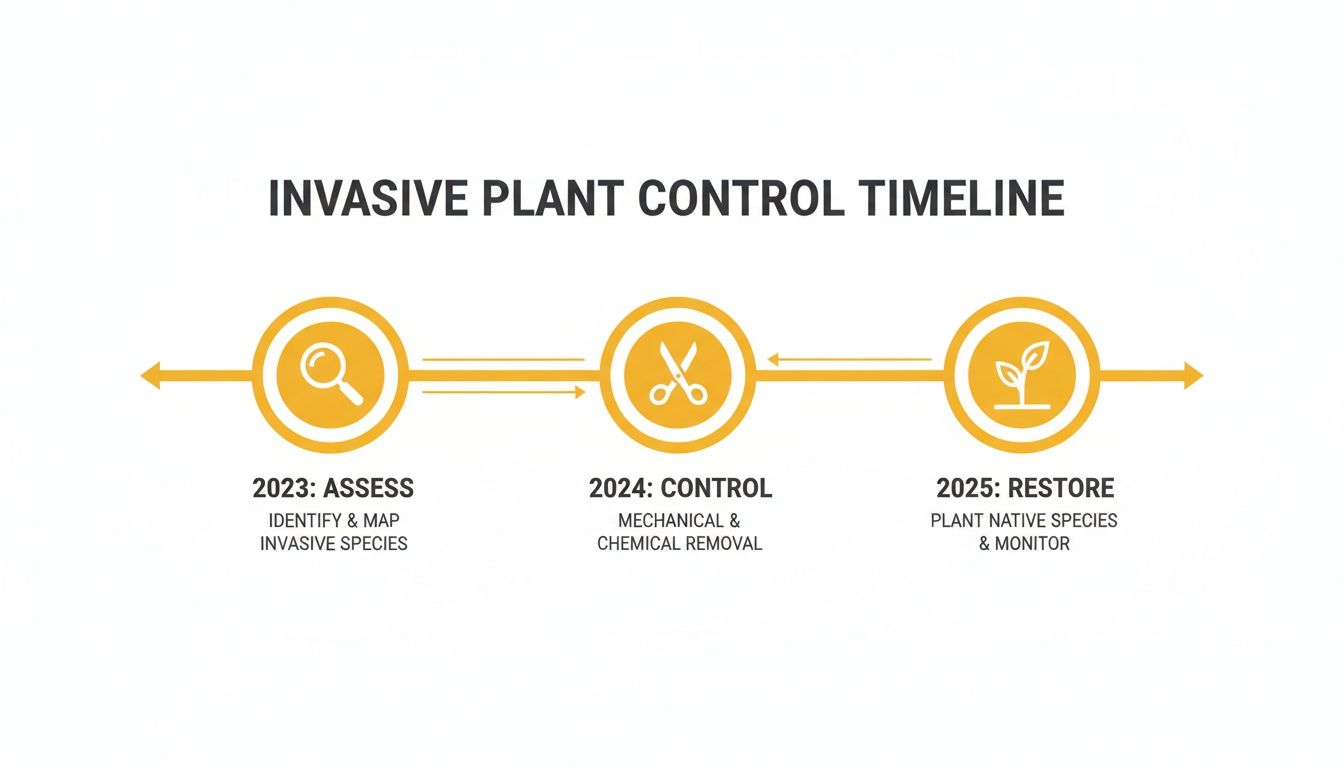
It’s a good reminder that this isn't a one-and-done job. It's a multi-year commitment of assessing the problem, hitting it hard, and then diligently restoring the land.
A Seasonal Calendar for Central Florida Invasives
To make this really practical, here’s a simplified seasonal game plan for our region. Think of it as your strategic calendar for getting the upper hand.
Late Fall to Early Winter (October - January): This is prime time for chemical treatments on woody species. With plants going dormant and pulling resources to their roots, cut-stump applications are incredibly effective on things like Brazilian Pepper and Chinese Tallow.
Late Winter to Early Spring (February - April): Now’s the time to focus on mechanical removal before that big spring growth spurt. Mulching or cutting down thickets before they flower and seed is a huge win. It’s also the perfect time to get out there and hand-pull the young saplings that popped up over winter.
Summer (May - August): Think of summer as your monitoring and spot-treatment season. The rains fuel rapid growth, which makes new outbreaks easy to spot and treat. For aggressive vines like Air Potato, this is when you want to be removing the "bulbils" before they drop and sprout.
Early Fall (September): As the intense summer heat finally breaks, this is your window to prepare for restoration. After a season of control work, you can start planning which native species to plant in the cleared areas. Giving them a head start is key to outcompeting new invasive seedlings.
The Critical Need for Early Intervention
Maybe the most important part of timing is simply acting early. An invasion doesn't stand still; the damage gets worse, often exponentially, over time. This is especially true when it comes to the loss of native biodiversity, which can build up until it's irreversible.
A global analysis of over 775 studies found that the timing of an invasion is crucial. It showed that some of the worst impacts, like crowding out native plants and animals, build up over months and years. This "ecological tempo" is exactly why early detection and rapid removal are the most powerful tools you have.
This research just confirms what we see in the field: tackling a small patch of Cogon Grass today is infinitely easier and cheaper than reclaiming five acres of it three years from now. With new alien species being introduced globally at a rate of around 200 per year, timely management isn't just a good idea—it's absolutely essential for protecting our local ecosystems. You can dig into the findings yourself and see how this global study reveals the ecological tempo of invasive species and why it matters for every landowner.
Restoring Your Land With Native Florida Plants
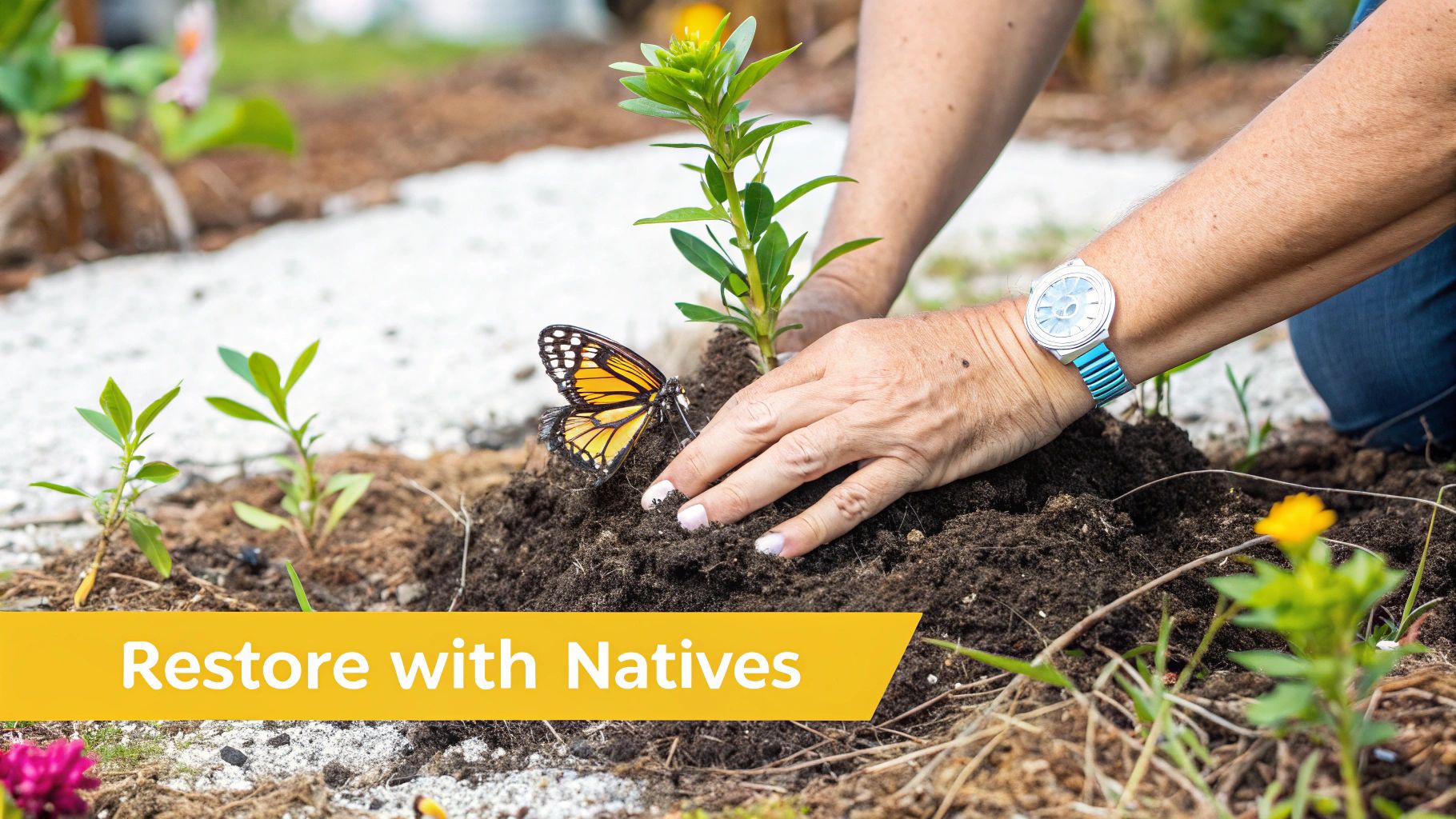
Successfully clearing out invasive species is a huge win, but the work isn't over yet. In fact, that bare, disturbed soil you just reclaimed is now prime real estate for the next opportunistic invader. Leaving it empty is like sending an open invitation for fast-growing weeds to move right back in, and you'll be stuck in that frustrating cycle all over again.
This is where the second, equally crucial phase comes in: restoration. You're not just clearing land; you're healing it. By strategically reintroducing native Central Florida plants, you create a resilient, self-sustaining ecosystem that can naturally defend itself against future invasions.
Choosing the Right Native Plants for Your Property
The secret to successful restoration is picking plants that are perfectly adapted to your specific site. A plant that loves a sunny, sandy upland spot will quickly die in a moist, shady hammock. Think of it as recruiting the perfect team for the job, where every plant has a specific role to play.
For anyone interested in modern, tech-assisted approaches, there's even a fascinating podcast episode that discusses using AI for selecting native plant species.
As you plan your native landscape, think in terms of layers:
Groundcovers: These low-growing plants are your first line of defense. Species like Sunshine Mimosa (Mimosa strigillosa) or Twinflower (Dyschoriste oblongifolia) spread out to cover bare soil, denying weed seeds the sunlight they need to sprout.
Shrubs and Understory Plants: This mid-level layer is crucial. Firebush (Hamelia patens) is a magnet for hummingbirds and butterflies, while Wax Myrtle (Morella cerifera) provides food and cover for birds. Their root systems are also fantastic for stabilizing soil, especially after extensive clearing from professional forestry mulching services.
Canopy Trees: Planting long-lived natives like Live Oak (Quercus virginiana) or Longleaf Pine (Pinus palustris) is a powerful long-term investment. They eventually create shade that shades out sun-loving invasives and restore that classic Florida landscape character.
Sourcing and Planting for Long-Term Success
Where you get your plants really matters. Always track down reputable nurseries that specialize in Florida-native or Florida-Friendly plants. These experts propagate plants from local ecotypes, which means they are genetically wired for our specific climate, soils, and rainfall. This gives them a much better shot at survival.
Try to avoid the big-box stores. They might sell "native" plants, but they are often sourced from other states or are cultivars that don't offer the same ecological punch. A true native nursery is also an incredible source of advice on what will thrive on your specific piece of land.
Here's a pro tip for planting: don't just dig a hole the exact size of the pot. Go two to three times wider. This simple step gives the roots room to stretch out into the surrounding soil and dramatically improves the plant's ability to get established quickly and strongly.
Watering is absolutely critical for the first few months. You'll want to water deeply and consistently until the plants are established and can handle our natural rainfall on their own. Adding a layer of pine straw or another natural mulch (never cypress!) will help hold in soil moisture, keep weeds down, and regulate soil temperature.
This proactive approach does so much more than just stop the next invasion. You are actively rebuilding a functional habitat, supporting local pollinators, feeding the birds, and bringing back the authentic, natural beauty of your Central Florida property. It's the final, essential step in truly reclaiming your land for good.
Knowing When to Call for Professional Help
The DIY spirit runs deep in property owners, and there’s a real satisfaction that comes from tackling an invasive species problem yourself. But there comes a point where sheer determination and a good pair of gloves just aren't enough. Learning to recognize when it's time to trade in your hand tools for a phone call is one of the most important skills in managing invasive species effectively.
Pushing forward on a project that’s too big or too hazardous doesn’t just lead to burnout—it can actually make the problem worse. Knowing the signs that you’re out of your depth is the key to saving yourself time, money, and a lot of headaches. It's not about admitting defeat; it’s a strategic decision to get the job done right.
Recognizing the Tipping Points
Some situations are clear signals that it's time to bring in the pros. These are scenarios that usually involve scale, safety, or specialized knowledge that go beyond what a typical landowner can handle. If any of these sound familiar, it’s probably time to start getting some quotes.
Here are the most common tipping points I see:
Overwhelming Scale: A few Brazilian pepper saplings? You can handle that. But a dense, five-acre thicket that’s been taking over for a decade is a whole different ballgame. When an infestation covers a huge chunk of your land, you need professional-grade equipment like forestry mulchers to even make a dent.
Specialized Equipment is Needed: Think about grinding hundreds of stumps or clearing thick underbrush across multiple acres. That kind of work requires machinery that’s not only expensive to rent but flat-out dangerous to operate without proper training and insurance. The pros have the right tools and know how to use them safely and efficiently.
Restricted-Use Herbicides are Required: Some of Florida's most stubborn invaders, especially the aquatic ones, only respond to herbicides that require a state-issued applicator's license. Licensed professionals are trained in how to handle, mix, and apply these controlled chemicals safely, keeping you and the environment compliant with the law.
Sensitive Environmental Areas: Working near wetlands, streams, or protected habitats requires a delicate touch. Professionals understand the regulations and best practices needed to get rid of invasives without causing collateral damage to these crucial ecosystems.
Investing in professional services might feel like a big expense upfront, but it often ends up being the more economical choice. The cost of repeatedly buying supplies for ineffective DIY treatments, giving up your weekends for little to no progress, and risking damage to your property or yourself can quickly add up to more than a one-time professional service fee.
The True Cost of Inaction
Putting off a call for help on a large-scale invasion doesn’t just let the problem fester; it actively costs you money. Globally, invasive species cause staggering economic damage, hitting industries like agriculture and forestry especially hard. Between 1970 and 2020, the estimated economic toll of biological invasions worldwide topped U.S. $644 billion. This just goes to show that uncontrolled invasives aren't just an ecological headache—they're a serious financial liability. You can read more about how these industries have lost hundreds of billions due to invasive species on environment.ec.europa.eu.
Making the Smart Decision
At the end of the day, calling a professional is a strategic investment in the health and value of your property. A reputable land-clearing company can do in a single day what might take a landowner months, or even years, to accomplish. They bring efficiency, safety, and expertise to the table, giving you a clean slate so you can move on to the rewarding final step of restoration.
Common Questions About Florida Invasive Species Control
Even with a solid game plan, questions always pop up once you start getting your hands dirty. It’s natural to second-guess yourself, wondering if you're making the right call or missing a better way to tackle the problem. We’ve pulled together some of the most common questions we hear from landowners across Central Florida to give you straightforward, actionable answers.
Think of this as your quick reference for those moments of doubt. Having the right information handy helps you push forward with confidence, making sure your hard work pays off.
What Is the Single Most Important Invasive Plant to Remove in Central Florida?
While every piece of land is unique, the undisputed champion of destructive invaders around here is the Brazilian Peppertree (Schinus terebinthifolia). If you have this on your property, it should be priority number one, hands down.
Why? It’s a triple threat. This tree grows incredibly fast, forming dense, impenetrable thickets that completely block sunlight, killing off all the native plants struggling to survive underneath. It also pulls a nasty trick by releasing chemicals into the soil that stop other plants from growing—a sort of chemical warfare. This aggressive behavior absolutely decimates local habitats, wiping out the food and shelter our native wildlife depends on. Tackling Brazilian pepper first is often the single most impactful step you can take to reclaim your land.
Can I Just Cut Down Invasive Plants Without Using Herbicides?
You can, but for many of Florida’s toughest invasive plants, it’s just a temporary fix. Think of it like trimming a weed but leaving the root in the ground—it's guaranteed to come back, often with a vengeance.
Many of these aggressive species, especially Brazilian Pepper and the notorious Cogon Grass (Imperata cylindrica), will re-sprout like crazy from their stumps and massive root systems. In fact, just cutting them down can actually stimulate even thicker regrowth. This is precisely why a targeted "cut-stump" herbicide treatment works so well. By cutting the plant and immediately dabbing a small amount of the right herbicide onto the fresh cut, the chemical gets pulled directly down to the roots, killing the plant for good. It saves you countless hours of re-doing the same work later.
For any long-term strategy to be successful, the goal isn't just to knock down the visible part of the plant. It's to stop it from ever coming back. Combining mechanical cutting with a targeted chemical application is often the most effective way to permanently solve the problem with stubborn woody invaders.
Are There Any Non-Chemical Ways to Control Invasive Species?
Absolutely. A purely chemical approach is rarely the best answer. The most sustainable and effective strategies use a mix of methods, often called Integrated Pest Management (IPM).
Here are a few powerful non-chemical options:
Mechanical Removal: This is your foundation. It can be as simple as hand-pulling young seedlings and digging up smaller shrubs, or as heavy-duty as bringing in forestry mulchers to clear out large-scale infestations.
Biological Control: This is a fascinating approach where you use an invasive species' own natural enemies against it. A classic Florida success story is the air potato leaf beetle, which was introduced to control the destructive Air Potato Vine. This method is highly specific and takes years of careful research to implement safely.
Cultural Control: This is the proactive, long-term play. After you've cleared an area, you need to create conditions that favor native plants. By establishing a dense cover of native grasses, groundcovers, and shrubs, you create intense competition for sunlight and resources, effectively squeezing out and suppressing any new invasive seedlings that try to pop up.
How Should I Dispose of Invasive Plant Material After Removal?
This is one of the most overlooked—and most critical—steps in the whole process. If you get this wrong, you can accidentally spread the very plants you just worked so hard to get rid of.
The most important rule is to never put invasive plants with seeds, berries, or viable root parts (like rhizomes) into a regular compost pile. A typical home compost setup just doesn't get hot enough to kill them off.
Instead, here are a few safer methods. Piling the material on-site in an upland area (away from wetlands) and letting it completely dry out and rot is a great, low-effort option. This ensures it can't re-sprout. For bigger jobs, chipping or mulching the material right there on-site is fantastic. If you have to haul it away, make sure you check with your county’s solid waste department. They often have specific procedures for handling invasive plant debris to prevent it from spreading.
When the scale of the problem feels overwhelming, or you need specialized equipment to get the job done right, Palm State Clear Cut is here to help. We provide professional forestry mulching and invasive species control to reclaim your Central Florida property quickly and effectively. Contact us today for a free quote.
Comments