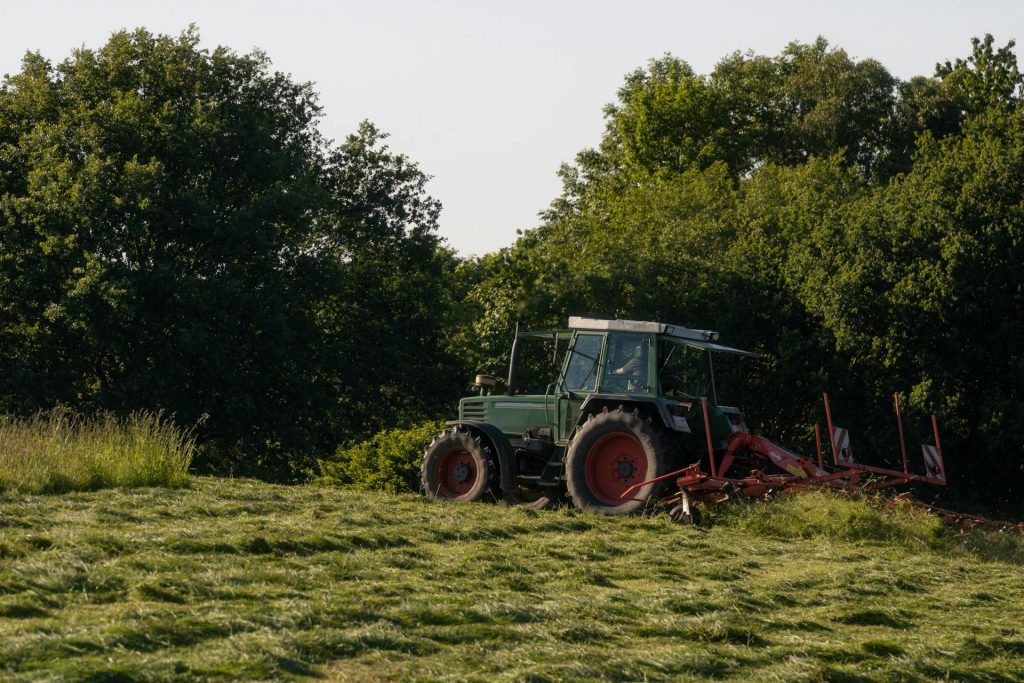
Think of your Central Florida property like a blank canvas, just waiting for your vision to come to life. Right now, that canvas might be completely hidden behind a tangled mess of overgrown brush, vines, and scraggly trees. Professional brush clearing is how we peel back that chaotic layer, revealing the true potential of your land and turning a hazardous, unusable plot into a safe, functional, and beautiful space.
This is more than just glorified mowing. It’s a strategic first step for any landowner looking to build, farm, or simply enjoy their property to the fullest.
Unlocking Your Property’s True Potential
Here in Central Florida, we know the threat of wildfire is real. Dense, dry undergrowth is the perfect fuel for a fire that can spread in a flash. Clearing this vegetation creates what firefighters call defensible space around your home and other structures, drastically cutting down your fire risk. In fact, the U.S. Department of the Interior reports that nearly nine out of ten wildfires are started by people, making proactive land management your single best defense.
More Than Just a Pretty View
But the benefits don’t stop at fire safety. Overgrown land is a five-star resort for pests you don’t want around—snakes, rodents, and invasive insects can all take shelter in that dense brush, posing a risk to your family and pets.
That same overgrowth also chokes the life out of the plants you do want. It competes with your beautiful, mature trees for sunlight, water, and nutrients. By clearing out the competition, we give your valuable trees the breathing room they need to truly thrive.
This quick visual breaks down how clearing your land directly boosts its safety, usability, and overall value.
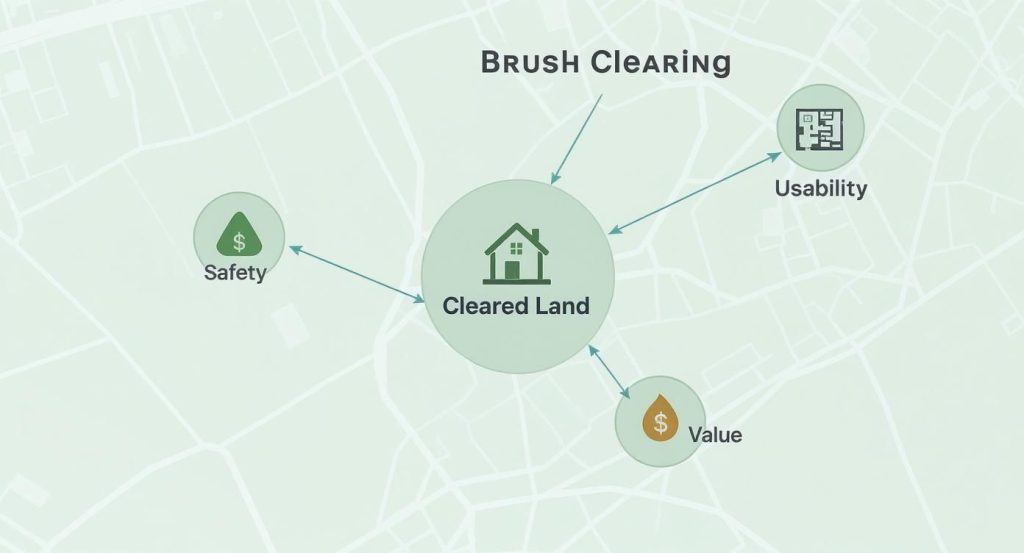
As you can see, these three core benefits are all connected. Clearing the land transforms what might be a liability into a prime asset, ready for whatever you have planned.
When you invest in professional brush clearing, you’re not just tidying up a messy lot. You are actively making your property safer, unlocking its potential for future projects, and boosting its market value all at once.
So, whether you’re prepping a site for a new home, carving out pasture for livestock, or just want to create some recreational trails for your family, it all starts here. A clean slate is the only way to build a safe and stable foundation for what’s next.
Key Brush Clearing Methods Explained
When it comes to clearing land, there’s no one-size-fits-all solution. You wouldn’t use a hammer to drive a screw, and the same principle applies here. The right method depends entirely on your land, the type of vegetation you’re dealing with, and what you want to achieve with the property. Getting familiar with these techniques helps you have a smarter conversation with your contractor, making sure the outcome is exactly what you envisioned.
It’s no surprise that the demand for professional brush clearing services is on the rise. The market for equipment like brush cutters was a hefty $4.2 billion industry in 2023, and it’s expected to hit $6.7 billion by 2032. That’s a lot of growth, and it shows just how many people are investing in managing their land, from backyard projects to large commercial developments.
Let’s walk through the five main ways we transform overgrown properties in Central Florida.
Forestry Mulching: The One-Pass Solution
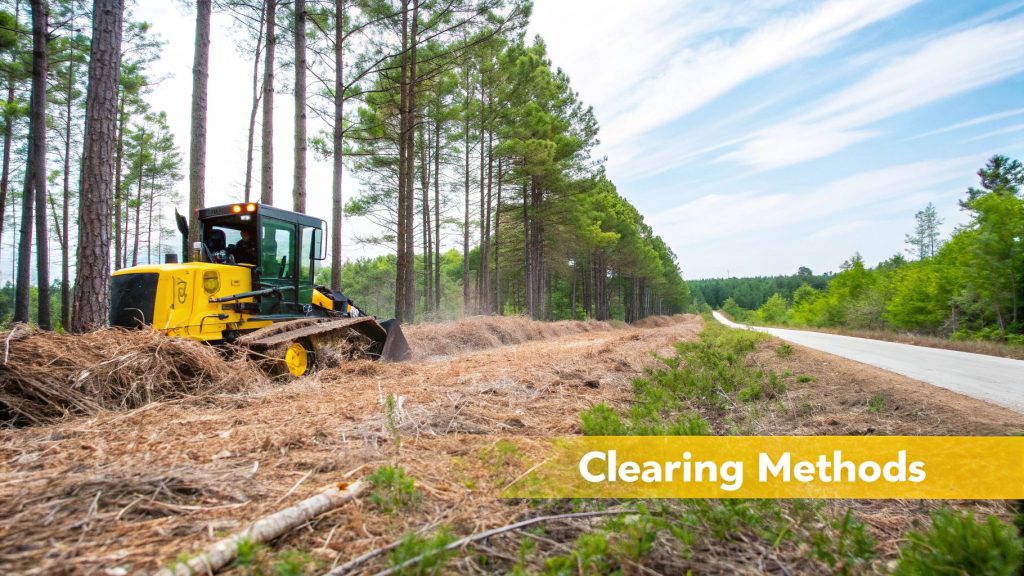
Picture a machine that powers through dense brush, instantly turning small trees and undergrowth into a natural, protective carpet of mulch. That’s forestry mulching in a nutshell. It’s an incredibly efficient, one-step process that clears your land while feeding the soil at the same time.
The machinery shreds everything right where it stands, spreading a layer of organic material across the ground. This mulch blanket is fantastic for preventing soil erosion, locking in moisture, and keeping new weeds from popping up. It’s the go-to choice for anyone who wants a fast, clean result without dealing with burn piles or hauling away debris. You can get a closer look at the heavy-duty equipment involved in our guide to underbrush clearing machines.
Forestry mulching is our most popular choice for ecologically sensitive clearing. It barely disturbs the soil and puts all that organic goodness right back where it belongs, giving the land a head start on recovery.
Stump Grinding: Erasing the Obstacles
Once the trees are gone, the stumps left behind are more than just an eyesore—they’re a hazard. Stump grinding is the surgical answer. We use a high-speed cutting wheel to chew the stump and its major roots into small wood chips, erasing it from your landscape.
Getting rid of stumps is a critical step for a few key reasons:
- Safety: No more tripping hazards. It makes your property safe for kids, pets, and even just mowing the lawn.
- Pest Control: Rotting stumps are a magnet for termites, ants, and other pests you don’t want anywhere near your home.
- Aesthetics: It’s all about creating a clean, level canvas. Removing stumps instantly improves your property’s look and usability.
- Construction Prep: If you’re planning to build anything from a shed to a house, you need a flat, stump-free foundation. It’s non-negotiable.
The wood chips created during grinding can be repurposed as mulch for your garden beds or simply spread out to enrich the soil as they decompose.
Perimeter Clearing: Defining Your Boundaries
Think of perimeter clearing as drawing a clean, sharp line around your property. It’s a strategic service focused on clearing a wide path along fence lines, property borders, or around buildings. This is a fundamental step for both property maintenance and security.
This is the best way to clearly mark where your land begins and ends, stop your neighbor’s overgrown mess from creeping in, and create easy access for installing or repairing a fence. More importantly, here in Florida, a cleared perimeter is a powerful firebreak. It creates a buffer of defensible space that can seriously slow down or even stop a wildfire in its tracks.
Selective Thinning: Cultivating a Healthy Forest
Clearing land isn’t always about wiping the slate clean. Selective thinning is the art of carefully picking which trees and brush to remove to help the rest of the forest thrive. It’s like pruning a garden, just on a much bigger scale.
By taking out the overcrowded, weak, or invasive plants, we give the stronger, more desirable trees room to breathe. They get more sunlight, water, and nutrients, which leads to healthier growth and makes the whole area more resistant to disease and pests. It’s the perfect approach for landowners who love their woods but want to make them healthier, more beautiful, and easier to enjoy.
Herbicide Application: Targeted Control
Sometimes, machines alone can’t finish the job, especially when you’re up against stubborn invasive plants. Herbicide application gives us targeted control to stop unwanted vegetation from coming right back after we’ve cleared it.
Our licensed applicators use specific, approved herbicides to treat stumps or foliage, making sure aggressive invaders like Brazilian Pepper or cogon grass are gone for good. When handled by a professional, it’s a safe and highly effective way to manage your property long-term, cutting down on future maintenance and protecting Florida’s native ecosystem.
Comparing Brush Clearing Methods for Your Property
Choosing the right approach can feel overwhelming, but it really comes down to your specific goals. This table breaks down the five methods side-by-side to help you see which one is the best fit for your project.
| Method | Best For | Key Benefit | Considerations |
|---|---|---|---|
| Forestry Mulching | Fast clearing, erosion control, and improving soil health. | No hauling or burning needed; clears and enriches in one step. | Best suited for small-to-medium diameter trees and brush. |
| Stump Grinding | Preparing land for construction, landscaping, or eliminating hazards. | Creates a flat, usable, and safe surface. | A separate process that follows tree removal. |
| Perimeter Clearing | Defining property lines, creating firebreaks, and fence line access. | Enhances security, safety, and property maintenance. | Focuses only on the boundaries, not the entire lot. |
| Selective Thinning | Improving forest health, aesthetics, and wildlife habitats. | Promotes stronger growth in remaining desirable trees. | Requires a careful, strategic approach to select which plants to keep. |
| Herbicide Application | Controlling invasive species and preventing regrowth. | Provides long-term control of aggressive, unwanted plants. | Must be applied by a licensed professional for safety and effectiveness. |
Ultimately, the best strategy often involves a combination of these techniques. A thorough site assessment is the first step in creating a plan that’s both efficient and effective for your Central Florida property.
Navigating Florida Land Clearing Permits
Before the first piece of heavy equipment rolls onto your property, we need to talk about regulations. It’s not the most exciting part of the job, but understanding the local and state rules for land clearing in Central Florida is non-negotiable. This isn’t just about dodging fines; it’s about being a responsible steward of the land we all call home.
Think of a permit as a project’s “license to operate.” It’s official confirmation that your plans have been reviewed and won’t harm our state’s unique natural resources. Trying to skip this step is a recipe for disaster, often leading to costly stop-work orders, steep penalties, and long-term damage to your property’s value.
When Do You Need a Permit?
Not every small brush-clearing job needs a formal permit, but the triggers for needing one are more common than you might think. Tidying up some overgrowth on a standard residential lot probably won’t raise any flags. However, the moment your project gets a bit bigger or involves sensitive areas, you’ll need to get the authorities involved.
You will almost certainly need a permit if your project involves any of the following:
- Clearing Larger Tracts of Land: Once you start clearing a significant area, often as little as one acre, local agencies will require a review.
- Impacting Wetlands: Florida is serious about protecting its wetlands. If your property is near or contains a designated wetland, a permit from the local water management district is mandatory. No exceptions.
- Removing Protected Trees: Many counties, like Orange and Seminole, have ordinances that protect “specimen” or “heritage” trees—think of those majestic, mature live oaks.
- Altering Shorelines or Waterfronts: Any work near lakes, rivers, or canals will automatically trigger a review process.
- Preparing for New Construction: If you’re clearing a lot for a new home or commercial building, it’s a regulated activity that requires a permit.
Navigating these rules isn’t something you should have to do alone. A reputable local contractor specializing in brush clearing services will know the permitting agencies in your specific county inside and out. They can guide you through the process and make sure your project gets started on the right foot.
Critical Environmental Factors in Central Florida
Our region is home to some incredibly sensitive ecosystems and protected species, and any land clearing activity has to take them into account. The key to a smooth, legal clearing process is being proactive. It’s far easier to plan around a protected habitat from the start than to deal with the fallout of disturbing one.
For a deeper dive into this initial phase, our comprehensive article on clearing land for construction in Florida offers valuable insights into site prep and regulatory compliance.
Gopher Tortoise Burrows
The gopher tortoise is a state-listed threatened species, and its burrows are strictly protected by law. It is illegal to harm, harass, or disturb a gopher tortoise or its burrow without a specific permit from the Florida Fish and Wildlife Conservation Commission (FWC). Before any clearing can begin, a professional survey must be done to identify any active burrows on the property.
Wetlands and Water Bodies
Central Florida’s interconnected system of lakes, rivers, and wetlands is its lifeblood. Powerful water management districts, like the St. Johns River Water Management District or the South Florida Water Management District, have jurisdiction over any activities that could impact these resources. They require permits for any work that might alter water flow or degrade water quality.
Protected Tree Species
It’s not just the iconic live oaks. Many other tree species are protected by local ordinances that vary from county to county. Before you plan to remove any significant trees, you have to check your county’s specific rules. You might even need an arborist’s report to justify the removal, and the permit may require a plan for replacing the trees you take down. Partnering with a knowledgeable contractor is your best defense against accidentally breaking these important local laws.
Budgeting for Your Brush Clearing Project
Let’s get right to it. Two questions are always front and center for any landowner planning a project: “How much is this going to cost?” and “How long will it take?”
While there’s no magic, one-size-fits-all price for brush clearing services, you can absolutely budget with confidence once you understand the key factors that shape the final quote. It’s not a simple calculation of a flat rate times your acreage—the unique character of your land is what truly drives the cost.
Think of it like hiring a moving company. The price isn’t just based on the square footage of your house. It depends on how much stuff you have, how many flights of stairs the crew has to climb, and how far they need to drive. Land clearing is exactly the same. A flat, one-acre lot with some light grass and a few saplings is a world away from a one-acre jungle choked with ten-foot-tall Brazilian Pepper, steep slopes, and massive stumps that need grinding. The first is a quick job; the second is a completely different beast.
Key Factors That Determine Your Quote
Every professional quote is custom-built around the realities of your property. A contractor has to get their boots on the ground to assess all the variables and figure out the time, labor, and equipment needed to get the job done right—and safely.
Here’s a breakdown of what we look at during a site visit:
- Acreage: This is just the starting point. Of course, larger properties take more time and fuel, but the cost per acre often drops as the total area gets bigger.
- Vegetation Density: How thick is the growth? We need to know if we’re dealing with light, manageable brush or a dense wall of vines, palmettos, and invasive trees that you can’t see through.
- Type of Vegetation: Not all green is created equal. Tough hardwoods take more horsepower and time to mulch than softwoods. Thorny vines or stubborn invasive species also add to the job’s complexity.
- Terrain and Accessibility: A flat, open field is a straight shot. But steep hills, swampy areas, or tight corners that are tough for heavy machinery to get into will naturally increase the project’s difficulty and cost.
- Required Method: Forestry mulching might be the perfect tool for one project. Another might need a tag-team approach with stump grinding and selective clearing, each with its own cost structure.
Setting Realistic Cost and Timeline Expectations
Here in Central Florida, brush clearing costs can land anywhere from $300 to over $2,000 per acre. Some jobs are better suited for an hourly rate, which typically falls between $150 and $400 per hour, depending on the machinery involved. For a much deeper dive into these numbers, check out our guide on the cost to clear an acre of land in Florida.
To put it in perspective, clearing a standard one-acre residential lot with moderate brush might be a one-day job. A dense 10-acre property, on the other hand, could easily take a full week or more and require multiple machines and a larger crew.
The most accurate way to budget is to get a free, on-site estimate. This allows a professional to see the land firsthand, discuss your goals, and provide a firm quote that accounts for all the unique variables of your property.
This hands-on approach is becoming the industry standard. The global brush hog rental market, a core part of the clearing industry, is on track to grow from $520.0 million in 2025 to $740.0 million by 2035. What’s telling is that professional contractors account for 60.0% of this market, showing a clear trend of landowners turning to experienced operators. You can read more about this growing market over on Fact.MR.
When you understand what drives the cost and timeline, you can have a much more productive conversation with your contractor and move forward without any surprises.
How to Hire the Right Clearing Contractor
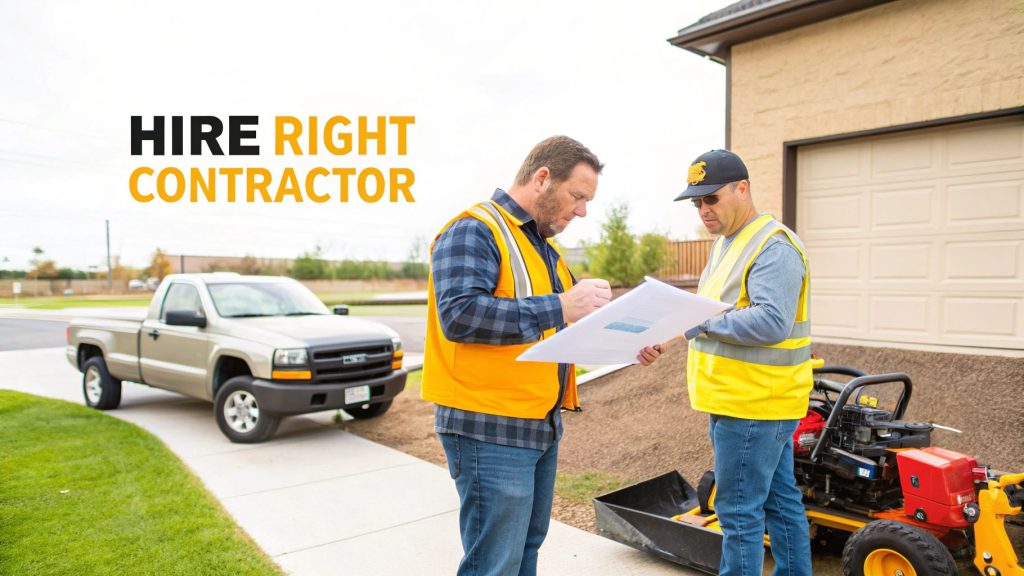
Choosing the right company for your brush clearing services is hands-down the most important decision you’ll make for your project. A great partner can bring your vision to life safely and on schedule. The wrong one? Well, that can lead to a world of hurt—costly delays, damaged property, and even legal trouble. This isn’t a time to just grab the cheapest quote you can find; it’s about finding a qualified, reliable pro who will protect your investment.
Think of it like hiring a surgeon. You wouldn’t just go with the lowest bidder. You’d check their credentials, ask about their experience with your specific procedure, and make sure you feel confident in their track record. The same level of diligence applies when you’re about to let someone operate heavy machinery on your valuable property.
Your Contractor Vetting Checklist
Any professional contractor worth their salt will be an open book, ready to show you proof of their qualifications. Don’t feel shy about asking for these essentials—it’s your right as a property owner. A legitimate company expects these questions and will respect you for doing your due diligence.
Before you even think about signing a contract, make sure the company can show you:
- Proof of General Liability Insurance: This is an absolute deal-breaker. It protects you from financial ruin if an accident happens on your property.
- Workers’ Compensation Insurance: This covers the contractor’s crew if they get injured on your site, which keeps you from being held liable for their medical bills.
- Appropriate Business Licenses: You need to confirm they are licensed to operate in your specific city and county here in Central Florida.
- A Portfolio of Past Work: A picture really is worth a thousand words. Ask to see photos or videos of jobs similar to yours so you can judge the quality of their work for yourself.
If a contractor hesitates to show you proof of insurance, that’s a massive red flag. Without it, you could be on the hook for thousands of dollars in damages or medical bills if something goes wrong.
Key Questions to Ask Every Contractor
Once you’ve covered the basics, it’s time to dig a little deeper. The answers to these questions will tell you a lot about a company’s expertise, professionalism, and whether they take responsible land management seriously.
- “What specific equipment do you recommend for my property, and why?” This is a great way to test their knowledge. A pro will connect the machinery (like a forestry mulcher vs. a skid-steer) directly to your property’s unique terrain, the type of vegetation, and what you’re trying to achieve.
- “What are your safety protocols for your crew and my property?” You want to hear specific answers here—things like personal protective equipment (PPE), setting up clear work zones, and daily equipment checks. If they give you a vague response, it probably means they don’t have a strong safety culture.
- “How do you approach erosion control, especially with Florida’s weather?” This is critical in our state. A knowledgeable contractor will immediately talk about methods like leaving a protective mulch layer, installing silt fences, or grading the land to manage heavy rainfall and protect our local waterways.
- “Can you provide a detailed, itemized quote?” A professional quote should break down all the costs: labor, equipment, debris disposal, and anything else. A single lump-sum price with zero details is a warning sign.
- “Who will be my main point of contact during the project?” Knowing exactly who to call with questions makes the whole process smoother and ensures clear communication from start to finish.
Red Flags to Watch Out For
Just as important as knowing what to look for is knowing what to run from. Be wary of any contractor who does these things, as they often signal a lack of experience or professionalism that could put your project at risk.
- High-Pressure Sales Tactics: A good contractor provides a fair quote and gives you the time and space to make an informed decision.
- Requests for Large Upfront Payments: A reasonable deposit is normal, but demanding a huge chunk—or the full amount—before any work begins is a major concern.
- Lack of a Professional Contract: Never, ever move forward on a verbal agreement. A written contract protects both of you by clearly outlining the scope of work, the timeline, and the payment schedule.
Project Safety and Best Practices
A truly professional land clearing job is about more than just getting the vegetation down. It’s about prioritizing the safety of every single person on site and protecting the long-term health of your property.
That commitment is what separates a quick, messy job from a genuine land management solution. We’re not just cutting brush; we’re strategically preparing your land for whatever comes next, and doing it the right way.
It all starts with creating a secure work zone. Heavy machinery doesn’t play around, so a clearly marked operational area—free from people, pets, and vehicles—is an absolute must. Any reputable crew will secure the perimeter and kick off each day with a safety briefing. This ensures every operator knows the plan, the potential hazards, and how to work together safely.
And of course, proper personal protective equipment (PPE) is completely non-negotiable. Our operators are always geared up with hard hats, eye and ear protection, steel-toed boots, and high-visibility clothing. It’s not a suggestion; it’s the standard for any professional brush clearing services team.
Protecting Your Property and Florida’s Environment
Beyond the immediate work zone, responsible clearing is deeply rooted in environmental stewardship—especially when it comes to erosion control. Here in Central Florida, our sandy soils and sudden, heavy downpours can turn freshly cleared land into a muddy mess in no time.
Uncontrolled erosion does more than just wash away your valuable topsoil. All that sediment and nutrient runoff ends up in our local creeks, rivers, and lakes, which is bad news for water quality and the critters that live there.
A professional contractor knows their job isn’t done when the last machine leaves the property. They have to put measures in place to stabilize the soil and protect the surrounding ecosystem from the immediate effects of the clearing work.
We have a few proven best practices for managing this risk:
- Leaving a Mulch Layer: This is one of the biggest benefits of forestry mulching. It creates a natural blanket over the soil that absorbs rain, prevents runoff, and even helps keep weeds from popping back up.
- Installing Silt Fences: For any sloped areas or sites near water, silt fences are a critical tool. They act as a simple but effective barrier, trapping sediment before it can wash off your property.
- Strategic Grading: On certain job sites, some minor re-shaping of the land can help guide water flow in a controlled way, keeping it from carving out destructive channels.
The Bigger Picture of Land Management
This focus on doing things responsibly isn’t just a local concern; it’s part of a much larger, global movement toward more sustainable land management. For example, forestry mulching is now a key tool for maintaining forest health and cutting down on wildfire risks all across the country.
The growing demand for these kinds of thoughtful services shows a real shift toward better environmental practices worldwide. You can explore more about this global trend and its impact on modern forestry.
By making these safety and environmental protocols part of every project, we turn a simple clearing job into a smart investment that boosts your land’s value while respecting the natural beauty of Florida.
A Few Final Questions We Often Hear
Even with a solid plan in mind, a few questions almost always pop up. It’s completely normal. We’ve heard just about everything over the years, so let’s tackle some of the most common ones we get from landowners right here in Central Florida.
“Can’t I Just Do This Myself and Save Some Money?”
We admire the DIY spirit, but when it comes to land clearing, it’s worth looking at the real numbers. Renting a skid-steer or a forestry mulcher can set you back hundreds of dollars a day, and that’s before you even factor in fuel costs and the steep learning curve to operate that powerful machinery safely.
When you weigh the significant safety risks of handling equipment you’re not trained on against the very real possibility of getting a choppy, uneven result, hiring a professional brush clearing crew often turns out to be the smarter, safer, and ultimately more cost-effective decision.
“How Should I Get My Property Ready for the Crew?”
A little prep work goes a long way and helps us get straight to work the moment we arrive. It makes the whole process smoother and safer for everyone.
Before we show up, a few simple steps from you can make a world of difference:
- Flag Your Property Lines: Use stakes or bright-colored flags to mark your property boundaries. This tells our operators exactly where the work starts and stops.
- Point Out Hidden Hazards: If you know where your septic tank, wellhead, irrigation lines, or other underground utilities are, please mark them clearly.
- Clear the Area of Personal Items: Move any vehicles, lawn furniture, equipment, or other personal belongings out of the clearing zone.
“What Happens to All the Brush and Debris?”
That’s a great question, and the answer really depends on the method we use. With forestry mulching, nothing ever leaves your property. All the brush and small trees are shredded into a nutrient-rich layer of mulch that’s spread right back onto the ground. It’s fantastic for preventing erosion and feeding your soil.
The other option is more traditional, where we pile up the debris to be hauled off-site to a disposal facility. This leaves the ground bare, which is usually what you want if you’re about to pour a foundation or start a major construction project right away.
Choosing between mulching-in-place and hauling debris really comes down to what you plan to do next. Mulching is an investment in your land’s health, while hauling is a practical first step for new construction.
“Will Clearing Hurt My Big Oak Trees?”
Not a chance—as long as you hire a crew that knows what they’re doing. A huge part of professional land clearing is being selective about what goes and what stays. We call it selective thinning. Our operators are experts at carefully maneuvering around the beautiful, mature trees you want to keep, like those magnificent live oaks.
We focus on removing the overgrown, competing underbrush. This actually helps your prized trees by giving them the sunlight, water, and nutrients they need to truly thrive.
Ready to see what your property is capable of? The team at Palm State Clear Cut is here to walk your land with you and figure out the best plan.
Contact us today for a free, no-obligation quote. Let’s create a custom clearing strategy for your Central Florida property. Head over to https://palmstateclearcut.com to get started.