
What Is the Real Cost of Clearing an Acre of Land?
- Mike Walker
- Dec 17, 2025
- 16 min read

When you're staring at an overgrown plot of land, one of the first questions that comes to mind is, "What's this going to cost me?" The truth is, the cost of clearing an acre of land can swing wildly, from around $800 for light brush to well over $6,000 for a densely wooded lot packed with large stumps.
Your final price tag really boils down to the specific condition of your property, the kind of heavy machinery we'll need to bring in, and how you want to handle the debris.
Breaking Down Land Clearing Costs

Whether you're getting ready to build your dream home, expand a pasture, or just take back your property from nature, you need a clean slate. But figuring out what that blank canvas will cost isn't about finding a single magic number. It's about understanding the variables that add up to your final quote.
Think of it this way: clearing an acre of light, grassy overgrowth is a lot like mowing a lawn that's been ignored for a year. It's a straightforward job that doesn't demand the biggest, toughest equipment.
But tackling a dense forest full of mature hardwoods and stubborn stumps? That's a whole different beast. It's more like a demolition project, requiring heavy-duty machinery, more time, and a lot more muscle.
A Quick Guide to Price Ranges
To give you a realistic starting point, we've put together a quick look at the estimated costs for the most common types of land we see here in Central Florida. This table helps you get a ballpark idea of where your project might land.
Estimated Cost to Clear One Acre by Land Condition
This table gives you a snapshot of typical price ranges based on what's currently on your land.
Land Condition | Typical Price Range Per Acre | Common Activities Included |
|---|---|---|
Light Brush & Overgrowth | $800 – $2,500 | Mowing tall grass, clearing small saplings, and light mulching. |
Moderately Wooded | $2,500 – $4,500 | Removing medium-sized trees, grinding stumps, and clearing underbrush. |
Heavily Wooded & Dense | $4,500 – $6,500+ | Felling large trees, extensive stump removal, and debris hauling. |
These numbers are a solid baseline for budgeting. They also line up with national data, which shows most mechanized land-clearing jobs fall between $1,565–$4,520 per acre. Of course, the final invoice always comes down to the specific challenges your acre presents. You can learn more about the factors behind these land restoration costs and how they're viewed globally.
Key Takeaway: The single biggest factor driving your cost is vegetation density. The more trees, stumps, and thick undergrowth you have, the more time, labor, and powerful equipment are needed. An accurate estimate always starts with a thorough on-site evaluation.
The 7 Key Factors That Drive Your Land Clearing Costs
Trying to nail down a price for clearing an acre is a lot like asking a mechanic, "How much to fix my car?" Without looking under the hood, it's impossible to say. A simple oil change is one thing; a full engine rebuild is something else entirely.
That's the best way to think about land clearing. An acre of light grass and a few saplings is the oil change—quick, straightforward, and relatively cheap. But an acre of dense, mature oaks on a steep, rocky hill? That’s the engine rebuild. It’s going to take more muscle, more time, and a completely different set of tools. Let's pop the hood and look at the seven big variables that determine where your project falls on that spectrum.
1. Vegetation Type and Density
This is the big one. What’s actually on your land is the single most important factor driving the cost. The thicker and bigger the growth, the more horsepower and time it takes to get it cleared.
Light Growth: We're talking tall grass, weeds, and small saplings you could almost push over by hand (under 3 inches in diameter). This is the easiest and most affordable clearing work.
Moderate Growth: Now we’re getting into dense underbrush, thick shrubs, and a good number of small-to-mid-sized trees (3-8 inches in diameter). The job just got a lot more serious.
Heavy Growth: This is the heavyweight division. Land packed with mature, large-diameter trees (over 8 inches), dense thickets, and deep, stubborn root systems. This is where the real work begins, and it’s the most intensive and costly scenario.
2. Stump Removal and Grinding
Stumps are the hidden icebergs of land clearing. Taking down the tree is only half the battle. What’s left in the ground is a whole separate challenge that can seriously inflate your costs.
You might be fine leaving stumps for a simple pasture, but if you're pouring a foundation or paving a driveway, they have to go. That means bringing in specialized stump grinders or excavators. The price tag for this work depends on the number, size, and type of stumps. A field of old pine stumps is a much easier day at the office than grinding out a dozen deep-rooted live oaks. Forgetting to budget for stump removal is one of the quickest ways to blow past your expected cost.
3. Terrain and Slope
The lay of the land matters—a lot. A perfectly flat, dry lot is the dream scenario. Our equipment can move efficiently and work at full capacity, making the job faster and cheaper.
But once you throw in steep hills, swampy areas, or rocky ground, everything changes.
Expert Insight: Operating heavy machinery on a significant slope isn’t just slow; it’s dangerous. It takes a highly skilled operator and the right gear to work safely and avoid rollovers. That added complexity and risk will always be reflected in the price.
Wetlands, creeks, and rocky soil create their own headaches. They limit where heavy equipment can go, forcing a more strategic—and often much slower—clearing process.
4. Site Accessibility
This one’s simple: can we get our machines to the job site easily? A property right on a paved road with a wide gate is perfect. We can get our forestry mulchers and dozers in and out without a problem.
On the other hand, a landlocked parcel down a narrow, winding dirt path is a logistical puzzle. If our crew has to spend the first few hours clearing a road just to get to the area you want cleared, that time gets added to your bill.
5. Debris Disposal Method
After everything is cut, you have to do something with the debris. There are a few ways to go, and each has a different price. The old-school way is to pile it all up and haul it away in dump trucks. It works, but you're paying for the labor to pile it, the machine time to load it, and the fees at the landfill. It adds up fast.
This is where a modern approach like forestry mulching really shines. Instead of hauling anything away, a mulcher grinds up trees and brush right where they stand, instantly turning them into a layer of natural mulch. This mulch protects the soil from erosion and feeds it as it decomposes. Best of all, it completely eliminates hauling and disposal costs, making it a smarter, often more affordable, choice. You can learn more about the different tools for this in our guide to the essential equipment for clearing underbrush.
6. Permits and Regulations
Depending on where you are in Central Florida, you might need a permit from the county or city to clear your land. Many local governments have rules about removing trees (especially protected species or large "specimen" trees) and disturbing the land, particularly near wetlands. Getting these permits can take time and often involves fees for applications, surveys, or environmental reviews, all of which get factored into the total project cost.
7. Additional Services
Finally, the base price for land clearing covers just that—clearing the vegetation. But most projects need more work to be ready for what comes next. These services are quoted separately but are essential for getting your site truly "build-ready."
Common add-ons include:
Grading and Leveling: Creating that perfectly smooth surface for a building pad or road.
Soil Compaction: Making sure the ground is solid enough to support a heavy foundation.
Erosion Control: Installing silt fences or other measures to keep your soil from washing away after it’s been cleared.
Herbicide Application: Spraying the area to stop aggressive weeds and brush from coming right back.
Forestry Mulching vs. Traditional Clearing Methods
Deciding how to clear your acre in Central Florida isn't just a practical choice—it's a choice between two entirely different philosophies. You've got the modern, efficient approach of forestry mulching versus the classic, bare-earth method of traditional clearing with dozers and dump trucks.
Think of it like getting a garden bed ready. Forestry mulching is like using a rototiller. It churns up all the existing organic material and works it right back into the ground, creating a rich, protective layer for whatever you plan to do next. It's a one-and-done process that actually improves the land as it clears it.
Traditional clearing, on the other hand, is like scraping the topsoil completely clean. It gives you a perfectly bare canvas, which is absolutely essential for things like a home foundation, but it's a multi-step process that can be a lot tougher on the soil.
The Modern Mulching Approach
Forestry mulching uses a single, powerful machine to cut, grind, and spread vegetation into a fine layer of mulch across your property. The whole process is incredibly efficient because one machine does everything at once. No piles of debris to burn, and nothing to haul away.
This method is perfect for projects where you want to keep your soil in great shape. That layer of mulch is a game-changer in Florida; it helps prevent erosion from our heavy rains, keeps moisture in the soil, and slowly breaks down to return vital nutrients to the ground.
Speed and Efficiency: A single operator in one machine can clear acres far faster than a whole crew juggling chainsaws, dozers, and haul trucks.
Cost-Effectiveness: The biggest win here is eliminating hauling and disposal fees. Those costs can add a huge chunk to the cost of clearing an acre of land, and mulching avoids them completely.
Environmental Benefits: By leaving root structures intact and creating a blanket of mulch, this method protects precious topsoil and promotes a healthier ecosystem.
If your goal is to cut new trails, thin out dense woods, clear fence lines, or prep a site for a pasture without tearing up the ground, mulching is almost always the better choice.
The Traditional Dozer and Haul Method
The traditional method is what most people picture when they think of land clearing. It involves heavy equipment like bulldozers pushing over trees and scraping the land clean. The debris gets piled up, loaded into trucks, and hauled off to a landfill or burned on-site (if local regulations allow).
You absolutely need this approach when you need the land perfectly flat and free of all organic material. For example, you can't pour a concrete foundation for a new home on a bed of mulch and roots. For projects like that, the soil has to be completely cleared, graded, and compacted to create a stable building pad.
But this method comes with some trade-offs. It’s far more disruptive to the land, scraping away valuable topsoil and leaving the ground exposed and vulnerable to erosion. All the extra steps—felling, piling, loading, and hauling—also mean more machine hours and higher labor costs.
The image below shows how key factors like terrain, tree density, and site access will impact the cost of either method.
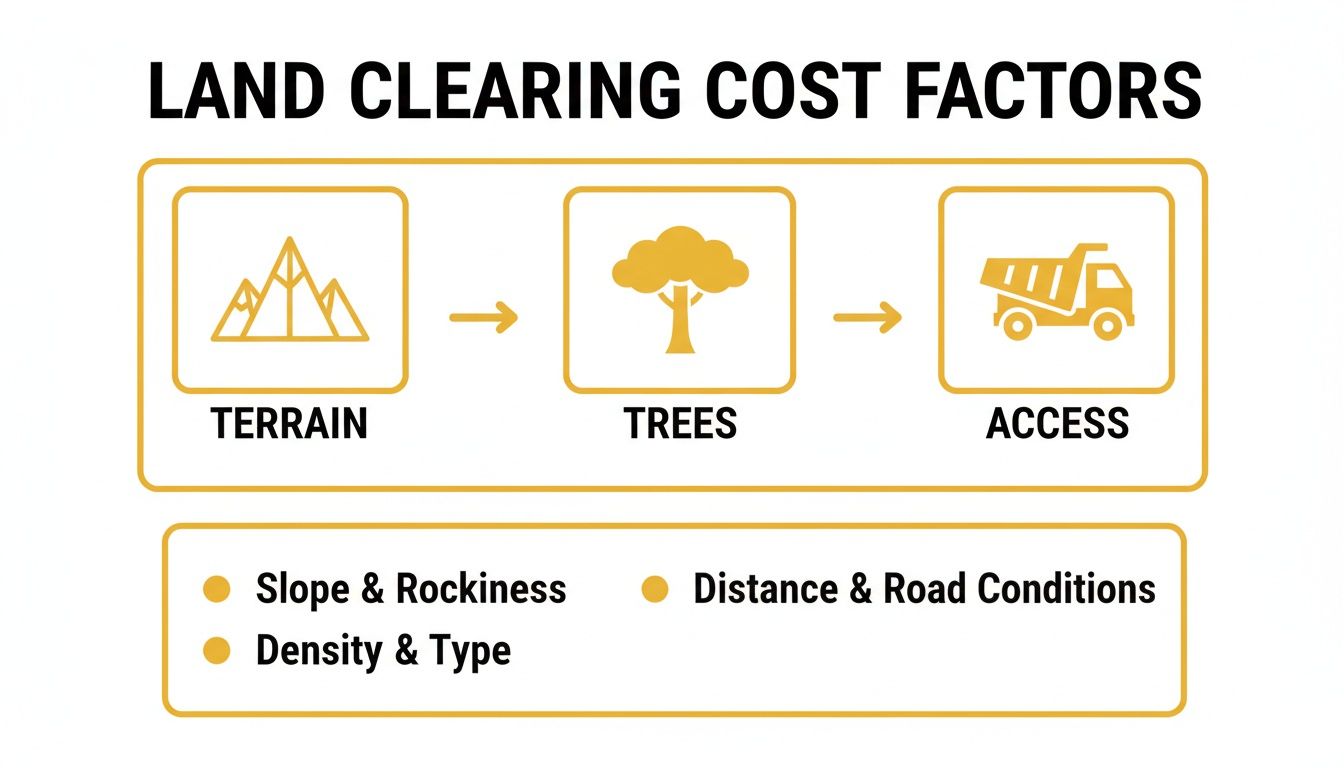
As you can see, whether you mulch or use a dozer, tough terrain, big trees, and poor access will always add time and expense to the job.
Head-to-Head: Which Is Right for You?
To help you decide, let's put these two methods side-by-side. This is where knowing your end goal is critical for both your budget and your timeline.
If you want a deeper dive into the numbers, check out our detailed guide on forestry mulching cost per acre to see how it compares in different scenarios.
When you're comparing land clearing options, it really comes down to what you need the final piece of land to look like. Here’s a quick breakdown to make the choice clearer.
Comparison of Land Clearing Methods
Feature | Forestry Mulching | Traditional Clearing (Dozer & Haul) |
|---|---|---|
Final Result | Soil is left intact with a protective mulch layer. | Bare dirt, ready for grading and foundation work. |
Cost | Often lower due to no hauling or disposal fees. | Typically higher due to extra labor, equipment, and landfill fees. |
Speed | Faster, as it's a one-step process with a single machine. | Slower, involving multiple stages (clearing, piling, hauling). |
Environmental Impact | Low impact; enriches soil and prevents erosion. | High impact; removes topsoil and increases erosion risk. |
Best For | Pasture creation, underbrush removal, trail cutting, property beautification. | New home construction, road building, commercial development pads. |
Ultimately, the best method really depends on what your specific project needs. At Palm State Clear Cut, we help landowners weigh these options every day to find the most effective and economical solution for their property.
How to Estimate Your Project Cost Before Calling a Pro
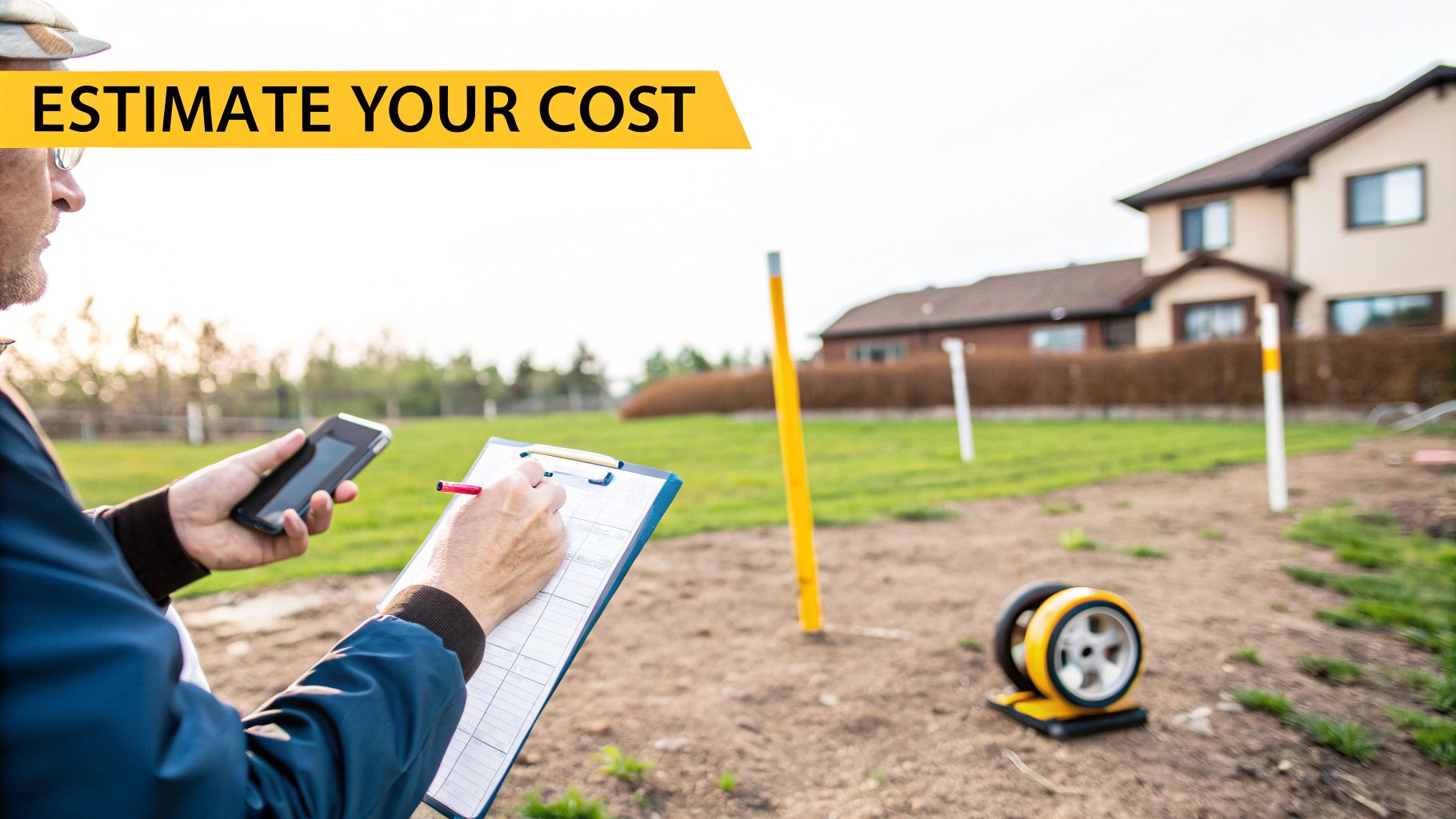
Before you ever pick up the phone, you can do some simple groundwork to get a surprisingly solid idea of your project's scope. This quick self-assessment won’t replace a professional estimate, but it will absolutely transform your first conversation with a contractor. You'll go from a vague inquiry to a productive, informed discussion.
Think of it like being a detective on your own property. The more clues you gather upfront, the more precise those initial estimates will be. This process helps you see your land through a contractor’s eyes and truly understand the final cost of clearing an acre of land.
This is all about documenting what you have, spotting challenges, and deciding what you want the finished product to look like.
Step 1: Document Your Starting Point
Your smartphone is your best friend for this part. Walk the entire property and take plenty of photos and videos from different angles. Don't just get the wide shots—capture the details that will actually impact the work.
Overall Views: Get panoramic shots from each corner of the lot to show the general layout and density.
Vegetation Close-Ups: Snap pictures of the thickest areas. Are you dealing with tall grass and a few saplings, or dense palmettos and mature oaks?
Problem Areas: Make sure to photograph any potential obstacles. Think steep slopes, low-lying wet spots, big boulders, old fencing, or junk piles.
Access Points: Take a few pictures of the entrance to your property from the main road. Show the width of any gates or paths leading back to the work area.
This visual evidence is gold. It lets a contractor see what they're up against before they even set foot on your land.
Step 2: Assess Your Vegetation Density
Now, let's put some rough numbers to what needs clearing. You don’t have to be a forester for this; just categorize what you see. A simple way to do this is to mentally divide your acre into four quadrants and size up each one.
For each section, ask yourself:
What percentage is light brush and grass? (Easy to clear)
What percentage is dense undergrowth and small trees (under 8 inches in diameter)? (Moderate effort)
What percentage is large, mature trees (over 8 inches in diameter)? (High effort and cost)
Jot down your estimates. A property that’s 80% light brush with a couple of big trees is going to have a dramatically different cost than one that’s 80% dense, mature woods.
Key Insight: This quick "density audit" is the most direct way to get a feel for your costs. The more moderate-to-heavy growth you have, the more machine time, horsepower, and labor the job will need—and that's what drives the final quote.
Step 3: Identify and Map Obstacles
Next up, grab a piece of paper and create a simple sketch of your acre. It doesn’t need to be a professional survey, just a basic map. On this map, mark the location of every potential obstacle you found during your photo tour.
Draw lines for any steep slopes or ravines.
Shade in areas that are always wet or marshy.
Mark the spots with large rocks, old foundations, or hidden stumps.
Note any property lines, fences, or utility poles the crew will have to work around.
This little map helps you clearly communicate the unique challenges of your land. An experienced operator can glance at it and immediately start planning their approach, which makes for a much more accurate initial estimate.
Step 4: Define Your End Goal
Finally, get crystal clear on what you want the land to look like when we're finished. Your desired outcome is a massive piece of the puzzle that directly influences the methods and machinery we'll use.
Ask yourself these questions:
Do you need a completely bare-dirt finish, ready for a building foundation? That usually points toward traditional dozer work.
Are you creating a pasture or thinning woods where a protective layer of mulch would be beneficial? That's a perfect job for forestry mulching.
Do the stumps need to be ground down below the surface, or is it okay if they're left in place?
Having a clear vision helps a contractor recommend the right service and quote the job accurately from the get-go. Globally, the cost of these projects is huge; recent data shows we lose around 25 million acres of forest every year. If you apply a mid-range commercial cost of $1,500 per acre, that's roughly $37.5 billion in direct clearing expenses alone, not even counting site prep or restoration. You can find in-depth data on global land use changes to see how these figures are tracked.
By completing this quick self-assessment, you’re not just saving time—you’re taking control of the process and making sure your project starts on the right foot.
Smart Ways to Reduce Your Land Clearing Expenses
Everyone wants to get the most for their money, and a land clearing project is no different. Bringing down the overall cost of clearing an acre of land doesn't mean you have to sacrifice quality or safety. It's all about smart planning.
A little strategic thinking and some prep work can make a huge difference. Think of it as setting the stage perfectly so our crew can roll in and get straight to the heavy lifting, saving time and money.
Prepare Your Property for Success
One of the easiest ways to shave costs is to handle the small stuff yourself before the big machines arrive. This cuts down on the billable hours our team spends on minor tasks.
Clear Small Debris: Do a walkthrough and pick up any old fencing, scrap metal, loose trash, or other clutter. Every item you move is one less thing the crew has to work around or pay to haul away.
Mark Your Boundaries: Use stakes or flags to clearly mark your property lines and the exact area you need cleared. This simple step avoids any confusion and makes sure operators don't waste time second-guessing the job's scope.
Identify Utilities: Clearly mark the location of any known septic tanks, wellheads, or underground utility lines. Hitting one of these by accident is a costly mistake that's easy to prevent.
Even these small efforts can trim hours off the job, which translates directly into savings. For smaller lots or lighter brush, you might even consider other options for how to clear land without heavy equipment.
Make Smart Financial Decisions
Beyond the physical prep, your approach to hiring and choosing a clearing method will have the biggest impact on your budget. Being an informed customer is your best tool.
Expert Insight: The single most effective cost-saving move is often choosing forestry mulching over traditional clearing. By turning vegetation into mulch right on-site, you completely sidestep the huge expense of hauling debris and paying landfill fees. This one decision can slash a project's budget.
Getting multiple detailed quotes is also non-negotiable. It's not about finding the absolute cheapest price—it's about understanding the going rate and making sure you're getting a fair, all-inclusive bid.
You can also try scheduling your project during a contractor’s off-season, like the hottest summer months or just after the new year. Demand might be lower, and you could find more competitive pricing. Combine savvy planning with smart choices, and you can make your land clearing project both effective and affordable.
Frequently Asked Questions About Clearing Land
Once you've wrapped your head around the different methods and costs, a few specific questions usually pop up. That’s a good thing. Clearing land is a big step, and you want to be sure you’ve covered all your bases before breaking ground.
To help you feel confident moving forward, we’ve put together answers to the most common questions we get from property owners right here in Central Florida. Think of it as a final gut-check before you get started.
How Long Does It Take to Clear One Acre of Land?
This is the big one, and the honest answer is: it completely depends on what’s on that acre. There's no magic number.
A good way to think about it is like cleaning out a garage. If it's just got some light clutter and a few boxes (like tall grass and light brush), you can get it done in an afternoon. If it's moderately packed with old furniture and stacked-up junk (small trees and dense undergrowth), you're looking at a full weekend project. But if that garage is floor-to-ceiling with heavy, forgotten stuff (mature trees and massive stumps), it could take you the better part of a week.
Here’s how that translates to land clearing:
Lightly Overgrown Acre: If you're dealing with just tall grass, weeds, and a handful of small saplings, a skilled forestry mulching crew can often knock it out in 4 to 8 hours.
Moderately Wooded Acre: For property with a solid mix of thick brush and a lot of small-to-medium trees, you should plan on it taking 1 to 2 full days.
Heavily Wooded Acre: An acre dense with large, mature trees, stubborn stumps, and tangled thickets? That job could easily stretch to 3 days or even more.
Things like steep hills or tricky access can slow the crew down, too, since they have to operate more carefully. The bottom line is that the density of the vegetation sets the clock.
Do I Need a Permit to Clear My Land in Florida?
The classic answer here is a firm "it depends." Sorting out the local rules is one step you absolutely can't skip. While you probably don't need paperwork to clear a few nuisance bushes in your backyard, most real clearing projects will.
Here in Central Florida, almost every county and city has its own rules about tree removal and changing the landscape. These ordinances exist to protect important natural resources, especially "specimen" trees (think those beautiful, huge live oaks) and environmentally sensitive wetlands.
Important Takeaway: Never, ever assume you're good to go without checking first. Firing up the equipment without a necessary permit can get you hit with a stop-work order and some seriously painful fines, blowing up your timeline and your budget.
A reputable land clearing company will know the local regulations and can usually help point you in the right direction for the permitting process, making sure your project is above board from day one.
Why Are Large, Mature Trees So Expensive to Remove?
Taking down a huge, old tree isn't just a bigger version of cutting down a small one—it's a completely different ballgame. It's a complex operation that demands serious skill and heavy-duty machinery, which is why a single big oak can cost more to remove than a whole patch of smaller pines.
It's like this: pulling up a sapling is like yanking a weed from the garden. Taking down a 50-foot oak tree is more like a demolition project.
Here’s a quick breakdown of what’s actually involved:
Felling: A skilled crew has to carefully plan and control how that massive tree comes down so it doesn’t crush a fence, a building, or another valuable tree.
Processing: Once it's on the ground, that enormous trunk needs to be sliced into sections that can actually be moved.
Stump Removal: The stump and its sprawling root system have to be either ground down or ripped out with an excavator—a task that takes serious horsepower.
Hauling: The sheer amount of wood and debris from one big tree can easily fill an entire dump truck. That means major costs for transport and disposal.
Every single one of those steps adds significant time, labor, and machine hours to the invoice.
Can a Forestry Mulcher Handle Stumps?
This is a great question and a common point of confusion. While a forestry mulcher is a beast when it comes to turning standing trees and brush into a layer of mulch, it's not designed to be a stump remover.
The mulcher’s grinding head does its work above the soil. It can chew a stump down until it’s perfectly flush with the ground, or even an inch or two below. This is an ideal solution if you're creating a pasture, cutting trails, or just reclaiming a recreational area. It gets rid of the trip hazard and lets you mow right over the spot.
However, if you need that stump and its entire root ball gone—say, for pouring a new home foundation or running utility lines—you'll need to bring in a dedicated stump grinder or an excavator. Those are the tools built to dig deep and completely remove the stump, leaving you with nothing but clean, ready-to-use dirt.
Ready to find out exactly what it would take to clear your property? The team at Palm State Clear Cut has the expertise and the right equipment for any land clearing job in Central Florida. We’ll walk your land with you, understand your goals, and give you a clear, detailed quote with no strings attached.
Comments