
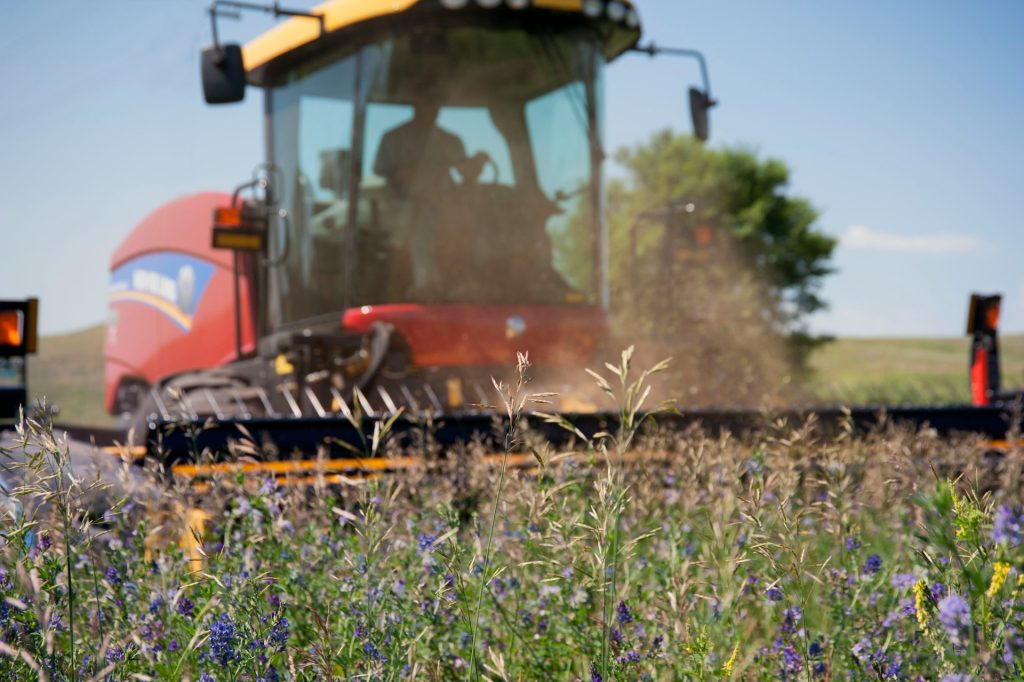
Trying to pin down a firm price for forestry mulching can feel a bit like asking, “How much does a home renovation cost?” The answer is always, “It depends.” You’ll often see prices ranging from $100 to $250 per hour or $500 to $2,500 per acre, but the final number really comes down to the unique conditions of your property.
Your Guide to Forestry Mulching Prices
Thinking about forestry mulching is a lot like planning a major landscaping project. The total cost isn’t just about the size of your lot—it’s about what’s on it. A flat, grassy acre is a world apart from a hilly acre choked with dense hardwoods and tangled vines.
Forestry mulching works the same way. The price directly reflects the time, effort, and machinery needed to turn your overgrown land into a usable, clean slate. To get a real sense of what you might spend, it’s helpful to understand the two main ways contractors price their work.
Per-Hour vs. Per-Acre Pricing
Most forestry mulching pros will bill you in one of two ways: by the hour or by the acre. Each model fits different types of jobs.
- Hourly Rate: This is the go-to for smaller properties, usually under three acres. It’s also perfect for projects where the scope is a bit tricky to nail down, like land with a mix of heavy brush and open spots, steep terrain, or jobs that require careful, selective clearing around keepers.
- Per-Acre Rate: For bigger, more uniform tracts of land, a per-acre price is standard. This approach gives you cost predictability right from the start. You’ll also find that many contractors offer a volume discount—the more acres you have mulched, the lower the cost per acre tends to be.
It’s important to remember that most contractors have a minimum charge, often between $500 and $1,000. This isn’t just an arbitrary fee; it covers the very real costs of getting their heavy equipment transported to your site, even for a small job.
To make things a bit clearer, here’s a quick breakdown of what you can generally expect from these pricing models.
Quick Guide to Forestry Mulching Cost Estimates
This table provides a high-level overview of common pricing models and average costs for forestry mulching services.
| Pricing Model | Average Cost Range | Best For |
|---|---|---|
| Per Hour | $100 – $250 | Small, complex, or selective clearing projects |
| Per Acre | $500 – $2,500 | Larger properties with uniform vegetation |
| Minimum Fee | $500 – $1,000 | Projects smaller than 1-2 acres |
Of course, these numbers are just a starting point. The real cost can swing based on what kind of vegetation you have, the lay of the land, and the specific equipment needed for the job. To get a better handle on the process itself, take a look at our detailed guide on what forestry mulching is and how it works.
These variables are exactly why getting a custom, on-site quote is an absolute must for an accurate budget. Your property’s unique character is what will ultimately decide where your project lands within these price ranges.
Key Factors That Drive Your Final Price
Those average per-hour and per-acre rates are a great starting point, but they don’t tell the whole story. The final forestry mulching cost is a direct reflection of the work involved, and let me tell you, no two properties are ever the same.
Think of it this way: driving one mile on a straight, flat highway is a completely different beast than navigating a one-mile, winding mountain road. One burns more fuel, takes more time, and requires more focus. Land clearing is exactly the same—the conditions on the ground dictate the effort, the time, and ultimately, the price.
To budget accurately, you need to understand the specific variables that a contractor looks at when building your quote. These are the things that determine how long the job will take, what kind of machine is needed, and how much wear and tear the equipment will endure.
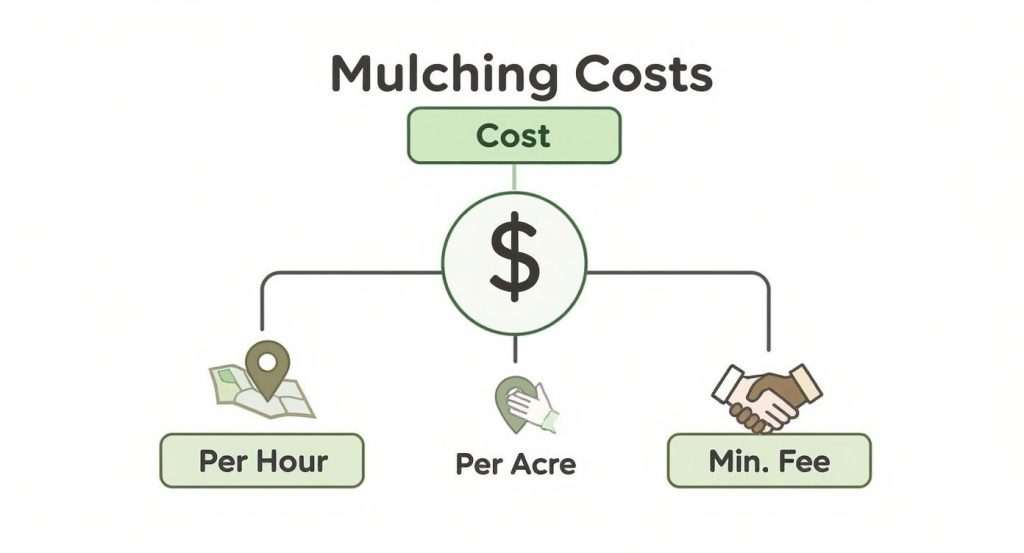
As you can see, the final cost starts with one of these basic models and is then fine-tuned based on the unique challenges your land presents.
Vegetation Density and Type
The single biggest factor influencing your cost is what we’re actually clearing. Mulching soft, easy-to-shred pines and light underbrush is a world away from grinding through dense, mature hardwoods like live oak.
It’s the difference between cutting through butter and trying to slice a frozen steak—one takes a whole lot more power, fuel, and time.
The density is just as important. A sparse patch of 4-inch saplings can be cleared in a fraction of the time it takes to tackle a thicket of the same trees packed in tightly together. Any good contractor will walk your property to assess the “grind time” needed for your specific mix of trees, vines, and brush.
A property choked with dense, 6-inch diameter hardwoods and tangled vines can easily take twice as long to clear as a similar-sized lot with just scattered 3-inch pines. That time difference hits the final cost directly.
Terrain and Slope
The lay of the land is another huge piece of the puzzle. A flat, dry piece of ground is ideal; it lets the mulching machine run at peak efficiency.
But once you introduce challenges like steep slopes, soggy ground, or rocky soil, the whole process slows down. Operators have to move carefully to stay safe and avoid breaking the machine. This cautious navigation means less land gets cleared per hour, which naturally pushes the overall project cost up.
Property Accessibility
Don’t forget, we have to get the heavy machinery to the worksite. If your property is right off a main road with easy entry, mobilization costs will be minimal.
However, if the job site is tucked away down a long, narrow private road, that extra travel time and logistical planning will be factored into your quote.
We always check for a few key things:
- Gate Width: Is the entrance wide enough for the truck and the mulcher to pass through?
- Overhead Clearance: Are there low-hanging power lines or tree limbs that could be an issue?
- Ground Conditions: Is the path in solid enough to support thousands of pounds of equipment without it getting stuck?
Any hurdle in getting the machine to the starting line will find its way into the final bill.
Project Size and Economies of Scale
This might sound backward, but bigger projects often have a lower cost per acre. It all comes down to economies of scale.
Every job has fixed costs, like hauling the equipment out and getting set up. On a small, one-acre job, these costs make up a big slice of the pie. But when you spread those same fixed costs over a 10-acre project, the rate per acre drops significantly.
Contractor’s Equipment and Overhead
The type of machine a contractor brings to your property absolutely affects their rates. Bigger, more powerful mulchers get the job done faster, but they also have much higher operating costs for fuel, maintenance, and insurance. The initial investment is no joke—a professional setup can easily run from $187,000 to $485,000.
Those high startup costs are a major reason why the hourly rates are what they are. A contractor with a powerful, well-maintained machine might have a higher hourly rate, but they can often finish the job so much faster that you end up saving money in the long run. If you want to get into the weeds on the different types of equipment, check out our guide to underbrush clearing machines.
The table below breaks down how these common factors can swing your final price one way or the other.
Cost Impact of Common Project Variables
| Factor | Low Cost Scenario (Example) | High Cost Scenario (Example) | Estimated Cost Impact |
|---|---|---|---|
| Vegetation | Sparse, 2-3″ softwoods (pines) and light brush | Dense, 6″+ hardwoods (oaks) with thick vines | +50% to 100% |
| Terrain | Flat, dry, and clear of obstacles | Steep slopes, wet/boggy areas, and rocky soil | +20% to 50% |
| Accessibility | Easy access from a paved road; wide gate | Remote site with a long, narrow, or muddy path | +5% to 15% |
| Project Size | 10+ acres (economies of scale apply) | 1-2 acres (fixed costs have a higher impact) | -10% to 25% (per acre) |
As you can see, the “best case” and “worst case” for a property can result in dramatically different quotes, even for the same acreage.
Permits and Additional Services
Finally, remember to account for any potential extras. Standard mulching usually doesn’t need special permits, but if your project is in or near sensitive areas like wetlands, you may need approval. Getting those permits is typically the landowner’s responsibility.
Also, be sure to clarify what’s included. Services beyond basic mulching will add to the price:
- Stump Grinding: Mulching cuts stumps flush with the ground, but grinding them below the surface is a separate service.
- Debris Removal: If there’s old fencing, scrap metal, or concrete that needs to be hauled away, that will be an extra charge.
- Herbicide Follow-Up: To keep invasive plants from coming back, a follow-up herbicide treatment is a smart move, and it’s priced separately.
Real-World Mulching Cost Scenarios
It’s one thing to talk about the factors that drive forestry mulching cost, but it’s another to see how they come together on an actual piece of land. To really get a handle on what you might spend, let’s walk through a few common projects we tackle right here in Central Florida.
Every property has its own story, and the final price tag is just a reflection of its unique challenges and goals. By looking at these real-world examples, you can find the one that sounds most like your own and get a solid idea of what to expect.
Scenario 1: The New Homesite
Imagine a family has just bought a beautiful two-acre lot in a semi-rural neighborhood. They need the front acre completely cleared for their new home, septic field, and a driveway, but they want to keep the back acre wild for a natural privacy screen.
The land itself is perfect—flat and easy to get to from a paved road. The problem? That front acre is a classic Florida jungle. It’s choked with a dense mix of tough palmettos, invasive Brazilian pepper, and a smattering of 4 to 6-inch pines. You can barely take two steps into it.
Cost Driver Breakdown:
- Vegetation: The sheer density of fibrous palmettos and woody Brazilian pepper is the main event here. This isn’t just light brush; it’s a grind-intensive job that needs a powerful machine and a lot of time.
- Size & Scope: Since they’re only clearing one acre, the project falls into a higher per-acre price bracket. This is simply because of the fixed costs of getting heavy equipment to and from the site.
- Terrain & Access: The flat ground and easy road access are big wins. They help the operator work at maximum efficiency and avoid any extra fees for tricky access.
Estimated Project Cost: For this kind of heavy-duty clearing on a smaller lot, the family should budget somewhere in the $1,800 to $2,700 range. It would likely take a skilled operator one full day to transform that tangled mess into a clean, build-ready site.
Even though it’s just one acre, the sheer volume of material that needs to be processed is what’s really driving the cost.
Scenario 2: The Overgrown Pasture Reclamation
A local rancher has a 15-acre property, but a five-acre parcel that was once prime grazing land has been lost to a decade of neglect. It’s now an impassable wall of invasive shrubs, tallow trees, and thorny briar patches. The goal is simple: get that pasture back.
The ground is gently rolling but firm and dry, which is good. The real challenge is the vegetation. There aren’t many large trees, but the incredible density of tangled, thorny growth means the work will be slow and methodical. Luckily, a solid dirt road leads right to the work area.
Cost Driver Breakdown:
- Vegetation: The trees are small (mostly 2-4 inches), but the density is off the charts. The operator can’t just plow through it; they have to carefully chew through the tangled mess to mulch it all properly.
- Size & Scope: At five acres, the project is large enough to benefit from some economies of scale. We can offer a much better per-acre rate than we could for the single-acre homesite.
- Terrain & Access: The gentle hills might slow the machine down a tiny bit, but it’s not a major issue. The easy access is a big plus for logistics.
Estimated Project Cost: To reclaim these five acres, the rancher is likely looking at a cost between $4,500 and $7,000. That breaks down to a more attractive $900 to $1,400 per acre. This is a multi-day job, probably taking two to three days to turn that useless thicket back into productive land.
Scenario 3: The Firebreak and Trail Project
Here we have a homeowner with a 10-acre wooded lot in an area at high risk for wildfires. Their goal is twofold: create a 30-foot-wide firebreak around the entire property line for safety, and cut a nice half-mile walking trail through the woods for recreation.
The property is mostly mature pine forest with a light to moderate understory of gallberry bushes and small saplings. The terrain is flat, but getting the machine to the back of the property will require some careful maneuvering around large, established trees.
Cost Driver Breakdown:
- Vegetation: This is the easiest clearing of the three scenarios. The undergrowth is relatively light, so the mulcher can move through it quickly. The focus is on small vegetation, not big, time-consuming trees.
- Size & Scope: This is selective work, not bulk clearing. The operator is working along specific lines, not clearing the entire area. For jobs like this, an hourly or day rate makes the most sense and provides the most clarity for the client.
- Precision Work: Cutting clean, straight firebreak lines and a winding, natural-looking trail requires more finesse and control than just clearing a field.
This project isn’t about total land clearing; it’s about strategic, careful work to improve safety and enjoyment while preserving the forest’s character.
Estimated Project Cost: A specialized job like this is almost always quoted by the day. The homeowner can expect the total project to cost between $3,500 and $5,000. This would likely cover the two to three days needed for a professional to meticulously cut the firebreak and trail system.
Seeing the Bigger Picture: The Long-Term Value of Mulching
Thinking about the forestry mulching cost as just an upfront expense is like only looking at one side of a coin. To really get it, you have to flip it over and see the powerful return on investment (ROI) it brings over time. Mulching isn’t simply about clearing land; it’s a strategic move that invests in your property’s future health, safety, and value.
Don’t see it as an expense. See it as a down payment on a more valuable, more manageable piece of land. You’re instantly turning overgrown, unusable acres into clean, open spaces, which dramatically boosts your land’s usefulness and curb appeal. That kind of upgrade often leads directly to a higher property valuation, making the initial cost a smart financial play.
Financial Wins Beyond Just Clearing Land
The long-term value of mulching goes way beyond just making the place look good. It’s a win for both your wallet and the environment, and it keeps paying you back long after the machines have packed up and gone home.
Here’s how that investment breaks down over time:
- Healthier Soil: Traditional clearing methods can strip the land bare. Mulching does the opposite by leaving a protective blanket of organic material. This layer holds in moisture, stops erosion, and slowly breaks down, feeding vital nutrients back into the ground.
- Huge Savings on Future Maintenance: That same layer of mulch acts like a natural weed barrier. It smothers the regrowth of pesky invasive species and underbrush, which means you’ll spend far less time and money on upkeep down the road.
- Lower Wildfire Risk: By grinding up dense underbrush and “ladder fuels” that let fires climb into treetops, forestry mulching creates a defensible space around your home and property. It’s a proactive step that can seriously reduce your wildfire risk, and some insurance companies might even reward you with lower premiums.
It’s no surprise that this approach is catching on. The global market for forestry mulchers was valued at around $615 million in 2023 and is on track to hit nearly $1.02 billion by 2032. This growth is all driven by the increasing demand for smarter, more sustainable land clearing. You can dive deeper into the forestry mulcher market growth at archivemarketresearch.com.
Shifting from Cost to Investment
Once you start adding up the benefits—higher property value, revitalized soil, and long-term savings on maintenance and potential risks—the initial forestry mulching cost stops looking like an expense and starts looking like a well-calculated investment.
Forestry mulching is one of the few land improvement methods where the process that clears the land simultaneously begins to heal and enrich it for the future.
This dual benefit is what makes it such a financially sound decision. You’re not just paying to get rid of unwanted vegetation; you’re investing in the long-term health, usability, and resilience of your most valuable asset. The upfront cost buys you a service that actively protects and enhances your land for years, making it one of the smartest choices a landowner can make.
How to Hire the Right Mulching Contractor

Choosing the right contractor is just as critical as the decision to mulch your property in the first place. The right team gets the job done safely, efficiently, and on budget. The wrong one can leave you with property damage, surprise fees, and a massive headache.
Think of it like hiring a builder for a new home—you wouldn’t just pick the first one you find. You need someone with the right tools, a solid track record, and clear communication. A great contractor not only has the right equipment but also gets the specific challenges of Central Florida land, from our sandy soils to those stubborn palmettos.
Your Contractor Vetting Checklist
Finding a qualified pro doesn’t have to feel like a shot in the dark. A little structure in your search helps you compare companies apples-to-apples and protects you from problems down the line.
Here’s a simple checklist to guide you from your initial search to signing on the dotted line:
- Gather Multiple Quotes: Never, ever settle for the first price you get. You should reach out to at least three reputable local companies for written estimates. This gives you a real-world sense of the fair market rate and helps you immediately spot any bids that seem way too high or suspiciously low.
- Verify Insurance and Licensing: This one is non-negotiable. A legitimate contractor must carry General Liability insurance to cover any potential property damage and Workers’ Compensation to protect their crew if someone gets hurt on your land. Ask to see their certificates of insurance and don’t be afraid to call the provider to verify they’re active.
- Check Reviews and References: Look for companies with a consistent history of positive feedback on Google and other platforms. Better yet, ask for references from recent local projects that were similar to yours. A contractor who is confident in their work will be more than happy to connect you with a few satisfied clients.
Essential Questions to Ask Every Contractor
Once you have a few bids in hand, it’s time to dig a little deeper. The answers you get here will tell you everything about a contractor’s professionalism, experience, and what’s really included in their forestry mulching cost. Our landowner’s guide to forestry mulching services dives into even more detail, but these questions are the perfect place to start.
Questions About Equipment and Process:
- What specific type and size of machine will you be using for my job?
- How do you handle unexpected obstacles like big rocks or old fence wire?
- What’s your process for protecting the mature trees or sensitive areas I want to keep?
- Is stump grinding below ground level part of the deal, or is that a separate charge?
Always get a detailed, written contract before a single machine rolls onto your property. It should clearly spell out the full scope of work, the total cost, the payment schedule, and an estimated timeline. This document is your protection—it ensures you and the contractor are on the same page from day one.
Questions About Logistics and Costs:
- How do you calculate the final price—is it per hour, per day, or a flat per-acre rate?
- What is explicitly not included in this quote? (Think debris hauling, permits, etc.)
- Do you have a minimum project fee I should be aware of?
- What happens if we get rained out? What’s your policy for weather delays?
By asking these pointed questions, you can truly compare your bids and find a partner who will get the job done right. A true professional will welcome your questions and give you clear, confident answers, setting the stage for a smooth and successful project.
Even after you get a handle on the pricing models and the factors that drive costs up or down, a few specific questions always seem to pop up. Think of this as your quick-reference guide, where we tackle the most common things we hear from landowners who are on the fence about mulching.
Getting these details straight can make a world of difference. It helps you accurately compare mulching to other clearing methods and, more importantly, ensures there are no sticker-shock moments when the final bill arrives.
Is Forestry Mulching Cheaper Than Traditional Land Clearing?
In most cases, yes. When you look at the total project cost, forestry mulching is often far more budget-friendly than bringing in bulldozers and dump trucks. It’s a one-machine, one-step process, which means you skip the costs of hauling away debris, burning massive piles, or repairing the extensive ground damage that older methods leave behind.
While the upfront quote might look similar on a tiny job, the savings on disposal, extra permits, and site remediation really add up, making mulching the smarter economic choice for the majority of projects.
Does the Price Per Acre Decrease for Larger Projects?
Absolutely. It’s a classic case of economies of scale. Nearly every professional contractor will offer a lower rate per acre as the job size increases. The fixed costs—like getting heavy machinery out to your property—get spread out over more acres, which brings your overall price per acre down.
It’s always a good idea to ask if a contractor has price breaks at certain thresholds, like 5, 10, or 20 acres. Planning ahead can unlock some serious savings, so if you have long-term goals for your property, clearing it all at once often makes the most financial sense.
Clarifying what is not included is just as important as knowing what is. A professional quote will be transparent, but it is your responsibility to read it carefully and ask for specifics on any service you assume is covered.
What Is Not Included in a Standard Mulching Quote?
This is a big one, and it’s crucial to get clarity before any work starts. A standard forestry mulching cost quote is for the mulching itself and typically does not include:
- Deep stump grinding that goes well below ground level.
- Hauling away non-organic debris like old fencing, concrete chunks, or random trash.
- Securing permits for you. This is almost always the landowner’s responsibility.
- Follow-up services like seeding or applying herbicide.
Always read your quote top to bottom. If you assumed something was included but don’t see it listed in black and white, ask your contractor to clarify. A good one will be happy to explain exactly what you’re paying for.
Ready to transform your overgrown property into a clean, usable space? The team at Palm State Clear Cut has the equipment and local expertise to get the job done right. Contact us today for a free, no-obligation quote!