
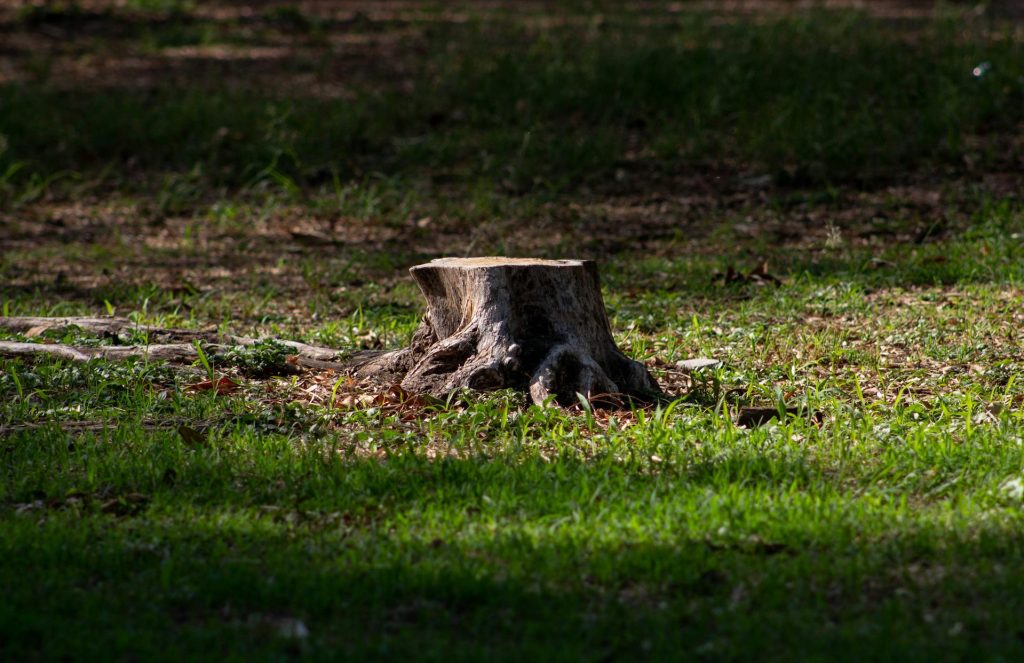
So, you’ve had a tree taken down, and now you’re left with the stump. What’s next? This is where the real decision-making begins. You have two main routes: stump grinding or complete stump removal. While they both get rid of that eyesore, the methods, costs, and impacts on your property are worlds apart.
Making the right call here depends entirely on what you plan to do with that space next.
Stump Grinder vs. Stump Removal: The Core Difference
At its heart, the difference is pretty simple. Stump grinding is like performing surgery on the stump. We bring in a machine that essentially shaves the stump down into tiny wood chips, grinding it down well below the surface of your lawn. The roots are left behind to decompose naturally over time.
Stump removal, on the other hand, is a full-on excavation. This is the more intensive option, where we use heavy equipment to dig out the entire stump and its massive root ball, leaving a large, clear hole in the ground.
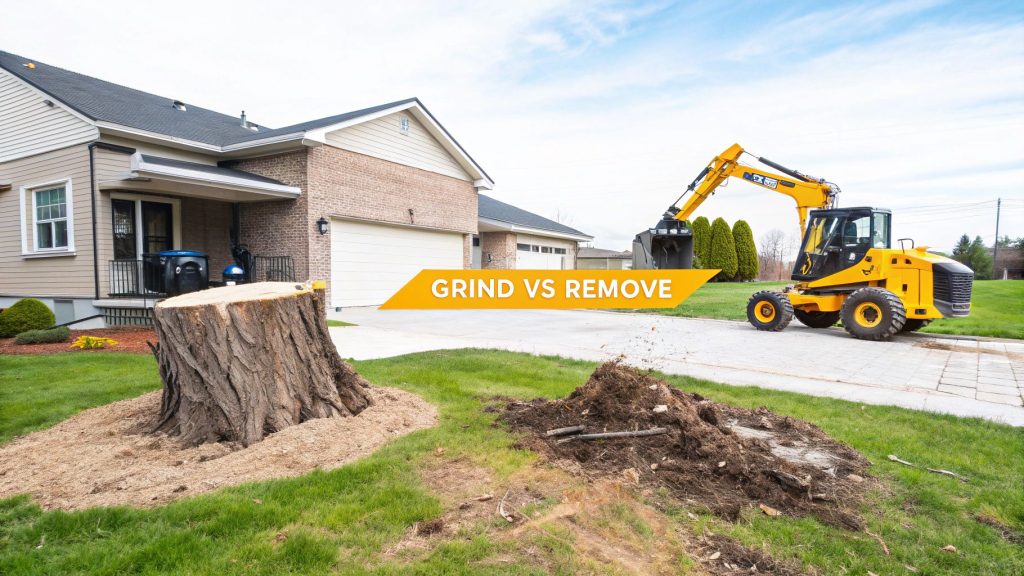
Think of it this way: grinding is a quick, clean solution for reclaiming your lawn, while removal is the first step toward a new construction project.
Stump Grinding vs. Stump Removal At a Glance
To make it easier to see the differences side-by-side, here’s a quick breakdown of what each process entails.
| Factor | Stump Grinding | Stump Removal |
|---|---|---|
| Method | Grinds stump into wood chips 6-12 inches below ground level. | Excavates the entire stump and the major root ball. |
| Landscape Impact | Minimal disruption, leaving a small pile of mulch. | Creates a large hole and significant soil disturbance. |
| Outcome | The visible stump is gone, but roots remain underground to decay. | The stump and entire root system are completely gone. |
| Best For | Aesthetics, lawn restoration, and budget-conscious projects. | New construction, replanting large trees, or paving. |
This table gives you the high-level view, but the real decision often comes down to the practicalities—namely, how much it’s going to cost and how long it’s going to take.
Cost and Efficiency
When it comes to your wallet, there’s a clear winner. Grinding is almost always the more affordable and efficient choice.
On average, property owners can expect to pay around $320 for stump grinding. For a full removal, that cost often climbs to $360 or more per stump, and that’s before factoring in the cost of filling the massive hole left behind. For smaller stumps, the price gap can be even more dramatic.
If you’re just looking to get your lawn back to normal without breaking the bank, grinding is hands-down the way to go. You can learn more about how prices are calculated by checking out this guide on the cost differences between stump services.
What Actually Happens? A Look at Each Method
To really get a handle on the stump grinder vs. stump removal choice, it helps to picture what’s going to happen on your property. While both end with the stump gone, the way they get there couldn’t be more different—in equipment, in labor, and in what your yard looks like when the crew leaves.
Let’s walk through how each approach works.
The Stump Grinding Process Explained
Stump grinding is the surgical option. Think of it less like demolition and more like systematically erasing the stump from the top down.
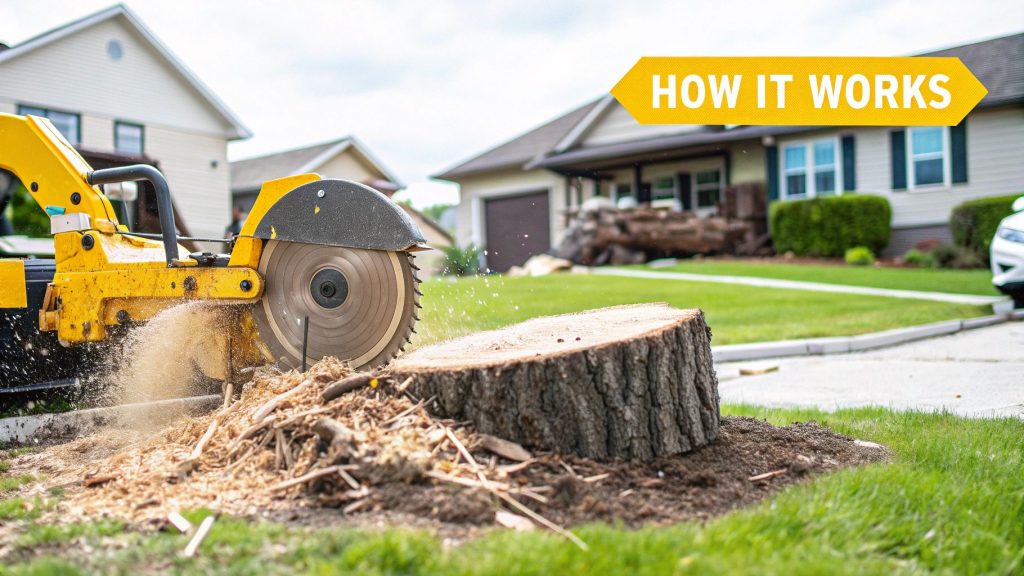
The whole process starts when our team rolls a specialized stump grinder into place. This beast of a machine has a high-speed rotating wheel covered in sharp carbide teeth. Once it’s running, the operator carefully lowers that spinning wheel right onto the stump.
Here’s how the grinding operation plays out, step-by-step:
- First Contact: The wheel hits the stump’s surface, instantly shredding dense wood into small chips.
- Side-to-Side Sweeps: Our operator guides the cutting wheel back and forth across the stump, methodically chewing away layer after layer.
- Going Below Grade: We keep grinding until the stump is gone, typically reaching 6 to 12 inches below the ground’s surface. This ensures it’s out of sight and won’t interfere with your lawn mower.
- The Result: You’re left with a pile of wood chips mixed with soil. You can use this as organic mulch right in your garden beds. The main roots are left underground to decompose naturally over the next few years.
This method’s efficiency is a game-changer. Before portable grinders, total removal was often the only choice. The arrival of modern stump grinders slashed the time and cost of getting rid of a stump by up to 60%, turning a full-day job into a task that takes just a couple of hours.
The Full Stump Removal Process Explained
Full stump removal, on the other hand, is a full-blown excavation. It’s far more invasive and is usually reserved for situations where the entire root system has to go—think new construction, driveways, or laying a foundation.
Full stump removal is the only way to guarantee a completely clear underground space for foundations, utilities, or replanting a large tree in the exact same spot. It’s a solution born of necessity, not convenience.
This process calls for heavy machinery and will definitely disrupt your soil. Here’s what’s involved:
- Clearing the Zone: We first clear a wide area around the stump to make room for heavy equipment like an excavator or backhoe.
- Digging In: The operator starts digging a deep trench around the stump’s perimeter to expose the big anchor roots.
- Cutting the Roots: We use the excavator’s bucket or special cutting tools to sever the major lateral roots holding the stump in place.
- The Big Lift: Once the main roots are cut, the machine leverages its power to pry and pull the entire stump and root ball right out of the ground.
- The Aftermath: This process leaves a huge crater in your yard that needs to be backfilled with fresh soil. The massive stump and its root ball then have to be loaded up and hauled away.
While it’s incredibly thorough, this method is a serious investment in both time and landscape repair. To get a better idea of the kind of heavy-duty machines we’re talking about, take a look at our guide on the essential equipment for clearing underbrush and land.
Analyzing the Impact on Your Landscape and Soil
Choosing between stump grinding and removal isn’t just about getting rid of an eyesore. It’s a decision that will have a real, lasting effect on the health and look of your entire yard. Each method leaves a completely different footprint on your soil, surrounding plants, and the overall lay of your land.
Think of stump grinding as a surgical procedure for your lawn. Its biggest plus is just how little it disturbs everything around it. The process is precise, zeroing in only on the stump itself while leaving your lawn, garden beds, and walkways completely untouched.
This focused approach keeps the existing ecosystem of your yard intact, avoiding the widespread damage that comes with more heavy-handed methods.
The Gentle Footprint of Stump Grinding
Because grinding is so targeted, you don’t need heavy excavation equipment that would otherwise compact your soil or tear up the grass. The machine is carefully maneuvered into place, does its job, and is then removed, leaving behind little more than a pile of fresh wood chips where the stump used to be.
Those leftover wood chips are a fantastic bonus. You can spread them in your garden beds as a natural, organic mulch that’s great for holding in moisture and keeping weeds down.
There is one small thing to keep in mind, though. As fresh wood chips break down, they can temporarily pull some nitrogen from the top layer of soil. For most gardens, this is no big deal and can be easily balanced out with a little nitrogen-rich fertilizer if you notice any issues.
The core trade-off is clear: Stump grinding offers a fast, low-impact solution that preserves your existing landscape, while removal provides a completely clear slate at the cost of significant, immediate disruption.
The environmental perks of this less invasive method are also worth noting. Research shows that stump grinding results in up to 50% less soil disturbance and 30% less carbon emissions compared to a full removal. This is because it doesn’t rely on big, fuel-guzzling machinery and avoids all that heavy digging.
The Major Disruption of Full Removal
Full stump removal, on the other hand, is a major excavation project. There’s no way around it. It requires bringing in heavy equipment like backhoes or excavators to dig, tear, and haul the entire stump and its massive root system right out of the ground.
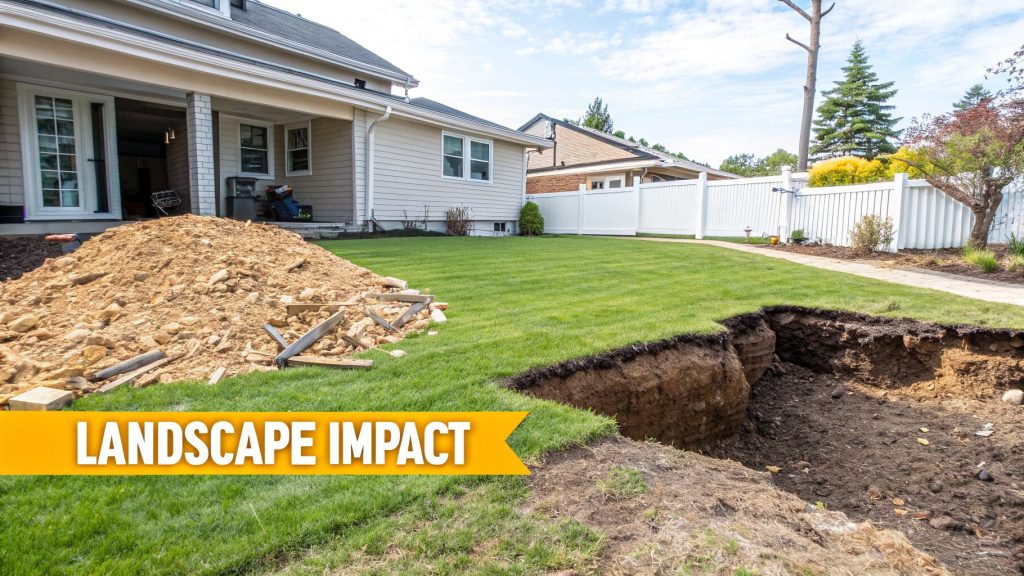
What you’re left with is a giant crater, often several times wider than the stump itself. This process doesn’t just tear up the immediate area; it can damage the root systems of nearby trees and shrubs, stress your lawn, and completely disrupt the soil structure.
Once the stump is gone, the real work begins. You’re facing a significant restoration job. The hole has to be filled, and not with the dirt that came out—that’s now just a messy pile of soil, roots, and rocks. You’ll need to truck in clean fill dirt and topsoil just to get the area level again.
This kind of major disturbance can lead to other headaches down the road. That big pit can mess with natural water drainage and, if it’s not filled and compacted correctly, can cause soil settlement and erosion over time. If that’s a concern, it’s worth learning more about how to prevent soil erosion on your property.
Here’s how the two methods stack up side-by-side:
| Impact Category | Stump Grinding (Surgical Approach) | Stump Removal (Excavation Approach) |
|---|---|---|
| Soil Disturbance | Minimal. The impact is confined to the stump’s immediate footprint. | Severe. Creates a large crater and disrupts soil structure across a wide area. |
| Surrounding Plants | Safe. Nearby lawns, gardens, and tree roots are left undisturbed. | At Risk. Can damage or kill adjacent plants and their root systems. |
| Restoration Work | Simple. Rake the wood chips and plant grass seed or lay sod. | Extensive. Requires backfilling with new soil, grading, and complete re-landscaping. |
| Final Outcome | A level surface ready for grass, with roots left to decay harmlessly underground. | A completely clear underground space, but with a major repair job needed on the surface. |
Breaking Down the Cost and Time Commitment
When it comes down to stump grinding vs. stump removal, the conversation almost always lands on two critical questions: How much is this going to cost, and how long will it take? The answers reveal one of the biggest differences between the two methods. In short, stump grinding is consistently faster and easier on the wallet, while full removal is a much bigger investment of both time and money.
The final price for either service isn’t just pulled out of a hat; it’s figured out based on a few key factors. The most important variable is the stump’s diameter, since a wider stump requires more machine power and time. The hardness of the wood also matters—a stubborn oak stump is going to put up more of a fight than a soft pine. Finally, how easy it is to get to the stump can affect the quote, as tight spaces or tough terrain might call for special equipment or extra hands.
Comparing the Financial Investment
When it comes to your budget, stump grinding is the clear winner. Its efficiency and lower labor needs mean direct savings for you. Full stump removal, on the other hand, relies on heavy machinery, a lot of manual labor, and the logistics of hauling away a giant root ball, making it a far more expensive project.
The global stump grinder market was valued at $1.2 billion in 2023, and North America is a big reason why—homeowners here love how cost-effective it is. On average, stump grinding will run you anywhere from $75 to $400 per stump. For a full removal, you’re typically looking at $150 to $800. That makes grinding a staggering 40–60% more affordable for most residential jobs. You can dig into more details with these cost and time comparisons for stump services.
So, what’s behind that big price gap? A few things:
- Equipment Costs: A stump grinder is a specialized but relatively compact machine. Full removal often requires an excavator or backhoe, which costs more to operate.
- Labor Hours: Grinding is usually a one-person job that’s over pretty quickly. Removal is a multi-step process that involves digging, cutting, lifting, and then filling the hole back in.
- Disposal Fees: Hauling away a massive stump and its root system comes with serious disposal or transport fees. That’s a non-issue with grinding.
- Restoration Expenses: After a stump is removed, you have to buy new soil to fill the crater, adding another line item to your project cost.
The decision often comes down to this: are you paying to simply get rid of a stump, or are you paying for a complete excavation of the ground beneath it? The first is a simple landscaping task; the second is a minor construction project.
Comparing the Time Commitment
Just like with the cost, the time needed for each service is worlds apart. Stump grinding is a remarkably quick process, designed to cause as little disruption to your day as possible. Full removal, however, is an all-encompassing job that can easily eat up the better part of a day, if not more.
For grinding, a small stump under 12 inches in diameter can be gone in less than an hour. Even a big, gnarly stump rarely takes more than a few hours from start to finish. In contrast, removing that same large stump could mean a full day of digging, hauling, and initial site cleanup.
A quick look at the numbers shows just how different the time and cost can be.
Estimated Cost and Time by Stump Size
This table gives you a clear idea of what to expect for both grinding and removal as the stump size increases.
| Stump Diameter | Grinding Cost/Time | Removal Cost/Time |
|---|---|---|
| Small (under 12″) | $75 – $150 / 30-60 mins | $150 – $350 / 2-4 hours |
| Medium (12″ – 24″) | $150 – $250 / 1-1.5 hours | $300 – $600 / 4-6 hours |
| Large (over 24″) | $250 – $400+ / 2-3 hours | $500 – $800+ / 6-8+ hours |
As you can see, the bigger the stump, the wider the gap in cost and time between the two methods becomes. For anyone whose main goal is to reclaim their lawn quickly and without breaking the bank, the efficiency of stump grinding makes it the most logical and practical choice.
When to Choose Grinding vs When to Choose Removal
Knowing the pros and cons of stump grinding and removal is one thing, but applying that knowledge to your own yard is where the real decision happens. The right choice boils down to what you plan to do with the space, what your budget looks like, and how much disruption you can handle.
Let’s translate the technical specs into real-world situations. We’ll look at when grinding is the clear, practical winner and when nothing short of complete removal will do the job right.
Scenarios Where Stump Grinding Is the Best Choice
Stump grinding is the hero when you want to restore your landscape quickly and affordably, without turning your yard into a major project site. For most residential jobs, it’s the go-to solution.
Grinding is almost always the better option if you’re in one of these situations:
- Restoring a Lawn: Is your main goal just to get that stump gone so you can have a flat, green lawn? Grinding is perfect. It takes the stump down just far enough to lay topsoil and sod, blending the spot seamlessly into the rest of your yard.
- Protecting Existing Landscaping: When a stump is wedged near garden beds, a patio, or the roots of your prized oak tree, grinding is really the only safe bet. Its precision is like surgery for your yard, ensuring everything around the stump stays untouched.
- Budget and Time Constraints: If speed and cost are your top priorities, the choice is simple. Grinding is a fraction of the cost of removal and is often done in less than an hour. It’s a quick, efficient fix for an ugly stump.
Think of it this way: when your project is about aesthetics and immediate use—like planting grass or flowers—stump grinding gets you there without the collateral damage and high price tag of a full excavation.
Choosing the right service at the right time is key. To get more timing insights, check out our guide on the best time of year for tree removal in Central Florida, since that’s usually the first step.
When Full Stump Removal Is Non-Negotiable
While grinding handles most situations, some projects absolutely require the stump and its entire root system to be gone. Period. Taking a shortcut with grinding in these cases will only create bigger, more expensive headaches later on.
Full removal is the only real choice in these circumstances:
- New Construction or Foundations: If you plan to build anything over or near the stump’s former location—a deck, a shed foundation, a driveway, a home addition—the whole root ball has to come out. Any roots left behind will eventually rot, creating voids in the ground that can cause the structure above to sink, crack, or fail.
- Replanting a Large Tree in the Same Spot: To give a new tree the best shot at a healthy life, you have to get the old root system out of the way. The decaying wood from a ground stump would hoard nutrients and space, stunting the new tree’s growth from day one.
- Concerns About Disease or Pests: If the tree was cut down because of a root disease like Armillaria root rot, just grinding it won’t solve the problem. The infected roots left in the soil can easily spread the disease to other healthy trees and shrubs. Complete removal is the only way to protect the rest of your landscape.
This flowchart zeroes in on the most critical factor: new construction.
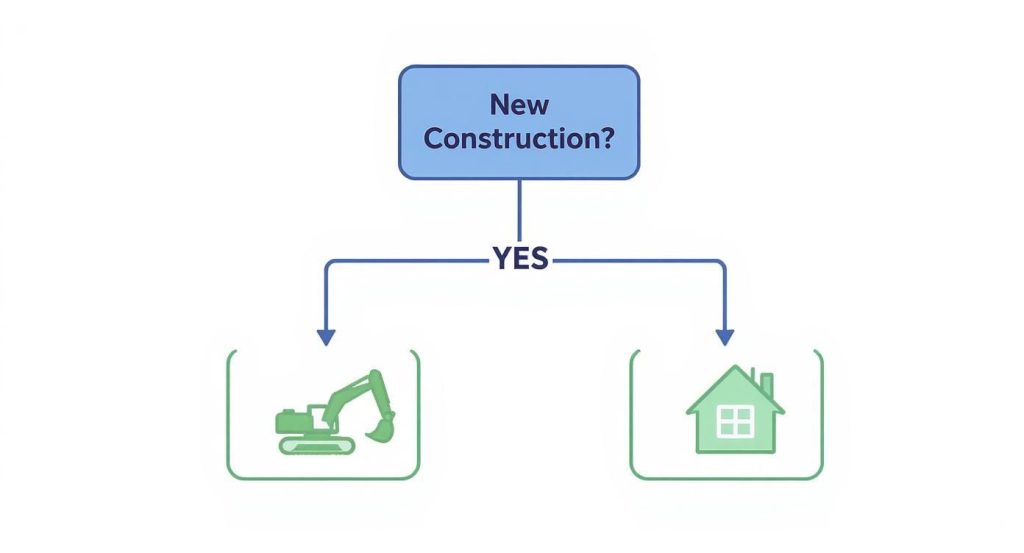
The visual makes it crystal clear: if any kind of new build is in the works for that spot, stump removal is the only path forward to guarantee structural integrity.
You’ve decided between grinding and removal—great! But the job’s only halfway done. Now comes the part that truly determines the quality of the outcome: finding the right professional to handle the work. Who you hire makes all the difference.
This decision is more crucial than you might think. Over the last two decades, stump grinding has become the go-to method across North America because it’s fast and doesn’t break the bank. This boom has led to a 40–60% spike in companies offering the service since 2010, which means you have a lot of options—but not all are created equal. You can read more about the rise of stump grinding services on bloomatree.com.
Key Questions to Ask Before Hiring
Before you sign on the dotted line, you need to ask a few direct questions. A true pro will have no problem answering them clearly and confidently. How they respond tells you everything about their experience, what their service actually includes, and whether that quote is the real final price.
Here’s what you need to ask:
- How deep are you grinding? The industry standard is 6-12 inches below the ground. If they go any shallower, you’ll have a hard time growing a healthy lawn over the spot.
- Does your quote include cleanup? This is a big one. Some outfits grind the stump and leave you with a mountain of wood chips to deal with. Make sure you know if hauling them away or spreading them as mulch is part of the deal.
- Can I see your proof of insurance? Don’t even consider hiring someone who can’t show you proof of liability insurance and workers’ compensation. It’s non-negotiable. This is what protects you if an accident happens on your property.
- What kind of equipment will you be using? Knowing their gear helps you understand if they can even get to the stump without tearing up your lawn, breaking sprinkler heads, or taking out a section of your fence.
A reputable contractor will welcome these questions. If you get vague answers or they hesitate to show you their insurance certificate, that’s a major red flag. Walk away.
Here at Palm State Clear Cut, we believe in being upfront about everything. We give you a detailed quote that spells out exactly what we’re going to do—from how deep we grind to our full-service cleanup—so there are absolutely no surprises.
What to Expect from a Professional Service
A real professional service is about more than just firing up a machine. It’s a commitment to doing the job right while protecting your property. From that first phone call to the final rake of the cleanup, the whole process should feel smooth and worry-free.
Any top-tier contractor will always focus on these three things:
- Site Protection: They’ll take care to avoid damaging your surrounding lawn, garden beds, and any nearby structures. Your property should be their priority.
- Thorough Work: They won’t just hit the main stump. They’ll grind it and any large, visible surface roots down to the depth you agreed on, leaving a clean, level area.
- Complete Cleanup: They leave your property looking tidy. That could mean piling the wood chips neatly for you to use as mulch or hauling every last bit away.
Our team at Palm State Clear Cut lives by these principles. We treat every property like it’s our own, making sure our work improves your landscape with as little disruption as possible.
Frequently Asked Questions About Stump Services
Even after laying out the differences between grinding and removal, a few practical questions always seem to pop up. These are the details that often make or break a decision, so let’s walk through some of the most common concerns we hear from homeowners before we start a project.
Getting these points squared away from the beginning helps ensure there are no surprises on the day we show up. A clear plan always leads to a better outcome for your property.
Can I Plant a New Tree in the Same Spot?
This is a big one, and the answer depends on your method. If you go with stump grinding, trying to plant a large tree in the exact same spot just isn’t a good idea. The old, decaying root system and the freshly ground wood chips will be fighting with your new tree for critical soil nutrients.
For the best shot at success, you’ll want to plant a new tree several feet away from where the old stump was. This gives it a clean slate with undisturbed, nutrient-rich soil. If you’re absolutely set on that specific location, a complete stump removal is the only way to truly clear the space for new growth.
The real issue here is soil health. A ground stump leaves a ton of organic material behind. While that material eventually breaks down into great mulch, the decomposition process temporarily messes with the soil’s nitrogen balance, making it a tough environment for a young tree to establish strong roots.
Will the Stump Grow Back After Grinding?
Nobody wants to deal with a zombie stump sprouting new growth a few months down the line. Thankfully, when a professional handles the job, this isn’t something you need to worry about.
A proper stump grinding service will chew the stump down 6 to 12 inches below ground level. This process completely obliterates the tree’s cambium layer—the part responsible for new growth. The leftover roots, now cut off from their life source, will simply rot away underground without any chance of resprouting.
What Happens to the Wood Chips?
After grinding, you’ll have a surprisingly large mound of wood chips mixed with soil, often filling the hole where the stump used to be. So, what do you do with it?
Most homeowners actually find this byproduct incredibly useful. The chip-and-soil mix is basically free, all-natural mulch. It’s perfect for spreading in garden beds, around shrubs, or along pathways. But if you’d rather have a clean patch of dirt, most contractors (including us) offer cleanup and haul-away services for an added fee. It’s really important to ask if this is included in your initial quote to avoid any unexpected charges.
Ready to get that stubborn stump out of your yard for good? The expert team at Palm State Clear Cut has the equipment and experience to handle any stump, big or small, with minimal impact on your Central Florida property. Visit us at https://palmstateclearcut.com to request your free, no-obligation quote today.