

So you’ve found yourself with a landlocked property in Central Florida. It can feel like you’re holding a key without a door, but I assure you, getting legal access is more common—and achievable—than you might think. The solution usually comes down to one of two paths: digging into historical deeds to find an existing easement or legally establishing a brand-new one by negotiating with your neighbors or, if needed, through court action.
The Landlocked Dilemma: A First Look at Gaining Access in Florida
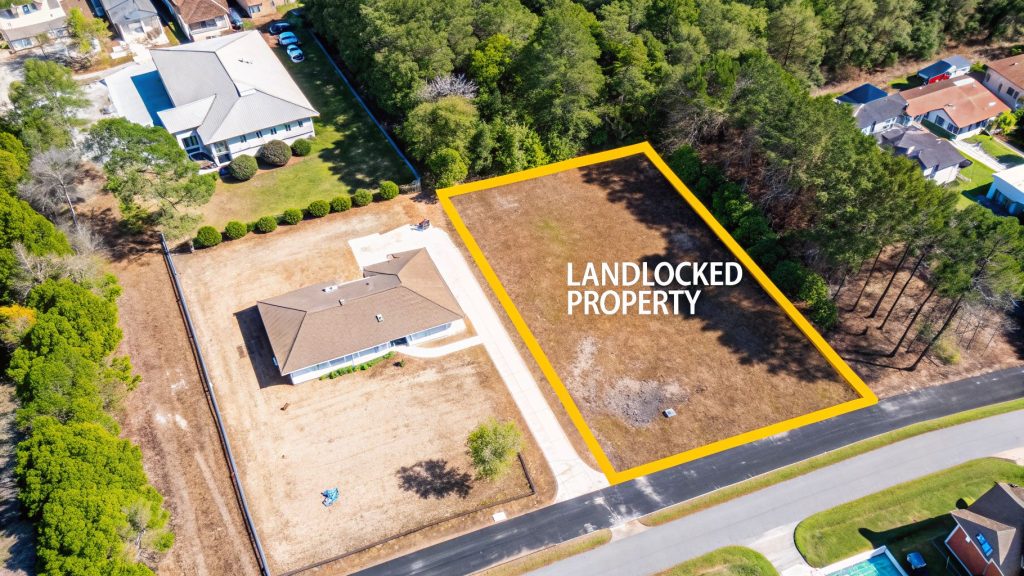
It’s a frustrating moment for any landowner—realizing your new parcel has zero road frontage. This is a surprisingly common headache in Florida, where old land divisions and sprawling rural development have left countless properties cut off from public roads. The journey forward is a bit of a puzzle, one that involves legal rights, neighborly handshakes, and eventually, some practical site work.
Think of this guide as your roadmap. We’re here to help you turn a frustrating problem into a valuable, usable asset. We’ll kick things off by looking at the legal tools you have, mainly the different kinds of easements. The first step to accessing your landlocked property is knowing what rights might already be on the books—and what your options are if there’s nothing recorded.
Connecting Legal Rights to Physical Access
Here’s the thing: securing an easement is only half the battle. The real goal is to create an actual, physical path to your land. This guide is all about connecting the dots between the legal paperwork and the practical outcome of getting equipment on-site to clear the way for your home, farm, or investment.
Solving this access issue is a huge deal. It doesn’t just let you onto your property; it dramatically boosts its value.
In Florida, over 15% of property boundary cases in 2023 involved right-of-way claims. When the historical deeds show a clear intent for access, landowners successfully establish an “easement by necessity” in about 60% of those cases.
Once you have that legal access locked down, it’s time to bring the land to life. According to real estate appraisals here in Central Florida, professional land clearing can boost a property’s value by a staggering 25-40%. You can get a solid overview of the process from our detailed guide on what land clearing is: https://www.palmstateclearcut.com/post/what-is-land-clearing-a-clear-guide-to-process-costs-and-steps. For an even broader look, check out this comprehensive buyer’s guide on accessing landlocked property.
The Value of a Clear Path Forward
Successfully working through this process does so much more than just grant you passage. It unlocks the full potential and market value of your real estate investment. A clear, legal, and physical access route is absolutely non-negotiable if you want to build, farm, or sell your land.
It’s the critical step that transforms an isolated plot into a functional, desirable property ready for whatever you have planned. This journey—from dusty legal research to the final clearing—is essential, and we’ll guide you through every stage.
Uncovering Your Starting Point with Recorded Easements
Before you even think about calling a lawyer or knocking on a neighbor’s door, your first move should be a deep dive into your property’s history. The key to unlocking your landlocked parcel might already be on paper, tucked away in county records as a recorded easement.
This is, hands-down, the most cost-effective first step you can take. A little bit of detective work now could save you thousands in legal battles down the road. The goal is simple: find out what rights you already have. An easement is a legal right to use someone else’s land for a specific purpose, and you’d be surprised how often these are established when a large property is split up, only to be forgotten over the decades.
Where to Begin Your Search in Public Records
Your hunt starts at the county level. For landowners here in Central Florida, that means a trip to the public records or property appraiser’s office in your county, whether it’s Orange, Polk, or elsewhere. These offices are a treasure trove of historical data for every single parcel of land.
Here’s what you need to look for:
- Past Deeds: Pull the deeds for your property and every single surrounding property. Go back as far as you can. You’re looking for specific language that “grants” or “reserves” an easement for access.
- Plat Maps: When a developer subdivides land, they file a plat map that lays out all the lots, roads, and common areas. These maps are legally binding and often show designated easements for access or utilities.
- Official Records: Search the official records using your property’s legal description. You might find a document explicitly titled “Easement Agreement” or “Right-of-Way Grant.”
Honestly, this part can feel like searching for a needle in a haystack, especially when you’re trying to decipher cursive on a deed from 1952. The legal jargon can be dense, but sticking with it can pay off big time.
Why Professional Help Is a Smart Investment
While you can absolutely do this search yourself, hiring a professional is often money well spent. A good title company or real estate attorney has the tools and, more importantly, the experience to run a thorough title search far more efficiently. They know precisely what to look for and how to interpret the kind of complex legal descriptions that are easy for the rest of us to miss.
A professional title search goes beyond just looking for obvious easements. They’ll examine the entire chain of title, which can uncover implied easements or rights established decades ago when your land was part of a much larger tract. This is often the smoking gun you need to claim your access.
Before you get too deep, it’s also wise to get a handle on understanding title insurance in Florida. A good title policy can sometimes reveal existing easements or other issues tied to a property’s history, giving you another critical piece of the puzzle.
Deciphering the Clues You Find
Let’s say you hit the jackpot and find a potential easement in an old deed. Great! The next step is to figure out exactly what it means. A properly recorded easement will spell out the details you need to know.
Key Easement Details to Look For
| Detail | What It Means for You |
|---|---|
| Location & Width | Spells out the exact path and size, like “a 30-foot wide easement along the northern boundary.” |
| Purpose | Defines what the easement is for. You’re looking for terms like “ingress and egress” (the right to enter and exit). |
| Beneficiaries | Identifies who can use it. It should name your property (or a previous owner) as the beneficiary. |
| Maintenance | Outlines who is responsible for keeping the access route in good shape. |
Finding a recorded easement is a total game-changer. It means you already have the legal right to cross a neighbor’s property to get to yours. This solidifies your position and becomes the foundation for everything that comes next. Once your legal access is confirmed, our guide to fence line clearing in Central Florida can walk you through the practical next steps of clearing that path.
So, your title search came up empty. Don’t worry, this is actually a pretty common bump in the road for Central Florida landowners, and it’s far from a dead end. This is simply where we shift gears from digging through dusty old records to exploring proactive legal strategies.
Florida law has specific tools designed for this exact problem. Your next move is to get familiar with the two main legal remedies: an “easement by necessity” and a “prescriptive easement.” They sound similar, but they operate on completely different principles. Figuring out which one fits your unique situation is the key to unlocking your property.
The Case for an Easement by Necessity
An easement by necessity is grounded in simple common sense. The law assumes that no one ever intended to create a piece of property that’s completely unusable. It’s based on the history of the land itself.
To make this claim, you have to prove that your parcel and a neighbor’s adjoining property were once a single tract of land, owned by the same person. When that original property was divided, your piece was left without any path to a public road.
Picture a classic scenario in Polk County: an old 100-acre family farm with plenty of road frontage. The family decides to split it into four 25-acre parcels for the kids. The two front parcels get the road access, but the two in the back are suddenly landlocked.
In a situation like this, the owners of the back parcels have a strong legal argument. They can file a lawsuit to establish an easement by necessity across one of the front properties, because the court presumes the original owner intended for all parcels to be accessible.
The critical piece of evidence is proving this “unity of title.” Your attorney will use those same historical deeds you researched earlier to pinpoint the exact moment the land was split, creating the landlocked parcel.
The flowchart below gives you a clear visual of this process. If you strike out finding a recorded easement, your path pivots toward legal action.
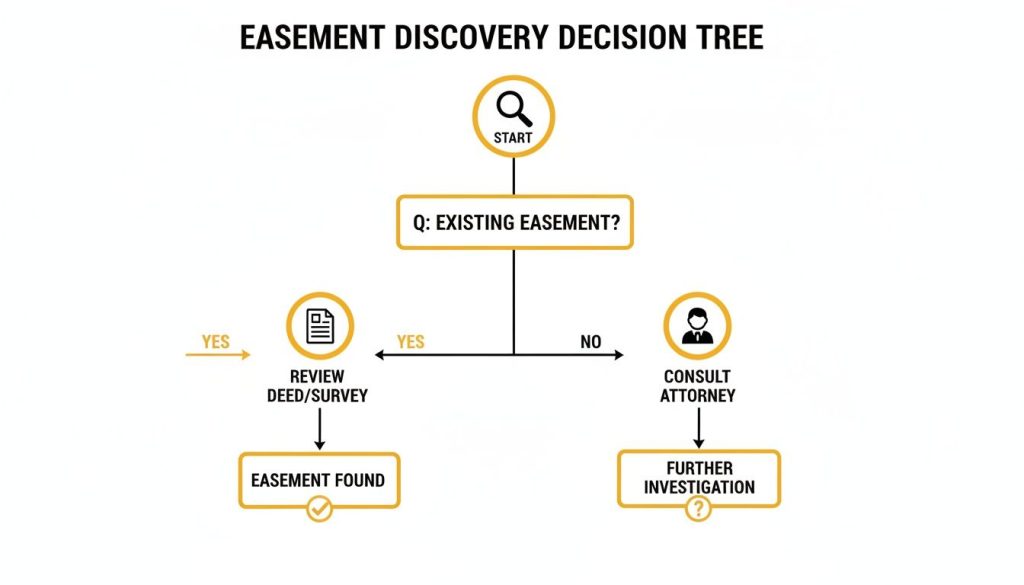
Earning Your Access with a Prescriptive Easement
A prescriptive easement is a whole different ballgame. It isn’t based on a historical deed, but on long-term, consistent use of someone else’s land. You essentially earn the right of way through your actions over time.
To win this kind of claim in Florida, you have to meet some very strict requirements. The use of the route must have been:
- Open and Notorious: It had to be obvious, not secretive. The landowner knew—or should have known—you were crossing their land.
- Continuous: You used the path without interruption for a full 20 years.
- Adverse: This is crucial—you used it without the owner’s permission. If they ever said, “Sure, go ahead,” your claim is likely invalid.
Let’s say a landowner in rural Lake County bought his property back in the 90s. For more than two decades, he and the guy before him used the same dirt track across a neighbor’s field to reach the main road. No one ever signed a paper; it was just how things were always done.
If that neighbor suddenly fences off the path, the landowner might have a solid case for a prescriptive easement. He’d need to gather proof—like testimony from old-timers, dated photos, or even receipts for gravel he put on the path—to demonstrate 20 years of uninterrupted use.
Gaining a prescriptive easement isn’t a slam dunk. Under Florida Statute 704.01, it requires that 20-year period of open use, and claims succeed in roughly 45% of litigated cases. With over 8,500 landlocked cases reported in fast-growing counties like Polk and Lake, the stakes are high. For a deeper dive into global property access laws, you can review this in-depth global analysis on land use policies.
Legal Easement Options in Florida: A Quick Comparison
Navigating these legal avenues can be complex. Each has its own specific requirements and is best suited for different historical circumstances. This table breaks down the core differences to help you see which path might apply to your property.
| Easement Type | Primary Requirement | Common Scenario | Success Factor |
|---|---|---|---|
| Easement by Necessity | Proof of “unity of title”—your land and the neighbor’s were once one parcel. | A large property was subdivided, leaving one or more new parcels without road access. | Having clear, traceable deed history showing the exact moment your parcel was severed from the larger tract. |
| Prescriptive Easement | 20 years of open, continuous, and adverse (without permission) use of a path. | A long-established, unofficial path across a neighbor’s property has been used for decades by previous owners as the primary access route. | Strong evidence of consistent use over the 20-year period (witnesses, photos, maintenance records). |
| Statutory Easement (Condemnation) | No practical route to a public or private road exists for use or cultivation. | A property is completely surrounded, and no historical basis for another easement type exists. The owner needs access for practical use. | Proving the easement is “reasonably necessary” and being prepared to compensate the neighboring landowner for its use. |
Understanding these distinctions is the first step in forming a solid legal strategy with your attorney.
Weighing Your Next Steps
Both the easement by necessity and prescriptive easement routes will lead you to court. That means hiring a good real estate attorney and bracing for a process that can be both time-consuming and expensive. It’s a serious decision.
But when friendly negotiations hit a wall and the public records are a dead end, litigation is often the only tool left to make your land usable. Knowing these options gives you a clear-eyed view of what’s ahead, empowering you to make the best call for unlocking your property’s true value.
The Art of Negotiation: Securing Access with Your Neighbors
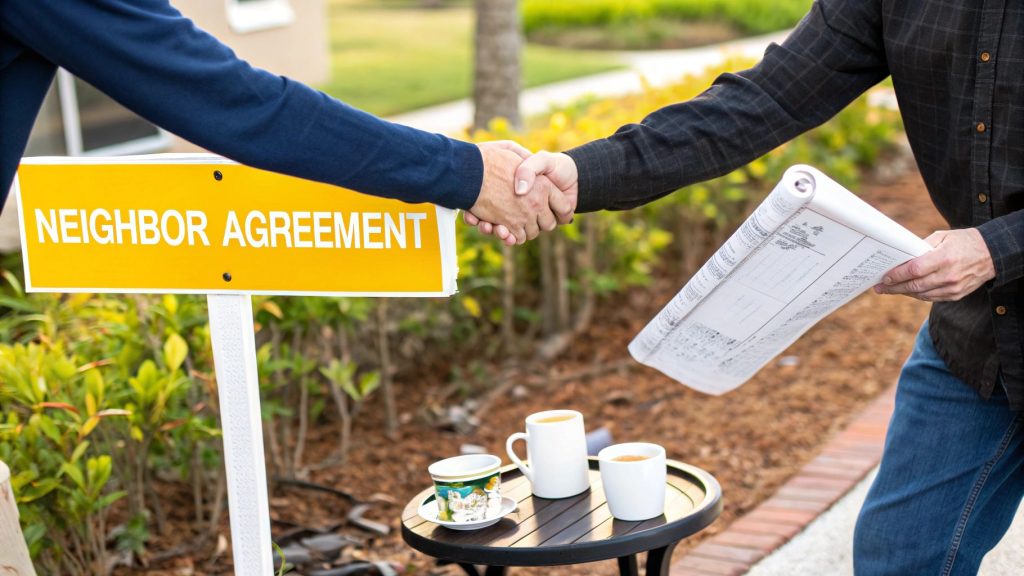
Sometimes the simplest solution to a landlocked property is found not in a courtroom, but over a cup of coffee. Before you even think about expensive legal battles, a direct, friendly conversation with your neighbor is often the quickest and most affordable path to securing an easement.
This approach keeps you in the driver’s seat. Instead of leaving your fate in a judge’s hands, you and your neighbor can work together to create a practical agreement that benefits both of you. It’s a chance to build a partnership, not an adversarial relationship, and can save you a world of stress and money.
Preparing for a Productive Conversation
Just showing up on your neighbor’s doorstep unprepared is a recipe for a “no.” A good negotiation always starts with good preparation. The goal here is to present a clear, fair, and professional proposal that makes it easy for them to agree.
Before you ever make contact, do your homework. Get a handle on the fair market value of land in your area so you have a realistic idea of what that strip of their property is worth. It’s also smart to have a surveyor map out a potential route beforehand. This shows you’re serious and have thought through the logistics, not just asking for a vague favor.
Most importantly, try to walk in their shoes. What are their biggest worries going to be?
- Privacy: Is this new road going to run right past their living room window?
- Liability: Who’s on the hook if someone gets hurt on the easement?
- Property Value: Will this easement make their property harder to sell down the road?
- Maintenance: Who’s going to pay to maintain the new access road?
Having solid answers to these questions shows respect. It proves you’re not just thinking about what you need, but also considering how this will impact them.
Making a Fair and Compelling Offer
Your first offer needs to be more than just a question—it should be a complete package that offers them genuine value. A simple “can I please drive across your field?” is not going to cut it. You need to build an offer that directly addresses their concerns and compensates them fairly.
A strong offer usually combines a few key incentives. Imagine a developer in Osceola County trying to get access to a 10-acre parcel. Their offer might look something like this:
- Direct Compensation: A one-time cash payment for the easement itself, based on a professional appraisal of the land’s value.
- Covering All Costs: An offer to pay 100% of the associated professional fees. This means you cover their attorney’s fees to review the agreement, the full survey cost, and all county recording fees.
- Future Maintenance: A clear, written plan for who maintains the access road, from grading and gravel to any future repairs. Typically, the person using the easement (you) takes on this responsibility.
This kind of well-thought-out offer removes the financial and logistical headaches for your neighbor, making your proposal much more appealing.
Remember, the goal is to create a win-win scenario. By offering fair compensation and covering all the hassle and costs, you’re not just buying a right-of-way; you’re investing in a positive long-term relationship with your neighbor.
Putting It All in Writing
A handshake and a verbal agreement are nice, but they aren’t legally binding. Once you’ve come to terms, it’s absolutely critical to get every detail documented in a formal, written easement agreement. This legal document is the only thing that makes your access rights official and permanent.
This agreement must be drafted by a qualified real estate attorney and it needs to be precise. It should clearly define the exact location, width, and boundaries of the easement. It also needs to specify the terms of use—is it just for residential access, or are commercial vehicles allowed? Things like maintenance duties, liability clauses, and any specific restrictions have to be spelled out clearly.
After both parties sign, the document must be legally recorded with the county clerk’s office. This last step is non-negotiable. Recording the easement attaches it to the deeds of both properties, ensuring the right of access is permanent and transfers to any future owners. If you skip this, you risk losing your hard-won access the moment your neighbor sells their property.
Turning Your Legal Right into a Physical Road
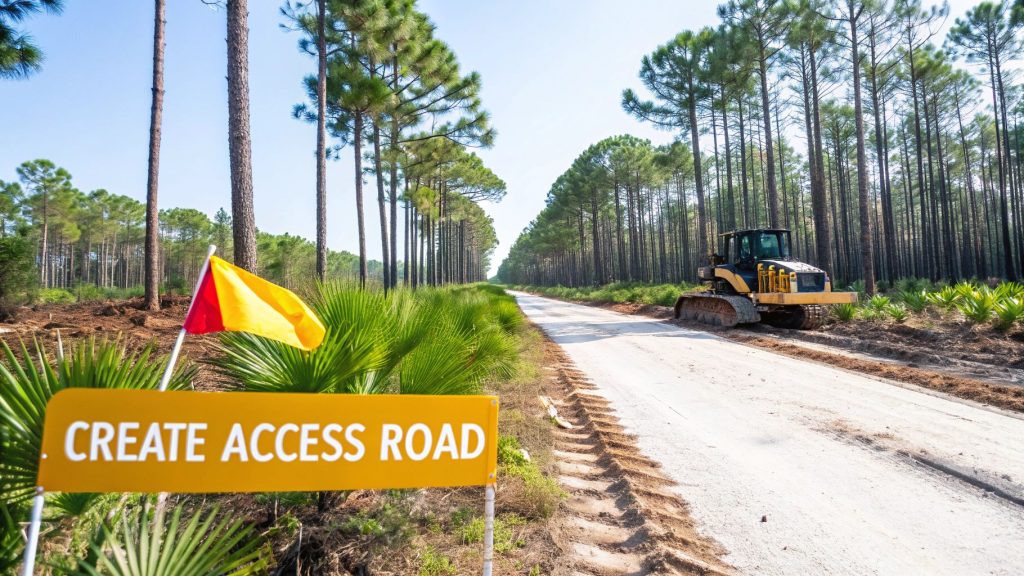
Securing an easement is a huge milestone. But let’s be real—an easement on paper doesn’t help much when it’s choked with palmettos or disappears into a swamp. Now the real work begins. You’ve won the legal right, and the next challenge is to turn that right-of-way into a usable, physical path to your property.
This part of the journey is all about surveying, permitting, and smart land clearing. It’s a process that demands careful planning, especially when navigating Central Florida’s unique environmental landscape and local regulations.
From Lines on a Map to Stakes in the Ground
The very first thing to do on the ground is to hire a professional surveyor. Their job is to take the legal description from your easement agreement and translate it into precise, physical markers. This isn’t just about knowing where to drive; it’s a critical step that prevents future disputes with your neighbor.
A surveyor will stake out the exact boundaries of your access route, making sure every curve and straightaway follows the recorded document to the letter. This gives you, your neighbor, and any contractors undeniable clarity. It’s what keeps you from accidentally clearing a path onto your neighbor’s land, a mistake that could land you in serious legal and financial trouble.
Think of a survey as the blueprint for your access road. Without it, you’re just guessing, and that’s a risky gamble when property lines are involved. A clear survey is your best insurance against costly mistakes and neighborly conflicts.
Navigating Florida’s Environmental and Permitting Maze
With your route clearly marked, the next hurdle is dealing with Central Florida’s environmental rules and getting the right permits. This is one area where you absolutely cannot afford to cut corners. Counties like Brevard, Volusia, and Osceola have strict regulations to protect natural resources.
Before a single tree comes down, you need to know what you’re up against.
- Wetlands Delineation: Florida is famous for its wetlands. If your planned route crosses a low-lying or swampy area, you’ll almost certainly need a wetlands specialist to perform a delineation and secure permits from the local water management district or even the Army Corps of Engineers.
- Protected Species: Your land might be home to protected wildlife, like the gopher tortoise. A professional survey is often required to identify and relocate any protected species before clearing can start. This involves a specific permitting process through the Florida Fish and Wildlife Conservation Commission (FWC).
- Tree Ordinances: Many counties have rules protecting certain types or sizes of trees, especially heritage oaks. You may need a permit just to remove them, even if they’re squarely in your easement’s path.
Trying to bypass the permitting process can lead to hefty fines and stop-work orders, potentially delaying your project for months. The best first step is always to check with your local county planning and zoning department for a full checklist of what’s required.
Choosing the Right Clearing Method for the Job
Once you have permits in hand, it’s finally time to clear the way. For most overgrown Central Florida lots, the most effective and eco-friendly method is forestry mulching. Unlike old-school land clearing that leaves behind massive debris piles and torn-up soil, forestry mulching is a cleaner, more sustainable process.
A forestry mulcher is a single machine that cuts, grinds, and shreds everything from small brush to large trees right where they stand. The resulting mulch is spread evenly across the ground, creating an immediate, stable surface. This technique not only clears your path but also returns nutrients to the soil, helps prevent erosion, and suppresses future weed growth. It’s an all-in-one solution that skips the need for hauling and burning debris.
Of course, there are other options. For smaller projects or in very sensitive areas, you might want to learn how to clear land without heavy equipment. However, when it comes to creating a durable and lasting access road, professional machinery is almost always the right call.
By combining a professional survey, diligent permitting, and the right clearing method, you can efficiently transform that legal document into a functional road, finally unlocking the true potential of your landlocked property.
Common Questions We Hear About Gaining Property Access
Even after you’ve waded through the deeds, legal options, and neighborly chats, it’s natural to have a few more questions. Let’s tackle some of the most common ones we get from landowners in Central Florida. The goal here is to give you clear, direct answers so you can keep moving forward.
So, How Much Does It Cost to Get an Easement in Florida?
This is a tough one because the cost can swing wildly. There’s no flat fee. It all boils down to whether you can strike a deal with your neighbor or if you have to head to court.
If you and your neighbor are on good terms and can work something out, you’re in a much better financial position. Your main costs will be paying a surveyor to map out the easement, an attorney to draft the legal paperwork, and the county’s recording fees. This route might only cost you a few thousand dollars, plus whatever you agree to pay your neighbor for the right-of-way.
But if negotiations fall apart and you’re forced to sue for an easement by necessity or a prescriptive one, the numbers climb fast. Legal fees for a court battle can easily hit the $10,000 to $50,000 range, and sometimes more if the case gets complicated or nasty. This is why spending a few hundred dollars on an initial title search is such a smart move—it can save you a fortune down the road.
Can My Neighbor Just Block My Easement?
Absolutely not. Once an easement is legally recorded, it’s a real property right. It attaches to your land’s deed, and your neighbor has no legal standing to block you from using it for getting to and from your property.
That means they can’t throw up a locked gate without giving you a key, build a fence across it, or park vehicles and pile up debris in the way. If your neighbor interferes with your easement, they’re stepping on your property rights, plain and simple.
Your first move should always be to have your attorney send a formal letter demanding they clear the obstruction. A lot of times, that’s all it takes. If they still don’t budge, you have every right to take them to court to enforce the easement.
Easement by Necessity vs. Prescriptive Easement — What’s the Difference?
Good question. Both are legal ways to get access, but they come from completely different situations. Knowing which is which is key to figuring out if you have a valid legal argument.
An easement by necessity is all about the property’s history. It happens when a single, larger piece of land gets split up, and one of the newly created parcels gets cut off from any public road. The law just assumes the original owner intended for that new parcel to have access. To win this kind of case, you have to prove that your land and your neighbor’s were once owned by the same person.
A prescriptive easement, on the other hand, is earned over time through use, not through a past sale. The history of the deeds doesn’t matter. In Florida, you have to prove that you (or the previous owners) have been using a specific path across your neighbor’s land openly, continuously, and without their permission for a solid 20 years. One is based on a transaction, the other on decades of consistent use.
I Got My Easement! What’s the Very First Thing I Should Do?
Congratulations! Getting that legal right is the biggest hurdle, so take a moment to celebrate. Once that easement is signed, sealed, and recorded with the county, your first physical step is to call a licensed surveyor.
Don’t skip this. Have them come out and plant stakes or flags to mark the exact, legally defined boundaries of your new access route. This protects both you and your neighbor by making sure any clearing or road building stays exactly where it’s supposed to.
With the path marked, you’re ready to clear it. For the kind of overgrown lots we see all over Central Florida, the quickest and most practical solution is forestry mulching. A single machine comes in, cuts down the trees and brush, and grinds it all into a layer of mulch right on the spot. It creates a stable, usable path almost immediately—and it’s often way faster and more affordable than old-school methods that need multiple machines and someone to haul all the debris away.
Ready to turn that legal paper into a real road? The team at Palm State Clear Cut specializes in forestry mulching and site prep all over Central Florida. We can clear your new easement the right way, creating a safe path to your property without the headache. Visit us online for a free quote and let’s get your project moving.