
Florida: Clearing the Brush - A Landowner's Guide
- Mike Walker
- Nov 23, 2025
- 17 min read

When you hear "clearing the brush," it's easy to think of it as just tidying up. But for landowners here in Central Florida, it’s the foundational first step toward unlocking what your property can truly be. This is all about strategically removing that tangled mess of overgrown vegetation, stubborn invasive species, and any unwanted trees to make your land safer, more usable, and ultimately, more valuable.
Why Clearing the Brush Is a Must for Your Florida Property
If you own a piece of land in Central Florida, you probably inherited a jungle of palmettos, invasive vines, and dense undergrowth. Tackling it might seem like a purely cosmetic job, but clearing the brush is a serious investment in your property's health and future. It’s what transforms an impassable, forgotten lot into a functional and secure space.
This isn't just something we do here; it’s a recognized need across the globe as development changes our landscapes. The global market for brush cutters, a key tool in this work, was valued at $2.789 billion back in 2025 and is only expected to grow, according to research from datainsightsmarket.com. That kind of growth tells you one thing: people everywhere are realizing that managing overgrowth is absolutely essential.
Boost Property Value and Usability
An overgrown lot is a hidden gem. Clearing the brush is like pulling back the curtain, instantly revealing the true size, contours, and potential of your land. This one action can seriously boost its market value by making it far more attractive to buyers or simply getting it ready for your own plans.
Suddenly, you have a blank canvas for:
Building a new home or an addition
Creating gardens, pastures, or recreational areas
Providing clear access for surveyors and site planners
Mitigate Wildfire Risks
During Florida's long, hot dry seasons, wildfire is a constant threat. All that dense, unmanaged brush is the perfect fuel for a small spark to become a raging fire, putting your property and your neighbors at risk. And with almost nine out of ten wildfires caused by people, proactive prevention is non-negotiable.
Creating a defensible space around your home—a clean buffer zone free of dense vegetation—is one of the most powerful safety measures you can take. It dramatically cuts the risk of a wildfire ever reaching your structures.
Enhance Ecosystem Health and Pest Control
Our beautiful Florida environment is also ground zero for aggressive invasive species like Brazilian Pepper and cogon grass. These intruders can quickly choke out native plants, throwing the entire local ecosystem out of balance. Clearing the brush is a cornerstone of good vegetation management, which is critical for restoring that natural balance.
On top of that, dense undergrowth is a five-star resort for pests. Ticks, fire ants, and even venomous snakes love the cover it provides. By removing their hiding spots, you make your property a much safer place for your family, pets, and livestock to enjoy. It’s a direct investment in your peace of mind.
Navigating Florida Land Clearing Rules and Permits
Before you even think about firing up the machinery, the most crucial work happens on paper and over the phone. A successful land clearing project lives or dies by how well you understand the local rules. Here in Central Florida, those rules can get complicated fast, changing dramatically from one county line to the next.
Trying to skip this part is the quickest way I've seen projects get shut down cold, often with some hefty fines attached.
Your very first move should be to walk your property and sketch out a basic site plan. Get a feel for the land. Pinpoint the trees you absolutely want to keep—those beautiful old Live Oaks or big pines—and map out the dense patches of undergrowth that have to go. This isn't just for looks; it’s about creating a clear vision that will guide every single decision from this point forward.
Understanding Local and State Regulations
In Florida, you can't just start clearing land as you please. Multiple layers of government have a say in what happens on your property. It's a common and costly mistake to not check in with the right agencies first.
Here are the primary authorities you’ll need to get familiar with:
Your County's Planning and Zoning Department: This is your number one contact. They set the specific rules on tree removal, how far you need to stay from property lines, and whether your job requires a formal permit.
Your City or Municipality: If your land falls within city limits, you can bet there’s another layer of rules you'll need to follow.
Water Management Districts: Got property near wetlands, a lake, or a river? One of Florida’s five Water Management Districts (like the St. Johns River WMD or the South Florida WMD) will have jurisdiction. Their regulations are all about protecting our water quality and preventing erosion.
A quick phone call or a browse through their website usually clears up most questions. Just make sure you have your property's address or parcel ID number handy.
Identifying Protected Species and Setbacks
Florida is teeming with protected plants and animals. Certain trees, like some cypress species or historic Live Oaks, might be protected by a local ordinance. That means you can't touch them without special permission. And if your land is home to protected wildlife, like the gopher tortoise, a whole different set of regulations and relocation protocols will come into play.
Pro Tip: Always, always check for local ordinances protecting specific tree species before you start. A tree that looks like any other to you could be protected by county law, and removing it without a permit is a recipe for big penalties.
Property line setbacks are another detail you can't afford to ignore. These rules dictate exactly how close to your property's edge you can clear or build. Getting this wrong can lead to serious disputes with neighbors and a costly order to restore the area you just cleared. Your county's zoning office will have the exact setback requirements for your specific property.
When Do You Need a Permit?
"Do I need a permit?" is the million-dollar question for every landowner. The honest answer is: it completely depends on where you are and what you're planning to do.
You will almost certainly need a permit if your project involves any of the following:
Removing large or protected trees. Many counties have a threshold, defining a "significant" tree by its trunk diameter (for example, anything over 12 inches).
Clearing land for new construction. Prepping a lot for a house or commercial building involves a much more extensive permitting process. Our in-depth guide on clearing land for construction in Florida covers these specific steps.
Working near wetlands or shorelines. Any activity that could impact these sensitive areas is very heavily regulated.
Large-scale clearing. Clearing several acres at once will usually trigger a review, even if you aren’t taking down massive trees.
On the flip side, you might not need a permit for smaller jobs. Think clearing out nuisance undergrowth, tackling invasive species like Brazilian Pepper, or just thinning some small, non-protected trees on your lot.
But never, ever assume. A quick call to verify with your local authorities is the best first step you can take. That due diligence is what separates a smooth, successful project from a legal headache.
Staying Safe in the Florida Heat and Terrain
Let's be clear: clearing brush in Central Florida is tough, physical work. You're dealing with a nasty combination of intense heat, tricky terrain, and wildlife that can surprise you. Safety isn't just a recommendation—it's the absolute bedrock of a successful project. Going in unprepared is a surefire way to get seriously hurt.
This is about more than just avoiding a few scrapes. It’s about respecting the environment you're in and deliberately protecting yourself from some very real dangers. Every single decision, from the gear you wear to how you move, truly matters.
Your Non-Negotiable Safety Gear
Your Personal Protective Equipment (PPE) is your first line of defense, and it's non-negotiable. Think of it as your uniform for the job; you simply don't start work without it. Each piece has a specific, critical job to do.
Here's what you should have on, every time:
Safety Glasses or Goggles: These keep wood chips, dust, and whipping branches out of your eyes. It's a simple thing that prevents a world of pain.
Hard Hat: A must-have when you're working near trees or using heavy equipment that can kick up bigger debris.
Steel-Toed Boots: Protects your feet from falling logs and sharp stumps, but just as importantly, they give you stable footing on uneven ground.
Heavy-Duty Work Gloves: A good pair will save you from countless cuts, splinters, and blisters while giving you a much better grip on your tools.
Chainsaw Chaps: If you're firing up a chainsaw, these are mandatory. They're designed to instantly stop a running chain on contact and can literally save your leg.
Long-Sleeved Shirts and Pants: This is your primary shield against sunburn, scratches, and nasty encounters with plants like poison ivy.
Handling Florida-Specific Dangers
Beyond the equipment you're running, the Florida landscape itself comes with its own set of hazards. You're stepping into the natural habitat of creatures and plants you need to be able to spot and sidestep. Situational awareness is just as vital as wearing the right gear.
Always be on the lookout for:
Venomous Snakes: Central Florida is home to six species of venomous snakes, including the Eastern Diamondback Rattlesnake and Water Moccasin (Cottonmouth). Get in the habit of never reaching into brush piles or hollow logs without looking first.
Fire Ant Mounds: Kicking one of these by accident can lead to dozens of incredibly painful stings. Keep your eyes on the ground as you move and give any mounds a very wide berth.
Poison Ivy: That classic "leaves of three, let it be" vine can cause a miserable allergic reaction. Learn what it looks like and keep your skin covered.
My most important piece of advice is this: never work alone. Having a partner on-site means someone is there to help if things go wrong, whether it's an equipment failure or a medical emergency. A second set of eyes also doubles your chances of spotting a hazard before it becomes a problem.
Finally, you have to respect the Florida heat. It's a relentless opponent. Dehydration and heat exhaustion can sneak up on you fast, messing with your judgment and strength. Start drinking water the day before you plan to work and keep hydrating all day long—don't wait until you're thirsty.
Make sure you have a well-stocked first-aid kit close by, with everything you need for cuts, bites, and heat-related issues. Taking these specific risks seriously is what turns a potentially dangerous job into a manageable one.
Choosing Your Brush Clearing Method and Tools
Once you’ve got your plan and safety measures locked in, it’s time to get down to the actual work. The method you pick for clearing the brush is a huge decision—it dictates the cost, the time it'll take, and what your property will look like when you're done. Here in Central Florida, we're not just whacking weeds. We’re up against everything from stubborn palmetto roots to impossibly dense thickets of Brazilian Pepper.
Making the right call here is all about matching the right tool to your land's specific challenges and what you want to achieve. This is the difference between a project that drags on forever and a smooth, satisfying transformation of your property.
Assessing Your Land and Goals
Before you even think about renting equipment, take another walk around your property. This time, look at it with a critical eye. What are you really dealing with out there? The answer will steer your entire approach.
Think about these key factors:
Vegetation Density: Are you looking at some light, grassy overgrowth? Or is it a solid wall of brush and small trees you can't even push through?
Type of Plants: Knowing your enemy is half the battle. Palmettos need some serious muscle to uproot, while invasive vines might call for a completely different strategy than woody shrubs.
Property Size: The needs of a one-acre lot in a neighborhood are worlds apart from a sprawling 10-acre rural parcel. Scale is probably the single biggest factor in choosing between handheld tools and heavy machinery.
End Goal: What does "finished" look like in your mind's eye? Are you aiming for a perfectly smooth, park-like lawn ready for sod? Or are you just trying to carve out some trails and firebreaks, leaving things a bit more rustic?
Your desired outcome is everything. If the goal is a build-ready site, you'll need methods that take care of stumps and roots completely. If you're just reclaiming an old pasture, a rougher cut might be perfectly fine—and a lot cheaper.
Comparing Popular Brush Clearing Methods
With so many ways to tackle a land clearing project, it helps to see the options side-by-side. Each technique has its place, depending on your property's size, the type of vegetation, and your budget.
Here’s a breakdown of the most common methods we see used in Central Florida, from heavy-duty machines to more precise, hands-on tools.
Technique | Best For | Key Equipment | Pros | Cons |
|---|---|---|---|---|
Forestry Mulching | Large, dense areas; returning nutrients to soil. | Skid-steer or dedicated mulcher with a forestry head. | Incredibly fast; one-step process (no hauling); improves soil. | High rental/hiring cost; leaves a rough, mulchy finish. |
Bulldozing & Raking | Site prep for construction; complete vegetation removal. | Bulldozer, root rake attachment. | Leaves very clean, root-free ground. | Major soil disturbance; creates huge debris piles. |
Manual Clearing | Small lots; selective thinning; tight spaces. | Chainsaw, brush cutter, loppers, pole saw. | Precise control; low initial cost; preserves desirable plants. | Extremely labor-intensive; not practical for large areas. |
Stump Grinding | Removing tree stumps for a smooth, usable surface. | Stump grinder (various sizes). | Essential for creating lawns or building pads; eliminates trip hazards. | A separate, specialized step; can be slow for many stumps. |
This table should give you a clearer picture of which approach might be the best fit. Often, a project will require a combination of these methods—like using a forestry mulcher for the bulk of the work, followed by manual cleanup and stump grinding in key areas.
Heavy Machinery for Large-Scale Clearing
For larger properties or truly overgrown land, bringing in the big guns is often the only realistic choice. These machines can accomplish more in a few hours than a person could in weeks of back-breaking labor.
Forestry Mulching
This is the real powerhouse for clearing land in Central Florida. A single machine—usually a beefy skid-steer or a purpose-built mulcher—uses a rotating drum with steel teeth to literally shred trees and brush right where they stand. It grinds everything down into a layer of natural mulch that’s left on the ground.
It's an incredibly efficient, one-and-done process for big areas. The best part? No hauling, no burning. That mulch layer even helps prevent erosion and slowly adds nutrients back into our sandy soil. The downside is that the equipment is expensive to rent or hire, and the finish can be a bit rough, requiring more cleanup if you want a polished look.
Bulldozing and Root Raking
This is the old-school, brute-force method. A bulldozer pushes over trees and scrapes the top layer of vegetation clean. A special root rake attachment can then be used to pull the remaining roots and debris out of the soil.
The main advantage here is that it leaves the ground exceptionally clean and free of roots, making it perfect for preparing a construction site. However, it causes massive soil disturbance, which can lead to serious erosion if you're not careful. It also creates giant piles of debris that you then have to figure out how to get rid of.
Manual and Handheld Tools for Smaller Jobs
For smaller lots, precision work, or cleaning up the edges, manual tools are what you’ll need. They obviously require more sweat, but they give you a level of control that heavy machinery just can’t offer.
Before you fire up any tool, always run through a quick safety check. This flowchart is a great way to visualize the decision-making process before you start cutting.
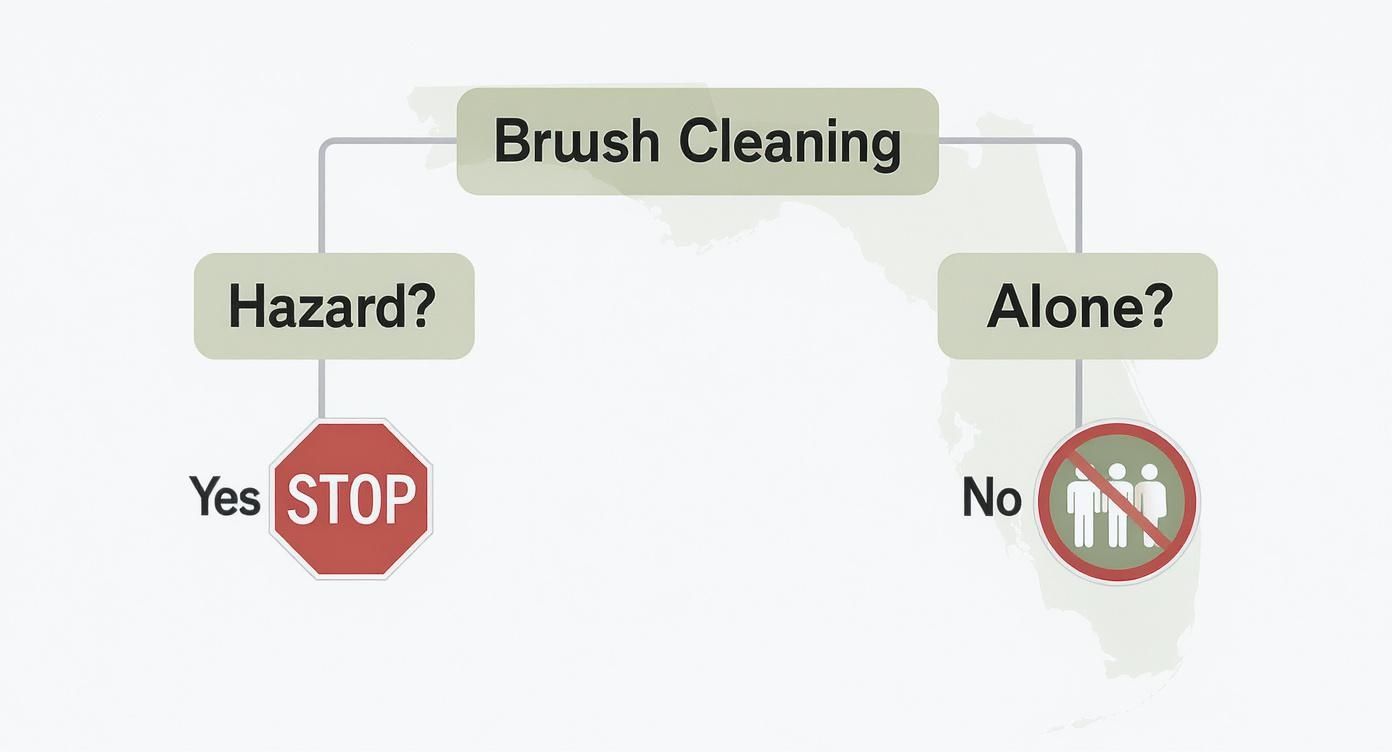
It boils down to two non-negotiable rules: if you spot a serious hazard, stop. And never, ever attempt this kind of work alone.
Chainsaws and Brush Cutters
A reliable chainsaw is non-negotiable for felling small trees and bucking up larger limbs. For all the thick, non-woody stuff and overgrown grassy areas, a heavy-duty brush cutter (think of a string trimmer on steroids with a metal blade) will be your workhorse.
Pole Saws and Loppers
For thinning out branches high up or doing selective pruning, a pole saw is a lifesaver. A good pair of long-handled loppers and a sharp handsaw are perfect for getting through thick vines and smaller saplings with surgical precision, which is key when you’re trying to save the good plants.
Specialized Techniques for a Finished Look
Just clearing the brush is often only the first phase. To get your land truly ready for what’s next, you might need some follow-up work to handle what the initial pass left behind.
Stump Grinding
After the trees come down, the stumps remain. A stump grinder is a machine with a high-speed cutting wheel that chews the stump into wood chips, taking it down well below ground level. This is an absolute must if you plan to lay sod, pour a foundation, or just want a smooth, trip-free yard.
Selective Thinning
This is the artful side of land clearing. It’s not about wiping the slate clean, but thoughtfully removing specific trees and undergrowth to improve the health and look of what’s left. By thinning things out, you reduce the competition for sunlight and water, which can help your prized Live Oaks thrive. It’s a strategic approach that enhances the natural beauty of your Florida property instead of erasing it.
Dealing with Debris and Protecting Your Soil
Once you’ve done the heavy lifting of clearing the brush, you’re staring at two new challenges: mountains of green waste and a lot of bare, exposed earth. What you do next is every bit as critical as the clearing itself. Handling this aftermath the right way protects your investment and the delicate Central Florida ecosystem.
It’s tempting to just walk away, but ignoring the debris and exposed soil can create major headaches down the road. Luckily, you’ve got some smart, sustainable options that can turn this problem into a genuine asset for your property.
Smart Ways to Handle Brush Debris
So, you’ve cut it all down. Now what? Hauling truckloads of debris to a landfill is not only expensive but, in most cases, completely unnecessary. Let’s look at some more efficient and eco-friendly methods that we see used all the time here in Central Florida.
On-Site Chipping and Mulching: Rent a commercial-grade wood chipper and turn those branches, small logs, and brush into a pile of high-quality organic mulch. This "black gold" can be spread in garden beds, around your trees, or along pathways to keep weeds down and hold moisture in the soil.
Controlled Burns: For some rural properties, a controlled burn (or prescribed burn) is a fast way to eliminate large debris piles. This is not a DIY weekend project. It absolutely requires a permit from the Florida Forest Service, meticulous planning, and following safety rules to the letter. You never, ever burn when it’s windy or when a burn ban is in effect.
Piling for Wildlife: This one isn’t as common, but it’s a fantastic ecological choice. Creating a few "brush piles" in out-of-the-way corners of your land provides incredible shelter and habitat for birds, rabbits, and other small wildlife.
The real goal here is to handle debris on-site whenever you can. You’ll save a ton on hauling and disposal fees, and you get to recycle all that valuable organic matter right back into your own land.
Protecting Your Soil from Florida Rains
With the brush gone, your soil is now completely exposed. Anyone who’s lived in Florida knows how quickly a thunderstorm can pop up. A single downpour can wash away your valuable topsoil in minutes, causing erosion, nutrient loss, and runoff that pollutes our local ponds and streams. This isn't just a local concern; it’s a snapshot of a much larger global issue.
Even though deforestation rates have slowed, the world still lost an average of 10.9 million hectares of forest each year between 2015 and 2025. According to a Carbon Brief analysis of a UN report, these clearing activities make it crystal clear why responsible erosion control is so vital for protecting our soil.
Putting erosion control measures in place immediately after clearing isn't just a good idea—it's non-negotiable.
Immediate Erosion Control Strategies
Your number one priority is to get that bare ground covered as fast as possible. This creates a shield against the direct force of raindrops and slows down water flowing across the surface.
Here are three highly effective techniques we recommend for Central Florida properties:
Spread Straw or Hay: This is one of the quickest and most affordable fixes. A thick blanket of straw protects the soil while giving grass or ground cover seeds a chance to sprout underneath.
Install Silt Fences: If your property has any kind of slope, even a gentle one, putting up a silt fence at the low points is crucial. These fabric barriers are designed to catch sediment and prevent it from washing off your land and into waterways.
Plant Native Ground Cover: For a permanent solution, get some fast-growing native ground cover seeds in the ground. Bahia grass is a tough, drought-tolerant workhorse in Florida that establishes quickly and locks the soil in place.
These aren't just feel-good environmental tasks. They are a direct investment in the long-term stability and health of your property. Taking these steps ensures your hard work pays off with a beautiful, sustainable piece of land, not a barren, eroded mess.
Deciding Between a DIY Project and Hiring a Pro
One of the biggest questions you'll face is whether to tackle brush clearing yourself or bring in a professional crew. The DIY route can look tempting—you save some money and get the satisfaction of a job well done. But it's absolutely critical to be realistic about what the work actually entails.
For very small, manageable lots, doing it yourself can be a solid choice. Think less than half an acre with only light brush and no large trees to worry about. If you're physically up for it and the vegetation is mostly grass and small shrubs, renting a heavy-duty brush cutter for a weekend might be all you need.
If you’re leaning toward a smaller-scale project, you might find some useful tips in our guide on how to clear land without heavy equipment.
When to Call a Professional
The math changes in a hurry as the property gets bigger and the vegetation gets thicker. For anything over an acre, or land choked with dense palmetto thickets, invasive Brazilian Pepper, or a significant number of trees, hiring a professional service becomes the smarter, safer, and often more cost-effective decision.
Bringing in a professional crew gives you a few key advantages you just can't replicate on your own:
The Right Tools for the Job: Pros show up with industrial-grade machinery like forestry mulchers and powerful stump grinders. This equipment is light-years beyond what you can rent at the local hardware store.
Experience and Safety: Licensed and insured operators know how to handle Florida’s unique terrain and hazards. They minimize the risk to people and property—something that’s priceless.
Serious Efficiency: A professional team can accomplish in a single day what might take you weeks of back-breaking labor. They get the job done right and done fast.
The Financial Reality
The sheer size of the professional land management industry tells you something about the value of expertise. The US tree trimming services market, a close relative of what we do, ballooned into an estimated $39.5 billion industry in 2025. This isn’t just a niche service; it reflects a widespread need for skilled professionals to handle complex, hazardous jobs safely. You can dig into these trends with insights on the tree trimming services market.
Ultimately, the decision comes down to a clear-eyed assessment of your project's scale, your own capabilities, and what your time is worth. The upfront cost of hiring a pro might seem higher, but it often saves you from hefty equipment rental fees, costly mistakes, and the immense physical toll of the work. For most significant land clearing projects, a professional service is a wise investment.
Common Questions About Clearing Florida Brush
If you're looking at an overgrown lot in Central Florida, you've probably got questions. It's a big job, and getting straight answers is the first step to planning your project and avoiding some common headaches. We hear these questions all the time from property owners just like you.
How Much Is This Going to Cost?
There's no single price tag for land clearing—it really depends on what we're up against. The cost is a mix of your property's size, how thick the vegetation is, and the clearing method we use.
For a pretty standard one-acre lot here in Central Florida, you can expect professional forestry mulching to run somewhere between $1,500 and $4,000. Sometimes more, sometimes less.
What moves that number?
Density: A property choked with stubborn palmettos and invasive Brazilian Pepper trees is a tougher fight than one with just light brush.
Access: If the land is hard to get to, it just takes more time and effort to get the equipment in place.
The Method: Bringing in a heavy-duty forestry mulcher has a higher day rate, but it's an absolute beast. For bigger or denser jobs, its speed often makes it the more cost-effective choice in the long run.
When’s the Best Time of Year to Do This?
Hands down, the best time to clear brush in our part of Florida is during the cooler, drier months. Think late fall through early spring—basically October to April.
There are a few solid reasons for this. First, the lower humidity and milder weather are a lot safer and more comfortable for the crew doing the hard work. Second, the ground is firmer, which means less risk of our heavy machinery getting bogged down or tearing up your soil.
And maybe most importantly, many of the critters we'd rather not disturb—especially venomous snakes—are far less active when it's cool.
You can clear land any time of year, but trust me, avoiding the peak heat and hurricane season of a Florida summer is the smart play. It leads to a safer, faster project with less impact on your property.
How Long Will It Take to Clear My Lot?
Just like cost, the timeline can vary quite a bit. A small, half-acre lot with just some light undergrowth? We could have that knocked out in a single afternoon with the right machine.
On the other hand, a five-acre parcel buried under years of dense growth and mature trees could easily take a professional crew several days to mulch down and tidy up.
As a general rule, a professional forestry mulching service can clear anywhere from one to three acres per day, depending on how gnarly the terrain and vegetation are. If you're planning to go the DIY route with handheld tools, that same acre could take you weeks of back-breaking work.
Ready to get a clear picture of what your project will take? Palm State Clear Cut offers professional, efficient land clearing services across Central Florida. We can transform your overgrown property quickly and safely. Get your free, no-obligation quote today at https://palmstateclearcut.com.
Comments