
Finding a Brush Removal Service Near Me in Florida
- Mike Walker
- Nov 17, 2025
- 14 min read

That tangled mess of palmettos and invasive vines on your property isn't just an eyesore—it's a barrier to what your land could be. Finding a professional brush removal service near me is the crucial first step to reclaiming your space. Think of this guide as your practical roadmap for transforming that unusable patch of Central Florida land into a valuable asset.
Your Guide to Reclaiming Overgrown Florida Land
Whether you're dreaming of a new garden, need a safe play area for your kids, or are prepping a site for construction, professional brush clearing is where it all begins. We’ll cut through the confusing jargon to break down exactly what to look for in a local service, how costs are calculated for our unique Florida landscape, and the critical questions you absolutely need to ask.
By the end, you'll have the confidence to pick the right crew for the job, understand their process, and get your property ready for a smooth, efficient clearing.
The Land Transformation Process
Taking back overgrown land follows a pretty straightforward path, from the initial walk-through to finally enjoying your new space. This visual lays out the core phases you can expect in just about any land clearing project.
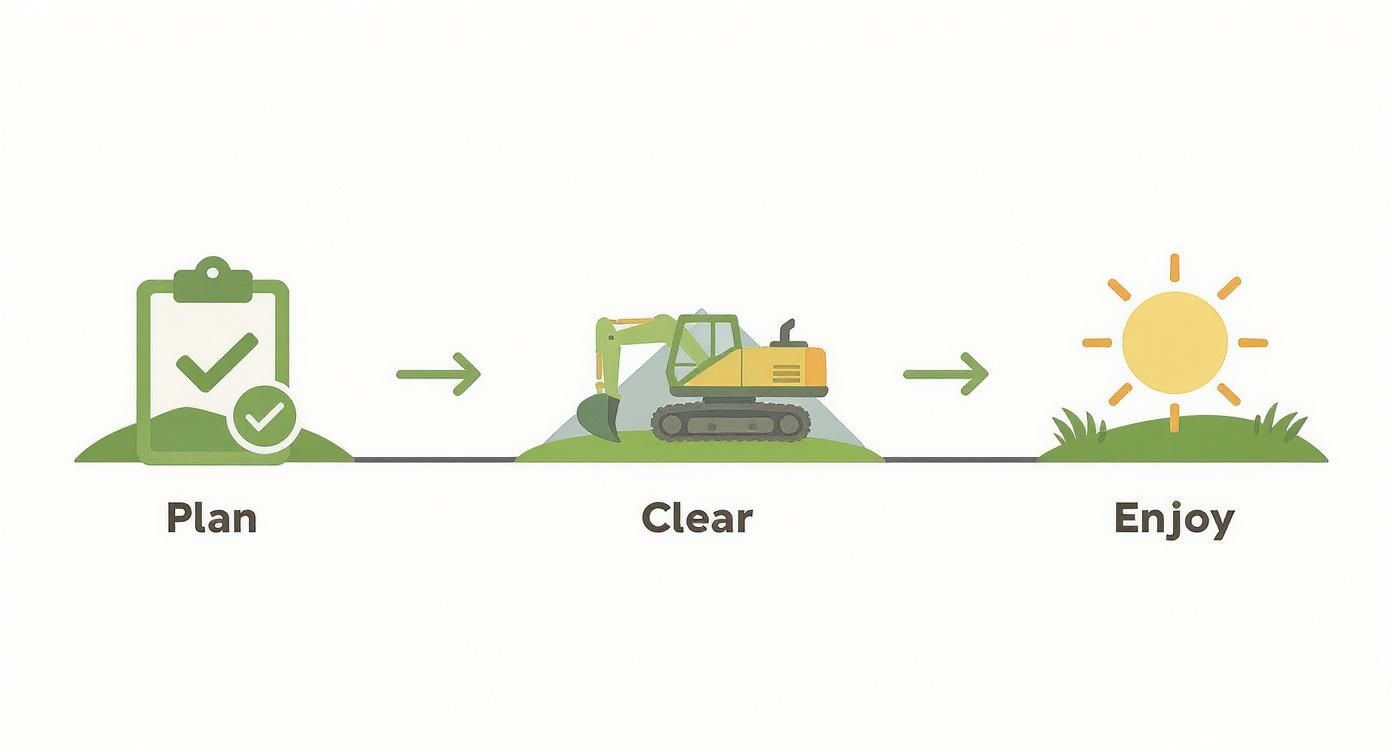
This simple flow shows that a great result always starts with a clear plan before any machinery even arrives on site. That's followed by the professional clearing work, which ultimately leaves you with a usable, enjoyable property.
For a lot of landowners, the hardest part is just figuring out where to start. That feeling of being overwhelmed by a jungle of vegetation is completely normal. You might see a wall of Brazilian Pepper trees, dense thickets of saw palmettos, and a web of tangled vines and have no idea how to even begin tackling it.
The goal isn't just to remove the brush; it's to unlock the potential of your property. Proper clearing is the foundation for everything that comes next, from construction to landscaping.
This guide provides the framework you need. We'll walk through how to assess what you're dealing with, find the right professionals for the job, get a handle on the costs, and prepare your site. This ensures that when the brush removal service crew shows up, the project runs efficiently, safely, and delivers the results you have in mind for your Central Florida property.
Defining the Scope of Your Brush Removal Project
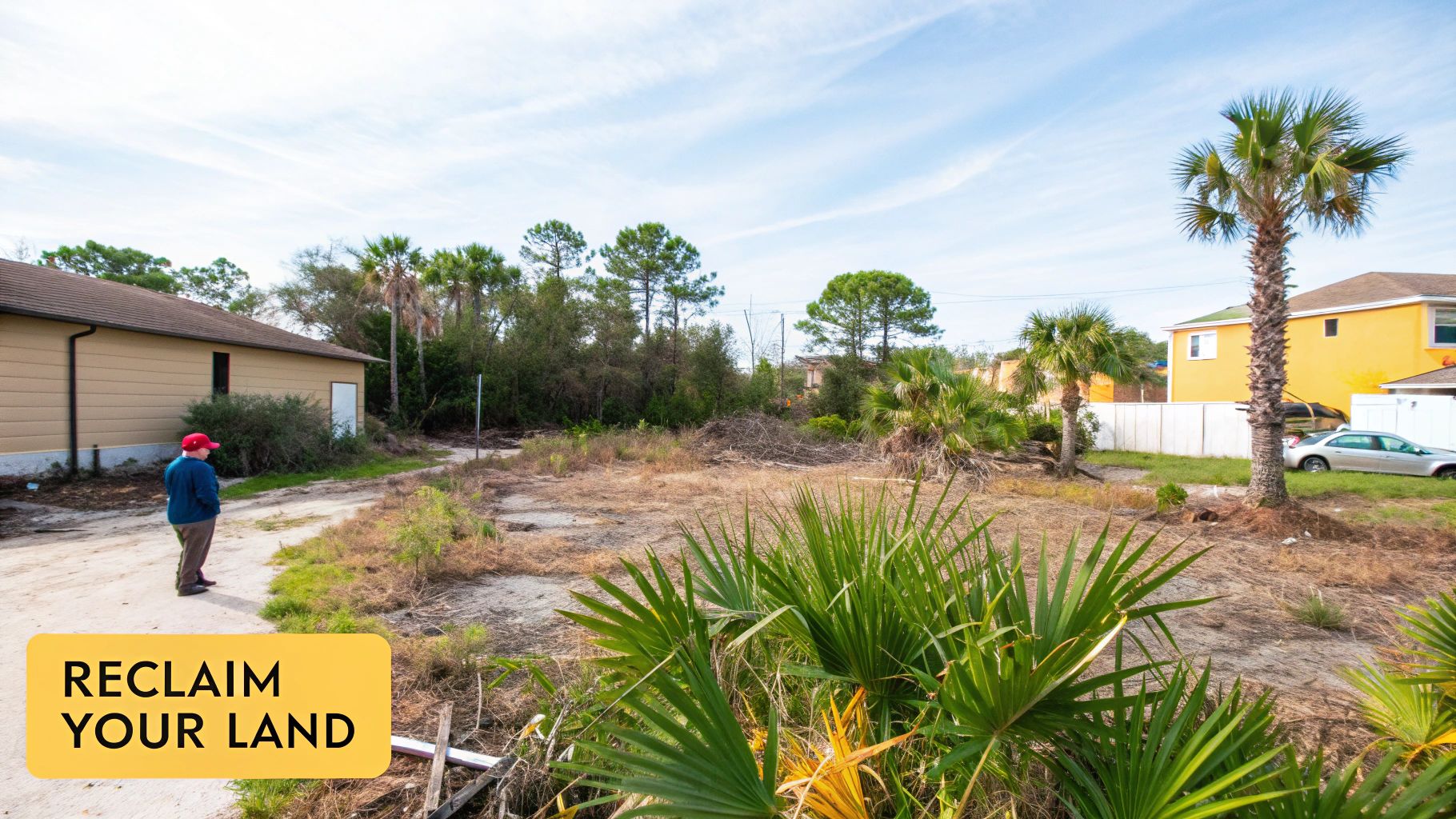
Before you even think about searching for “brush removal service near me,” the most important thing you can do is get a crystal-clear picture of what you actually need. Let's be honest: cleaning up a small backyard is a completely different ballgame than clearing five acres of dense, jungle-like undergrowth for a new construction site.
The equipment needed, the time it will take, and—most importantly—the final cost all come down to how well you understand the scope of your own project.
Taking a few minutes to do this self-assessment is the single best way to avoid sticker shock and make sure the final result is exactly what you envisioned. When you can hand a contractor a simple project brief, you’re guaranteeing that every quote you get is accurate and easy to compare.
Assess Your Property's Unique Challenges
First thing's first: walk your property with a critical eye. What are you really dealing with out there? A simple mix of tall grasses and weeds is one thing. A property choked out by the stubborn, woody vegetation so common here in Central Florida is another beast entirely.
Take note of the specific plants you see. Are there dense clusters of saw palmettos with those tough, fibrous root systems? Or maybe you're fighting invasive species like the Brazilian Pepper tree, which spreads like wildfire and can completely take over.
Identifying these plants upfront helps a contractor know exactly what kind of machinery and how much time they'll need to get the job done right.
A project's complexity isn't just about its size; it's about the density and type of vegetation. An acre of light grass is a different job than an acre of thick palmettos and vines.
Don't forget to look at the ground itself. Is the land flat and easy to get to, or are you dealing with steep slopes, ditches, or soggy, wet areas? Tricky terrain can have a big impact on the cost and timeline, as it might require specialized tracked machinery instead of standard wheeled equipment. Jot down a quick list of any obstacles that could complicate the work.
Create a Project Scope Checklist
The clearer you are about your needs, the easier it is for a professional brush removal service to give you a precise and fair quote. Your goal is to create a simple checklist that spells out exactly what you want done.
To help, we've put together a simple table. Use this as a guide to define the parameters of your project before you start making calls. This little bit of prep work will save you a ton of headaches down the road.
Project Scope Checklist for Brush Removal
Assessment Area | Key Questions to Answer | Example Scenario |
|---|---|---|
Total Acreage | How large is the area to be cleared? (Be as specific as possible). | "I need about 2.5 acres cleared at the back of my property." |
Vegetation Type | What are the main plants? (e.g., palmettos, vines, Brazilian Pepper, pines). | "It's mostly thick saw palmettos and invasive Brazilian Pepper trees." |
Desired Outcome | What's the end goal? Mulch everything in place? Remove stumps for building? | "I want everything mulched on-site to enrich the soil. No stump removal needed." |
Obstacles & Hazards | Are there any utility boxes, septic lids, large rocks, or power lines? | "There's a well head and an irrigation control box we need to work around." |
Property Boundaries | Are your property lines clearly marked? | "The property is staked, but the back corner is hard to see." |
Trees to Keep | Are there any mature trees or plants you want to save? | "Yes, we need to preserve the three large live oaks along the fence line." |
This checklist doesn't have to be fancy, but having this information documented is a game-changer.
Once you have these details hammered out, you’re ready to start contacting local companies. You'll be able to explain your needs with confidence and get quotes that are actually comparable, making your decision-making process a whole lot simpler.
How to Find and Vet Local Clearing Companies
So, you've got a clear picture of what your project entails. Now comes the crucial part: finding the right team for the job. While plugging "brush removal service near me" into a search engine is a start, the most reliable and experienced companies often aren't just at the top of the search results. They're found through real-world connections.
Don't overlook the power of a good old-fashioned recommendation. Start asking around. Local home builders, surveyors, real estate agents, and even your county's agricultural extension office are fantastic resources. These are folks who deal with land professionals day in and day out and know who does quality work. Community forums and local social media groups can also be goldmines for honest, unfiltered feedback from your neighbors.
Essential Questions to Ask Every Contractor
Once you have a shortlist of a few potential companies, it's time to dig a little deeper. This is where you move beyond the initial price quote and really get into the nuts and bolts of how they operate. Your goal is to find a partner who isn't just available, but is truly experienced, properly insured, and equipped for the unique challenges of your property.
To keep things fair and make an apples-to-apples comparison, have a consistent set of questions ready for each company you speak with.
Here are the absolute must-asks:
Are you licensed and insured? This is non-negotiable. Ask for proof of both general liability and worker's compensation insurance. Any legitimate company will have these documents ready and won't hesitate to share them.
What's your experience in Central Florida? You need a crew that knows the difference between clearing pine scrub and tackling a thicket of stubborn palmettos or invasive Brazilian Pepper.
What kind of equipment will you be using? The machinery makes a huge difference. A company with a dedicated forestry mulcher has capabilities far beyond a crew with just a skid steer and a grapple bucket.
Can you provide a few recent references? The best proof is past performance. Ask to speak with a couple of recent clients who had a project similar in scope to yours.
This initial screening will help you quickly filter out the operations that aren't a professional fit for your job.
Red Flags to Watch Out For
Knowing what to look for is only half the battle; you also need to recognize the warning signs of a potentially unreliable contractor. Spotting these red flags early can save you from major headaches, unexpected costs, and a project that drags on forever.
A vague quote or a high-pressure sales tactic should immediately raise your suspicion. True professionals are confident in their work and their pricing. They’ll take the time to walk you through every detail without making you feel rushed.
Be very cautious if a company tries to give you a firm quote over the phone without ever setting foot on your property—it’s nearly impossible to do that accurately. Another major red flag is a flimsy online presence with no verifiable reviews or a portfolio of their work. And of course, be wary of anyone demanding a large cash payment upfront before a single branch has been touched.
The land maintenance industry is growing fast—the global brush cutters market is projected to hit $6.7 billion by 2032—which means more and more companies are jumping in. This makes careful vetting more critical than ever. You can read the full research about the expanding land maintenance market. A trustworthy pro, like us here at Palm State Clear Cut, will always insist on a thorough on-site evaluation before giving you a detailed, written estimate for your project.
Breaking Down Quotes, Contracts, and What It All Costs
When a quote for brush removal lands in your inbox, don't just skip to the bottom line. A good, professional estimate is more than just a number; it's the entire game plan for your project. Knowing how to read between the lines is what separates a smooth project from a surprise headache down the road.
As you start collecting bids, you’ll notice that most companies price their work in one of three ways. Understanding how they operate will help you figure out who’s offering the best real value for your specific piece of land.
By the Hour: This is pretty common for smaller, unpredictable jobs where it's tough to guess the exact time needed. It can be a great deal for a quick cleanup, but the costs can creep up if the crew runs into unexpected snags.
By the Day: Got a medium-sized project that's definitely going to take a full day or more? A flat day rate can give you some cost certainty for a solid block of work.
Flat Project Fee: For most well-defined projects, this is the gold standard. After a proper on-site walkthrough, the contractor gives you a single, all-in price to get the job done, start to finish.
So, which one is right? It all comes down to your project. A flat fee to clear two acres of stubborn palmettos gives you peace of mind. An hourly rate? That might be perfect for just cleaning up an overgrown fence line.
What Really Drives the Price Up (or Down)
No two properties in Florida are the same, which is why there's no such thing as a one-size-fits-all price list. A few key things will always have the biggest impact on your final cost.
The density and type of vegetation is the number one factor. An acre of light, grassy weeds is a walk in the park compared to an acre choked with invasive Brazilian Pepper trees and thick, woody palmettos. The tough stuff requires bigger machines and more hours on the clock. Site access is another huge one. A flat, dry, open lot is a dream to work on. A sloped, soggy, or hard-to-reach spot? That might require specialized tracked equipment, which adds to the cost. The demand for this kind of work is real—the industrial brushes sector, which includes these services, was valued at around USD 775.73 million in 2024 and is still growing. You can discover more insights about industrial brush market trends on archivemarketresearch.com.
A professional quote isn’t just a number; it’s a transparent breakdown of labor, equipment, and disposal methods. If a quote is vague or missing key details, consider it a red flag.
Finally, think about what happens to all the debris. Forestry mulching, where everything is processed right there on-site, is usually the most efficient and cost-effective route. If you need everything hauled away, remember that you’re adding labor, trucking, and disposal fees to the total bill. For a deeper dive into how these factors play out, check out our guide on the cost to clear an acre of land in Florida.
Getting it in Writing: What Your Contract Must Have
Once you've picked your contractor, that quote needs to become a formal contract. This isn't just a formality—it protects you and the company.
Make sure the final document clearly spells out the complete scope of work, a realistic project timeline, and a fair payment schedule. A rock-solid contract leaves zero room for misinterpretation and ensures your project gets done on time, on budget, and exactly the way you envisioned.
Preparing Your Property for a Smooth Clearing Day
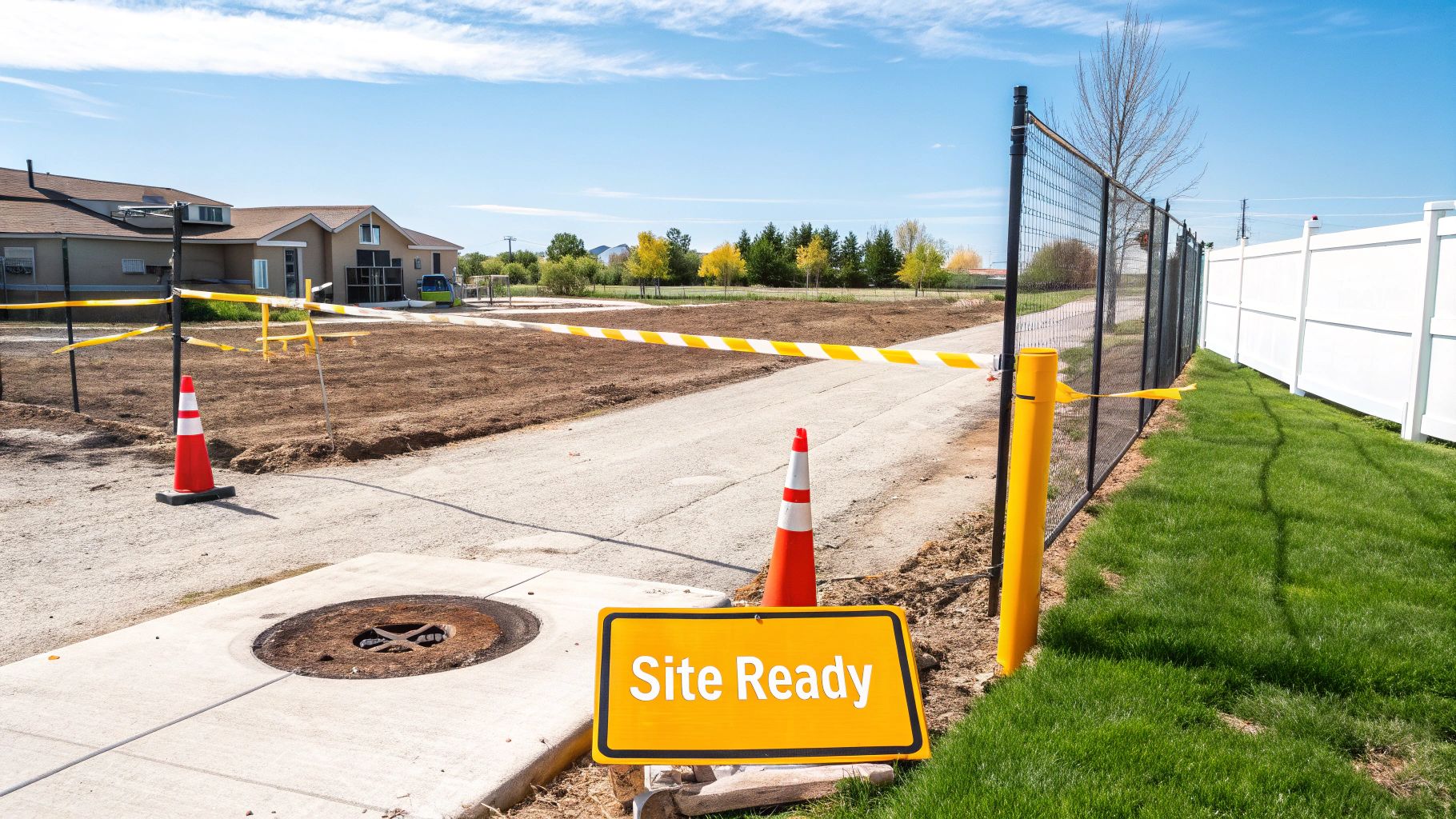
You’ve vetted the companies, picked your crew, and have a date circled on the calendar. So, you’re done, right? Not quite. A little prep work on your end can make a world of difference when the crew shows up.
Proper site preparation isn't just about being helpful—it’s about making the entire operation safer and more efficient, which ultimately saves you time and money. It’s also your best defense against those preventable "oops" moments, like a crunched irrigation head or an accidental clearing of your neighbor's prized azaleas.
Think of it as setting the stage. When the crew arrives, they’re ready to get right to work. But without a clearly marked site and a little prep, they’re starting the day with one hand tied behind their backs. An hour spent walking your property with some brightly colored tape is one of the smartest investments you can make in the whole project.
Marking Boundaries and Saving Valuables
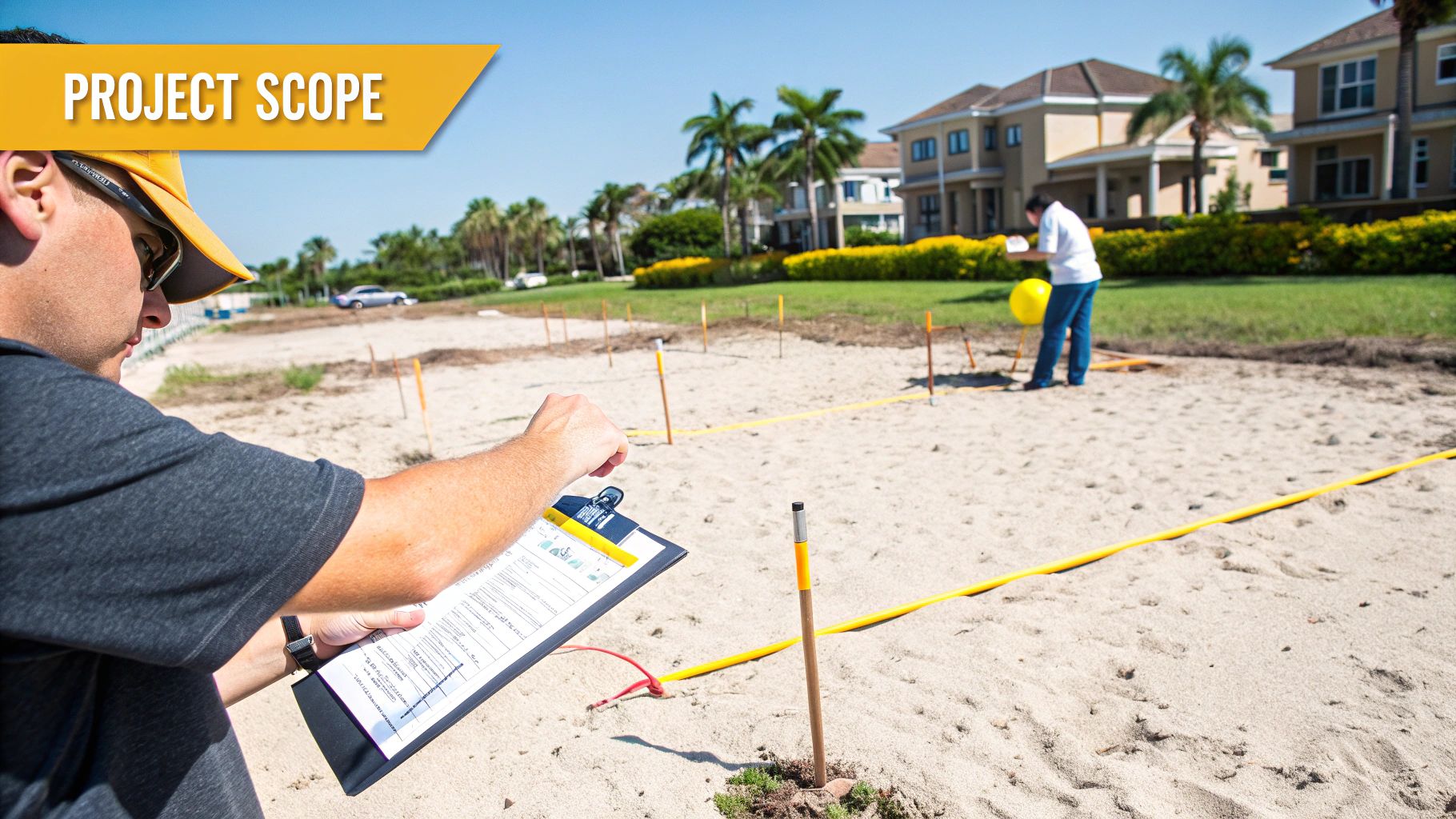
First things first: clearly define the work zone. A property line dispute with a neighbor is a headache nobody wants, and it's 100% avoidable with just a few simple markers.
Mark Your Lines: Grab some brightly colored survey flags or flagging tape and make your property lines impossible to miss. Don't just assume everyone knows where the boundary is.
Flag What Stays: Take a walk through the area that’s being cleared. Do you have a septic tank lid, a well head, or irrigation sprinklers hiding in the brush? What about that one old oak tree you absolutely love? Use a different color of tape to clearly mark every single thing you want to protect.
Clear the Path: That heavy machinery needs a way to get in. You might need to temporarily take down a section of fence, remove a gate, or trim a few low-hanging branches that could get in the way of a large machine.
A final walkthrough with the crew leader before a single engine starts is non-negotiable. This is your last chance to physically point out every marked hazard, confirm the exact boundaries, and make sure you’re both looking at the same game plan.
Planning for the "What Ifs"
While most clearing jobs go off without a hitch, it never hurts to think through the logistics. If you're working with a smaller suburban lot, for instance, you might not even need heavy machinery. There are plenty of techniques for clearing land by hand that can minimize the footprint on your property. For a deeper dive, you can learn how to clear land without heavy equipment in our guide.
Taking these steps ahead of time shows your clearing company that you’re a prepared partner in the project. It helps turn what could be a chaotic day into a well-oiled operation, getting you the results you want, faster.
What to Expect During and After the Brush Removal
Knowing what the day of service will actually look and sound like can take a lot of the stress out of the process. When you hire a professional brush removal team, you should be ready for a day of planned activity and—let’s be honest—some serious noise.
The day usually kicks off with the early arrival of heavy machinery. Crews are methodical. They’ll start at a designated point and work their way through the property with a clear plan. You can definitely expect a significant amount of noise from engines and grinders, so it's always a good idea to give your neighbors a heads-up as a courtesy.
The real magic, though, is what you see after the engines go quiet. The immediate "after" state of your property really depends on the clearing method used.
The Final Result: Forestry Mulching
If you’ve chosen forestry mulching—a very popular and eco-friendly option here in Florida—your land won't be left as bare dirt. Instead, it will be blanketed with a fresh, even layer of shredded organic material. This isn't just leftover debris; it's a nutrient-rich blanket for your soil.
This mulch layer is incredibly beneficial for a few key reasons:
Erosion Control: It acts as a shield, protecting precious topsoil from getting washed away by Central Florida's notorious downpours.
Soil Health: As that mulch decomposes over time, it feeds valuable nutrients back into the ground, improving the soil's structure and fertility.
Weed Suppression: That thick blanket of mulch does a great job of smothering out new growth, preventing unwanted weeds and brush from quickly returning.
The equipment that makes this happen is highly specialized. The technology is always improving, much like in other industries. In fact, the global market for specialized industrial cleaning brushes is projected to hit USD 68.6 million by 2035, all driven by the need for automated solutions that deliver better results with less manual labor. You can read more about how automation is shaping industrial brush technology to see how this trend impacts various fields.
Life After Clearing: Your Next Steps
Once the crew packs up and leaves, your role begins. The new layer of mulch will settle over the next few weeks. It's perfectly normal to see a little sporadic regrowth from some stubborn roots, but this is usually minor and easy to manage.
The goal of brush removal isn't just to clear the land for a day, but to set you up for long-term success. The mulch layer created by modern equipment is a key part of that strategy.
Getting a better handle on the machinery that gets these results can give you a new appreciation for the entire process. If you’re curious about the kind of equipment we put to work, check out our guide to underbrush clearing machines.
This freshly cleared landscape is now your blank canvas, ready for whatever you have planned next—whether that’s putting down sod, starting a garden, or prepping a new building site.
Common Questions About Brush Removal in Florida
When you're searching for a brush removal service near me, you're bound to have a few questions. We get calls from landowners all across Central Florida, and a handful of the same concerns pop up again and again. Let's get you some straight answers.
Do I Need a Permit for Brush Removal?
This is a big one, and the answer is: it depends. The scope and location of your project are the deciding factors.
For basic yard cleanup and getting rid of underbrush on a typical residential lot, you’re almost always in the clear. No special permission is needed.
But the game changes for larger-scale jobs. If you’re clearing several acres, taking down protected trees like large live oaks, or working anywhere near wetlands, you'll almost certainly need a green light from your city or county. Any reputable local contractor will know the ins and outs of these regulations and can help you navigate the permit process.
The biggest mistake you can make is just assuming you don’t need a permit. A quick check with your local government or a knowledgeable contractor beforehand can save you from some serious headaches, like hefty fines and project shutdowns.
What Is the Difference Between Brush Removal and Land Clearing?
People often use these terms as if they mean the same thing, but in our world, they describe two very different jobs.
Brush Removal: Think of this as a strategic cleanup. We use equipment like a forestry mulcher to target the messy stuff—undergrowth, tangled vines, invasive plants, and smaller trees. The goal is to leave your mature, desirable trees and topsoil intact while turning the overgrowth into a beneficial layer of mulch. It’s all about making your land healthier and more usable.
Land Clearing: This is the full reset button. Land clearing is a far more intensive process where we remove everything—trees, stumps, roots, and all. Often, it includes grading the land to create a blank slate. This is what you do when you’re preparing a site for new construction.
How Long Does a Typical Project Take?
The timeline for a brush removal project is all over the map because every property is unique.
Cleaning up the underbrush on a half-acre lot might just be a few hours of work. Easy.
On the flip side, tackling five acres of thick, woody vegetation choked with tough Florida palmettos? That could easily take a crew several days to get through. A true professional service will always give you a solid time estimate in their official quote after they've walked the property with you. That way, there are no surprises.
Ready to reclaim your overgrown property and turn it into a clean, beautiful space? The team at Palm State Clear Cut has the expertise and the right equipment to handle any brush removal job in Central Florida. Get your free quote today!
Comments