
A Florida Guide to Growing Grass in Shade Under Trees
- Mike Walker
- Dec 19, 2025
- 16 min read

Trying to grow a lush, green lawn under a sprawling Florida live oak or a thick pine canopy can feel like a losing battle. It’s a common frustration. Most people point the finger at the lack of sunlight, and while that’s a huge part of the problem, it’s not the whole story.
Success in these tricky spots isn't about finding one secret weapon. It’s about understanding the complex fight happening both above and below the ground.
Growing grass in the shade is, at its core, a brutal competition for resources. Your turf isn’t just starved for the sun's energy—it's also in a constant tug-of-war with a much bigger, more established opponent: the tree itself.
The Triple Threat to Shaded Turf
When grass fails under trees, it’s almost always due to a combination of three critical issues working together.
Severe Light Reduction: A dense tree canopy can block 70-90% of the sunlight your grass needs for photosynthesis, which is how it makes its food. Without enough light, grass blades get thin, weak, and leggy as they stretch desperately for any ray of sun they can find.
Intense Root Competition: A mature tree has a massive, aggressive root system. These roots create a dense, shallow mat that greedily soaks up the majority of the water and nutrients in the soil, long before your grass's smaller root system even gets a shot.
Poor Soil Conditions: The ground directly under a tree often has its own set of problems. Years of falling leaves and pine needles can make the top layer of soil more acidic, throwing off the pH and making it a tough place for turf to live. On top of that, the soil gets heavily compacted from all that root growth and a lack of air.
The reality is, you're trying to grow a sun-loving plant in what is essentially a forest-floor environment. To win, you have to change your mindset and actively manage that environment to give your grass a fighting chance.
This means you can't treat the shady parts of your yard the same way you treat the sunny areas. Just tossing down some seed and fertilizer is a recipe for failure. From day one, the grass will be outgunned for light, water, and food.
A smarter strategy involves attacking the problem on all fronts. You'll need to improve the environment by pruning the tree, amend the soil so it can hold more resources for your grass, and choose a turf variety specifically bred to handle these stressful, low-light conditions. It’s a multi-front war, and you need a multi-front strategy to win it.
Selecting the Best Shade-Tolerant Grass for Your Yard
After you’ve tackled the big challenges under your tree canopy—the soil, the roots, the sunlight—the single most important decision left is picking the right grass. Get this wrong, and you’re in for a long, frustrating battle with a thin, struggling lawn, no matter how much work you put in.
For us here in Central Florida, that means looking past the generic "shade mix" bags at the big box stores and focusing on specific, proven warm-season turfgrass varieties.
Think of it like picking an athlete for a specific sport. You wouldn't send a marathon runner to a weightlifting competition. In the same way, the tough, sun-loving Bahia grass that’s thriving out by the road will quickly give up in the low-light, high-competition environment under a mature oak tree.
You need a specialist. You need a grass that’s genetically wired to handle less sunlight. These grasses are simply more efficient at photosynthesis, allowing them to create enough energy to get by with just a few hours of dappled or indirect sun each day. This is the absolute foundation of success.
St. Augustine Grass: The Shade-Tolerant Champion
For most shaded yards in our area, St. Augustine is the undisputed champion. It has a coarser texture and spreads with aggressive above-ground runners (called stolons), which is great for filling in those inevitable thin spots.
But here’s the key: not all St. Augustine varieties are the same when it comes to shade.
Two cultivars, in particular, really stand out for their performance in low-light conditions:
'Palmetto' St. Augustine: For years, 'Palmetto' has been the go-to choice. It has excellent shade tolerance and a slightly finer texture than other St. Augustine types. It holds its color well under big trees but can be prone to fungal diseases if you overwater it.
'CitraBlue' St. Augustine: This is a newer variety developed by the University of Florida, and it’s a real powerhouse. 'CitraBlue' has a unique blue-green color and has shown exceptional shade tolerance, often outperforming 'Palmetto' in trials. Plus, it has better disease resistance, making it a very strong contender for modern Florida lawns.
Let’s say you have a backyard with large live oaks that cast a ton of shade, but it's also where the kids and dogs play. In that scenario, 'CitraBlue' is probably the better pick because of its combined shade tolerance and durability. For a purely ornamental, low-traffic shaded spot, 'Palmetto' is still a reliable and excellent option.
Zoysia Grass: A Durable and Fine-Textured Alternative
While St. Augustine often gets the top billing, Zoysia grass is another fantastic choice, especially if you want that finer-textured, more manicured look. Zoysia is known for its incredibly dense growth, which naturally helps it choke out weeds. Once it’s established, it’s also more drought-tolerant than St. Augustine.
The trick is picking the right Zoysia cultivar. Many types need a lot of sun, but some of the finer-bladed varieties have been specifically bred for better performance in the shade.
'Zeon' Zoysia: People often call this the "barefoot grass" for its soft feel. 'Zeon' is one of the most shade-tolerant Zoysia varieties you can find. It creates a beautiful, dense carpet and has good wear resistance, making it a solid choice for areas with moderate activity.
'Emerald' Zoysia: This is another fine-bladed Zoysia with good shade tolerance, though maybe a touch less than 'Zeon'. It has a gorgeous dark green color but can be slower to establish and recover from damage.
If your main goal is a pristine, carpet-like lawn under your pine trees that has a more refined look, 'Zeon' Zoysia is an outstanding investment. It takes a bit more patience to get it going, but the reward is a stunning, resilient turf.
To help you visualize the differences, here’s a quick comparison of the top contenders for a shady Central Florida yard.
Comparing Shade-Tolerant Grasses for Central Florida
This table breaks down the key characteristics of each grass, making it easier to see which one fits your specific needs, from shade levels to foot traffic.
Grass Type | Shade Tolerance Level | Drought Resistance | Wear Tolerance | Best For |
|---|---|---|---|---|
'CitraBlue' St. Augustine | Very High | Moderate | Good | Heavily shaded areas with some family/pet use. |
'Palmetto' St. Augustine | High | Moderate | Moderate | Dappled shade in low-traffic, ornamental areas. |
'Zeon' Zoysia | High | Good | Good | A manicured, "barefoot soft" lawn in moderate shade. |
'Emerald' Zoysia | Moderate-High | Moderate | Moderate | Homeowners wanting a fine-textured look; slower to establish. |
Choosing the right variety from this list sets you up for success from day one. It’s about matching the grass to the reality of your yard, not forcing a sun-loving plant to survive where it can't.
The core issue with growing grass in shade is a massive drop in energy production. Research shows many grass species see a 30-50% reduction in growth under moderate shade. That’s why picking a genetically superior, shade-tolerant cultivar isn’t just a suggestion—it's essential for survival. You can explore the detailed findings on grass performance under shade to really understand the science.
This decision tree shows the main culprits when grass fails, helping you diagnose whether the issue is a lack of sun, root competition, or poor soil.

As the chart shows, sunlight is critical, but it’s tied directly to root and soil health. You can’t solve one problem without considering the others.
Ultimately, picking the right grass variety is the first and most important step. By matching a proven performer like 'CitraBlue' St. Augustine or 'Zeon' Zoysia to your yard's specific conditions, you avoid a costly mistake and give your lawn the best possible start. This one choice dramatically increases your odds of finally getting that lush, green lawn under your beautiful Florida trees.
How to Prepare Soil for a Thriving Shaded Lawn
Every healthy lawn is built from the ground up, but this is doubly true when you're trying to grow grass under trees. The soil in these spots is almost always a triple threat: it's compacted, acidic, and stripped of nutrients by the tree's massive root system. Just tossing some sod or seed on top of that is a recipe for a patchy, struggling lawn.
Think of it like building a house—you wouldn't put up walls on a cracked, uneven foundation. The same idea applies here. Getting the soil right is the essential first step that gives your shade-tolerant grass a real fighting chance to take root and hang on for the long haul.
Assessing Your Soil's Condition
Before you add a single thing, you have to know what you're up against. The soil under a mature oak or pine is rarely in great shape; it's often rock-hard and worn out.
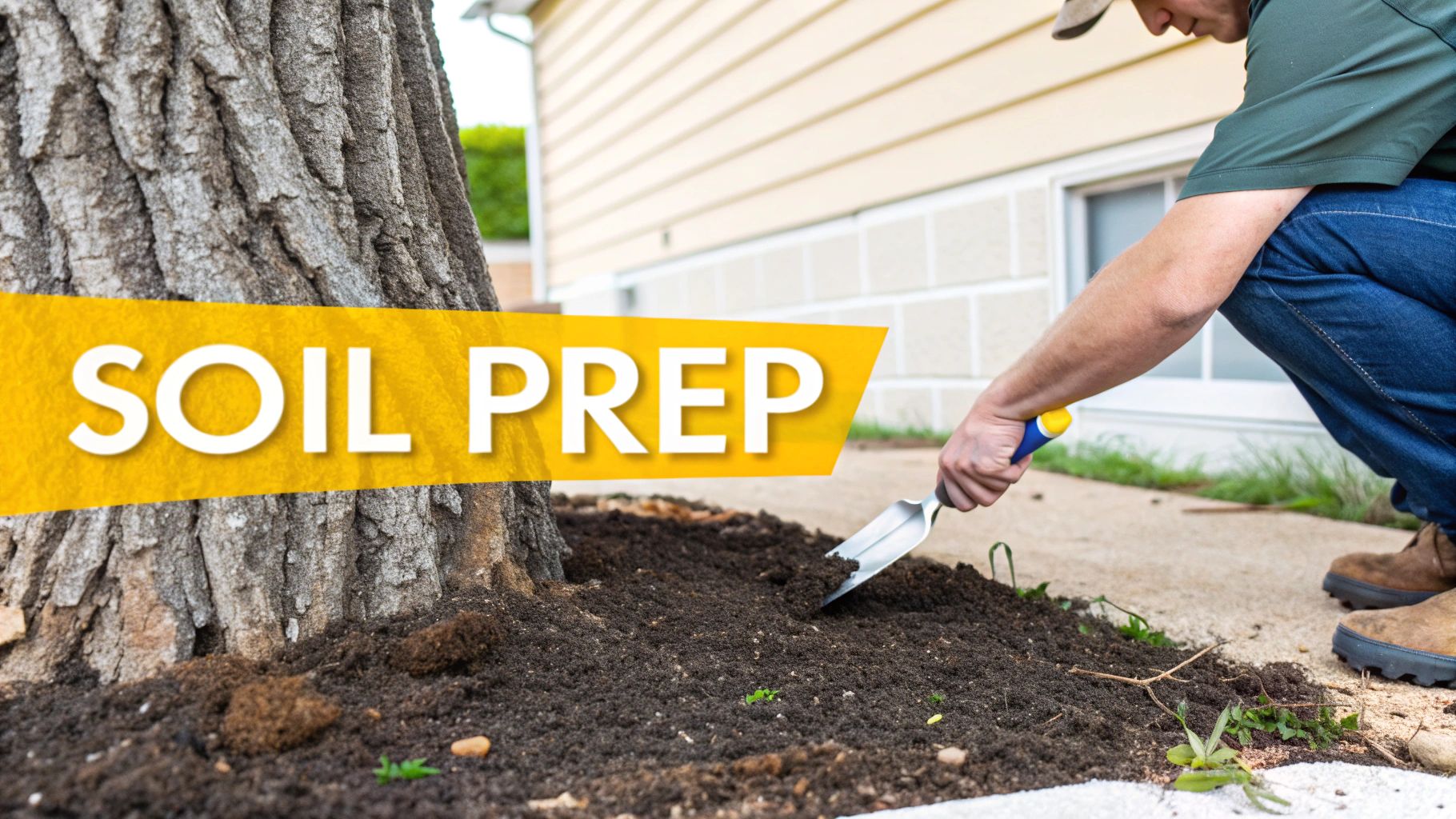
First, check for compaction. The easiest way is the old "screwdriver test." After a good rain, try pushing a long screwdriver into the ground. If it goes down six inches without a fight, you're in pretty good shape. If you can barely get it in an inch or two, you've got a serious compaction problem on your hands.
Next, you'll want to get a read on your soil’s pH level. Years of falling leaves and pine needles can make the soil too acidic, which essentially locks up nutrients so the grass can't use them. You can grab an affordable DIY pH test kit from any local garden center. Most grasses are happiest with a pH between 6.0 and 7.0.
Amending the Soil Without Harming Tree Roots
Once you know what's wrong, you can start making it right. The goal is to work in plenty of organic matter to loosen the soil, help it hold water, and make nutrients available. For the sandy soils we have here in Central Florida, this step is absolutely non-negotiable.
Here are a couple of the best amendments for the job:
Compost: This is the gold standard. Good compost adds beneficial microbes, improves drainage in compacted soil, and helps our sandy soil hold onto water and nutrients.
Peat Moss: This stuff is fantastic for water retention, which is a huge deal when your grass is competing with thirsty tree roots. It also helps loosen up that hard-packed soil.
The key here is to be gentle. You can't just fire up a heavy rototiller and churn up the soil under a tree. That's a surefire way to shred the tree’s critical feeder roots, which are often just inches below the surface. Damaging those roots can seriously stress, or even kill, a beautiful, mature tree.
Instead, take a more delicate approach. Spread a layer of compost or peat moss, about one to two inches thick, over the whole area. Then, use a heavy garden rake or a pitchfork to gently work it into the top two to three inches of soil. You're aiming to mix it in, not deep-plow the ground. This improves the top layer for the new grass without declaring war on the tree.
For spots with really bad compaction or erosion issues, you might need to look at more advanced solutions. You can explore a practical guide to soil stabilization techniques to see how to handle those tougher conditions.
Creating the Ideal Seedbed
After you've mixed in your amendments, the last step is to create a smooth, level surface. Rake the area one final time, breaking up any clumps and pulling out any rocks or old roots. The finished surface should be smooth, but not packed down.
This carefully prepared bed now gives new grass everything it needs:
Improved Airflow: Loosened soil lets oxygen get to the roots.
Better Water Penetration: Water can soak in instead of just running off.
Nutrient Availability: The organic matter holds onto nutrients for the new grass.
Easier Root Growth: New roots can push down and get established easily.
Taking the time to get the soil prep right is the single most important thing you can do to make sure your investment in new grass pays off. It creates a foundation that can support healthy turf, even in that tough, competitive environment under a dense tree canopy.
Letting the Light in with Strategic Tree Pruning
So, you’ve prepped the soil and picked out the perfect shade-tolerant grass. That’s a great start, but there's one more piece to this puzzle you can't ignore: the source of the shade itself. You have to manage the dense tree canopy that's blocking all that precious sunlight.
The secret to successfully growing grass in shade under trees is strategic pruning. This isn’t about hacking the tree back; it's about making smart, targeted cuts to open things up. This allows just enough dappled sunlight to hit the ground, giving your new grass the light it needs to establish and eventually thrive.
Raising the Canopy for Morning Sun
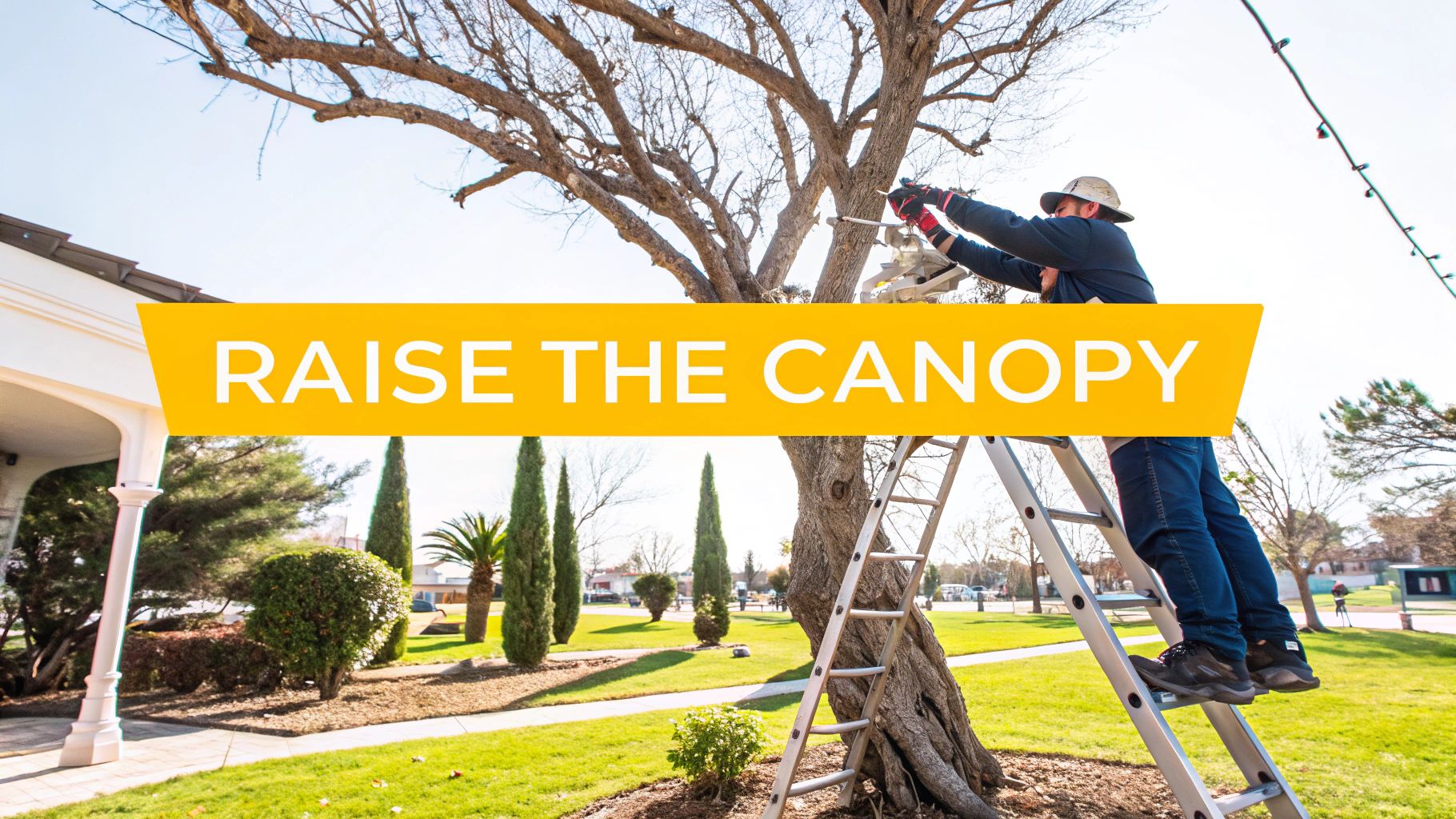
One of the most effective techniques is called crown raising, or "limbing up." It's exactly what it sounds like—you simply remove the lowest branches of the tree. The goal here is to lift the entire canopy higher off the ground, which lets that valuable, low-angle morning and late-afternoon sun sneak in underneath.
Think of your tree like a giant umbrella. By raising it up, you expose more of the ground around its base to light. Limbing up a mature oak by just a few feet can make a world of difference, especially during those critical morning hours when the sunlight is less intense.
Thinning the Canopy for Dappled Light
The other key technique is canopy thinning. This is a more delicate process where you selectively remove branches within the canopy—focusing on ones that are crossing, rubbing, or just growing too close together.
This doesn't really change the tree's overall shape, but it does reduce its density. It’s like opening the blinds just enough to let light filter through. Thinning creates small gaps all over, allowing bits of sunlight to penetrate straight down to the grass throughout the day, which is a huge benefit for turf health.
Combining crown raising and thinning is a powerful one-two punch. In fact, research shows that when you pair cultural practices like pruning with a shade-tolerant grass, you can dramatically improve your odds. It can shift your chances of keeping over 80% turf cover from less than 30% to as high as 80% after three years.
Knowing When to DIY and When to Call an Arborist
For small, easy-to-reach branches, a little DIY pruning is fine. But it's critical to know your limits, both for your own safety and for the health of your tree.
Crucial Takeaway: Never try to remove a large branch you can't control or that forces you to use a chainsaw on a ladder. The risk of serious injury or property damage is just too high.
It's time to call a certified arborist if:
The branches are thicker than 3-4 inches in diameter.
The job requires climbing or using power tools from a ladder.
You aren't sure which branches to cut without harming the tree.
The tree is close to power lines, your house, or other structures.
A professional can thin the canopy safely and correctly, making sure the tree stays healthy and structurally sound. To get a better handle on the right techniques, check out our guide on the 8 essential methods for trimming limbs on trees in 2025. Properly pruning your trees is more than just a lawn care chore; it’s an investment in a healthier, more beautiful landscape.
Mastering a New Lawn Care Routine for Shaded Areas
The rules you follow for the sunny parts of your yard simply don't apply under a tree canopy. Grass in the shade is already stressed, fighting for every drop of light, water, and nutrient. If you treat it the same as the rest of your lawn, you're setting it up to fail.
To succeed at growing grass in shade under trees, you have to throw out your old playbook and adopt a completely new maintenance routine. This specialized approach is all about maximizing every resource and minimizing stress on the turf.
Mow High and Keep It Sharp
The single most impactful change you can make is raising your mower deck. While you might scalp your sunny St. Augustine down to two or three inches, grass in the shade needs to be kept taller—ideally between three and four inches.
A taller blade means more surface area, and that's critical for capturing what little sunlight filters through the leaves. Think of each grass blade as a tiny solar panel; a bigger panel collects more energy. This extra height allows the grass to photosynthesize just enough to survive and stay green.
It's also crucial to keep your mower blades sharp. A dull blade doesn’t cut, it tears. This creates a ragged wound that invites disease and forces the plant to expend precious energy on healing—energy it just doesn't have to spare in a low-light environment.
Water Deeply, but Way Less Often
One of the biggest mistakes I see homeowners make is overwatering shaded grass. Without direct sun and with less air circulation, moisture just sits on the blades and soil surface. This creates the perfect breeding ground for fungal diseases like brown patch, which absolutely thrive in damp, shady corners.
The right strategy is to water deeply but much less often than you would in the sun.
Frequency: Ditch the fixed schedule. Water only when the grass shows signs of thirst, like a slight wilting or a bluish-gray tint. For many shaded areas, this might mean just once a week, even in the heat of a Florida summer.
Depth: When you do water, aim for a long, slow soak that delivers about one inch of water. This encourages the grass to send its roots deeper into the soil, forcing them to compete with tree roots for moisture and making the whole plant more resilient.
Shade causes significant physiological changes in turfgrass. Scientific studies show that shaded plants often have reduced total root length, surface area, and volume. This fundamental weakness is precisely why deep, infrequent watering is so critical for encouraging a stronger, more competitive root system. You can read the full research on how shade impacts grass physiology to understand the science behind these recommendations.
Fertilize Lightly and Strategically
Just as shaded grass grows slower on top, its nutrient needs are lower, too. Over-fertilizing is a common and often fatal mistake. It pushes out weak, leggy growth that’s a magnet for disease and stress. When it comes to feeding shaded lawns, less is definitely more.
Follow these simple fertilization guidelines:
Cut the Rate: Apply fertilizer at about half the rate you’d use for the sunny parts of your lawn.
Time it Right: The best time to fertilize is in the fall. This helps the grass store energy for the winter and gives it a healthier start the following spring. Avoid heavy spring fertilization, which just encourages that weak flush of growth.
Go Slow-Release: Always choose a balanced, slow-release fertilizer. This provides a steady, gentle supply of nutrients that matches the grass's slower metabolism without overwhelming it.
By adapting how you mow, water, and fertilize, you create a maintenance routine that works with the challenging environment, not against it. This new playbook is your key to finally getting a healthy, sustainable patch of grass under those beautiful trees.
Troubleshooting Common Problems and Finding Alternatives
Even after you've done everything right—perfect prep, the best shade-tolerant grass—there are times when growing turf under trees just feels like an impossible task. You might start seeing the same problems pop up again and again, a sure sign that the environment is simply too stressful for grass. Don't get discouraged; this is a common reality under a dense tree canopy.
The trick is to recognize these problems for what they are: symptoms. Moss, for instance, isn't the cause of a bad lawn. It's a symptom of damp, acidic, compacted soil where your grass is too weak to outcompete it. Recurring fungal diseases like brown patch or bare spots that never fill in are also red flags, telling you the area is too dark and moist for turf.
Addressing Persistent Lawn Issues
When you spot these warning signs, there are a few things you can try.
Fighting Moss: First, check your soil pH. If it's on the acidic side, a light dusting of lime can help. I'd also recommend aerating the area to improve drainage and airflow, which makes the soil far less inviting for moss.
Dealing with Fungus: The culprit here is almost always too much moisture and not enough air. Pruning some of the lower-hanging tree limbs can work wonders for air circulation. Also, make sure you're watering deeply but infrequently, giving the soil a chance to dry out.
Bare Patches: If the same spots keep dying off, you're likely dealing with extreme root competition or a total lack of sun. You can try to reseed, but if it fails a second time, that's a pretty clear signal that grass is never going to make it there.
At a certain point, you have to know when you're fighting a losing battle. If an area gets less than four hours of dappled sunlight a day, no grass—not even the toughest shade-tolerant variety—is going to perform well in the long run.
When to Embrace Lawn Alternatives
Instead of forcing grass where it clearly doesn't want to grow, why not turn those trouble spots into beautiful, intentional landscape features? Making this strategic shift can save you a world of time, money, and frustration.
Shade-loving groundcovers are a fantastic choice for Florida yards, as they're built for low light and tough root competition.
Asiatic Jasmine (Trachelospermum asiaticum): This is a seriously tough, drought-tolerant option that forms a dense, dark green mat. Once it's established, it’s about as low-maintenance as it gets.
Mondo Grass (Ophiopogon japonicus): If you want a grass-like look without all the hassle, Mondo Grass is perfect. It creates a lush, dark green carpet and handles deep shade exceptionally well.
Another really elegant solution is to create a naturalized bed around the tree's base. A well-defined ring of mulch or pine straw looks clean and is actually much healthier for the tree, as it eliminates damage from mowers and weed eaters hitting the trunk. You can learn more about why this works so well in our guide on unlocking the power of mulching for sustainable land management.
By accepting the limits of deep shade and opting for a smart alternative, you can transform a landscaping headache into a beautiful, easy-to-care-for focal point in your yard.
Your Top Questions About Growing Grass in the Shade
Even when you've done everything right, a few tricky questions always seem to pop up when you're trying to coax a lawn to life under a tree canopy. Let's tackle some of the most common ones I hear from homeowners.
Can I Just Throw Some Grass Seed Under My Trees and Hope for the Best?
I wish it were that easy, but unfortunately, that's a recipe for disappointment. Just scattering seed on unprepared ground under a tree is setting it up to fail.
Think of it this way: you've got a massive, established tree with a root system that acts like a sponge, immediately out-competing tiny new seedlings for every drop of water and nutrient in the soil. Add in the lack of sunlight, and those new grass blades never stand a chance. Success starts with proper prep work.
How Often Should I Overseed Bare Patches?
Overseeding is your best friend for keeping turf in shady spots looking full. It’s just a fact of life that these areas will thin out over time, and a little fresh seed goes a long way.
The best time to do this is in the spring or fall when the Central Florida heat isn't so brutal. For many shady lawns, making this an annual ritual is what keeps them from turning into patchy dirt zones.
My Two Cents: Before you even open the bag of seed, figure out why that patch is bare. Is the soil hard as a rock? Is it getting zero light? Take a rake to the spot to rough it up, clear out any dead stuff, and give the new seed a fighting chance to actually touch the soil.
Will Fertilizer Make My Shady Grass Grow Thicker?
Yes, but this is one of those situations where less is definitely more. Grass in the shade grows much slower and simply doesn't need the heavy dose of nitrogen that its sun-loving counterparts do.
If you over-fertilize, you'll just encourage weak, spindly growth that’s incredibly susceptible to fungus and disease—something we have plenty of here. Your best bet is to stick with a balanced, slow-release fertilizer and apply it at about half the rate you'd use on the sunny parts of your lawn.
Here at Palm State Clear Cut, we understand that sometimes the problem isn't the grass—it's the light. If your tree canopy is just too thick, strategic thinning might be the answer. We can help you create the perfect balance of sun and shade. Contact us today for a free quote and let's get your lawn on the right track.
Comments