Getting your land ready for construction is a huge first step, and it’s way more than just bulldozing trees. Think of it as setting the stage for your entire project. A proper land clearing for construction plan is what separates a smooth, on-schedule build from a project plagued by delays, fines, and unexpected costs.
It’s about a methodical approach to site prep: knowing your land inside and out, getting the right permissions, and figuring out how to handle the debris before a single machine rolls onto the property.
Laying the Groundwork Before Clearing Begins
I’ve seen it happen too many times: someone gets excited and rushes in with heavy equipment, only to hit a buried utility line or get slapped with a stop-work order from the county. That’s a recipe for disaster. The most successful construction projects always start with meticulous planning.
This pre-clearing phase is your chance to uncover potential roadblocks ahead of time. You’ll identify everything from property line disputes to protected gopher tortoise burrows, ensuring the actual clearing work is smooth, safe, and legal. Skipping these steps is a gamble that rarely pays off.
The Professional’s Pre-Clearing Checklist
Before we even think about starting the equipment, we run through a strict sequence of checks. This isn’t just about ticking boxes; it’s about building a clear, efficient path forward where each step informs the next.
Here’s a quick rundown of what that looks like:
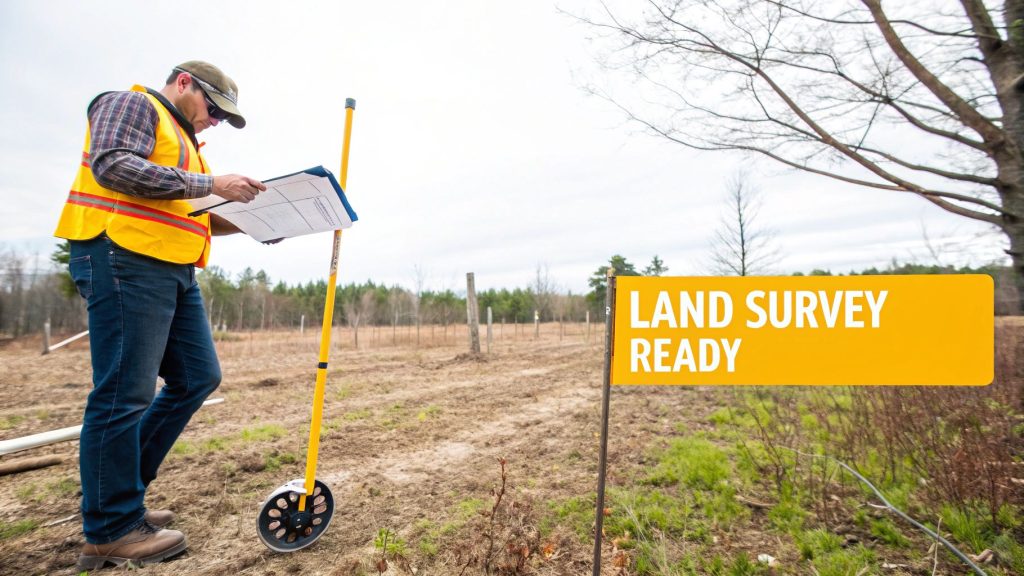
- Get a Professional Land Survey: This is non-negotiable. A survey definitively marks your property lines, which prevents costly arguments with neighbors. It also maps out the topography, easements, and any major obstacles like rock outcroppings or wetlands that will influence your site plan.
- Assess the Vegetation and Soil: What are you dealing with? Is it a jungle of invasive Brazilian pepper and dense palmettos, or do you have valuable mature oak trees you might want to save? The type and density of vegetation will dictate the best clearing method. A soil check is also vital for planning your foundation.
- Check for Environmental Factors: We’re in Central Florida, and our ecosystem is sensitive. Your plan absolutely must account for protected species (like the gopher tortoise), wetlands, and local tree ordinances. Many counties have rules that protect “heritage” or “specimen” trees.
This simple flow chart nails the core sequence: survey first, then permits, and finally, utility locates. It’s the professional standard.
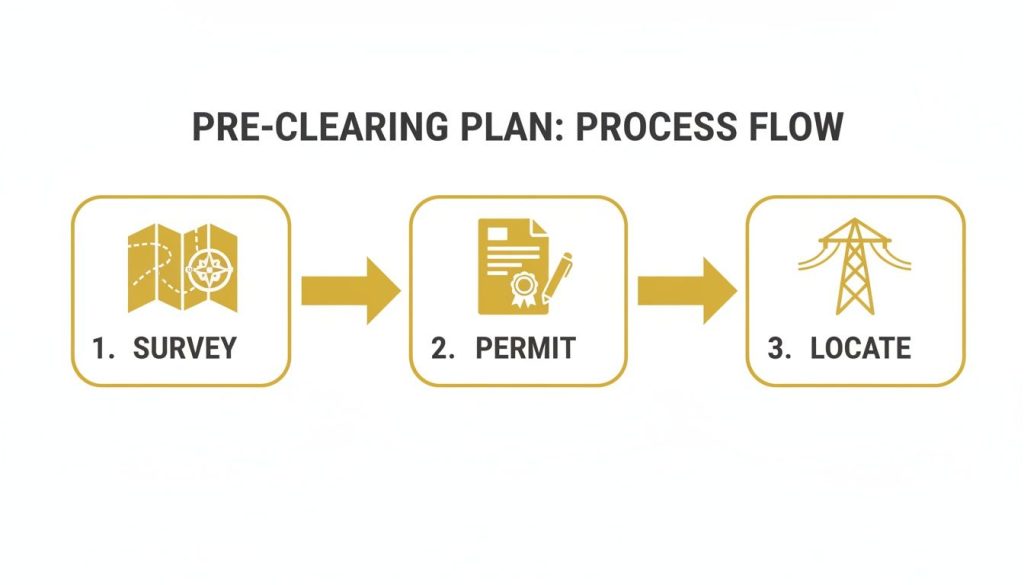
Following this order prevents having to backtrack and ensures all your legal and safety bases are covered before the real work begins.
To make this easier to track, here’s a simple checklist you can use.
Your Pre-Clearing Planning Checklist
This table breaks down the essential actions you need to take before breaking ground. Following these steps will help you organize the process and avoid common pitfalls we see in the field.
| Action Item | Why It’s Critical | Key Considerations (Central Florida) |
|---|---|---|
| Obtain a Boundary Survey | Establishes legal property lines to prevent disputes. Identifies easements and topography crucial for site layout. | Ensure the surveyor is licensed in Florida. Verify any utility or access easements that could restrict your buildable area. |
| Secure All Necessary Permits | Avoids fines, stop-work orders, and legal trouble. Ensures compliance with local, state, and federal regulations. | Permit requirements vary widely by county (e.g., Orange, Seminole, Volusia). You may need separate land clearing, tree removal, and/or environmental permits from a Water Management District. Start this process months in advance. |
| Call 811 for Utility Locates | Prevents catastrophic, life-threatening accidents from hitting buried gas, electric, water, or fiber optic lines. | This is a free service and is required by law. Wait for all utilities to be marked (usually within a few business days) before any digging, grading, or stump grinding begins. |
| Conduct an Environmental Review | Identifies protected species (like gopher tortoises or bald eagles), wetlands, and heritage trees. | Florida has strict protections. A gopher tortoise survey and potential relocation by a licensed agent may be required. Be aware of tree ordinances that protect large or historic trees (e.g., “Grand Oaks”). |
| Develop a Debris Disposal Plan | Determines how you will manage removed vegetation (e.g., mulching on-site, hauling to a landfill). | On-site forestry mulching is often the most cost-effective and eco-friendly option. If hauling, factor in trucking costs and landfill tipping fees, which can be significant. |
Working through this checklist systematically is the surest way to build a solid foundation for your project.
Securing Permits and Ensuring Safety
Navigating the local permitting process can be a real headache and is often the most time-consuming part of the whole pre-clearing phase. Every county, from Orange to Volusia, has its own unique rulebook. You might need a general land clearing permit, a specific tree removal permit, or even environmental permits. Starting this process as early as possible is the best advice I can give.
Safety is just as critical. Before any machine starts digging, you must call 811 to have all underground utilities located and marked with paint or flags. Hitting a buried power line or gas main isn’t just expensive—it can be deadly.
As you map out the early stages, also think about how you’ll secure the area. Good construction site hoarding solutions are essential for keeping the public out and can even double as a spot for your company’s branding.
A well-defined plan is your project’s greatest asset. It transforms land clearing from a brute-force task into a strategic operation, saving you time, money, and countless headaches down the road.
This careful planning isn’t just about one project; it’s about responsible development. Globally, the construction sector is a massive driver of land-use change and generates about two billion tons of waste every year. This is why professional, well-planned land clearing for construction is so important. It helps minimize waste, protect topsoil, and reduce the project’s overall environmental footprint, setting a positive tone for the entire build.
Choosing the Right Land Clearing Method
How you clear your land will ripple through your entire project, affecting everything from the budget and timeline to the long-term health of your property. There’s no one-size-fits-all answer here. Think of it like a toolbox—you wouldn’t grab a sledgehammer to drive a finishing nail.
The right approach depends entirely on what you’re trying to build and where you’re building it. Clearing a tight residential lot in a Brevard County neighborhood is a totally different ballgame than prepping a massive commercial tract out in Polk County. Let’s break down the modern techniques so you can make a smart choice that balances progress with responsible land management.
Forestry Mulching: The Eco-Friendly Powerhouse
Forestry mulching has quickly become the go-to for a reason. It’s an efficient, one-and-done process where a single machine cuts, grinds, and shreds everything from thick brush to small trees, spreading the resulting mulch directly back onto the soil.
Instead of leaving behind bare, exposed dirt, you get a protective blanket of natural material. This mulch layer is fantastic for preventing soil erosion, locking in moisture, and choking out weeds. As it decomposes, it pumps valuable nutrients back into the topsoil, giving your future landscaping a huge head start.
This method really shines when you need to:
- Tackle dense underbrush while carefully preserving specific mature trees.
- Carve out trails, fence lines, or firebreaks without tearing up the ground.
- Work on sensitive terrain where heavier equipment would cause too much soil compaction.
For anyone looking to get their land build-ready without completely stripping it, forestry mulching is often the perfect solution. If this sounds like a fit for your project, you can get the full rundown on how a forestry mulcher service works in our detailed guide.
Traditional Bulldozing: When You Need a Blank Slate
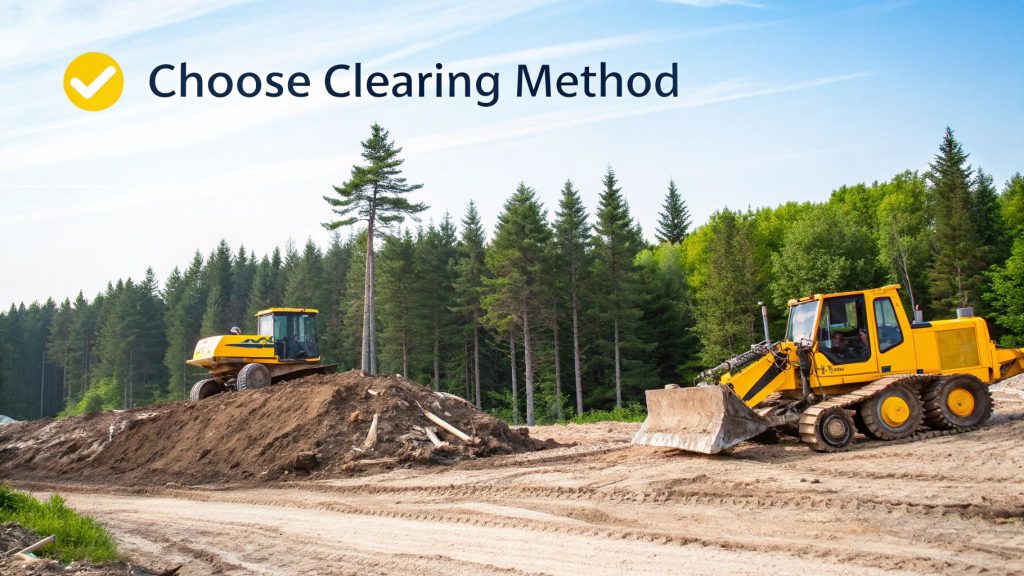
The classic image of land clearing for construction is often a bulldozer pushing everything aside. This “pushover” method is aggressive, powerful, and gets the job done by removing trees, stumps, and all vegetation to create a completely bare canvas.
While it’s true that bulldozing causes more soil disturbance and compaction, sometimes it’s exactly what’s needed. It’s the undisputed champ when an entire plot has to be cleared and graded for a large foundation, a sprawling parking lot, or a new road. This approach is all about total removal to prep for major earthwork.
Expert Insight: Bulldozing is a tool for total transformation, not preservation. Opt for it when your project demands a completely clean slate and you have a solid plan for erosion control and soil stabilization ready to go afterward.
The trade-off is the debris. You’ll have massive piles of trees, stumps, and roots to deal with. That means hauling it all to a landfill or, if you’re in a rural area where it’s permitted, burning it on-site. Both of these add extra steps and costs to the job.
Dealing with Stumps: Grinding vs. Removal
So, what about the stumps left behind? You’ve got two main choices, and your foundation plans will dictate the right one.
- Stump Grinding: A specialized machine grinds the stump down several inches below the surface. This is a great, cost-effective way to handle stumps in areas that will become lawns, gardens, or driveways. The wood chips it creates can even be repurposed as mulch.
- Stump Removal (Grubbing): This is the more intensive option, where the entire stump and its root ball are dug out of the ground. It’s absolutely necessary wherever a building foundation, septic system, or underground utility will be placed. Skipping this step can lead to settling and serious structural problems down the road.
Selective Thinning and Responsible Practices
Not every clearing job is a total wipeout. Selective thinning is a more surgical approach where we only remove specific trees and undergrowth. It’s perfect for preserving high-value hardwoods like mature oaks, improving the look of a property, or boosting the health of the remaining trees by giving them more room to breathe.
This thoughtful method is part of a bigger shift toward more sustainable land management. Globally, deforestation has slowed from 17.6 million hectares per year in the 1990s to about 10.9 million hectares annually, partly thanks to smarter forest management. For those of us developing land in Central Florida, it’s a reminder that using modern, low-impact methods helps us build responsibly. You can read more about these global forestry trends on FAO.org.
Managing Debris and Protecting Your Topsoil
Once the trees and brush are down, the real work of site preparation begins. A successful land clearing for construction project isn’t just defined by what’s removed, but by what’s left behind.
How you handle the mountain of organic debris and protect that priceless layer of topsoil is what separates a professional, build-ready site from a future headache. This part of the job is all about smart resource management. Get it wrong, and you could be facing costly erosion problems, nutrient-poor soil for landscaping, and a messy site that complicates every other phase of construction.
Smart Strategies for Debris Management
After the initial clearing, you’re looking at piles of trees, stumps, and undergrowth. You’ve got a couple of ways to deal with it, and the right choice really boils down to your project goals, budget, and local rules.
One of the most popular and eco-friendly methods is on-site mulching. We already touched on forestry mulching, which does this in one pass. But even debris from traditional clearing can be fed through a large-scale grinder. This repurposed mulch is an incredible asset.
You can use this material to:
- Create a protective layer over exposed soil to prevent erosion.
- Enrich the topsoil as it breaks down, adding vital organic matter.
- Suppress weed growth in areas you’ve set aside for future landscaping.
The other option is hauling and disposal. This is exactly what it sounds like: loading all the debris into trucks and taking it to a landfill or green waste facility. While it leaves your site looking spotless, it comes with significant costs. You’re paying for trucking, labor, and landfill “tipping fees,” which can add up fast.
Pro Tip: Before you sign off on hauling, get a detailed estimate that includes every transportation and disposal fee. You’ll often find that the cost savings and long-term soil benefits of processing debris on-site make it the far better value.
Protecting Your Most Valuable Asset: Your Topsoil
Think of your property’s topsoil as a living resource that took centuries to form. It’s packed with organic matter and is absolutely critical for growing healthy grass and plants down the road. Aggressive clearing methods can scrape it all away or compact it so badly it becomes useless. Protecting it is non-negotiable.
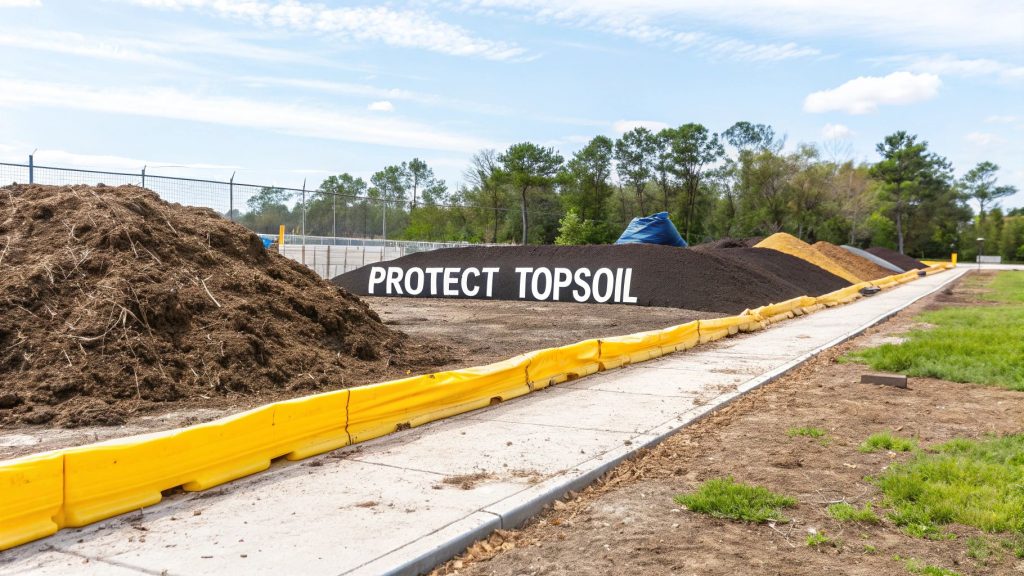
The first move is usually to scrape and stockpile the topsoil. A skilled operator using a dozer or grader will carefully remove the top 6-12 inches of soil from the building footprint. This is then piled in a designated spot, safely away from heavy equipment traffic, ready to be spread back over yard areas during final grading.
Another huge part of topsoil preservation is erosion control, especially with Florida’s intense rainy seasons just around the corner.
Essential Erosion and Sediment Control Tactics
Exposed soil is vulnerable soil. A single Florida thunderstorm can wash away tons of topsoil, pushing sediment into storm drains and waterways—a recipe for fines and environmental damage. Putting erosion control measures in place isn’t just a good idea; it’s often a legal requirement.
Here are a few common and effective methods we use all the time:
- Silt Fences: You’ve seen them. These are temporary fabric barriers staked into the ground along the downhill side of a job site. They slow down water runoff and trap sediment, keeping it on your property where it belongs.
- Erosion Control Blankets: For steep slopes or really sensitive areas, we roll out these biodegradable blankets made of straw or coconut fiber. They hold the soil in place and give vegetation a chance to take root.
- Temporary Seeding: On parts of the property that won’t be developed right away, we can quickly plant a fast-growing grass like ryegrass. It establishes a quick root system to hold the soil together.
These simple tactics are foundational to responsible site work. For a closer look at creating a stable foundation for your build, check out our practical guide to soil stabilization techniques for more advanced strategies. By actively managing debris and safeguarding your soil, you’re not just clearing land—you’re investing in the long-term health and stability of your property.
Navigating Florida Specific Environmental Rules
Clearing land in Central Florida isn’t just about moving dirt. It’s about working inside a sensitive and highly regulated ecosystem. From Indian River to Lake County, a specific set of environmental rules governs our work, and they’re designed to protect our natural treasures. Ignoring them simply isn’t an option—it leads to steep fines and project-killing delays.
The key to getting it right is local knowledge. You have to be proactive. Understanding how to handle protected species, identify wetlands, and follow county tree ordinances is what keeps your land clearing for construction project moving smoothly and responsibly.
Handling Protected Species And Habitats
One of the first things you have to check for on any Florida property is protected wildlife. We run into gopher tortoises all the time during site prep. They are a keystone species, and their burrows provide shelter for over 350 other animals. You can’t touch them.
State law strictly protects these tortoises and their burrows. If a wildlife survey finds active burrows on your land, you cannot disturb them. Period. You’ll have to hire a licensed agent authorized by the Florida Fish and Wildlife Conservation Commission (FWC) to safely and humanely relocate the tortoises before any clearing begins. This requires its own permit and has to be factored into your schedule from day one.
And it’s not just tortoises. You also need to be aware of nesting seasons for birds like the bald eagle or sandhill crane, which can trigger specific setbacks and work-stop periods.
The Importance Of Wetlands Delineation
Florida’s landscape is defined by water. It’s no surprise that many properties, especially larger tracts in counties like Osceola or Polk, contain wetlands protected by both state and federal law. These areas are vital for filtering our water and controlling floods.
Before you clear anything, you need a professional wetlands delineation. This process officially maps the boundaries of any jurisdictional wetlands on your property.
If wetlands are found, you’ll almost certainly need a permit from one of Florida’s Water Management Districts (like the St. Johns River or South Florida WMD). That permit will dictate exactly where you can clear and build, and it often requires you to leave a natural buffer zone around the wetland.
Navigating environmental rules is non-negotiable. Proactive compliance isn’t just about avoiding fines; it’s about being a good steward of the land and ensuring your project contributes positively to the community.
Managing Trees And Invasive Species
Every county in Central Florida has its own tree ordinance. These local laws often protect what they call “specimen” or “heritage” trees, which are usually defined by their size (diameter) or species—think of our huge, old live oaks. Removing one often requires a separate permit, and you might have to pay into a tree fund or plant replacement trees.
Just as important as saving our native trees is getting rid of invasive ones. Species like the Brazilian pepper tree are aggressive invaders that just choke out native vegetation and ruin the local habitat. A good clearing plan always includes the complete removal of these nuisance plants.
Responsible land management is a big deal everywhere. Globally, forest loss reached 8.1 million hectares in a single year, with construction being a major driver. That wider context makes it even more crucial for us here in Florida to follow local rules and work with professionals who use low-impact methods to protect our unique habitats. You can learn more about the impact of land use on global ecosystems.
How to Hire the Right Land Clearing Contractor
Picking a contractor for your construction land clearing project is easily the most critical decision you’ll make. Get it right, and the job runs smoothly, safely, and on budget. Get it wrong, and you’re in for a nightmare of surprise costs, property damage, and frustrating delays. Let’s walk through how to find and properly vet a pro here in Central Florida.
Making a smart choice comes down to asking the right questions. Don’t let the conversation stop at the price tag. You need to dig into their actual experience, the equipment they run, and their process from start to finish. Any true professional will be happy to answer your questions with clear, direct answers.
Vetting Potential Land Clearing Companies
Before you even pick up the phone, do a little homework. A quick search online can tell you a whole lot about a company’s reputation. Look for a professional website that shows recent work, and see what past customers are saying in reviews.
Once you have a shortlist, it’s time to talk to them directly. Have a list of questions ready that go beyond just “how much will it cost?”
- Experience in Central Florida: Ask them point-blank how long they’ve been clearing land specifically in this area. A seasoned local contractor knows our unique soil types, the invasive plants we deal with, and the little quirks of each county’s permitting process. That knowledge is invaluable.
- Equipment and Capabilities: Find out what machinery they’ll be bringing to your property. Are they using modern, low-impact forestry mulchers, or are they planning to just show up with an old bulldozer? The right equipment for your specific job minimizes soil damage and works far more efficiently.
- Insurance and Licensing: This is an absolute deal-breaker. Ask for their proof of general liability insurance and workers’ compensation. If they can’t provide it, walk away. Without proper coverage, you could be left holding the bill for any accidents or damage.
After you’ve narrowed down the field, it’s time to look at quotes. But here’s a critical tip: not all quotes are created equal.
How to Read and Compare Quotes
That surprisingly low bid? That’s usually a massive red flag. It often means the contractor is uninsured, cutting corners on safety, or planning to slam you with “unexpected” charges later on. A real professional quote is a detailed document, not just a number jotted down on an invoice.
Look for a complete breakdown of every service. Does that final price include:
- Stump grinding or full stump removal?
- Hauling away all the debris?
- Final grading and site cleanup?
If those things aren’t spelled out, you can bet they aren’t included. Vague quotes leave you wide open to extra costs for work you thought was part of the original deal. The best contractors give you a line-by-line estimate so there are no surprises. For more tips, finding a land clearing contractor near you in Central Florida is a great resource that goes deeper into what to look for locally.
Key Takeaway: The cheapest bid is almost never the best value. Look for clarity, professionalism, and a comprehensive scope of work. It will save you a world of headaches and money down the road.
Your Contractor Vetting Checklist
When you start comparing proposals, it’s easy to get lost in the details. Use this checklist to keep your evaluation focused on the things that truly matter when choosing a partner for your project.
| Qualification | What to Look For | Red Flags to Avoid |
|---|---|---|
| Local References | Happy to provide you with names and numbers of recent clients in the area. | Hesitates or can’t give you any verifiable references. |
| Insurance Coverage | A current Certificate of Insurance (COI) showing both liability and workers’ comp. | Vague talk about being “fully insured” but won’t show you the paperwork. |
| Detailed Quote | An itemized list of every service included, from the initial clearing to final debris hauling. | A single lump-sum price with no breakdown of what’s actually covered. |
| Equipment | A modern, well-maintained fleet of machinery that’s right for your property’s needs. | Old, beat-up equipment or a “one-size-fits-all” approach to every job. |
| Communication | Answers your questions clearly, promptly, and professionally. | Is hard to get ahold of, gives you rushed answers, or uses high-pressure sales talk. |
Ultimately, choosing the right contractor means finding a skilled partner you can trust to prepare your land the right way. Taking the time to do your homework now is the single best investment you can make in the success of your entire construction project.
Common Questions About Land Clearing
When you’re staring at an overgrown property, trying to envision a new home or commercial building, a lot of questions pop up. The whole process of land clearing for construction can feel like a huge undertaking, but getting some straight answers upfront makes a world of difference.
It’s about more than just knocking down trees. It’s about setting your entire project up for success. We hear the same questions every day from property owners, so let’s walk through the big ones you probably have on your mind.
How Much Does Land Clearing For Construction Cost?
This is always the first question, and the honest answer is: it really depends. Every piece of land is unique. You could be looking at a few thousand dollars for a small, lightly wooded lot, or tens of thousands for a large commercial tract that’s been completely reclaimed by nature.
Several things will directly swing the final price tag:
- Parcel Size: The total acreage is always the biggest factor. More land simply means more work.
- Vegetation Density: A property choked with thick underbrush and mature hardwoods is a different beast than one with just grass and a few saplings.
- Terrain: Working on steep slopes or rocky ground requires more time and specialized effort, which adds to the cost.
- Chosen Method: Modern forestry mulching is often more efficient per acre. Traditional methods involving bulldozers mean you also have to factor in separate costs for hauling and disposing of all that debris.
The only way to get a real number is to have a professional walk the property with you. They can see the challenges firsthand and give you a detailed, itemized quote so you know exactly what you’re paying for.
How Long Does The Land Clearing Process Take?
Think of the timeline in two parts: paperwork and fieldwork. The administrative side—getting the right permits from your Central Florida county—can sometimes be the longest leg of the journey. If you need environmental surveys for protected species or wetlands, this phase can take weeks, sometimes even months.
Once all the permits are approved, the on-site work moves surprisingly fast. With the right equipment, a typical one-acre residential lot can often be cleared in just 1-3 days. Of course, larger or more difficult properties will take longer. Things like unexpected weather or the need for wildlife relocations can also shift the schedule.
A good contractor will always give you a realistic timeline that covers both the permitting wait and the actual job. No one likes surprises once the equipment shows up.
Will Clearing My Land Increase Its Value?
Absolutely. In almost every case, clearing your land is a direct investment that pays off. You’re transforming an unusable, overgrown lot into a build-ready site, which is exactly what builders, developers, and home buyers are looking for.
When you clear away the overgrowth, you instantly reveal the property’s true potential. You can see the natural lay of the land, identify the best spots for a foundation, and make it accessible and safe. Plus, when you get rid of invasive species, you’re adding long-term value by cutting down on future maintenance headaches.
Do I Need A Permit To Clear My Lot In Florida?
It’s extremely likely. While the rules change from county to county and even city to city, you’ll almost certainly need a permit if your work impacts wetlands, protected trees (often defined by their trunk size or species), or known wildlife habitats.
Most local governments here in Central Florida have specific tree ordinances you have to follow. The safest first step is to always call your local planning and zoning department before you do anything. A seasoned local contractor will know the ins and outs of these regulations and can help you navigate the paperwork to keep your project fully compliant.
Once the land is cleared, you’re ready for the next big step: the foundation. For anyone starting a residential build, the next thing to learn about is residential foundation concrete services, as this sets the stage for everything that follows.
At Palm State Clear Cut, we believe in providing clear answers and professional results. We manage the entire process, from forestry mulching to final site prep, making sure your Central Florida property is ready for your vision. Contact us today for a free, on-site quote.