
How Much to Clear 1 Acre of Land A Complete Pricing Guide
- Mike Walker
- Dec 22, 2025
- 15 min read

So, you're asking, how much to clear 1 acre of land? The quick answer is it can run anywhere from $500 for light brush all the way up to $5,600 or more for a plot packed with mature forest. Most typical one-acre lots with a mix of trees and overgrown underbrush will land you somewhere in the middle.
Your Guide to One Acre Land Clearing Costs
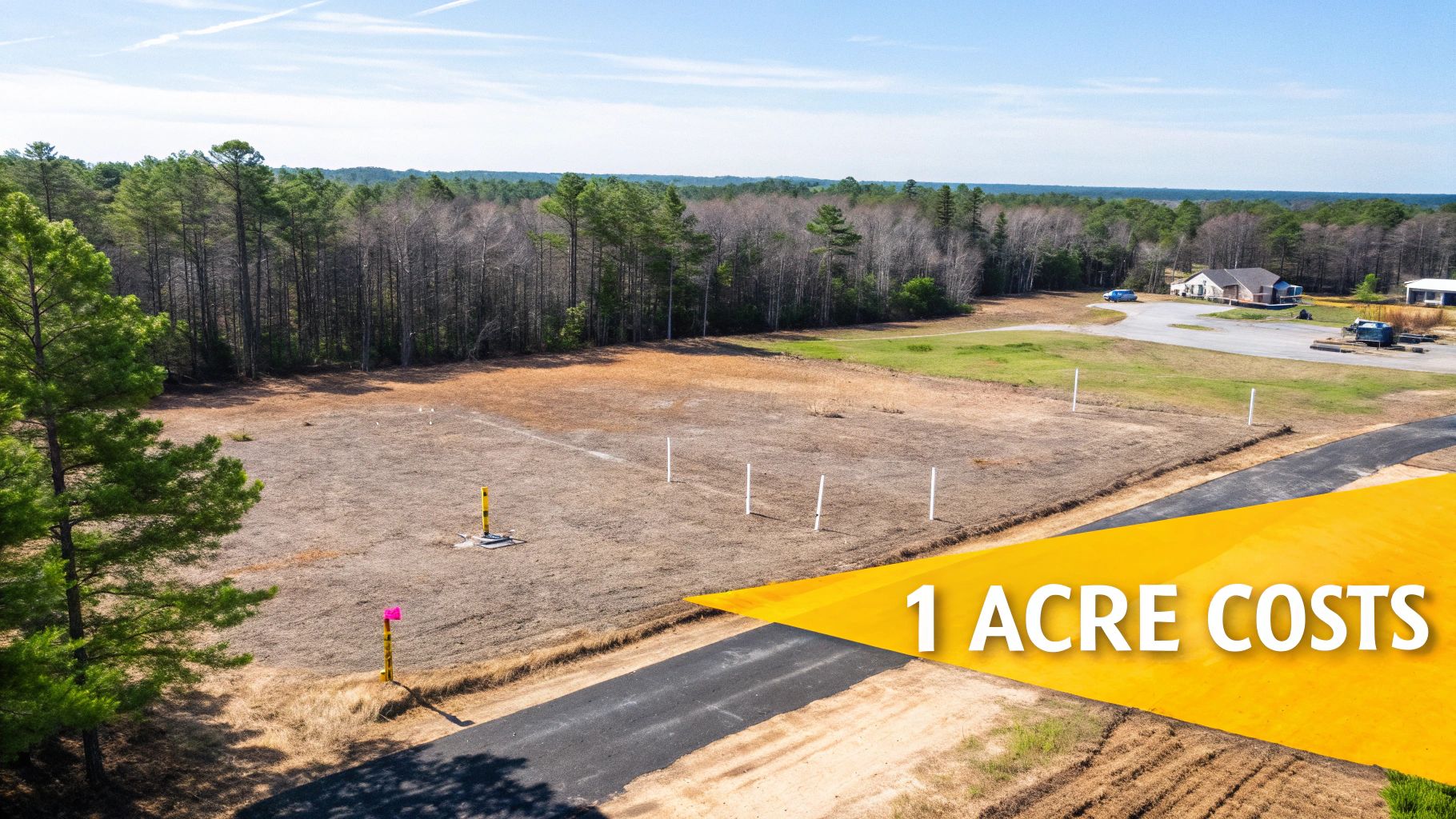
Let’s get right to it. You have an overgrown piece of land that needs to become a blank canvas, and the price is the first big question mark. The honest truth is, the cost to clear an acre varies wildly—but saying "it depends" isn't very helpful, is it?
This guide is here to demystify those numbers for you. We'll break down the 'why' behind the price tag, walking you through all the factors a contractor looks at when putting together a quote. Think of it like building IKEA furniture: an acre of light grass is like a simple bookshelf, but a heavily wooded lot is a complex entertainment center with a lot more parts and steps.
To give you a clearer starting point, here’s a quick snapshot of what you can generally expect.
Quick Cost Estimates for Clearing One Acre
This table provides a snapshot of estimated costs and typical timelines based on the condition of your one-acre lot.
Land Condition | Estimated Cost Range per Acre | Typical Timeframe |
|---|---|---|
Light Brush & Grass | $500 - $1,800 | 1-2 Days |
Mixed Trees & Shrubs | $1,800 - $4,500 | 2-4 Days |
Dense Forest & Large Stumps | $4,500 - $5,600+ | 4-7+ Days |
Keep in mind, these are just ballpark figures. Your final cost will depend on the specific challenges your property presents.
Understanding the Price Range
The cost to clear land has become more predictable over the years, and market data shows that one acre typically falls in that $500 to $5,600 range. It’s a significant investment for any property owner, with the national average for a typical acre hovering right around $3,779. You can dig deeper into these land clearing statistics to see how different factors play into that final number.
Key Takeaway: The condition of your land is the single biggest cost driver. A flat, grassy field and a sloped, wooded acre are two entirely different projects requiring different tools, time, and labor.
What This Guide Will Cover
We’re going to walk through everything that influences your final bill, from the type of trees on your lot to the slope of the land. To give you the full picture, here’s what we’ll get into:
Key Cost Factors: We'll detail how vegetation, terrain, and getting rid of the debris impact your quote.
Clearing Methods: You'll learn the difference between bulldozing, mulching, and clearing by hand.
Real-World Scenarios: We'll run through some sample calculations for common properties here in Central Florida.
By the time you're done reading, you’ll be able to look at your property with a contractor's eye and make sense of any quote that comes your way.
Decoding Your Land Clearing Quote
Ever get a price quote and feel like you're trying to decipher ancient hieroglyphics? It happens. When it comes to clearing land, a good estimate is much more than a final number—it’s the roadmap for your entire project. If you understand the line items, you'll know exactly what you’re paying for and why the cost to clear one acre can swing so wildly from one property to the next.
Think of your land as a unique puzzle. A contractor’s quote is just the list of pieces they need to solve it. Every factor, from the type of trees to the slope of the ground, adds another layer of complexity and, you guessed it, cost. Let's break down the common variables you'll see on any professional estimate.
Vegetation: What’s Actually on the Land?
The biggest driver of your final cost is what’s growing on your property. An acre covered in light grass and a few small shrubs is a walk in the park compared to an acre choked with 80-foot pine trees and dense palmetto thickets. They are two completely different jobs.
Here’s a simple way to think about it:
Light Growth: We’re talking grass, weeds, and sparse brush. This is the easiest and most affordable scenario, often handled with a heavy-duty mower or a skid steer with a brush cutter attachment.
Medium Growth: This is where you get into dense shrubs, smaller trees (think under 6 inches in diameter), and thick undergrowth. It requires more muscle, like a forestry mulcher, to chew through everything efficiently.
Heavy Growth: This is the big leagues—large, mature trees (over 12 inches thick), dense hardwood forests, and massive stumps. It’s the most labor-intensive and expensive work, calling for heavy machinery like bulldozers, excavators, and powerful stump grinders.
Just remember, removing a single large oak can cost hundreds of dollars. A whole forest of them will naturally push the price up quite a bit.
Topography and Accessibility: The Lay of the Land
How the land is shaped and how easily we can get equipment to it plays a huge role in the time and machinery needed. A flat, dry, and wide-open property is the dream scenario. It lets our heavy equipment move around freely and get the job done fast.
But when the terrain gets tricky, so does the work. Accessibility and topography have a major impact on the final price, since tough terrain and limited access mean more labor and specialized equipment. For example, excavation services just to level a sloped lot can cost anywhere from $1,660 to $6,730. That alone can be a huge chunk of your total clearing costs if your property needs serious grading. You can learn more about how grading affects overall land clearing costs in more detail.
A steep hill might demand specialized tracked equipment that won’t slide around, while rocky soil could mean bringing in more powerful machines to wrestle stubborn boulders and stumps out of the ground.
Stumps and Debris: What Happens After?
Once the trees and brush are gone, you're left with two big things to deal with: stumps and a mountain of green waste. These are almost always quoted as separate line items, so you need to be clear on what’s included in the plan.
Stump Grinding vs. Removal: Grinding chews the stump down below the soil surface, which is perfect if you're planning to lay sod or do some landscaping. Full removal yanks the entire root ball out of the earth. This is a must for building foundations, but it leaves behind a big hole that needs to be filled.
Hauling vs. On-Site Solutions: Hauling all that debris to a landfill gets expensive fast because of transport costs and landfill "tipping fees." On the other hand, a method like forestry mulching grinds up all the vegetation and spreads it as a nutrient-rich layer right on-site. This completely eliminates disposal costs and is great for the soil.
Always ask your contractor how they plan to handle stumps and debris. The choices they make here will have a direct impact on your final bill.
Choosing The Right Clearing Method For Your Land
Not all land clearing is the same. Far from it. The method a contractor uses will have a massive impact on your final bill, the project timeline, and the health of your property long after the machines are gone. Understanding your options is the first step to having an intelligent conversation with a contractor about what’s truly best for your land and your vision.
Think of it like this: you wouldn't use a sledgehammer to hang a picture frame. Bulldozing is that powerful sledgehammer—it’s fast and effective for wide-open spaces, but it can be brutal on the delicate topsoil. Manual clearing is more like using a scalpel; it's precise and perfect for sensitive spots, but it's also slow and incredibly labor-intensive. Then you have forestry mulching, the modern, specialized tool that gets the job done efficiently while often leaving the land healthier than it found it.
This decision tree helps visualize how different features of your property push the costs in one direction or another.
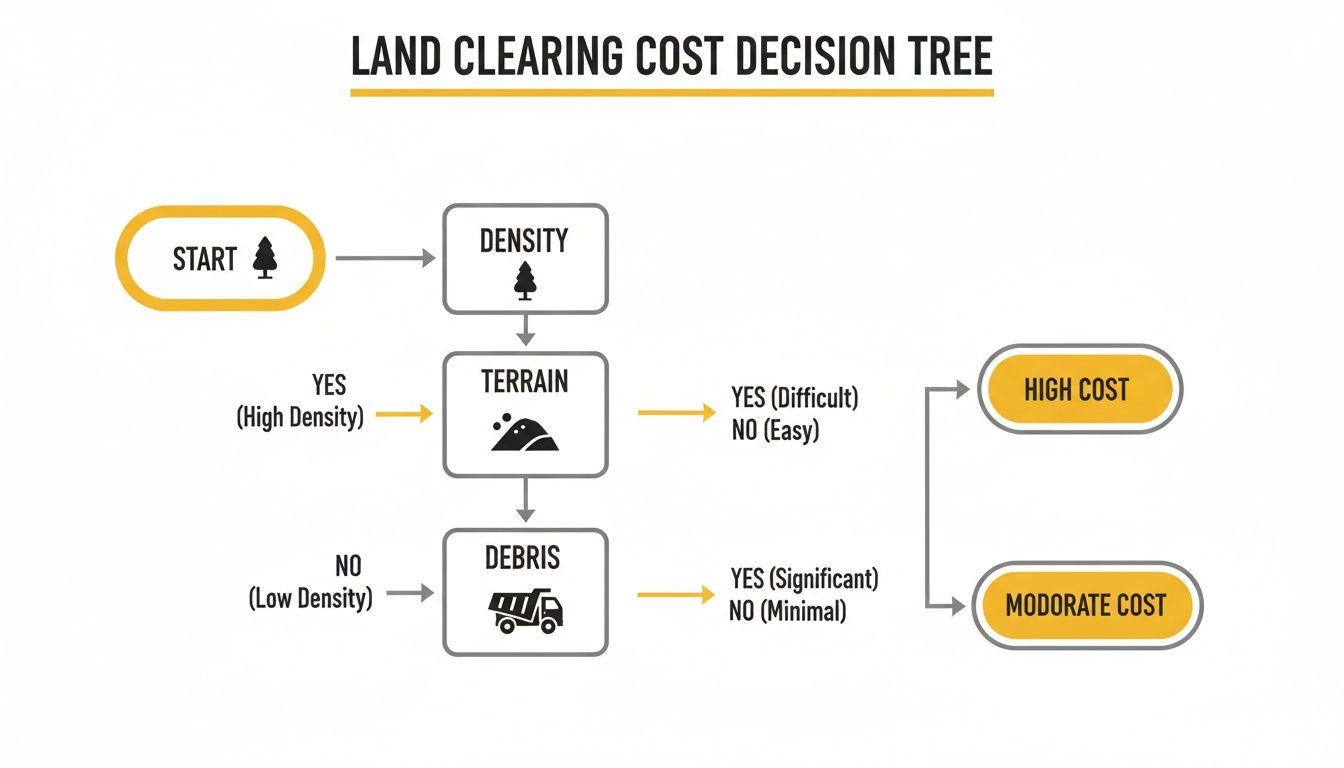
As you can see, heavy vegetation, tricky terrain, and the need to haul debris off-site are the three big levers that drive up the price of clearing an acre.
Common Land Clearing Approaches
Let's dig into the three main methods you'll come across. Each one has its own set of pros, cons, and costs that directly influence how much it costs to clear 1 acre of land.
The best way to see how these stack up is to compare them side-by-side. Each method has its place, but one is often a better fit depending on your budget, timeline, and long-term goals for the property.
Comparing Land Clearing Methods and Results
Method | Average Cost per Acre | Best For | Key Advantage | Potential Drawback |
|---|---|---|---|---|
Bulldozing & Traditional Clearing | $2,100 - $7,000+ | Large, open tracts where speed is the top priority and soil health is not the main concern. | Speed. It's the fastest way to clear large, flat areas of heavy growth. | Highly disruptive to topsoil, increases erosion risk, and leaves behind huge debris piles that are costly to remove. |
Forestry Mulching | $1,500 - $5,000 | Light to medium vegetation, selective clearing, and landowners wanting to avoid debris removal costs. | One-step process. It eliminates hauling fees and returns nutrients to the soil, creating a natural erosion barrier. | Not ideal for removing large-diameter stumps or clearing land down to bare dirt for a foundation slab. |
Manual Clearing | $3,500 - $9,000+ | Small, sensitive areas, very steep slopes inaccessible to machinery, or selective tree thinning projects. | Precision. It offers unparalleled control to protect specific trees and delicate ecosystems. | Extremely high labor costs make it impractical and cost-prohibitive for clearing a full acre. |
As the table shows, the "best" method really depends on the specifics of your lot. Now, let's look at each one in a bit more detail.
1. Bulldozing And Traditional Clearing
This is the old-school "push and pile" method. A bulldozer or excavator literally shoves trees and brush into massive piles. From there, the debris is either burned (if local regulations allow) or loaded onto trucks and hauled away.
Best For: Huge, open properties where getting it done fast is the name of the game, and you're not too worried about some soil disruption.
Potential Drawback: This is a rough process. It tears up the topsoil, which can lead to serious erosion problems down the road. You’re also left with a mountain of debris that you have to pay to get rid of.
2. Forestry Mulching
This is a much more modern and eco-friendly approach. A single machine equipped with a specialized mulching head moves through the property, grinding up trees and underbrush right where they stand. Everything is turned into a protective layer of natural mulch that’s spread across the ground.
Best For: Properties with light to medium vegetation, projects that require selective clearing, and for anyone who wants to avoid the huge extra cost of debris removal.
Key Advantage: It’s a one-and-done process. There are no hauling fees, you’re naturally feeding nutrients back into your soil, and the mulch layer acts as a fantastic barrier against erosion. You can explore more about what makes this method so effective by checking out the advantages of forestry mulching.
By grinding vegetation in place, forestry mulching often becomes the most cost-effective solution when you factor in the savings from not having to pay for debris hauling and landfill tipping fees.
3. Manual Clearing
This is exactly what it sounds like: a crew of workers with chainsaws, axes, and other hand tools. It’s the most precise method available, but it’s also the slowest and most physically demanding by a long shot.
Best For: Small, environmentally sensitive areas, incredibly steep hills where machines can’t safely operate, or thinning out a few specific trees while protecting valuable ones nearby.
Potential Drawback: The labor cost is sky-high. Using this method to clear an entire acre is almost always financially impractical unless there's absolutely no other way.
Putting It All Together with Real-World Scenarios
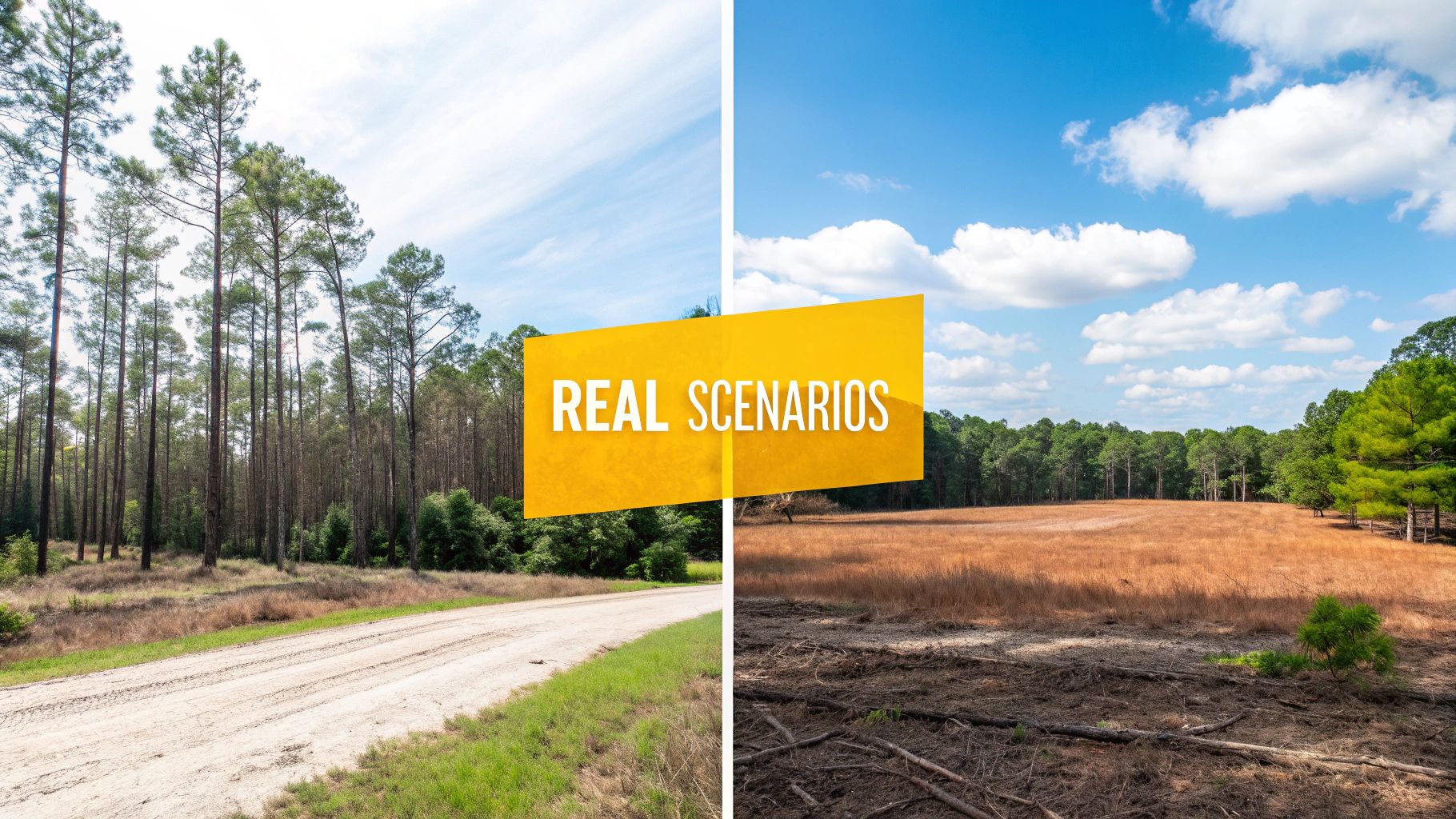
Theory and averages are a great starting point, but let’s be honest—it’s the real-world numbers that matter. To truly get a handle on how much to clear 1 acre of land, we need to move from abstract costs to concrete examples. We’ve pulled together three common scenarios you’ll find right here in Central Florida.
These examples should help you see where your own project might land on the pricing scale. Each one breaks down the big-ticket items—labor, equipment, and disposal—to show you how a final quote actually comes together.
Scenario 1: The Simple Homesite Prep
Let's start with a classic. Imagine a one-acre lot out in Osceola County. It’s mostly flat, easy to get to from the road, and the vegetation is light. We're talking overgrown grass, some scattered palmettos, and a handful of small shrubs—just enough to get in the way of a new home build.
Method: A skid steer with a brush cutter attachment is the perfect tool for this job. It's fast, efficient on light growth, and doesn't tear up the soil.
Labor: One skilled operator can knock this out in 1-2 days, easy.
Debris: The volume is low, so the debris can either be mulched right back into the soil or hauled off in a single dump truck. Simple.
In a straightforward case like this, the cost to clear one acre is going to be on the lower end. The easy access and light vegetation keep the clock from running up on labor and equipment time.
Estimated Cost Range: $1,500 - $2,800
Scenario 2: The Densely Wooded Lot
Now, let's picture a totally different beast: a heavily wooded acre in Lake County. This lot is packed with mature pine and oak trees, thick underbrush everywhere, and stubborn old stumps from past growth. The goal here is a complete clear-cut to make way for a small subdivision.
Method: This is a job for the heavy hitters. You’ll need an excavator to take down the big trees and a powerful stump grinder to chew through the massive root systems left behind.
Labor: You’re looking at a crew of 2-3 operators working for 4-6 days to safely fell all those trees, grind the stumps, and manage the mountain of debris.
Debris: Hauling is a huge factor here. It’s going to take multiple large dump truck loads to get all those logs and root balls to a disposal site, and those tipping fees add up fast.
Estimated Cost Range: $4,800 - $7,500+
Scenario 3: The Selective View Enhancement
For our final scenario, think about a sloped, one-acre property in Seminole County. It has a beautiful mix of mature oaks you want to keep, but a bunch of invasive Brazilian pepper trees are blocking a fantastic lake view. The owner wants to surgically remove the invasive plants and thin the undergrowth without touching the valuable oaks.
Method: Forestry mulching is the clear winner here. It allows the operator to be incredibly precise, targeting only the unwanted vegetation while easily handling the sloped terrain without causing erosion.
Labor: A single, highly skilled mulcher operator can tackle this selective work in 2-3 days.
Debris: Here's the best part—zero disposal costs. Everything that’s cleared gets turned into a protective, nutrient-rich layer of mulch that stays right where it is, benefiting the soil and the remaining trees.
Estimated Cost Range: $3,000 - $5,000
As you can see, the final price tag is shaped directly by what’s on your land and what you want to do with it.
Smart Ways to Save Money on Your Project
You've got the quote in hand, but the work isn't done yet. Figuring out how to bring that number down is the next crucial step. Clearing an acre is a real investment, but you can absolutely manage the expense with some smart planning—without cutting corners on the quality of the job.
It all starts with looking at what you have. One of the biggest missed opportunities is overlooking valuable timber on your property. If you have mature pines or hardwoods, selling them to a local mill can take a serious bite out of your clearing costs. It takes a bit of coordination, but the payoff can make it more than worth your while.
Get Competitive and Plan Ahead
Never settle for the first quote you get. It’s essential to get multiple, detailed bids from reputable contractors. This isn't just about finding the lowest price; it's about seeing how different pros plan to handle your specific piece of land. An itemized quote lets you compare apples to apples, making sure you're getting a fair market rate.
Timing can also be your secret weapon. Land clearing contractors have a busy season and a slow season just like anyone else. If your project isn't on a tight deadline, think about scheduling the work during a slower period, like late fall or winter. Companies are often looking to keep their crews busy and might offer more competitive rates.
A detailed analysis shows that while economies of scale benefit larger projects, the cost for a single acre can vary dramatically. For a one-acre lightly forested lot, expect to pay between $500-$2,000, but that can jump to $3,600-$5,600 for a densely forested plot. Learn more about how vegetation density impacts land clearing costs.
Choose Your Method Wisely for Long-Term Savings
The clearing method you pick has an immediate impact on your wallet and long-term consequences for your land. Traditional bulldozing might look fast, but the hidden costs of hauling away all that debris and potentially having to fix soil damage can add up in a hurry.
This is where a method like forestry mulching really shines. By grinding up all the trees and brush right where they stand, you completely eliminate the massive expense of disposal fees. Better yet, that fresh layer of mulch protects your topsoil, improves its health, and helps stop aggressive weeds from coming back, saving you a lot of money and headache down the road. For a deeper dive into managing regrowth, take a look at our guide on the proper use of herbicides to prevent regrowth.
How to Hire the Right Land Clearing Contractor
Choosing who to trust with your property is arguably the biggest decision you'll make. The right partner can save you thousands in costly mistakes and headaches, while the wrong one can quickly turn your project into a logistical nightmare.
Think of it like hiring a specialized surgeon. You wouldn't let someone operate without checking their credentials, understanding their exact plan, and getting a clear cost upfront. The same diligence applies here. You need to be sure the contractor you select is not just capable, but is the perfect fit for your specific piece of land.
A true professional will be transparent and ready to answer all your questions without hesitation. Vetting potential contractors is your best defense against surprise costs and shoddy work.
Your Contractor Vetting Checklist
Before you even think about signing a contract, make sure you walk through these essential questions. A trustworthy company will have solid answers ready to go.
Can you provide proof of license and insurance? This is a deal-breaker, plain and simple. Proper licensing proves they meet state requirements, and liability insurance protects you from any accidents on your property. Don't just take their word for it—ask to see the documents.
What equipment do you recommend for my property and why? A real pro will have a clear strategy. They should be able to explain exactly why a forestry mulcher is better for your sloped lot or why a bulldozer is necessary for those dense patches, connecting their plan directly to your land's unique features.
Is debris disposal included in your itemized quote? This is a classic "gotcha" that can blow your budget. Get clarity on how debris will be handled—hauled away, mulched on-site, or burned. Make sure the associated costs are clearly spelled out on the estimate so there are no surprises.
We always say, a company that understands the local ecosystem, like the unique terrain of Central Florida, is invaluable. They'll know how to handle our sandy soil, navigate protected wetlands, and manage the specific types of vegetation that grow like weeds here.
Partnering with a local expert like Palm State Clear Cut means your project is handled by a team that gets it. From knowing the ins and outs of local permit rules to choosing the right machinery for our environment, that regional expertise makes all the difference. This kind of knowledge is key to figuring out how much to clear 1 acre of land accurately and without a hitch.
Frequently Asked Questions About Land Clearing
Even after going through the details, you probably have a few more questions rattling around. That’s perfectly normal. Here are some clear, straightforward answers to the questions we hear most often from property owners just like you.
How Long Does It Take to Clear One Acre?
This is a classic "it depends" situation, but I can give you some solid goalposts. The timeline really hinges on the vegetation and terrain.
If you have a flat, open acre with just some light grass and brush, a single operator might knock it out in just 1-2 days. On the flip side, an acre choked with mature trees, thick palmettos, and dense undergrowth could easily keep a full crew busy for 4-7 days, maybe even longer if stump grinding and serious debris hauling are part of the job.
Is It Cheaper to Clear Land Myself?
It’s tempting to think renting some equipment will save a few bucks, but in our experience, it almost never does. The daily rental fees for heavy machinery, the cost of fuel, and any surprise permit fees can add up fast, often getting you close to what a professional would charge anyway.
Here's the real kicker: trying to clear land without the right experience isn't just slow, it's incredibly dangerous. A professional crew will get the job done 3-5 times faster and carries the proper insurance to protect you and your property from any mishaps.
What Permits Are Needed for Land Clearing?
Permit rules can be a real headache because they change from county to county, and even city to city, especially here in Central Florida with all our environmentally sensitive areas. You might need permits for:
Tree removal, particularly for protected species like certain oaks or trees over a certain diameter.
Working near wetlands or designated conservation areas.
Burning debris, which is almost always restricted and requires specific approval.
A good local contractor knows the ins and outs of the local regulations. They'll know exactly what your project needs and can handle the entire permitting process for you, saving you from potential fines and frustrating delays. If you're looking for more detailed answers, you can always check out our complete land clearing FAQ page.
Ready to turn that overgrown lot into a blank canvas? Palm State Clear Cut brings the local know-how and top-tier equipment needed to tackle your project the right way—safely and efficiently. Get your free, no-obligation quote today!
Comments