
How Much Does Forestry Mulching Cost? Your Quick Guide to Accurate Quotes
- Jan 27
- 16 min read
So, you're wondering about the real cost of forestry mulching. For most landowners here in Central Florida, a standard project averages around $2,000. We see typical jobs fall anywhere between $1,000 and $4,000, but that final number really comes down to the size and condition of your property. The good news? It's often a surprisingly affordable alternative to old-school land clearing.
Your Forestry Mulching Cost Explained
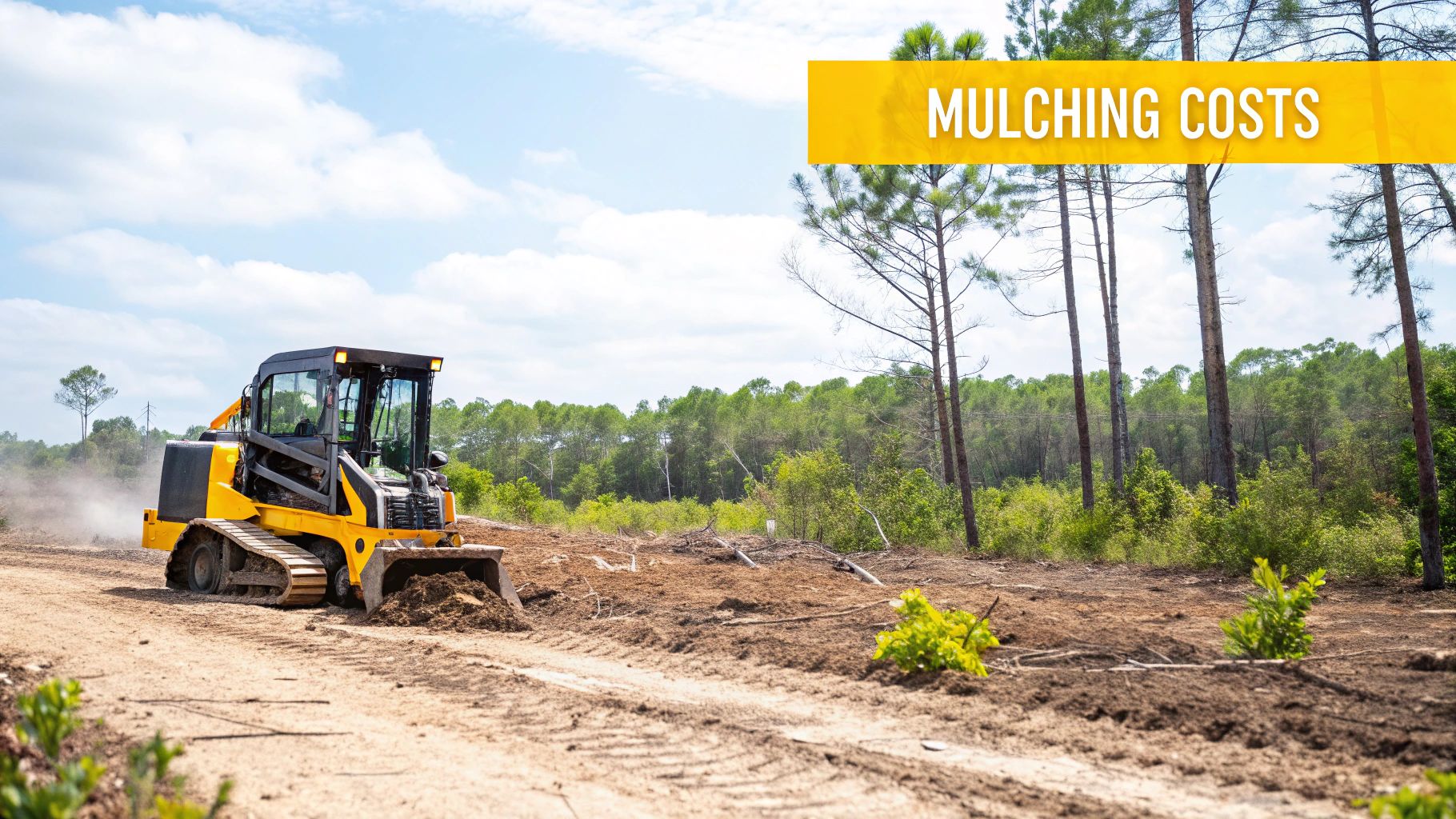
When you picture land clearing, it's easy to imagine bulldozers tearing up the ground, leaving a mess of debris and scarred earth behind. Forestry mulching is a much smarter, more eco-friendly approach. It uses a single, powerful machine to cut, grind, and spread vegetation into a natural mulch layer—all in one clean pass.
This modern method helps you sidestep the extra costs that pile up with traditional techniques, like hauling away debris, getting burn permits, and repairing site damage.
Think of it like landscaping, just on a grander scale. The price to landscape a backyard depends on its size and how overgrown it is, right? It's the same principle here. Clearing a small, lightly overgrown lot will always cost less than tackling a large, dense tract of land choked with stubborn palmettos and invasive vines.
Understanding the Price Structure
To get a feel for the investment, it helps to see how prices scale with the job. For instance, a small half-acre job often runs between $1,000 to $1,400. A full acre might be in the $1,200 to $2,500 range, while larger 5-acre properties can climb to $5,000-$10,000 or more if the vegetation is particularly thick.
These numbers show exactly why a custom quote is so important. If you're interested in the equipment side of things, you can learn more about market trends for forestry mulchers and their operational costs.
Forestry mulching is not just about clearing land; it's an investment in your property's health. The process returns nutrients to the soil, prevents erosion, and creates a clean slate for your future plans without the destructive impact of bulldozing.
Estimated Forestry Mulching Costs in Central Florida
To give you a clearer starting point, the table below provides some ballpark estimates for common scenarios we see right here in Central Florida. Use this to get a general idea of where your project might fall before we dig into the specific factors that will shape your final quote.
Project Size (Acres) | Typical Price Range (Light Undergrowth) | Typical Price Range (Dense Vegetation) |
|---|---|---|
0.5 Acre | $1,000 - $1,400 | $1,200 - $1,800 |
1 Acre | $1,200 - $1,800 | $1,500 - $2,500+ |
3 Acres | $3,000 - $4,500 | $4,200 - $6,500+ |
5 Acres | $4,500 - $6,000 | $6,000 - $10,000+ |
Keep in mind, these are just estimates. The actual cost will depend on the unique characteristics of your land, which we'll cover next.
The 7 Factors That Shape Your Mulching Quote
Trying to nail down the exact cost of forestry mulching without a site visit is a bit like asking a mechanic, "How much to fix my car?" without telling them what's wrong. Is it a simple oil change or a full engine rebuild? The scope, complexity, and time involved are worlds apart. It's the same exact story with land clearing.
You can have two one-acre lots right next to each other, but the quotes to clear them could be thousands of dollars apart. It all comes down to what's on the land and how tricky it is to work there. Let's pull back the curtain on the seven key ingredients we evaluate to build you an accurate, no-surprises quote. Once you see what goes into it, you'll understand exactly where your investment is going.
1. Vegetation Type and Size
In the world of mulching, not all plants are created equal. Zipping through a stand of soft, young pine saplings is one thing. Grinding down a fortress of dense, fibrous palmettos or tough, mature oak trees is another beast entirely.
Hardwoods don't just take more time; they put a serious beating on the machine's cutting teeth, which are expensive to replace. Think of it like this: are you mowing a lawn or clearing a field of thick bamboo? One requires a basic mower, the other demands heavy-duty gear and a lot more muscle. We look at the dominant vegetation on your property to bring the right machine for the job and accurately estimate our time. For a closer look at how these machines work, our guide explaining the forestry mulcher service is a great place to start.
2. Vegetation Density
Next up is density—how tightly everything is packed together. An acre with trees spaced far apart is a pretty straightforward job. But an acre choked with a tangled mess of vines, briars, and thick underbrush? That's a different challenge altogether.
This is the difference between a leisurely stroll in a park and hacking your way through a dense jungle. The thicker the growth, the slower the machine has to move to chew through all that material. More density means more hours on-site, and that's one of the biggest factors in your final cost.
3. Terrain and Slope
The lay of the land plays a massive part in how efficiently—and safely—we can work. A flat, dry pasture is the dream scenario. Our equipment can move at full speed and get the job done quickly.
But many properties here in Central Florida have a few curveballs:
Steep Slopes: Working on an incline requires specialized tracked machines and a slow, careful approach to stay safe.
Wet or Swampy Areas: Mucky soil is the enemy of heavy equipment. We sometimes need to bring in special low-ground-pressure machines just to avoid getting bogged down.
Rocky or Uneven Ground: Hidden rocks and old stumps can damage the mulching head in an instant, forcing us to proceed with caution.
4. Site Accessibility
This is the one people often forget. Just getting our heavy equipment to the work area is part of the job. If your property has a wide gate right off a paved road, we can be set up and running in minutes.
But if the job site is remote, tucked behind existing buildings, or requires us to navigate narrow paths and cross ditches, that adds time and logistical planning before the first tree is even touched.
The most accurate quotes come from a detailed site visit. An expert can see potential challenges—like a hidden gully or a patch of stubborn invasive species—that a satellite image might miss, ensuring your quote is transparent and free of surprises.
5. Stump Grinding Needs
Standard forestry mulching is designed to grind vegetation and small trees flush with the ground, leaving behind a smooth, walkable surface of mulch. But what it doesn't do is remove the root balls of larger trees (think anything over 8-10 inches in diameter). Those will remain just below the surface.
If you're planning to pour a foundation, build a driveway, or create a smooth pasture, you'll need separate stump grinding services. This requires a totally different machine to come in and completely obliterate the stump deep into the ground. It's an add-on service, but it's absolutely essential for many construction and agricultural projects.
6. Debris Disposal Options
One of the best things about forestry mulching is that you typically don't have any disposal fees. The machine turns the vegetation into a beneficial layer of mulch right on site. It's a clean, efficient process.
However, if your land has other debris—like old fencing, piles of concrete, or construction waste—that can't be mulched, we'll need to haul it away. That removal and disposal will appear as a separate line item on your quote.
7. Preventing Regrowth
Finally, a truly professional quote looks beyond just the initial clearing. While mulching gives you a clean slate, some aggressive plants will try to creep back over time. For landowners who want a truly low-maintenance property, we often recommend a follow-up herbicide application.
This targeted treatment stops regrowth in its tracks, making sure your land stays clear for years to come. It's a smart investment in the long-term health and usability of your property. Understanding the right equipment for each task, like the specialized Samo Variochop, also plays a role in keeping a project efficient and cost-effective from start to finish.
Hourly Rates vs. Per-Acre Pricing
When you start getting quotes for forestry mulching, you'll see they usually come in one of two flavors: a straightforward hourly rate or a fixed price per acre. It's really important to understand the difference so you know you're getting a fair, transparent deal that makes sense for your specific property here in Central Florida.
Neither one is automatically better than the other. The best choice really just depends on the job at hand.
Think of it like hiring a handyman. If you need a few small, specific things done—like fixing a leaky faucet and hanging a picture—you’d expect to pay by the hour. But for a full bathroom remodel, a fixed project price is better for everyone. It’s the exact same idea in land clearing.
When Hourly Rates Make Sense
An hourly rate is perfect for smaller, more focused jobs. It’s less about clearing a huge area and more about accomplishing specific tasks. This approach gives you flexibility for projects that are tricky to estimate just by their size.
You'll typically see hourly pricing fall somewhere between $150 and $300 per hour. This works best for things like:
Clearing Fence Lines: Cutting a clean, accessible path right along your property boundary.
Cutting Trails or Paths: Carving out trails for walking, ATVs, or just getting around your land.
Creating Firebreaks: Clearing out strategic strips to help protect your home and land from wildfires.
Selective Clearing: Hitting specific problem spots, like a patch of invasive plants or a small, overgrown corner of your lot.
For these kinds of jobs, a per-acre price just wouldn't capture the real scope of the work. An hourly rate guarantees you’re only paying for the actual time the machine is running and the operator is focused on your goals.
This diagram shows the main variables—vegetation density, terrain, and site access—that impact how fast we can work, which in turn influences both hourly and per-acre pricing.
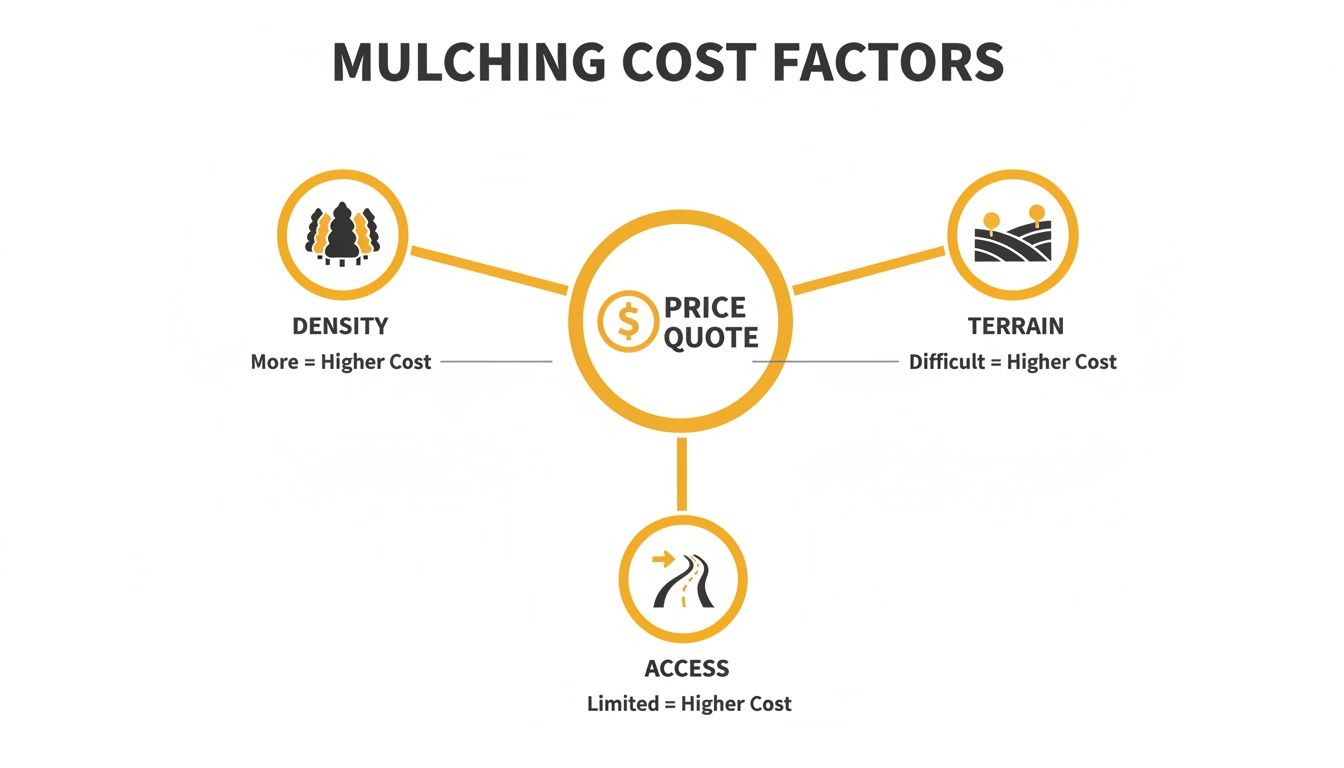
As you can see, tough terrain or super thick growth can slow a job down. That makes an hourly rate a bit unpredictable for big projects, but it's the ideal fit for these more targeted tasks.
When Per-Acre Pricing Provides Value
Now, for larger, more clear-cut projects, a flat per-acre price is almost always the way to go. This gives you absolute certainty on your budget, which is a massive plus when you're planning a significant investment in your property. You'll know the total cost right from the start, with no surprises if the job takes a bit longer than we guess.
Here in Central Florida, and across most of North America, per-acre forestry mulching costs often land between $1,000 and $2,500. That makes it an incredibly cost-effective alternative to traditional land clearing with bulldozers, which can easily shoot past $5,000 per acre once you add in stump removal and hauling debris away. At Palm State Clear Cut, our whole philosophy is built around minimal soil disturbance, so this approach is right in our wheelhouse. You can learn more about the forestry mulchers market on wiseguyreports.com.
A per-acre quote is a partnership based on a shared goal: clearing a defined area efficiently and effectively. It shifts the focus from "watching the clock" to achieving the best possible outcome for your property.
This pricing model is best suited for clearing entire lots, pastures, or tracts of land where the boundaries are well-defined. It lets our team focus 100% on efficiency and transforming your property, giving you a fixed cost you can bank on from day one.
Real-World Forestry Mulching Cost Scenarios
Understanding the factors that drive forestry mulching prices is one thing. Seeing how they come together on a real piece of land is where it all starts to make sense. The numbers just click when you can picture an actual project.
To give you a clearer idea of what your own investment might look like, let's walk through three common scenarios we tackle every week here at Palm State Clear Cut. These examples break down different goals, property sizes, and challenges you’ll find right here in Central Florida, showing how the specific details of a job directly shape the final cost.
Scenario 1: The One-Acre Residential Homesite
Picture this: a family in Orange County just bought a beautiful one-acre lot. They're excited to prep the site for their new custom home. The good news? The property is mostly flat with easy road access, which helps keep costs in check.
The challenge, however, is the thick growth covering the land—a classic Florida mix of dense palmettos, small oaks, and a tangled web of vines. The family wants to save a few majestic live oaks but clear everything else, giving their builder a clean slate to work with.
Goal: Clear the lot for new home construction while preserving select mature trees.
Challenges: The vegetation is incredibly dense. This means our mulcher has to work slowly and methodically to process everything.
Solution: We’d bring in a mid-size track loader mulcher. It’s powerful enough for the small oaks but nimble enough to maneuver carefully around the trees the family wants to keep.
Estimated Cost Range: $1,800 - $2,600This price is on the higher end of the typical per-acre rate. Even with great access, the sheer density of the brush requires more machine time and a skilled operator to get that selective clearing just right.
Scenario 2: Reclaiming a Five-Acre Pasture
Next up, let’s imagine a rancher over in Osceola County. He has a five-acre pasture that’s been completely swallowed up by invasive Brazilian pepper trees and thick brush. The land is no longer usable for his livestock, and he needs to take it back.
The terrain is flat and wide open, but those invasive trees are tough and woody. Access is decent down an old farm road. The goal here is simple: total clearance to get the pasture back in working order.
Goal: Wipe out invasive species and clear the land for livestock grazing.
Challenges: Brazilian pepper is notoriously tough and grows in dense, tangled clumps. You need serious power to grind it down effectively.
Solution: For a job like this, a larger, more powerful mulcher is the right tool. It can chew through the woody invasives efficiently. The project's larger size also helps bring the per-acre rate down. You can learn more about what goes into the cost of clearing an acre of land in our detailed guide.
Estimated Cost Range: $7,000 - $9,500 (or $1,400 - $1,900 per acre)The economy of scale really helps here, making the per-acre cost more affordable. The main cost driver is simply the volume and toughness of that invasive growth.
Scenario 3: The Ten-Acre Commercial Tract
Finally, let's look at a developer in Lake County with a ten-acre commercial tract slated for a new retail center. The property is a mix of pine trees, moderate underbrush, and a few low, soggy spots.
Access from the main road is excellent, but those wet areas demand a careful approach to keep heavy equipment from getting bogged down. The developer needs complete clearing, which includes grinding the stumps from the larger pines to prepare for grading and utilities.
Goal: Clear all ten acres for commercial development, including stump grinding.
Challenges: Working around soft, wet ground takes more time and may require specialized low-ground-pressure equipment. Stump grinding is also an added service on top of the initial mulching.
Solution: We would deploy our most powerful mulchers for speed and bring in a separate, dedicated stump grinder. The wet spots would be handled with extra care or scheduled for a drier time of year if possible.
Estimated Cost Range: $15,000 - $22,000+This estimate covers both the mulching and the necessary stump grinding. The cost reflects the project's large scale, the need for multiple pieces of heavy machinery, and the extra time and skill required to work around the difficult terrain.
How to Get the Best Value and Avoid Hidden Fees
Getting a fair price on your forestry mulching project is about more than just collecting quotes. It’s about being prepared and knowing the right questions to ask. A few smart moves before the crew even shows up can have a real impact on your final bill and help you avoid the kind of surprises that can throw a project off budget. This puts you in control, making sure you get the most out of your investment.
Simple prep work can save you a surprising amount of money. Think of it like getting a room ready for a painter—the less time they spend moving furniture and taping trim, the less you pay in labor. The same idea applies here. Taking a few small steps can easily shave hours off the job, and that time saved goes right back into your pocket.
Simple Steps to Lower Your Mulching Costs
You can actively bring your final cost down by tackling a few key tasks yourself. These actions help our mulching crew get straight to work and operate at peak efficiency from the moment they unload the equipment.
Mark Your Boundaries Clearly: Grab some bright flagging tape or spray paint and clearly mark your property lines. Also, flag any specific zones you want us to clear or, just as importantly, leave untouched. This simple step eliminates any guesswork and prevents costly do-overs.
Clear Non-Mulchable Debris: Take a walk through the work area and pull out any old wire fencing, metal t-posts, chunks of concrete, or other junk. Hitting these hazards can cause serious, expensive damage to our mulchers, leading to downtime and potential repair fees.
Discuss Stumps and Roots Upfront: Let us know your long-term plans for the land. If you’re building on your land and need large stumps completely gone for a foundation or driveway, be sure to mention that from the start so we can include stump grinding in the quote.
Your Contractor Vetting Checklist
Choosing the right partner for the job is the single best way to avoid hidden fees and headaches. A professional, transparent contractor will welcome your questions and be upfront about everything. Use this checklist when you talk to potential companies to make sure you’re hiring a true expert.
A detailed, all-inclusive quote is the hallmark of a trustworthy contractor. Vague estimates often hide future expenses for things like fuel surcharges, equipment transport, or unexpected site challenges.
Here are the essential questions you should ask any company before you sign on the dotted line:
Is your quote all-inclusive? Ask them to confirm that the price covers everything—fuel, equipment transport, and all labor—with no hidden surcharges.
Can you provide proof of insurance and licensing? A reputable company will have their documents for general liability and workers' compensation ready to go. This is non-negotiable and protects you from any liability.
What happens if you encounter unexpected obstacles? Talk about how they handle surprises, like discovering extremely rocky soil or a hidden swampy patch, and how that might impact the final cost.
Do you offer a free on-site evaluation? A quote given over the phone is just a ballpark guess. A real pro will insist on walking the property with you to give you an accurate, firm price.
Can you provide references from recent projects? Hearing from past clients is one of the best ways to get a feel for a company's reliability, professionalism, and the quality of their work.
Knowing what to look for when finding forestry mulching services near you is a huge part of the process. When you're armed with this knowledge, you can confidently pick a partner who will deliver incredible results without any unwelcome financial surprises.
The Palm State Clear Cut Promise: From Quote to Finish
Understanding the numbers is one thing, but finding the right partner to bring your vision to life is what really matters. At Palm State Clear Cut, we’ve built our entire business around clarity, communication, and delivering results we’re proud of. Our promise is simple: a smooth, professional experience from the first handshake to the final walk-through, with no surprises along the way.
We know a great project starts with a great plan. That’s why we’ve honed a straightforward, four-step journey to give you complete peace of mind and transform your overgrown property into a clean, usable space.
Step 1: Your Free Site Evaluation
It all begins with a conversation on your land. We don't do blind quotes over the phone because every single property has its own story. One of our experts will meet you right on-site to walk the property, listen to what you want to achieve, and get a feel for the key factors—from the density of the vegetation and the lay of the land to access points and any potential hiccups.
This is your time to ask us anything and share your vision. In return, we’ll offer our professional advice and make sure we’re perfectly aligned on the scope before we even start talking numbers.
Your project is more than just acres and hours; it's about achieving a specific goal for your property. Our on-site evaluation ensures our plan, and your quote, are built around that goal from day one.
Step 2: The Clear Project Plan and Quote
After our visit, you'll get a detailed, all-inclusive project plan. This isn't just a number on a piece of paper. It's a comprehensive proposal that lays out the exact work to be done, the specific equipment we’ll bring, an estimated timeline for completion, and a firm, transparent price.
Your quote will clearly break down what your forestry mulching project will cost, with no hidden fees or vague line items to worry about.
Step 3: The Professional Clearing Day
Once you give us the green light, our team of skilled and insured operators gets to work. We show up on schedule with modern, well-maintained equipment ready to transform your land safely and efficiently. We take real care to minimize soil disturbance and protect any trees or areas you’ve asked us to leave untouched.
Our whole focus is on executing the plan with precision, turning that dense overgrowth into a clean, uniform layer of beneficial mulch.
Step 4: Your Final Walk-Through and Satisfaction
When the mulcher stops, our job isn't quite done. We'll do a final walk-through with you to inspect the results and make sure every detail of the project plan has been met to your complete satisfaction. We stand by the quality of our work, and your approval is the final, most important step.
This commitment to value is everything in our industry. While average forestry mulching expenses are around $2,000 nationally, our Central Florida clients often see per-acre costs between $1,500 and $2,500 for comprehensive clearing. You can see how that compares by exploring more forestry mulching cost trends on angi.com.
Your Mulching Questions, Answered
When you're thinking about a land clearing project, a lot of questions pop up. It's totally normal. You want to understand the investment, sure, but you also want to know what the process is really like and what the long-term benefits are for your property.
Here are some quick, straightforward answers to the most common questions we hear from landowners right here in Central Florida. We want you to have all the practical details you need to move forward with confidence.
Is Forestry Mulching Really Cheaper Than Bulldozing?
Yes, for most projects, forestry mulching is significantly easier on the wallet. Think about it: a single, specialized machine does everything in one pass—it cuts, grinds, and spreads the material right where it stands.
This all-in-one process means you get to skip the separate, and often hefty, costs that come with bulldozing. You won't be paying for hauling debris, landfill disposal fees, or the extra work needed to repair the deep ruts and damage a dozer leaves behind. Plus, the mulch it creates is a free bonus for your soil, acting as a natural fertilizer and weed barrier that saves you money down the road.
Do I Need a Permit for Forestry Mulching in Florida?
That's a great question, and the answer is: it depends. Permit requirements can change from county to county and depend on your specific property. For a lot of standard residential jobs, you won't need one.
However, if your land has protected wetlands, sits in a conservation area, or is home to certain protected tree species, then a permit is almost certainly required. It’s always smart to check with your local county office before breaking ground. Here at Palm State Clear Cut, we know the rules across Central Florida and can help you figure out exactly what your project needs to be fully compliant from day one.
Always confirm local permit needs before starting any land clearing project. An experienced contractor can guide you through this process, preventing potential fines and delays.
How Long Does the Mulch Take to Decompose?
In Central Florida’s warm, humid climate, nature gets to work pretty quickly. The finer stuff—like shredded leaves and small twigs—will start breaking down and feeding your topsoil in just a few months.
The larger wood chips might take a year or more to fully disappear. This slow-release process is actually a huge benefit. It creates a protective blanket over your soil that smothers weeds, holds in moisture during our dry spells, and prevents erosion.
Can You Mulch Around Trees I Want to Keep?
Absolutely! This is one of the biggest reasons people choose forestry mulching. Our operators are true pros who can maneuver the equipment with incredible precision.
They can easily clear out all the unwanted underbrush, invasive plants, and small nuisance trees while leaving your beautiful, mature oaks or pines completely untouched. It allows you to sculpt your property just the way you want, whether you're aiming for a clean, park-like feel or just giving your favorite trees the breathing room they need to thrive.
Ready to see how affordable it can be to transform your property? The team at Palm State Clear Cut is here to provide a clear, accurate, and completely free on-site quote. Get your free estimate today!