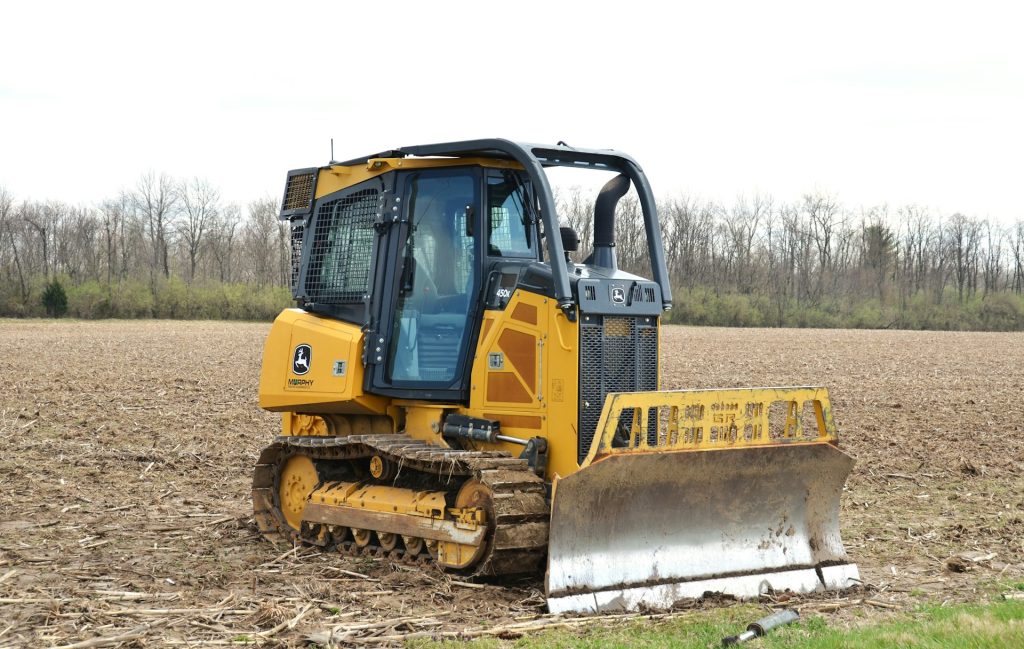
Think of agricultural land clearing as the essential prep work before you can start any real project on your property. It’s the process of clearing out trees, pulling up stumps, and getting rid of all the thick brush so you can actually use the land for farming, ranching, or even building a home. This is what turns a tangled, unusable piece of Central Florida wilderness into a blank canvas, ready for you to bring your vision to life.
Why Agricultural Land Clearing Is The First Step To Success
Imagine an artist trying to paint on a canvas that’s already covered in old, messy paint and grime. It’s just not going to work. Before they can create anything worthwhile, they need a clean, primed surface. That’s exactly what land clearing does for your property. It’s the critical first step that transforms raw land into a productive, valuable asset.
This isn’t just about getting rid of obstacles. It’s about creating a functional, organized space where your plans—whether it’s a productive farm, a healthy pasture, or a new homesite—can actually grow.
Without this step, a property is just stuck. Overgrowth can become a haven for pests, let invasive species take over, and stop the soil from getting healthy. For anyone with land in Central Florida, clearing out this mess is the starting line for any successful project.
From Overgrowth To Opportunity
At its core, land clearing is all about creating opportunity. Whether you’re taking everything out or being more selective, you’re basically designing how your land will be used from the ground up. This gives you control, making the property safer, more functional, and healthier in the long run.
Starting with professional land clearing brings some serious benefits:
- Improved Usability and Access: You suddenly have open, easy-to-navigate spaces. This means you can get equipment in, manage livestock, and plan for future construction without fighting through brush.
- Enhanced Soil Health: The right clearing techniques can get your topsoil ready for planting. By removing competing root systems and sometimes mixing organic matter back into the ground, you’re giving your soil a head start.
- Increased Property Value: Let’s be honest, a cleared, usable lot is way more appealing to potential buyers. It adds immediate value compared to an overgrown, inaccessible piece of land.
When you invest in proper land clearing, you’re doing more than just moving dirt and trees. You’re laying the foundation for a successful and profitable future. It’s the single most important thing you can do to enable everything that comes next.
Ultimately, this whole process just sets the stage. It makes sure your project starts on solid, stable ground, free from the problems that unmanaged vegetation can cause, and paves the way for sustainable growth.
Exploring The Most Common Land Clearing Methods
Picking the right land clearing technique is a bit like choosing a tool from a toolbox. You wouldn’t use a sledgehammer to hang a picture, right? The same logic applies here. The best method for your Central Florida property hinges on your ultimate goal, the kind of vegetation you’re dealing with, and what you plan to do with the land long-term.
Each approach has its own unique mix of pros, cons, and costs. Getting a handle on these differences is the key to making sure your project is done right—efficiently, within budget, and with respect for the land itself. It’s what separates a solid foundation for future growth from a project that creates more headaches down the road.
This handy guide can help you start thinking about which path makes the most sense for your goals.
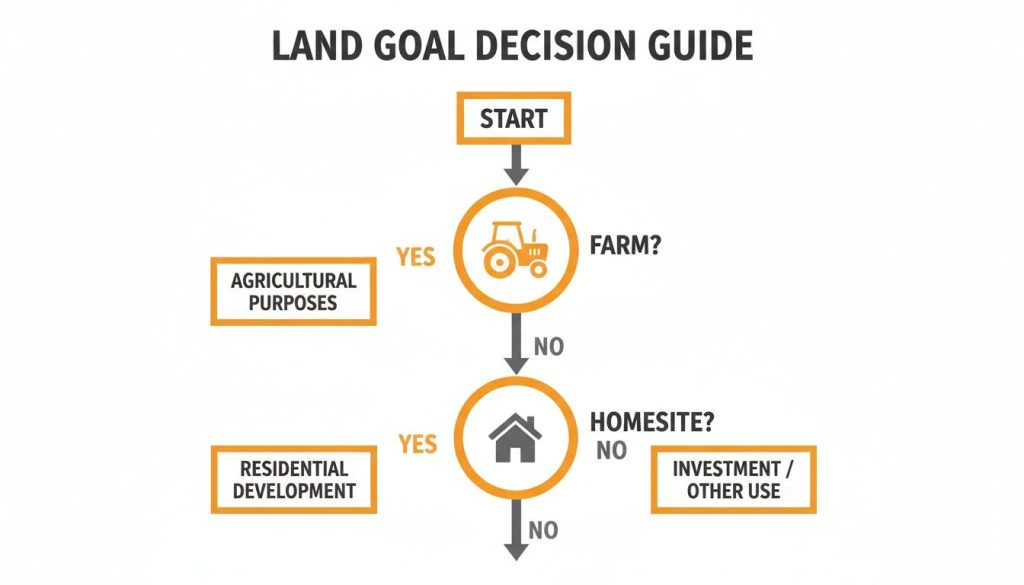
As you can see, what you plan to do with the land—whether it’s farming, ranching, or building a home—is the biggest factor in choosing how to clear it.
To help you sort through the options, this table breaks down the most common methods we use here in Florida.
Comparing Land Clearing Methods For Florida Properties
This table offers a clear side-by-side comparison to help you choose the best land clearing method for your project, budget, and environmental goals.
| Method | Best For | Environmental Impact | Key Benefit |
|---|---|---|---|
| Forestry Mulching | Selective clearing, eco-sensitive areas, improving soil health | Low | Leaves a nutrient-rich layer that prevents erosion. |
| Push-Over & Grubbing | Dense vegetation, preparing land for construction or row crops | High | Completely clears surface and subsurface obstacles. |
| Controlled Burning | Large-scale pasture management, forestry, wildfire prevention | Varies | Cost-effective for huge tracts and returns nutrients to the soil. |
Deciding between these methods often comes down to balancing speed, cost, and the long-term health of your property.
Forestry Mulching: A Low-Impact Solution
Forestry mulching has become a go-to method for good reason—it’s one of the most eco-friendly options out there. It uses a single, powerful machine to cut down, grind up, and evenly spread vegetation across the ground, creating a protective layer of natural mulch. Picture a giant, all-terrain shredder that recycles trees and brush right where they stand.
The biggest win here is how little it disturbs the soil. There are no massive debris piles to haul off or burn. Instead, that fresh, nutrient-packed mulch is left to decompose, feeding the topsoil and stopping erosion in its tracks. For anyone in Florida concerned about preserving their land’s health, this is a huge plus. If you want to dive deeper into the machinery, check out our complete guide to land clearing mulchers.
Forestry mulching is often the best choice for selective clearing and environmentally sensitive areas. It avoids the harsh impact of bulldozing and leaves the land in a healthier state than when the project began.
Let’s break down the key benefits:
- Soil Enrichment: As the mulch breaks down, it puts organic matter back into the ground, boosting fertility over time.
- Erosion Control: That layer of mulch acts like a blanket, shielding the ground from Florida’s heavy rains and wind.
- No Hauling or Burning: Everything is handled on-site, which means no burn permits and no extra costs for hauling debris away.
Traditional Push-Over And Grubbing
When you picture classic land clearing, you’re probably thinking of the push-over method. Using heavy-duty bulldozers, this is a raw, powerful way to clear dense brush, big trees, and stubborn stumps quickly. The machinery literally pushes everything over and piles it up to be dealt with later.
After the initial push, a second step called grubbing is usually needed. This is where crews use equipment to dig out all the leftover stumps and root systems, leaving a completely clean slate. It’s a must-do for projects like new home construction or planting crops where you can’t have any underground obstacles.
But there’s a trade-off. This method is much harder on the land. It scrapes away valuable topsoil, creates huge piles of debris that have to be managed, and dramatically increases the risk of erosion. Getting the big machines to the job also requires careful planning; you’ll need reliable heavy equipment trailers to move bulldozers and excavators safely.
Controlled Burning: A Specialized Approach
Controlled burning, also called a prescribed burn, is a specialized tool used to manage very large areas, especially for forestry and agriculture. It involves carefully setting intentional, managed fires to clear out undergrowth, lower the risk of dangerous wildfires, and recycle nutrients back into the soil.
Let me be clear: this is absolutely not a DIY job. A controlled burn requires a ton of planning, the right permits, and a crew of certified professionals to make sure the fire behaves exactly as intended. It’s a common practice here in Florida for restoring natural habitats and prepping large pastures for livestock.
While it can be very cost-effective for massive properties, it’s not a fit for smaller lots or any land near existing homes or buildings. The risks and smoke management are just too high. It’s a powerful technique, but one that demands expert oversight from start to finish.
Here is the rewritten section, crafted to sound completely human-written and natural, following all the provided instructions and examples.
Navigating Florida’s Permitting And Regulations
Before a single tree comes down or a dozer even touches the dirt, your most important work is going to be on paper and over the phone. Clearing agricultural land in Florida isn’t a free-for-all; it’s a careful process governed by a web of state and local rules designed to protect our unique environment. Trying to jump the gun without the right approvals is a surefire way to get hit with stop-work orders, steep fines, and project delays that end up costing way more than just doing it right from the start.
Think of the permitting process as building a solid legal foundation for the physical work. Here in Central Florida, that means getting in touch with your specific county—whether it’s Osceola, Brevard, or Orange—along with state-level agencies. The whole point is to make sure your project is 100% compliant before any heavy equipment rolls onto the property. This initial homework is non-negotiable for a smooth, successful project.
A simple phone call to your local county planning and zoning department is the best place to begin. They can give you a checklist of what’s needed for your particular property and the scope of your project, which will save you a ton of guesswork down the road.
Understanding The Key Players And Their Rules
Getting through the regulatory maze means knowing who to talk to. Several different agencies have a say in how land is cleared in Florida, and their jurisdictions often overlap. It’s on you—or your contractor—to make sure every box is checked.
Here are the main players you’ll likely be dealing with:
- County and City Governments: These are your local folks who handle the bulk of zoning rules, tree ordinances, and basic land-clearing permits. They should be your first and most frequent call.
- Florida Department of Environmental Protection (FDEP): The FDEP gets involved when a project could impact state waters, wetlands, or other protected ecosystems. Their job is to prevent pollution and preserve our natural resources.
- Water Management Districts: In our neck of the woods, you’ll be working with either the St. Johns River Water Management District or the South Florida Water Management District. They’re laser-focused on water resources, especially wetland protection and managing stormwater runoff.
Missing a step with any one of these agencies can bring your entire project to a screeching halt. A seasoned land clearing contractor will already have relationships with these agencies and can help you manage all the communication and paperwork.
Identifying And Protecting Wetlands
Wetlands are the crown jewels of the Florida landscape, and they are fiercely protected. These areas are absolutely vital for filtering our water, controlling floods, and providing a home for wildlife. Because of that, both state and federal laws are incredibly strict about disturbing them without authorization.
Now, identifying a wetland isn’t always as simple as looking for standing water. The real tell-tale signs are in the specific soil types and plant species. For any significant agricultural land clearing project, a professional wetland delineation is almost always a must.
An environmental consultant will come out to survey your property and literally flag the precise boundaries of any protected wetlands. If you try to clear these areas without the right mitigation permits from the FDEP and the Army Corps of Engineers, you could face severe penalties, including fines up to $10,000 per day for each violation.
Tree Ordinances And Erosion Control Plans
Beyond just wetlands, local governments have their own rules about which trees can come down. Many counties here in Central Florida have “specimen tree” or “heritage tree” ordinances that protect large, old, or otherwise significant trees. You can’t just bulldoze everything; you may need a separate permit to remove these protected trees, and sometimes, you’ll even be required to replace them elsewhere.
On top of that, an erosion control plan is pretty much standard procedure for most clearing projects. As soon as you remove the vegetation, that bare soil is incredibly vulnerable to being washed away by our famous Florida downpours.
Your plan needs to spell out the Best Management Practices (BMPs) you’ll use to keep the soil in place. This usually includes things like:
- Silt Fencing: Putting up temporary fabric barriers to trap sediment and stop it from running off into nearby ditches or ponds.
- Seeding and Mulching: Quickly planting a temporary cover crop or spreading a layer of mulch to hold the soil down right after clearing.
- Stormwater Inlet Protection: Placing special filters around storm drains to keep dirt, sand, and other debris out of the public water system.
This plan shows regulators that you’re being proactive and responsible, taking the right steps to protect water quality and prevent environmental damage from day one.
How To Estimate Land Clearing Costs And Timelines
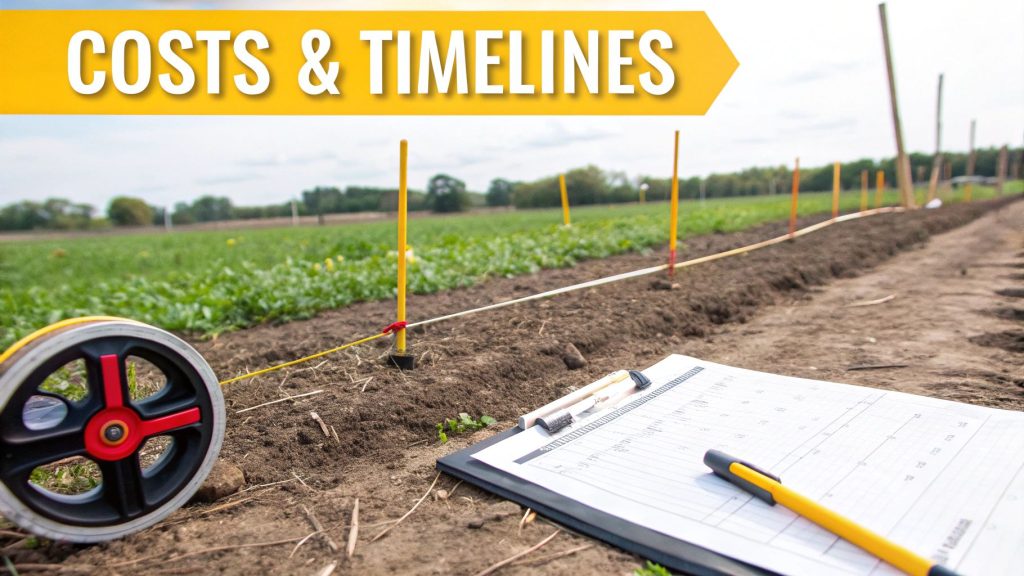
Trying to nail down a budget for agricultural land clearing can feel like throwing a dart in the dark. But the costs and timelines aren’t just random numbers; they’re directly tied to a handful of key variables on your specific property. Getting a grip on these factors is the first real step to mapping out a realistic budget and schedule.
No two pieces of land are ever the same, which means no two clearing jobs will carry the same price tag. A flat, five-acre parcel with some light brush is a world away from five acres of dense, swampy Florida jungle with crazy inclines. The tougher the job, the more time and resources it’s going to eat up.
Key Factors That Influence Your Project Cost
The final bill for your land clearing project comes down to a mix of things. Any good contractor will walk the property and assess these elements to give you a real quote, not just a shot-in-the-dark “per acre” guess.
Here are the main drivers that will shape your costs:
- Acreage: The most obvious one. More land naturally means more time and more fuel, which drives up the cost. The good news is the price per acre usually drops on bigger jobs.
- Vegetation Density: What are we dealing with? Light brush and a few saplings, or a thick jungle of mature hardwoods and tangled vines? Denser growth requires bigger machines and way more time to process.
- Terrain and Accessibility: A flat, dry field is a cakewalk. But steep slopes, wetlands, or rocky ground make it tough to maneuver heavy equipment, slowing everything down and adding to labor costs.
- Clearing Method: As we’ve covered, forestry mulching and traditional dozing have different price points. The method you and your contractor decide on will be a huge factor in the final invoice.
- Debris Removal: If you go with a method like push-over clearing, you have to account for either hauling away or burning those massive debris piles. That means extra labor, and often, extra disposal fees.
Realistic Cost And Timeline Expectations
While nothing beats a custom quote for your property, we can give you some ballpark figures to help you start planning. Here in Central Florida, the cost for forestry mulching usually lands somewhere between $1,500 and $3,500 per acre. Traditional dozing might look a little cheaper on paper, but don’t forget to add in the extra costs of grubbing and getting rid of all that debris.
For a much deeper dive, you can check out our guide on the cost to clear an acre of land in Florida.
Timelines are just as custom. A small, one-acre lot with light brush could easily be done in a day. On the flip side, a 10-acre property packed with palmettos and oak trees could take a full week or even longer, all depending on the machinery and crew on site.
Remember: The goal isn’t just to clear land, but to prepare it for its next purpose. This foundational work is a global practice, driven largely by the need for productive farmland.
Globally, agricultural expansion is the number one driver of deforestation, accounting for nearly 90% of all forest loss. That’s a sobering statistic that highlights the impact of land use on our planet and why responsible clearing practices are so important. You can learn more about how global forest area is changing because of farming needs. This bigger picture really underscores why efficient, smart, and targeted clearing methods are absolutely crucial.
Protecting Your Land After The Clearing Is Done
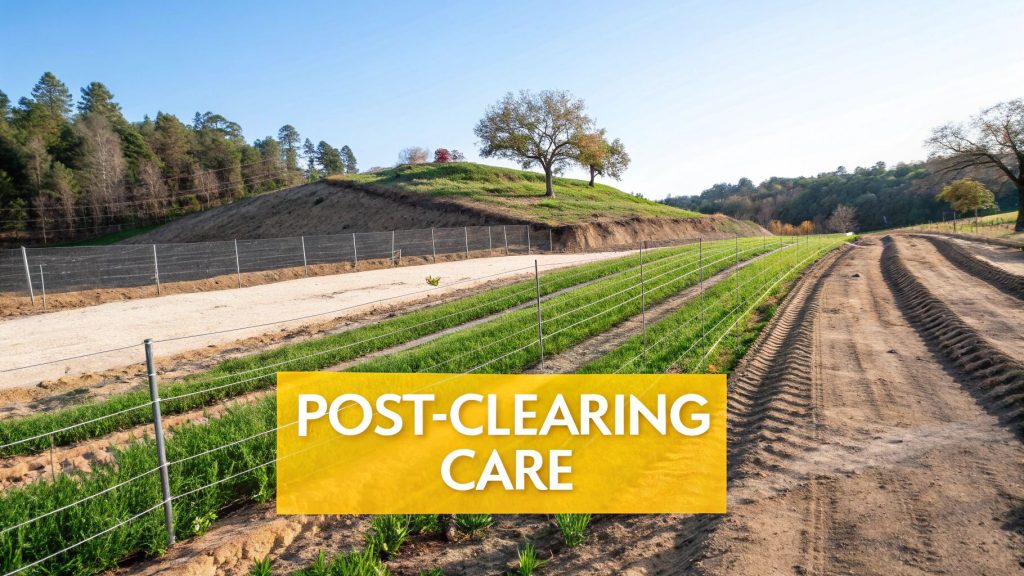
The moment the last piece of heavy equipment rumbles off your property, a new—and equally critical—phase of your project begins. Agricultural land clearing isn’t the finish line. Think of it as the starting line for bringing your land back to life and guaranteeing its long-term health.
Without a smart follow-up plan, all that hard work can be undone by two of Florida’s biggest troublemakers: soil erosion and invasive species.
Your newly cleared land is a lot like a patient fresh out of surgery. It’s stable, but it’s also incredibly vulnerable. It needs careful attention to heal properly. Bare soil is wide open to being washed away by our heavy rains or stripped by the wind. This soil erosion takes with it the nutrient-rich topsoil that’s absolutely essential for growing crops or healthy pasture.
This is your chance to stabilize the new environment you’ve created and set yourself up for years of success.
Implementing Effective Erosion Control Measures
Your first job after clearing is to lock down your soil. Bare ground is practically an invitation for erosion, which ruins the land, pollutes nearby water, and makes it nearly impossible to get new plants established. The good news is, there are some proven, straightforward ways to keep your soil right where it belongs.
These methods, often called Best Management Practices (BMPs), are all about slowing down water and giving new vegetation a fighting chance to take root. For a deeper dive, check out our complete guide on how to prevent soil erosion on your property.
Here are some of the most effective first steps:
- Installing Silt Fencing: These temporary fabric fences act like a filter. They let water pass through but trap the sediment, keeping your soil from washing into ditches or onto your neighbor’s land. They’re a must-have along the downhill edges of your cleared area.
- Planting Cover Crops: This is one of the best defenses you can mount. Seeding your land with a fast-growing crop like rye or clover quickly creates a root system that holds the soil together, almost like rebar in concrete.
- Applying Mulch or Hay: Spreading a layer of mulch (especially if you used the forestry mulching method), hay, or straw over the ground creates a protective blanket. It softens the impact of raindrops, slows runoff, and helps the soil hold onto moisture.
Taking these proactive steps isn’t just about being a good land steward. It’s a direct investment in the future value of your property. Protecting your topsoil today means a more fertile and productive farm or ranch for years to come.
Winning The War Against Invasive Species
Here in Florida, clearing land can accidentally roll out the welcome mat for aggressive, non-native plants. When you remove the existing cover, you create a sunny, wide-open space where invasive species can absolutely explode. Plants like Brazilian Pepper, Cogongrass, and Old World Climbing Fern are masters at taking over a cleared site, choking out the native plants and grasses you actually want.
If you don’t stay on top of it, these invaders can create dense thickets that are just as bad as what you paid to have removed in the first place. That’s why ongoing vegetation management is a non-negotiable part of any successful land clearing project. You have to be proactive, not reactive.
This is a global issue, not just a local one. Land use changes often create opportunities for new species to take hold. While global deforestation rates have slowed down in recent decades, the loss is still staggering. From 2015 to 2025, an estimated 10.9 million hectares of forest were lost each year. That’s a huge drop from previous years, but it’s still a massive area. This context really underscores why managing the land we do clear is so vital.
A solid management plan includes these key actions:
- Early Detection and Rapid Response: Get in the habit of walking your property regularly. You need to spot any unfamiliar plants as soon as they pop up. It’s far easier and cheaper to deal with a few small intruders than a full-blown infestation.
- Targeted Herbicide Application: Forget broad-spectrum spraying. The smart move is to use selective herbicides that go after specific invasive species without harming your desirable plants. It’s more effective and much better for the environment.
- Promoting Native Growth: The best long-term defense is a good offense. Actively plant and encourage native grasses and plants. Once they’re established, a healthy native ecosystem will outcompete invasive species for sunlight, water, and nutrients.
How To Choose The Right Land Clearing Contractor
Hiring the right contractor for your agricultural land clearing project is hands-down the most critical decision you’ll make. Get it right, and your vision becomes a reality, safely and on schedule. But the wrong choice can quickly spiral into a nightmare of costly delays, property damage, and even legal trouble.
This isn’t just about finding someone with a bulldozer. You’re looking for a true partner who understands your investment and has the expertise to see it through.
Think of it this way: you wouldn’t pick a surgeon based on who has the lowest price. You’d want an expert with a proven track record, the proper tools for the job, and a deep understanding of the procedure. The same principle applies here. Your land is a major asset, and the contractor you hire will shape its future health and value.
Verifying Credentials And Experience
Before you even start talking numbers, the very first step is to vet a contractor’s basic qualifications. This is the non-negotiable groundwork that separates seasoned pros from risky operators. A legitimate company won’t hesitate to provide this info.
Start by asking these questions:
- Are you fully licensed and insured for work in Florida? Don’t just take their word for it—ask to see their certificate of insurance. This is what protects you from liability if an accident happens on your property.
- Can you provide references for similar local projects? A contractor who is proud of their work will be happy to share past projects and connect you with satisfied clients.
- How long have you been clearing land in Central Florida? Local experience is huge. A team that knows our unique soil types, unpredictable weather patterns, and common invasive species is worth its weight in gold.
This initial screening quickly weeds out the unqualified folks, so you can focus on the real contenders.
A contractor’s equipment fleet speaks volumes about their capabilities. A company with a diverse range of modern, well-maintained machinery—like forestry mulchers, excavators, and grinders—is better equipped to handle your project’s specific needs efficiently.
Evaluating Their Process And Professionalism
Once you’ve confirmed their credentials, it’s time to dig into how they work. A true professional does more than just show up and start clearing; they have a structured, transparent process from start to finish.
They should be willing to walk your property with you and provide a detailed, written estimate. This document should clearly lay out the scope of work, the specific methods they plan to use, and a realistic timeline.
Be wary of anyone who gives you a vague quote or a price over the phone without ever setting foot on your land. That’s a major red flag for inexperience and often leads to surprise costs down the road. The right partner will also bring up crucial next steps, like erosion control and strategies for preventing invasive regrowth. That shows they’re invested in the long-term success of your property, not just cashing a check for the initial job.
Your Top Land Clearing Questions Answered
Even after walking through the whole process, you’re bound to have a few more questions rattling around. That’s completely normal. When you’re getting ready to move from a plan on paper to dirt-moving action, the practical details really start to matter.
Let’s tackle some of the most common questions we get from landowners right here in Central Florida.
How Long Does It Take To Clear Land?
This is the big one, but the honest answer is always, “it depends.” You could be looking at a single day for a small, one-acre lot with just some light brush. On the flip side, a dense 20-acre parcel choked with palmettos and mature oaks could easily take a week or even longer.
The timeline really comes down to a few key things:
- Total Acreage: More land simply takes more time. This is the biggest factor.
- Vegetation Density: A field of thick undergrowth and big trees is a different beast than one with just sparse grass and a few saplings. It requires more time and heavier machinery.
- Chosen Method: Forestry mulching is often much quicker than the old push-over methods, which leave you with piles of debris to haul away or burn.
- Terrain: Working on flat, dry ground is a whole lot faster than trying to navigate slopes or soggy, swampy areas.
Do I Need A Permit For Agricultural Clearing?
Almost certainly, yes. While you might find some very minor activities are exempt in specific rural zones, any significant land clearing project in Central Florida is going to require permits. Trying to skip this step is a recipe for disaster—you could face hefty fines and stop-work orders that bring your project to a screeching halt.
Your first call should always be to your local county’s planning and zoning department. They’ll give you the exact checklist you need for your specific property and project.
Can I Save Money By Doing It Myself?
For anyone without serious experience and the right equipment, attempting a DIY land clearing job is a huge risk. Renting heavy machinery isn’t cheap, and operating it without proper training can lead to severe injuries or thousands of dollars in property damage.
Hiring a professional isn’t just about paying for someone to run a machine. You’re paying for their expertise in safety, efficiency, and navigating all the local rules. A licensed and insured contractor is an investment that protects you from liability and guarantees the job gets done right the first time.
It’s amazing to think about how far farming has come. While clearing land is still the first step, modern agriculture has become incredibly efficient. Global agricultural output nearly quadrupled between 1961 and 2020, but the amount of land used for farming only grew by 7.6%. That just shows the power of effective land use. You can find more fascinating stats on global agricultural production on ers.usda.gov.
What Is The Best Time Of Year To Clear Land In Florida?
The sweet spot for clearing land in Florida is during our dry season. That typically runs from late fall through spring, think November to May. When the ground is dry, the work is safer, much more efficient, and you don’t have to worry as much about tearing up the soil and creating deep ruts.
Trying to clear land during the summer rainy season can turn into a muddy, messy headache. You’ll face constant delays and the difficult conditions make the whole job harder than it needs to be. Stick to the drier months for a smoother ride.
Ready to turn your vision for your property into a reality? Palm State Clear Cut offers the full spectrum of land clearing and site prep services across Central Florida. Reach out today for a free, no-obligation quote and let our team handle the heavy lifting. Check us out at https://palmstateclearcut.com to get started.