
A Central Florida Guide to Farm Land Clearing
- Feb 13
- 17 min read
So, you’ve got a piece of land in Central Florida and a vision for what it could be. Right now, it might be an overgrown mess, but turning that raw property into a productive farm or a build-ready lot is where the real potential is unlocked. Farm land clearing is about much more than just tearing out trees; it's the strategic first step in making your vision a reality, whether you're planting crops or building your dream home.
Let's walk through how to get it done right.
Your Farm Land Clearing Journey Starts Here
Starting a land clearing project can feel like a huge task. For a lot of folks, the first look at their property is daunting—whether it's the dense palmettos in Osceola County, stubborn oak stumps in Lake County, or just a sea of tangled undergrowth across Polk County. This guide is here to cut through all that noise.
Think of this as your field manual for turning a wild plot of land into a valuable, usable asset. We'll go beyond the basic "how-to" and dig into the critical "why" behind every step of your project.
Defining Your End Goal
Before a single machine hits the dirt, you need absolute clarity on your objective. The right way to clear your land depends entirely on what you plan to do with it. Are you trying to:
Establish Productive Farmland? If you're clearing for crops or pasture, you'll need to pay close attention to things like soil health and proper drainage from day one.
Prepare for Development? Getting a site ready for a new home or commercial building is a whole different ballgame. It demands the complete removal of all stumps and root systems.
Improve Habitat and Land Health? Maybe your goal is more about conservation. Selective clearing can get rid of invasive species, lower wildfire risk, and help native plants thrive.
Create Recreational Space? Sometimes, you just need to carve out trails, create food plots for wildlife, or put up a new fence line. This calls for a much more targeted approach.
Each of these goals shapes every decision you'll make, from the equipment you choose to how the site is finished. Clearing for a new homesite, for example, is a completely different operation than just thinning out a wooded lot to improve timber quality.
Land clearing isn't just about removal; it's about preparation. A successful project lays the groundwork for decades of productivity and usability, making the initial investment in planning and professional execution incredibly valuable.
Navigating the Process from Start to Finish
Consider this guide your A-to-Z resource for the entire farm land clearing process. We’ll cover every essential phase to make sure your project gets done safely, stays on budget, and complies with all the local rules.
We'll cover everything from the initial site assessment and navigating the permit maze in counties like Brevard and Volusia to comparing different methods like forestry mulching versus traditional dozing. You’ll get the insights you need to make smart decisions.
We'll also dive into the crucial steps after the clearing is done, like erosion control and long-term vegetation management, to protect your hard work. With this knowledge in hand, you can confidently team up with a professional contractor and turn that vision for your land into reality.
Preparing for a Successful Land Clearing Project
Success in farm land clearing is decided long before the first engine ever starts. In my experience, meticulous preparation is the single biggest factor separating a smooth, on-budget project from one plagued by costly delays and unexpected headaches. This is your playbook for getting the essential pre-clearing steps right from the very beginning.
It all starts with getting out there and walking the property. A comprehensive site assessment is non-negotiable. You have to understand exactly what you're working with, from the specific vegetation—like the stubborn palmettos and sprawling oaks we see all over Central Florida—to the subtle dips and swells of the terrain that could create drainage nightmares later on.
Conducting a Thorough Site Assessment
A proper assessment is far more than a casual stroll. Think of it as an investigative process where you document every key feature of your land. This information isn't just for you; it's vital for creating an accurate project plan and getting a reliable quote from any contractor you talk to.
Here’s what you need to focus on:
Property Boundary Verification: First things first, confirm your exact property lines. Clearing a neighbor's land by mistake is a costly, stressful scenario that is 100% avoidable with a recent survey. Don't guess.
Utility Locates: Before any digging or heavy equipment shows up, you must identify all underground utilities. Call 811 to have public lines for water, gas, and electricity marked. Don't forget to mark any private lines you have, like those for a well or septic system.
Terrain and Topography: Make detailed notes of any slopes, low-lying areas that might hold water, or rocky patches. The lay of the land dictates what kind of equipment can be used safely and efficiently.
Vegetation and Debris Analysis: Get specific. Document the types and density of vegetation. Is it mostly light brush, or are you dealing with mature hardwood trees? Identify any old fencing, trash, or other debris that has to go.
To really dial in your planning and budgeting, specialized tools can make a world of difference. For instance, using something like Exayard landscape takeoff software can help you quantify everything and streamline your entire preparation phase.
Defining Your Project Goals and Scope
With a detailed site assessment in hand, you can really sharpen your focus. What is the ultimate purpose of this clearing project? Your answer directly influences the methods, the timeline, and the final cost.
Clearing land for a new cattle pasture, for example, is a totally different ballgame than prepping a site for a concrete foundation. A pasture can tolerate some remaining organic material in the soil, but a future homesite requires complete stump and root removal to prevent dangerous settling issues down the road.
Clarity is key. A vague goal leads to a vague plan and, almost always, unexpected costs. Know precisely what you want the finished product to look and feel like before a single tree comes down.
Navigating Local Permits and Regulations
This is often the step that intimidates landowners in Central Florida the most, but it doesn't have to be a major hurdle. Counties like Brevard, Volusia, and Orange each have their own specific rules about land clearing and tree removal. Just assuming you don't need a permit can bring your project to a screeching halt with hefty fines and work-stop orders.
Your first move should be to visit your county's planning and zoning department website or simply give them a call. Here are the key questions you need answers to:
Are there permits required for clearing agricultural land of my acreage?
Are there any protected tree species on my property that have removal restrictions?
Are there special rules for properties near wetlands or conservation areas?
Globally, the push to clear farmland has reshaped our planet. Since 1990, a staggering 420 million hectares of forest—an area roughly the size of the entire European Union—have been lost, mostly for agriculture. This relentless pace accounts for 16% of total tree cover loss worldwide. For businesses serving counties from Brevard to Flagler, this global trend highlights the local demand for efficient clearing methods that turn unusable parcels into ready-to-use sites with minimal environmental disruption. You can explore more on these deforestation trends from Our World in Data.
This is one area where working with a local, experienced land clearing contractor pays for itself. They've been through the process countless times, know the specific requirements in your area, and can help guide you through the paperwork. It’s the surest way to keep your project compliant and moving forward.
Choosing The Right Land Clearing Methods And Equipment
Picking the right strategy for your farm land clearing project isn't just about personal preference. It's a critical decision that directly impacts your budget, your timeline, and the long-term health of your property. What worked for your neighbor in Osceola County might be the completely wrong approach for your acreage over in Lake County. It really boils down to your specific goals and the unique character of your land.
Getting familiar with the primary methods will put you in the driver's seat when you talk to a contractor. This knowledge ensures you land on a technique that's not just effective but also efficient, saving you from headaches and rework down the road.
Before you even start thinking about equipment, this simple decision tree helps visualize the prep work that guides the whole project.
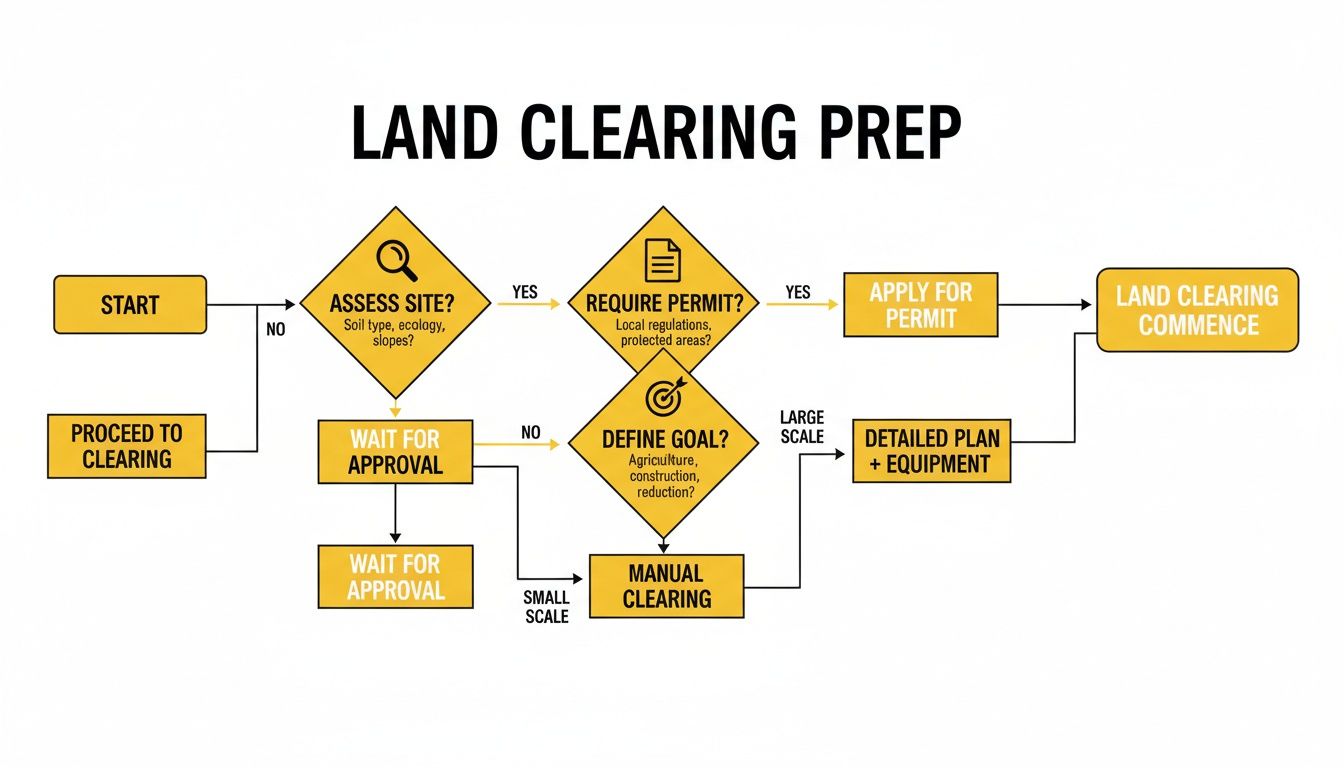
As the graphic shows, every successful job starts with diligent assessment, getting your permits in order, and having a clear goal. Those first steps dictate which method you'll ultimately choose.
Comparing Farm Land Clearing Methods
To make things a bit easier, I've put together a quick comparison of the most common methods we see used here in Central Florida. This should give you a good starting point for figuring out what makes the most sense for your land.
Method | Best For | Key Equipment | Soil Impact | Debris Management |
|---|---|---|---|---|
Forestry Mulching | Selective clearing, pasture reclamation, underbrush control, and sensitive areas. | Skid-steer or excavator with a mulching head. | Low. Protects topsoil and prevents erosion with a natural mulch layer. | On-site. Debris is turned into mulch and left to enrich the soil. |
Dozing & Grubbing | Complete site prep for new construction, roads, or agricultural fields. | Bulldozers, excavators, root rakes. | High. Removes topsoil, leaving the ground bare and prone to erosion. | Requires hauling, burning (with permits), or grinding the debris. |
Manual Clearing | Environmentally sensitive zones, very steep slopes, or small, precise projects. | Chainsaws, brush saws, hand tools. | Very Low. Minimal disturbance to soil and surrounding vegetation. | Labor-intensive piling, chipping, or hauling of cut material. |
Each of these approaches has its place. The key is matching the method's strengths and weaknesses to the specific demands of your project and property.
Forestry Mulching: A Soil-Friendly Approach
Forestry mulching has become a real game-changer in Central Florida, and for good reason. It’s a single-machine process that cuts, grinds, and scatters vegetation right where it stands. We find it’s the perfect solution for selective clearing, taming dense underbrush, and knocking out invasive species without wrecking the topsoil.
The equipment is surprisingly nimble—usually a skid-steer or excavator with a powerful mulching head. This lets an operator weave around desirable trees, creating a clean, park-like feel or just strategically thinning out a wooded area.
The real magic of forestry mulching is what it leaves behind. That mulch layer acts as a natural erosion barrier, helps the soil hold moisture, and slowly breaks down, feeding valuable nutrients back into the earth. It essentially recycles the vegetation on-site, so there's no need for hauling or burning.
This method is perfect for:
Selective Clearing: Getting rid of underbrush while keeping your mature, healthy trees.
Pasture Reclamation: Taking back fields that have been swallowed by brush and small trees.
Invasive Species Control: Shredding stubborn plants like Brazilian pepper trees into oblivion.
Trail and Fence Line Creation: Carving out clear paths with minimal impact on the surrounding area.
If this sounds like a good fit, it's worth understanding all the perks. You can learn more in our landowner’s guide to forestry mulching services for a much deeper dive.
Traditional Dozing And Grubbing
When your plan involves a new foundation or building, traditional dozing is often the only way to go. This method uses heavy iron like bulldozers and excavators to push over trees and scrape the land clean, right down to the mineral soil.
After the initial push, a process called grubbing comes next. This is where we pull the remaining stumps and major root systems out of the ground. It’s a non-negotiable step for any site that’s getting a foundation, road, or other permanent structure. Skip it, and you're asking for settling and structural problems later on.
While it’s incredibly effective for total clearing, this approach is much harder on the soil. It strips away the nutrient-rich topsoil and leaves the ground bare, making it highly vulnerable to erosion until you can get new vegetation growing. You also have to deal with the debris—all that pushed-over material has to be hauled away, piled and burned (which often requires another permit), or ground up.
Manual And Hand Clearing
For smaller, more delicate jobs, nothing beats the precision of manual clearing. This is old-school work, using chainsaws, brush saws, and hand tools to selectively take out specific trees or patches of vegetation. It’s definitely the most labor-intensive and slowest method, but it gives you absolute control.
Manual clearing is the go-to choice for:
Environmentally Sensitive Areas: Working near wetlands or protected habitats where you can't bring in heavy machinery.
Extremely Steep Terrain: Clearing slopes where it would be unsafe to operate equipment or would cause major erosion.
Very Small-Scale Projects: Just tackling a small section of your lot or expanding a garden.
Because the labor costs are so high, we typically only use manual clearing when machines just aren’t an option. It’s all about surgical precision, not broad-scale efficiency. By understanding these core methods, you can match your project's needs with the right tools and strategy for a successful clearing.
Managing Costs and Creating a Realistic Timeline
Before you break ground on any farm land clearing project, you need to get a firm handle on the real financial and time commitment involved. Getting this wrong is the quickest way to turn an exciting new chapter into a major headache. Let's pull back the curtain on what really drives the price so you can budget with confidence and sidestep those nasty surprises.
The bottom line is, no two properties are alike. A quote to clear one acre can be wildly different from another, even if they're in the same part of town. Why? Because the final cost is a direct reflection of the time, labor, and specific equipment needed to get the job done right—and safely.
What Drives the Cost of Land Clearing
A handful of key factors dictate the final price tag for clearing your land. Any experienced contractor worth their salt will walk your property and evaluate each of these before giving you a solid estimate. Knowing what they're looking for empowers you to ask the right questions.
Acreage and Scope: The total size is the obvious starting point, but it's not just about the square footage. The scope of the work—are we clearing the entire lot or just selectively thinning out the underbrush?—plays a huge part in the final number.
Vegetation Density: A property with a few scattered pines and some light palmetto is a straightforward job. It’s going to be a lot less expensive to clear than a lot choked with dense, mature oaks and a tangled mess of vines. The denser the growth, the more time and heavy-duty machinery it takes.
Terrain and Accessibility: Imagine a flat, dry, easy-to-reach parcel in Polk County. That's a simple project. Now picture a sloped, soggy, or hard-to-access site up in Lake County. That's a different story. The logistical challenges and safety measures required will naturally increase labor and equipment costs.
Chosen Clearing Method: Like we've touched on, forestry mulching and traditional dozing come with different operational costs. Mulching is often a faster, more efficient solution for underbrush, but dozing is a must for full-scale site prep, which absolutely influences the budget.
Debris Disposal: What are you going to do with all the cleared material? Forestry mulching leaves the debris right on site as a beneficial ground cover, completely eliminating hauling costs. Traditional methods, on the other hand, require hauling, burning, or grinding the debris, and each of those options adds another line item to the invoice.
A word of caution: the cheapest quote is rarely the best value. An unusually low bid might be a red flag for an inexperienced operator, inadequate insurance, or a plan that cuts corners on critical steps like proper stump grinding. That's how you end up with bigger, more expensive problems down the road.
For a much more detailed breakdown of what you can expect to pay locally, our guide on how much it costs to clear an acre in Central Florida dives into more specific examples and figures.
Establishing a Realistic Project Timeline
When you're planning a project like this, time is just as valuable as money. Setting a realistic schedule from the get-go prevents a ton of frustration and helps you coordinate all the next steps, whether that's bringing in builders or getting your fields planted.
A typical land clearing project timeline has a few distinct phases you need to account for.
Initial Consultation and Quote: From your first call, expect this to take about 1-3 business days. This is when a contractor comes out to your site, assesses the conditions, and gets a clear understanding of your goals.
Permitting: This is the biggest wild card in the whole process. Depending on which Central Florida county you're in, getting the necessary permits can take anywhere from a few days to several weeks. Whatever you do, do not skip this step.
The Clearing Work: The actual on-site work can be as quick as a single day for a small, simple lot. Or, it could stretch into several weeks for a large, complex acreage covered in dense forest.
Final Cleanup and Disposal: If you're having debris hauled away, this can add another day or two to the schedule after the main clearing work is finished.
For larger farm projects that are part of a bigger development or need to move quickly, specialized financing like hard money construction loans can be a great way to keep everything on track without delays.
To avoid hidden fees and schedule blowouts, always press a potential contractor for details. Ask them how they handle unexpected issues like buried debris. What's their policy on weather delays? What exactly does "final cleanup" include? A true professional will have clear, direct answers for all of it, putting you firmly in control of both your budget and your timeline.
After the Clearing: Environmental Care and Vegetation Management
Don't be fooled into thinking the job is done once the heavy equipment rolls off your property. In many ways, the most important work on your farm land clearing project is just beginning. This post-clearing phase is all about protecting your investment, stabilizing the now-exposed soil, and getting the land ready for long-term, low-maintenance use.
Skipping this step is like building a house and leaving the roof off. You're leaving your valuable topsoil exposed to the elements and basically rolling out the welcome mat for a whole new crop of weeds and unwanted growth. This is where a smart environmental care plan makes all the difference.
Protecting Your Soil from Erosion
Freshly cleared land, especially here in Florida with our sandy soil and sudden downpours, is extremely vulnerable to erosion. Losing that nutrient-rich topsoil can be a major setback for any agricultural plans you have. The good news is, preventing it is pretty straightforward if you act fast.
The key is to cover the bare ground as quickly as you can to anchor the soil. Here are a few of the most effective methods we rely on:
Seeding with a Cover Crop: Planting a fast-growing crop like ryegrass or clover is one of the best ways to get a root system going to hold the soil together. It's a fantastic, low-cost option if the area is destined to become pasture or farmland.
Installing Silt Fences: If your property has any kind of slope or is near a waterway, silt fences are a non-negotiable. These temporary barriers catch sediment and stop it from washing away, protecting your land and the local water quality.
Applying Hay or Straw Mulch: Spreading a layer of hay or straw is like putting a protective blanket over the soil. It cushions the impact of raindrops, helps hold in moisture, and gives new seeds a much better shot at sprouting.
The historical impact of land clearing is massive. A mind-boggling one-third of the world's forests have disappeared over the last 10,000 years—an area twice the size of the United States. Today, with forests covering about 31% of the globe, sustainable practices are more critical than ever. For property managers in Orange or Seminole counties, this global perspective underscores the local need for services like soil stabilization to make sure cleared land adds value without causing environmental harm. You can dig deeper into these global forest trends on Our World in Data.
Winning the War on Weeds and Invasive Species
Once the land is clear and the soil is secure, your next battle is managing the vegetation. Nature can't stand a vacuum. If you don't decide what grows, a whole host of weeds and invasive species will happily make the decision for you. This is where you need a long-term game plan.
Just clearing the land one time is rarely enough. A lot of aggressive plants can shoot right back up from tiny root fragments left behind. A proactive strategy now will save you the headache and cost of having to re-clear the same land in a year or two.
A well-managed property starts with a solid vegetation plan. The goal isn't just to remove what's there now, but to create an environment where desirable plants thrive and unwanted ones struggle to get a foothold.
A multi-pronged attack works best for keeping your cleared land in top shape. Targeted herbicide applications are often a necessary part of the toolkit, especially in that first year after clearing. A professional can use specific treatments to knock back aggressive regrowth without harming the ground you're trying to cultivate. We're not talking about blanketing the property; this is about precision strikes against problem plants.
For landowners here in Central Florida, fighting persistent pests is just part of the deal. If you're up against a tough fight, check out our practical guide on how to control invasive species for more detailed strategies.
Establishing Permanent, Healthy Ground Cover
At the end of the day, your best defense against weeds is a healthy, thick cover of the plants you actually want. This is the final step in turning your cleared dirt into a stable, productive asset. Whether you’re aiming for a lush pasture, a productive hay field, or a low-maintenance landscape of native grasses, getting that permanent cover established is priority number one.
This takes more than just tossing out some seeds. It requires proper soil prep, choosing the right seed mix for your specific soil and sun conditions, and getting the watering right. Once it's established, this ground cover will not only choke out weeds but also continuously improve your soil health, prevent erosion, and keep your property looking great for years to come.
Common Questions About Farm Land Clearing
When you're looking at a piece of overgrown property, it’s natural to have a lot of questions. As a landowner in Central Florida, you need to be sure you're making the right moves from the very beginning. Let's walk through some of the most common questions we get, with straight-up answers to help you plan your farm clearing project with confidence.
Getting these basics sorted out first means you're starting on solid ground, avoiding those common headaches that can blow up your budget and timeline.
How Much Does It Cost to Clear One Acre of Land in Central Florida?
This is always the first question, and the honest answer is: it depends. The cost to clear one acre can swing wildly based on what’s actually on your property. For instance, a flat, sandy lot with just a light covering of palmettos is a relatively straightforward job.
But if you're dealing with a tangled mess of mature oak and pine trees, with deep-rooted stumps that have been there for decades, you’re looking at a completely different project. That requires much heavier equipment and a lot more time, which naturally puts it at the higher end of the price scale.
The final number really boils down to a few key things:
Vegetation Density: Are we talking about scattered brush or a thick, impassable jungle?
Terrain Complexity: Is the land flat and easy to access, or is it sloped, swampy, or full of low spots?
Clearing Method: Can we get the job done with forestry mulching, or do we need to bring in the dozers for a full-scale clear and grub?
Debris Hauling: Will the debris be managed on-site, or does it need to be hauled away?
There's just no substitute for getting a professional out to walk the property. It's the only way to get a real quote that accounts for the specific challenges of your land.
Do I Need a Permit for Farm Land Clearing on My Property?
Most of the time, the answer depends on your exact location and what you’re planning to do. Permitting is handled at the county level, so the rules in Orange County can be quite different from those in Seminole or Lake County.
Many Central Florida counties have strict ordinances about removing certain trees, especially protected species like live oaks. There are also special rules if your property is near designated wetlands. While farm land clearing often qualifies for agricultural exemptions, you can't just assume your project is covered. That's a costly mistake.
Always, always check with your local county planning and zoning department before a single machine hits the dirt. A good land clearing contractor will be a huge help here—they know the local rules and can guide you through the process to keep your project compliant from day one.
What Is the Most Environmentally Friendly Land Clearing Method?
Hands down, forestry mulching is one of the most eco-friendly options out there. It's a world away from traditional land clearing, which scrapes the topsoil bare and rips out entire root systems. Mulching is a much lighter touch on the land.
The mulcher grinds up trees and brush right where they stand, leaving the critical root systems of surrounding trees undisturbed. This is huge for preventing soil erosion.
Better yet, that layer of mulch left behind acts as a natural, protective blanket for the ground. As it breaks down, it puts valuable nutrients back into the soil, helps hold in moisture, and even keeps weeds from popping back up. And since nothing has to be hauled off or burned, the whole project has a much smaller carbon footprint.
How Long Does It Take to Clear Land for a Farm?
The timeline is completely tied to the size of the job and how tough the terrain is. No two projects are ever the same. A small, five-acre plot with just light brush might be done and dusted in a couple of days with an efficient forestry mulcher.
On the other hand, a 50-acre tract of dense, mature forest with tricky, uneven ground could easily take a few weeks to finish safely and properly.
A few other things can affect the schedule:
The type and size of the equipment being used.
Florida's unpredictable weather—a week of heavy rain can bring things to a halt.
Any unexpected delays in getting permits approved.
A detailed assessment of the property before any work starts is the best way to get a realistic timeline you can actually plan around. It just makes sure everyone is on the same page.
Ready to get a clear, actionable plan for your property? The team at Palm State Clear Cut specializes in transforming overgrown Central Florida land into valuable, ready-to-use assets. For a free, no-obligation quote and expert guidance on your farm land clearing project, visit us at https://palmstateclearcut.com.

Comments