
Soil Erosion Prevention Methods: soil erosion prevention methods for property
- Feb 12
- 20 min read
In Central Florida, our sandy soils and intense seasonal rainfall create a perfect storm for soil erosion. For landowners, developers, and contractors, what starts as a small washout can quickly escalate into significant property damage, environmental compliance issues, and costly repairs. Uncontrolled runoff from a newly cleared lot or a sloped pasture can carry away valuable topsoil, undermine foundations, and pollute nearby waterways. The key to preventing this is not just about reacting to problems; it's about proactive management using effective soil erosion prevention methods.
This guide provides a comprehensive roundup of 10 practical strategies specifically adapted for the unique conditions of Central Florida, from Brevard to Orange and Polk counties. We will break down the what, how, and when for each technique, empowering you to make informed decisions that protect your investment and preserve the land. A fundamental understanding of soil characteristics, such as the soil weight per cubic yard, is crucial for effectively designing and implementing many of these erosion control strategies, ensuring they are properly engineered for the site's specific load and runoff conditions.
Whether you're preparing a homesite, managing agricultural acreage, or maintaining utility access, these strategies will form the foundation of a stable, resilient property. We will move beyond generic advice to provide actionable insights, including:
Suitable Site Conditions: Identifying where each method works best.
Pros and Cons: A balanced view to help you choose wisely.
Cost and Maintenance: Practical budget and upkeep considerations.
Implementation Tips: How to get it done right the first time.
By understanding these approaches, you can effectively combat erosion, maintain property value, and ensure long-term stability for any land-clearing or development project.
1. Forestry Mulching
Forestry mulching is a highly effective, single-step land clearing method that simultaneously removes unwanted vegetation and establishes immediate erosion control. Unlike traditional clearing that scrapes the land bare, this technique uses specialized machinery to grind trees, brush, and undergrowth directly into a layer of organic mulch. This material is left in place, blanketing the soil surface.
This natural ground cover is one of the most powerful soil erosion prevention methods for Central Florida’s sandy, vulnerable soils. The mulch layer acts like a sponge, absorbing rainwater and slowing down runoff. This prevents fast-moving water from carrying away topsoil, especially during intense summer storms.
How It Works and Key Benefits
The process involves a machine, often a skid-steer or excavator with a mulching head attachment, that finely shreds vegetation. The resulting mulch blanket immediately stabilizes the soil, enriches it with organic matter as it decomposes, and helps retain crucial moisture.
Immediate Soil Stabilization: The mulch provides instant protection against wind and water erosion from the moment the job is finished.
Improved Soil Health: Decomposing mulch adds nutrients back into the soil, improving its structure and fertility over time.
Water Conservation: The protective layer reduces evaporation, keeping moisture in the ground for desirable plants.
Pro Tip: For maximum benefit, schedule forestry mulching just before the rainy season. This allows the fresh mulch layer to settle and integrate with the soil, providing robust protection when it's needed most.
Ideal Applications in Central Florida
This method is particularly well-suited for transforming overgrown residential lots, maintaining utility rights-of-way, and preparing agricultural land without disrupting the topsoil. For a comprehensive understanding of this erosion prevention technique, consult a guide to professional forestry mulching to see how the equipment and process work in detail. It’s an ideal choice for sites with moderate to steep slopes where traditional clearing would leave the land dangerously exposed.
At Palm State Clear Cut, we often recommend this service for landowners looking to prepare a site for construction while safeguarding it against erosion. By turning invasive species and overgrowth into a protective ground cover, you set your property up for long-term stability and health. You can explore the sustainable land management benefits of mulching to see how this approach pays dividends beyond just erosion control.
2. Erosion Control Blankets (ECBs) and Biodegradable Mats
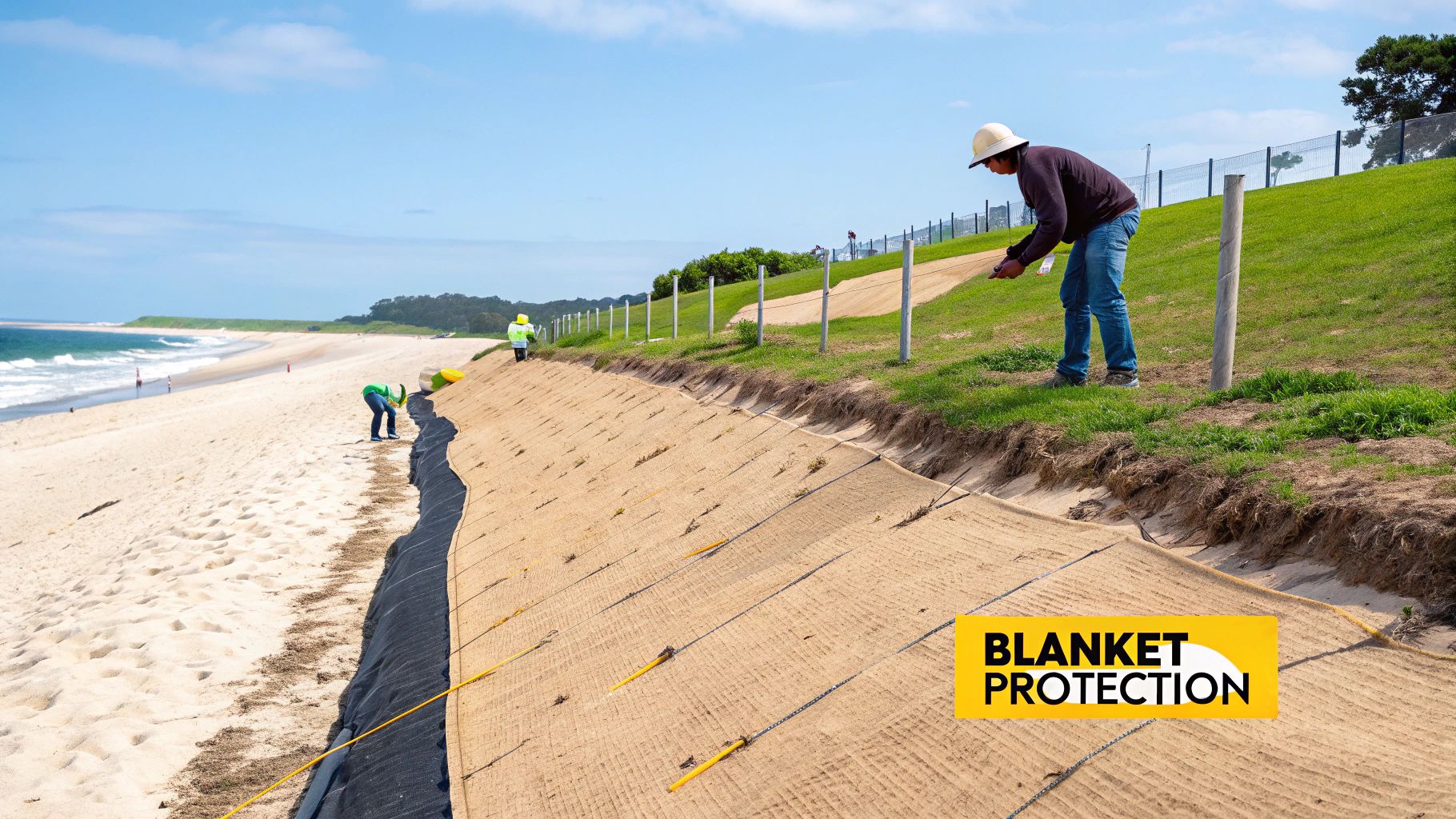
Erosion control blankets (ECBs) and biodegradable mats are protective coverings rolled over exposed soil, offering immediate defense against erosion. These mats, often made from natural fibers like jute, coir (coconut fiber), or straw, act as a shield, absorbing the impact of heavy rainfall and reducing the speed of surface water runoff. This temporary stabilization is crucial on newly graded or cleared sites where vegetation has not yet established.
For Central Florida's sandy soils, which are highly susceptible to being washed away during intense thunderstorms, ECBs are a critical tool. They hold soil and seeds in place, creating a stable microenvironment that encourages germination and root growth, leading to long-term, natural erosion control.
How It Works and Key Benefits
The installation involves unrolling the blankets over a prepared soil surface and securing them with staples or stakes. The matting provides a framework that physically holds the soil, while its porous structure allows water to seep through gently rather than wash over the surface. As native vegetation grows through the mat, the roots intertwine with the soil and blanket, creating a durable, stable slope.
Immediate Protection: ECBs provide instant stabilization on vulnerable slopes from the moment they are installed, preventing soil loss from wind and rain.
Enhanced Vegetation Growth: The blankets retain moisture, moderate soil temperature, and protect seeds from being washed away or eaten by wildlife, accelerating plant establishment.
Biodegradable Options: Many mats are made from organic materials that decompose over time, adding valuable nutrients to the soil as the new vegetation takes over erosion control duties.
Pro Tip: For optimal results, install ECBs within 24 hours of final grading. This minimizes the window for erosion to begin and ensures the seedbed is protected immediately. Overlap all blanket edges by at least 6 inches and use a dense staking pattern (every 2-3 feet) to prevent water from flowing underneath.
Ideal Applications in Central Florida
This method is essential for stabilizing steep slopes on residential development sites after grading, protecting newly seeded channel banks or retention pond slopes, and securing soil on utility rights-of-way during restoration phases. It's one of the most reliable soil erosion prevention methods for any Central Florida project where soil will be exposed for a period before full vegetation cover is achieved.
At Palm State Clear Cut, we often pair land clearing services with the recommendation for professional ECB installation, especially on properties with significant elevation changes. Securing your soil immediately after clearing is the key to preventing costly rework and environmental compliance issues.
3. Vegetative Buffers and Filter Strips
Vegetative buffers are intentionally planted and maintained strips of vegetation located along waterways, property lines, or downslope from disturbed areas. These natural barriers act as a frontline defense, slowing stormwater runoff, trapping sediment, and absorbing excess nutrients before they can cause damage.
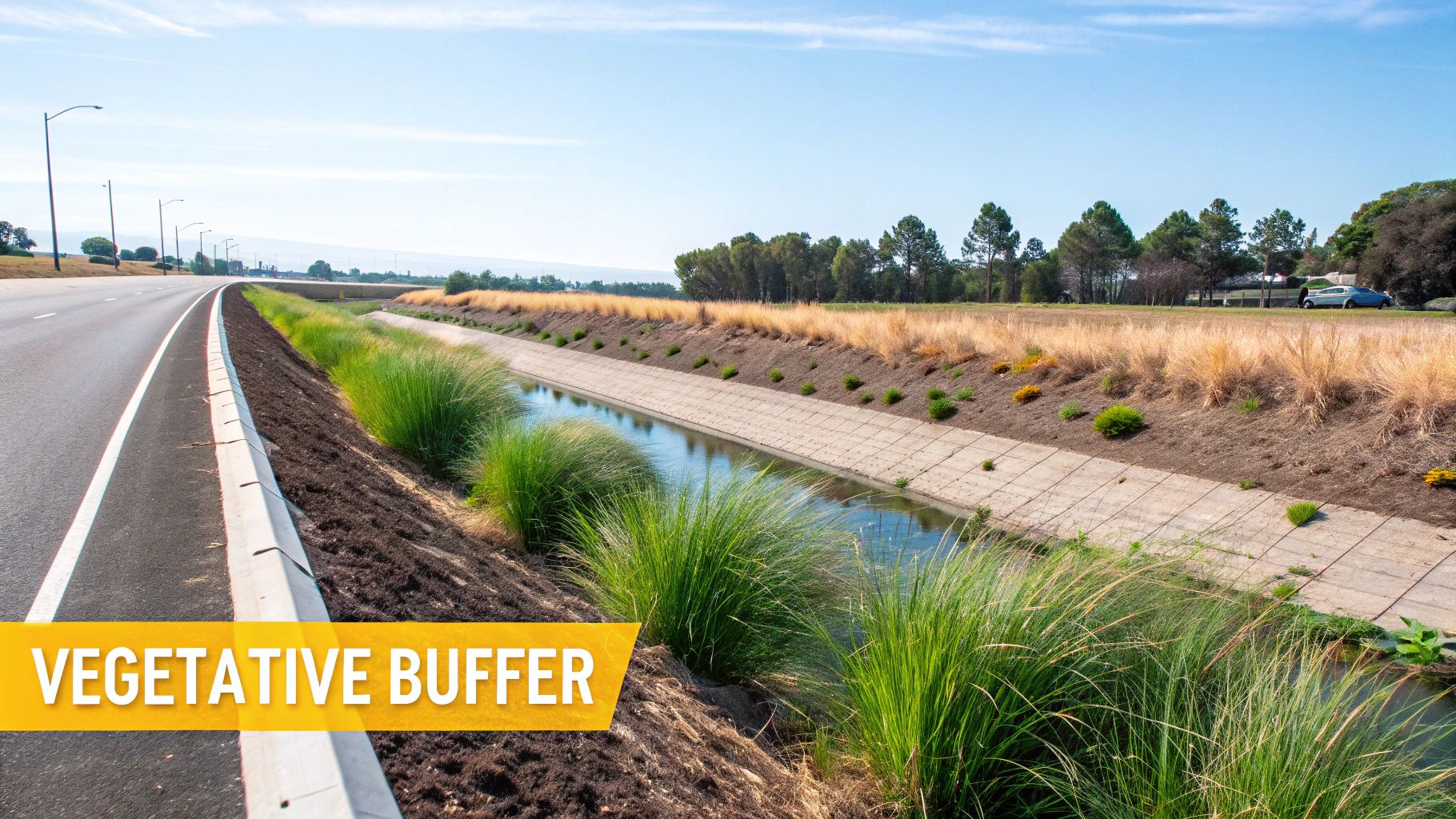
For Central Florida's flat terrain and frequent heavy rains, these living filter strips are one of the most sustainable soil erosion prevention methods. Their dense root systems anchor the sandy soil, while the foliage intercepts raindrops and reduces the erosive force of surface water flow, making them crucial for protecting water quality in nearby lakes and rivers.
How It Works and Key Benefits
The principle is simple: as water flows through the dense vegetation, its speed is significantly reduced. This loss of energy causes suspended particles like sand, silt, and pollutants to drop out of the water and get trapped within the buffer zone. The plants then utilize the captured nutrients, further cleaning the water.
Effective Sediment Control: Buffers can trap a significant percentage of sediment runoff, preventing soil loss from your property and protecting downstream ecosystems.
Enhanced Water Quality: They filter out fertilizers, pesticides, and other pollutants, which is vital for properties near Central Florida's sensitive waterways.
Wildlife Habitat Creation: Using native species like wax myrtle and saw palmetto creates valuable food and cover for local birds and pollinators.
Pro Tip: Select a mix of native grasses, shrubs, and trees to create a multi-layered buffer. This diversity enhances filtration efficiency and provides more robust soil stabilization than a single species.
Ideal Applications in Central Florida
Vegetative buffers are highly effective for agricultural field edges, residential lots bordering retention ponds or canals, and along utility rights-of-way to manage stormwater. They are a perfect long-term, low-maintenance solution for creating a stable and protective border on any property vulnerable to sheet erosion. We often help landowners prepare sites by clearing invasive species to make way for the establishment of these beneficial native plant barriers.
4. Silt Fences and Sediment Barriers
Silt fences are temporary sediment control devices essential for active construction and land clearing sites. These barriers consist of a specialized geotextile fabric stretched between support posts and are installed along the downslope perimeters of disturbed areas. Their primary function is to intercept and slow down sediment-laden runoff, allowing the soil particles to settle out before the water leaves the site.
This method is one of the most fundamental soil erosion prevention methods required on Central Florida job sites. During the vulnerable period between initial clearing and the establishment of permanent ground cover, silt fences act as a critical last line of defense, preventing sediment from polluting nearby waterways, storm drains, and adjacent properties, which is crucial for regulatory compliance.
How It Works and Key Benefits
The geotextile fabric is designed to be permeable, allowing water to pass through slowly while trapping fine soil particles. Proper installation, with the bottom of the fabric buried in a trench, is vital to prevent runoff from undercutting the barrier. This creates a temporary ponding area behind the fence where sediment can settle.
Perimeter Control: Effectively contains sediment within the project boundaries, protecting surrounding environments.
Regulatory Compliance: Helps meet local and state requirements for stormwater pollution prevention plans (SWPPPs).
Cost-Effective Solution: Provides an affordable and widely available temporary measure for sediment control during active construction phases.
Pro Tip: Always install silt fences along the contours of the land, parallel to the slope. Installing them perpendicular to the flow can concentrate runoff, leading to barrier failure and increased erosion.
Ideal Applications in Central Florida
Silt fences are a non-negotiable component for nearly any project involving soil disturbance. They are perfectly suited for establishing perimeter control around new home construction in Orange and Seminole counties, lining the downslope edges of commercial site grading projects, and protecting sensitive areas during road or utility work. They are specifically designed for the period when the soil is exposed and most susceptible to erosion from Florida’s intense rain.
At Palm State Clear Cut, installing compliant silt fences is a standard part of our comprehensive site preparation services. We ensure they are correctly placed and maintained throughout the clearing and grading process, safeguarding your project from costly fines and environmental damage while permanent stabilization measures like sod or landscaping are being planned.
5. Terracing and Grading Modifications
Terracing and grading modifications involve reshaping sloped land into a series of level or gently sloped steps, known as terraces. This engineering approach breaks one long, steep slope into several shorter, flatter sections, dramatically slowing down water runoff and minimizing its erosive force. This is one of the most effective structural soil erosion prevention methods for transforming highly vulnerable hillsides into stable, usable land.
In Central Florida's rolling terrain, especially in areas like Volusia and Flagler counties, strategic terracing is essential for developing sloped properties safely. By controlling the flow of water, this method prevents the formation of destructive gullies and ensures long-term landscape stability, making it a cornerstone of responsible site preparation.
How It Works and Key Benefits
The process requires heavy machinery to cut into the hillside and create the step-like benches. Each terrace is designed to intercept and hold rainwater, allowing it to soak into the ground rather than rush downhill. Proper grading ensures each terrace has a slight slope to direct excess water into a safe drainage channel.
Drastically Reduces Runoff Velocity: The flat benches act as barriers, stopping water in its tracks and preventing it from gaining enough speed to carry away soil.
Creates Usable Land: Terracing transforms previously unusable steep slopes into level areas perfect for agriculture, landscaping, or construction.
Improves Water Infiltration: By holding water on the terraces, this method enhances groundwater recharge and provides more moisture for vegetation.
Pro Tip: Always plan terracing projects during the dry season. This ensures heavy equipment can access the site easily without getting bogged down, and it minimizes the risk of a major storm washing away newly graded soil before it can be stabilized.
Ideal Applications in Central Florida
This method is crucial for preparing residential homesites on hilly terrain, restructuring agricultural land to improve irrigation and prevent soil loss, and stabilizing large development sites with significant elevation changes. For anyone facing a steep grade, it's essential to understand how to prevent soil erosion on slopes; a guide like our practical guide for sloped properties offers deeper insights into these techniques.
At Palm State Clear Cut, we integrate grading and terracing into our comprehensive site development services. By combining this earth-moving work with immediate stabilization methods like mulching or hydroseeding, we ensure your property is not only ready for its next phase but also permanently protected from the erosive power of Florida's rainfall.
6. Hydraulic Seeding and Hydroseeding
Hydraulic seeding, commonly known as hydroseeding, is a mechanical planting process that rapidly establishes vegetation to prevent soil erosion. This technique involves spraying a specialized slurry of native grass seed, mulch, fertilizer, and a bonding agent (tackifier) onto bare soil. It is one of the most efficient soil erosion prevention methods for covering large, sloped, or inaccessible areas quickly.
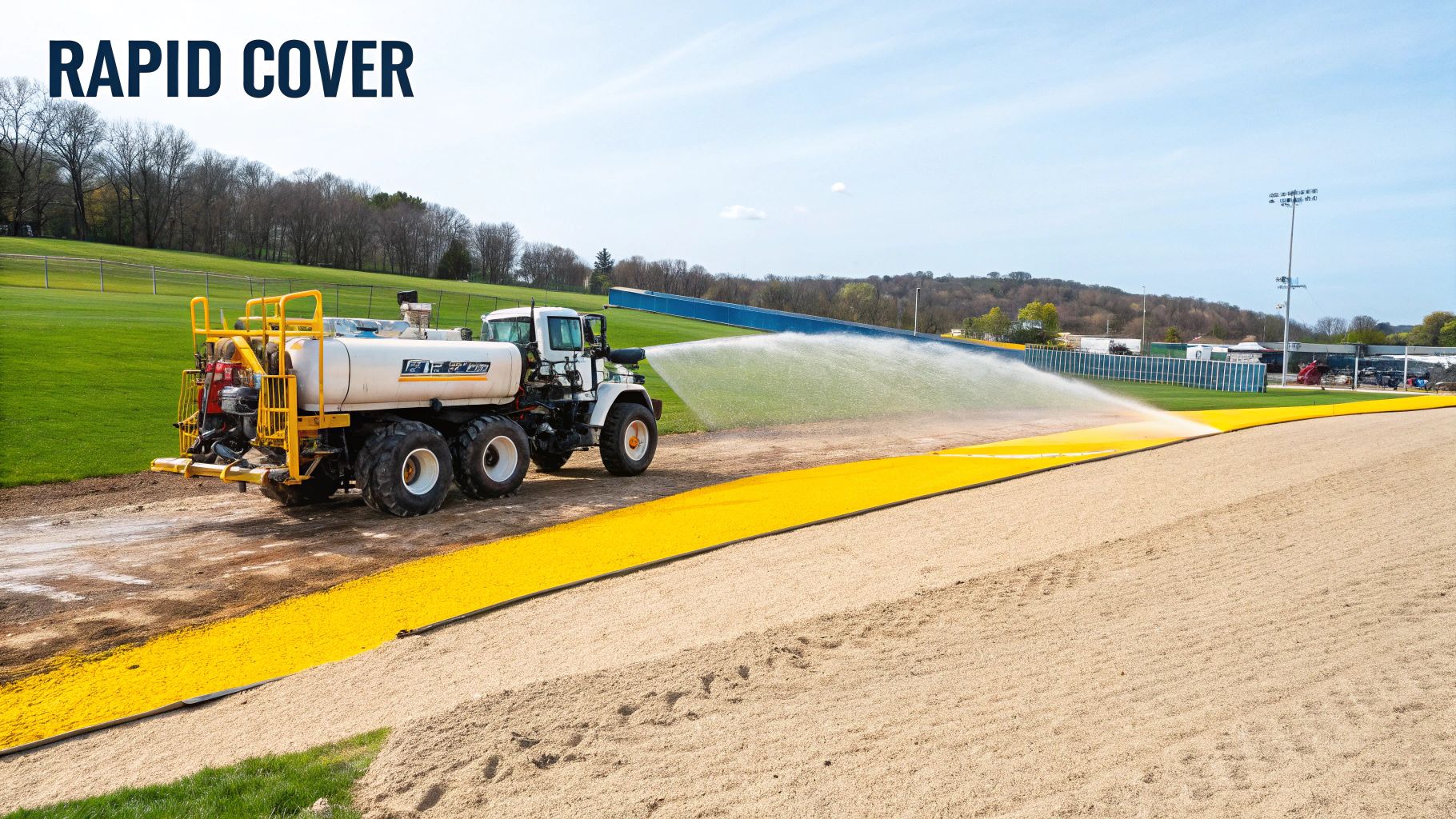
In Central Florida, hydroseeding bridges the critical gap between land clearing and stable plant coverage. The mulch in the slurry provides immediate, temporary erosion protection while creating a microenvironment that promotes rapid seed germination, locking down vulnerable sandy soils before heavy rains can wash them away.
How It Works and Key Benefits
The process uses a truck or trailer-mounted hydroseeder to mix and spray the slurry evenly across the target area. The tackifier in the mix acts like a glue, holding the seed and mulch in place, even on slopes, until the roots take hold.
Rapid Vegetation Growth: Hydroseeding promotes much faster germination than traditional broadcasting, often showing growth within a week.
Cost-Effective for Large Areas: It is significantly more affordable and faster than laying sod or hand-seeding for large-scale projects like new developments or utility corridors.
Superior Soil Contact: The liquid application ensures uniform seed distribution and excellent seed-to-soil contact, which is vital for successful growth in Florida's sandy terrain.
Pro Tip: For best results, schedule hydroseeding within 48-72 hours after final grading. Applying the slurry to freshly disturbed soil maximizes its bonding capabilities and jumpstarts the germination process before the surface dries out or erodes.
Ideal Applications in Central Florida
Hydroseeding is the go-to solution for stabilizing newly cleared residential lots in communities across Orange and Seminole counties, restoring large-scale utility rights-of-way, and providing post-construction ground cover for commercial developments. It's particularly effective on roadside embankments and steep slopes where other methods are impractical.
After clearing a site with forestry mulching, hydroseeding is the perfect next step to establish a permanent, low-maintenance vegetative cover. The combination of these two services provides a comprehensive one-two punch against erosion, first with immediate mulch protection and then with long-term root stabilization.
7. Swales, Ditches, and Drainage Channels
Swales and ditches are purpose-built drainage channels designed to manage stormwater runoff effectively. These shallow, often vegetated, depressions are engineered to capture, slow down, and redirect water flow, making them a cornerstone of responsible land management and one of the most practical soil erosion prevention methods for developed properties.
In Central Florida, where intense rainfall can quickly overwhelm flat landscapes, these channels prevent the formation of destructive gullies. By controlling the velocity and volume of runoff, swales allow more water to percolate into the sandy soil, filtering pollutants and recharging groundwater, all while protecting valuable topsoil from being washed away.
How It Works and Key Benefits
Swales work by intercepting surface runoff and conveying it to a safe outlet, like a retention pond or storm drain, at a non-erosive speed. When vegetated, the grasses and plants within the swale act as a natural filter, trapping sediment and contaminants. This simple yet powerful system is crucial for managing water across a site.
Controlled Water Conveyance: Safely moves water across a property without causing scour or channel erosion.
Enhanced Water Infiltration: Slowing down water flow gives it time to soak into the ground, reducing runoff volume and replenishing the water table.
Sediment and Pollutant Filtering: Vegetation traps particles and breaks down pollutants, improving the quality of water leaving the site.
Pro Tip: Design swales to handle the peak flow from a typical 10-year storm event in your area. Ensure a minimum slope of 0.5% to allow for positive drainage within 48 hours, preventing standing water issues.
Ideal Applications in Central Florida
This method is essential for residential developments, commercial properties, and agricultural operations. You'll often see swales running along property perimeters in Orange and Polk counties to manage drainage between lots or along utility rights-of-way to handle lateral runoff from roads and impervious surfaces. They are a fundamental component of any site's stormwater management plan.
At Palm State Clear Cut, we frequently grade and prepare land for the installation of these critical drainage features after a site is cleared. Proper grading is the first step in ensuring swales and ditches function correctly, protecting your investment from water damage and erosion from day one. By integrating drainage channels into your site plan, you create a resilient landscape that can handle Florida's heaviest downpours.
8. Retention and Sediment Basins
Retention and sediment basins are engineered depressions designed to capture stormwater runoff, primarily from construction sites or developed areas. This allows water to pool temporarily, giving suspended soil particles and other sediments time to settle to the bottom before the cleaner water is slowly released downstream or into the local stormwater system.
In Central Florida's development-heavy landscape, these basins are one of the most critical soil erosion prevention methods. They are essential for managing the immense volume of sediment-laden runoff generated during land clearing and construction, protecting our sensitive lakes, rivers, and coastal estuaries from damaging siltation.
How They Work and Key Benefits
These structures work by slowing water velocity to a near standstill. A properly designed basin includes an inlet for runoff to enter, a large pool or "forebay" for initial sediment settling, and a controlled outlet structure. This system effectively traps sediment that would otherwise pollute nearby water bodies and clog drainage infrastructure.
High Sediment Capture: They are highly effective at trapping coarse to medium-sized sediment particles mobilized by heavy rainfall.
Stormwater Management: Basins manage runoff volume, reducing peak flow rates and mitigating localized flooding during Florida’s intense storm events.
Water Quality Protection: By preventing sediment from leaving a site, they protect downstream aquatic ecosystems and maintain compliance with environmental regulations.
Pro Tip: Design your basin to handle runoff from a typical 2-year, 24-hour storm event. The forebay, where the heaviest sediment settles, should be cleaned out once it reaches 50% of its storage capacity to maintain effectiveness.
Ideal Applications in Central Florida
These basins are indispensable for residential and commercial development projects, especially during the initial mass grading and site preparation phases. They are commonly seen on construction sites in Brevard and Indian River counties and are often designed as permanent, aesthetically pleasing retention ponds in new residential subdivisions.
At Palm State Clear Cut, we frequently clear land for projects that require the immediate installation of temporary sediment controls. While we focus on preparing the land, ensuring a robust sediment basin is in place is a crucial next step for our contractor and developer clients. This ensures the site remains compliant and environmentally responsible from day one.
9. Soil Stabilization and Dust Control Products
Soil stabilization involves applying chemical or polymer-based products to bind loose soil particles together, creating a durable crust that resists erosion from wind and water. This method is particularly crucial on recently cleared or graded sites where the soil is left bare and vulnerable. For Central Florida’s sandy soils, which are easily displaced, these products offer immediate and effective protection.
These stabilizers are one of the most practical soil erosion prevention methods for active construction sites and large-scale land clearing projects. They act as a fast-acting shield, preventing topsoil loss and controlling dust generation during the critical period before vegetation can be established, protecting air quality and neighboring properties.
How It Works and Key Benefits
These products, often liquid polymers, are sprayed directly onto the soil surface. As the liquid cures, it forms a flexible, water-resistant membrane that holds soil particles in place. This man-made crust effectively mimics the protective function of natural ground cover, providing rapid stabilization where it’s needed most.
Rapid Dust Suppression: Immediately reduces airborne dust on active job sites, improving safety and environmental compliance.
Temporary Erosion Shield: Provides an effective barrier against rain and wind impact on bare soil for several weeks to months.
Enhanced Seed Germination: Some formulas can be combined with hydraulic seeding to lock seeds and moisture in place, promoting faster vegetation growth.
Pro Tip: Apply stabilizers within 24-48 hours of final grading. For best results, ensure the soil surface is slightly roughened, not compacted smooth, to allow for better product penetration and bonding.
Ideal Applications in Central Florida
This method is essential for temporary surface stabilization on residential homesites after clearing, dust control on active haul roads in Orange County, and protecting large, exposed areas during phased construction projects. You can find detailed information in our practical guide to soil stabilization techniques to choose the right product for your project. It is an indispensable tool for contractors needing to meet environmental regulations during site development.
At Palm State Clear Cut, we use soil stabilization products to secure sites that require immediate protection. By locking down the soil surface, we ensure that your property remains stable and compliant, preventing costly fines and environmental damage while you move forward with construction or landscaping.
10. Selective Tree Thinning and Precision Herbicide Management
This integrated approach combines the careful removal of unwanted or invasive vegetation with a strategic herbicide program to maintain long-term soil stability. Instead of clearing everything, selective thinning preserves desirable native trees and their crucial root systems, which anchor the soil. This method is then followed by precision herbicide applications to prevent the regrowth of aggressive invasive species that often thrive after initial clearing.
This two-part strategy is one of the most sustainable soil erosion prevention methods for Central Florida, where invasive plants like Brazilian pepper and cogongrass can quickly dominate a cleared site. By preserving native canopy and preventing invasive regrowth, you maintain the natural, multi-layered defense against erosion while restoring the local ecosystem.
How It Works and Key Benefits
The process begins by identifying and marking valuable native trees for retention. Undesirable and invasive species are then removed, often through forestry mulching, which converts them into a protective ground layer. Shortly after, a targeted herbicide program is implemented to treat stumps and suppress seed germination of invasive plants.
Maintains Root Structure: Keeping mature native trees preserves the deep, established root networks that are essential for holding soil together.
Prevents Invasive Recurrence: A follow-up herbicide plan is critical for stopping invasive species from re-establishing and outcompeting the native ground cover needed for erosion control.
Promotes Native Ecosystem Health: Allowing sunlight to reach the forest floor encourages the growth of native understory plants, creating a more resilient and diverse ground cover.
Pro Tip: For maximum effectiveness, apply a pre-emergent herbicide within 7 to 14 days after forestry mulching. This timing is crucial for preventing invasive seeds in the soil, like cogongrass, from sprouting through the new mulch layer.
Ideal Applications in Central Florida
This method is perfect for restoring agricultural acreage in Osceola and Polk counties, enhancing residential properties by removing invasive species while keeping mature oaks, and maintaining utility rights-of-way. It ensures that desirable vegetation thrives without competition, providing lasting erosion control. By combining the immediate soil protection of mulching with the long-term control of herbicides, you create a stable, low-maintenance landscape.
At Palm State Clear Cut, we specialize in this integrated approach for landowners who want to reclaim their property from invasive species without harming the native ecosystem. A targeted post-clearing herbicide program is a key part of our service, ensuring the benefits of your initial investment last for years. This precision management is the key to turning a cleared lot into a healthy, erosion-resistant property.
Comparison of 10 Soil Erosion Prevention Methods
Method | Implementation Complexity 🔄 | Resource & Cost ⚡ | Expected Effectiveness ⭐ | Ideal Use Cases 📊 | Key Advantages & Tips 💡 |
|---|---|---|---|---|---|
Forestry Mulching | Medium — single‑pass machinery and skilled operator | Moderate equipment cost, low disposal needs | ⭐⭐⭐⭐ — immediate erosion control; improves soil structure | Overgrown lots, rights‑of‑way, slopes needing soil cover | 💡 Retains organic matter; combine with precision herbicide; target 3–4" mulch; schedule before rainy season |
Erosion Control Blankets (ECBs) | Medium — careful placement and anchoring required | Higher upfront material & install labor; biodegradable options cost more | ⭐⭐⭐⭐ — 90%+ raindrop impact reduction; accelerates vegetation | Newly cleared slopes, steep banks, post‑grading sites | 💡 Install within 24–48h; overlap 6" and stake 2–3' apart; pair with hydroseeding |
Vegetative Buffers & Filter Strips | Medium — planning and species selection; long establishment | Moderate initial cost, land allocation, irrigation during establishment | ⭐⭐⭐⭐⭐ — permanent filtration and long‑term stabilization | Property edges, waterways, downslope areas for long‑term control | 💡 Use native species; dense 3–4' spacing; expect 12–24 months to fully establish |
Silt Fences & Sediment Barriers | Low — simple install but frequent upkeep | Low material cost, recurring maintenance and sediment disposal | ⭐⭐ — effective short‑term on mild slopes; limited in high flow | Perimeter control during active clearing and grading | 💡 Install before clearing; check weekly in rainy season; remove sediment at 50% buildup |
Terracing & Grading Modifications | High — significant earthwork and skilled operators | High upfront earthwork, possible permitting and design costs | ⭐⭐⭐⭐ — durable slope stabilization when properly designed | Steep slopes, redevelopment, sites needing planting terraces | 💡 Reduce slope length 50–80%; combine with mulching and swales; have drainage engineer review |
Hydraulic Seeding / Hydroseeding | Medium — specialized equipment and trained operator | Moderate cost for equipment, seed, mulch and tackifier; irrigation needed | ⭐⭐⭐⭐ — 50–75% faster vegetation establishment | Large areas, steep/inaccessible slopes, rapid stabilization needs | 💡 Seed within 48–72h of grading; test soil pH; irrigate regularly first weeks |
Swales, Ditches & Drainage Channels | Medium — design and excavation; vegetation establishment | Moderate land area and construction cost; recurring maintenance | ⭐⭐⭐⭐ — reduces runoff velocity 60–80% and promotes infiltration | Perimeter drainage, agricultural field edges, ROWs | 💡 Design for 10‑yr peak flow; plant native sedges; maintain and remove sediment annually |
Retention & Sediment Basins | High — engineered design, earthwork, possible permitting | High land and construction costs; ongoing maintenance and sediment removal | ⭐⭐⭐⭐⭐ — removes 80–95% suspended sediment; flood mitigation | Large developments, regulated sites, long‑term stormwater management | 💡 Size for 2‑yr storm, include forebay and spillway; inspect weekly and plan dewatering |
Soil Stabilization & Dust Control Products | Low–Medium — spray or palliative application | Low to moderate product cost; reapplication may be required | ⭐⭐⭐ — immediate temporary protection (3–12 months) | Dust control, temporary access roads, interim surface stabilization | 💡 Apply within 24–48h of final grading; reapply after heavy rain; choose formulation for sandy soils |
Selective Tree Thinning & Precision Herbicide Management | High — ecological expertise and licensed applicators | Moderate ongoing management costs; chemical controls and follow‑ups | ⭐⭐⭐⭐ — maintains root stability and reduces long‑term erosion | Sites with invasives, conservation priorities, canopy retention goals | 💡 Mark natives before clearing; herbicide 7–14 days post‑mulch; plan 12–24 month follow‑up treatments |
Implementing Your Erosion Control Strategy with Professional Support
Navigating the landscape of soil erosion prevention methods can feel overwhelming, but the journey from overgrown lot to stable, build-ready site is achievable with a strategic approach. We have explored a comprehensive suite of ten powerful techniques, each suited for the unique challenges presented by Central Florida’s sandy soils and intense rainfall. From the immediate stabilization offered by forestry mulching and erosion control blankets to the long-term, nature-based solutions of vegetative buffers and hydraulic seeding, the right tool is available for every scenario.
The core lesson is clear: effective erosion control is not about choosing a single, magic-bullet solution. Instead, it is about creating a layered, integrated system. A truly resilient site protection plan often combines multiple methods in a carefully sequenced manner. For instance, a new residential development might begin with selective tree thinning to preserve valuable hardwoods, followed by forestry mulching to process undergrowth and create a protective ground layer. As grading begins, silt fences are installed around the perimeter to contain sediment, while temporary swales direct runoff toward a newly constructed retention basin. Finally, hydroseeding establishes permanent vegetation, locking the soil in place for good.
From Knowledge to Action: Your Next Steps
Understanding these methods is the foundational first step. The next is to translate that knowledge into a tangible, site-specific plan. The most critical takeaway is that proactive planning is always more effective and less costly than reactive repair. Waiting for gullies to form or for sediment to wash into protected wetlands results in expensive remediation, potential fines, and significant project delays.
To move forward, consider these actionable steps:
Assess Your Site: Walk your property after a heavy rain. Observe where water flows, where it pools, and where soil is actively washing away. Note the slope, soil type, and existing vegetation. This firsthand observation is invaluable.
Define Your Goals: Are you preparing a lot for construction, managing a large agricultural tract, or restoring a natural habitat? Your end goal will dictate the most appropriate combination of soil erosion prevention methods.
Create a Phased Plan: Think about the sequence of events. What needs to happen first to minimize initial disturbance? What temporary measures are needed during construction? What permanent solutions will provide lasting stability?
Consider the Long-Term Vision: A well-designed erosion control strategy does more than just hold soil in place. It enhances property value, supports healthy ecosystems, and ensures regulatory compliance. Investing in robust solutions like vegetative filter strips or professionally graded swales pays dividends for years to come.
The Power of Professional Partnership
While some smaller-scale tasks can be managed by a diligent landowner, the complexity and scale of most land clearing and site preparation projects demand professional expertise. The difference between a properly installed silt fence and a failed one, or between effective forestry mulching and destructive land clearing, lies in the equipment, experience, and technique of the operator.
Key Insight: The most significant mistake a landowner or contractor can make is underestimating the forces of water and gravity. A professional site assessment can identify potential failure points that are not obvious to an untrained eye, preventing costly and damaging erosion events before they ever begin.
Partnering with specialists like Palm State Clear Cut ensures that your erosion control plan is not just a checklist of techniques but a cohesive strategy tailored to Central Florida's specific environmental conditions. We understand how to integrate low-impact land clearing with robust sediment control and long-term soil stabilization, creating a foundation for a successful and sustainable project. By leveraging the right expertise, you transform the challenge of soil erosion into an opportunity to build a resilient, valuable, and environmentally responsible property.
Ready to protect your investment and build a stable foundation for your project? The team at Palm State Clear Cut specializes in creating comprehensive site preparation and erosion control plans using state-of-the-art forestry mulching and land management techniques. Contact us today for a professional consultation and a free quote to see how our expertise in soil erosion prevention methods can benefit your Central Florida property.

Comments