
Forestry Mulching Cost Per Hour Explained for Florida Landowners
- Jan 31
- 17 min read
Let's get straight to the point: you need to know how much forestry mulching costs. For most projects here in Central Florida, you're looking at a range between $125 and $300 per hour. That figure typically includes the machine, a skilled operator running it, and the fuel to keep it going. But that number is really just the starting line.
Decoding the Hourly Rate for Forestry Mulching
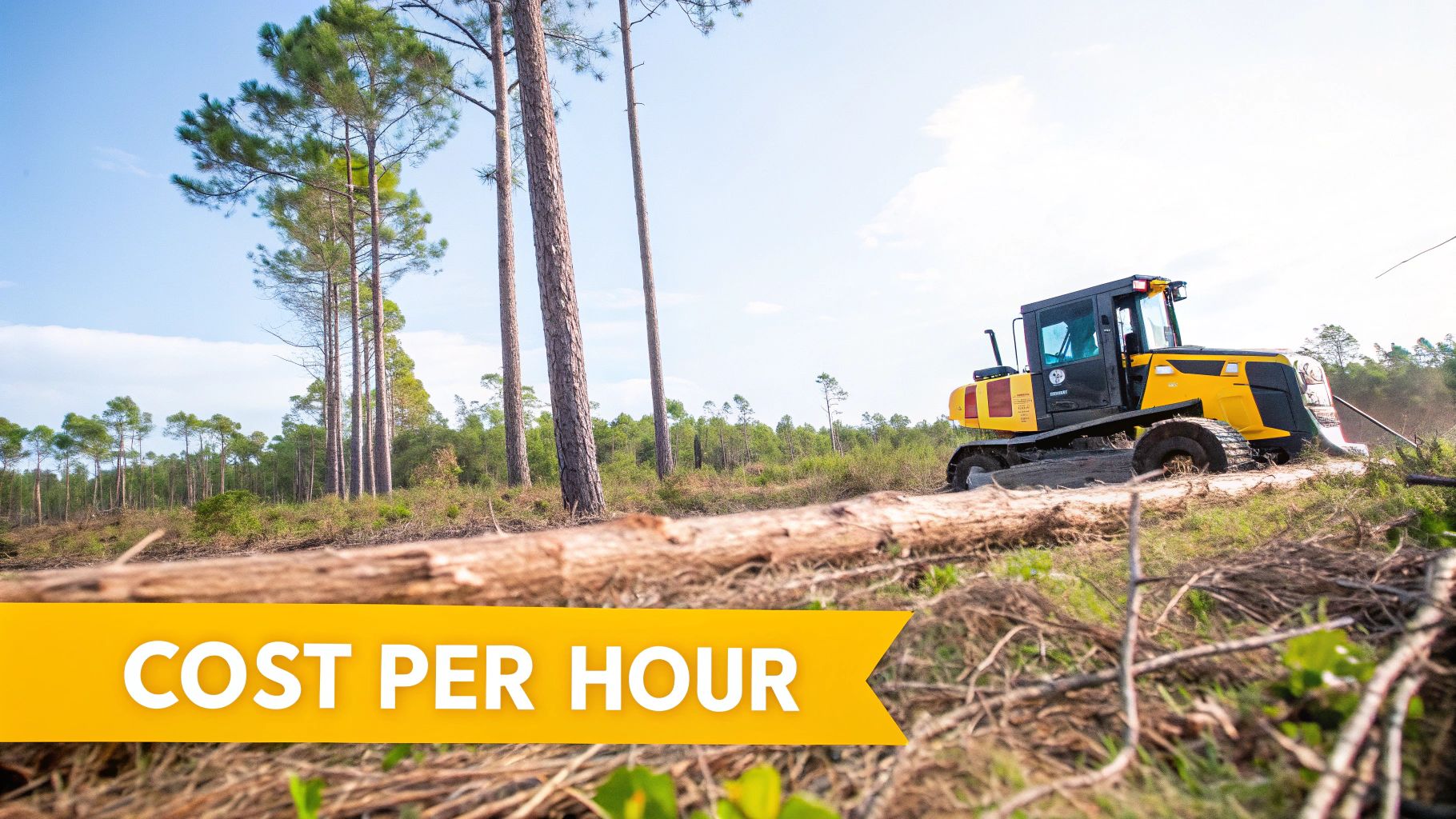
Thinking of the forestry mulching cost per hour as just a timer on a machine is like saying a surgeon's fee is only for the scalpel. What you're really investing in is a complete service that bundles several critical components into one efficient rate. This all-in-one approach is what transforms an overgrown, unusable patch of land into a valuable asset, minus the usual headaches of traditional clearing.
Think about the old way of doing things. A standard crew has to cut everything down, stack it up, and then haul it away. This often leaves you with a separate bill for disposal and a torn-up property that needs even more work to fix. Forestry mulching rolls all of those steps into one fluid, efficient motion.
What Is Included in the Hourly Price
So, what does that hourly rate actually get you? It's much more than just machine time; it's a package deal built for value and efficiency. Here’s what's covered:
The Operator's Expertise: A seasoned operator knows how to read the terrain, navigate obstacles safely, and clear land far faster than a novice. Their skill directly translates into fewer hours on the clock, saving you money.
Specialized Equipment: You’re paying for the raw power of a high-horsepower mulching machine, which can cost anywhere from $100,000 to $500,000. The rate covers the immense cost of owning, maintaining, and insuring this heavy-duty equipment.
On-Site Processing: The mulcher grinds trees, brush, and stumps right where they stand, turning them into a nutrient-rich layer of mulch. This completely eliminates the need for separate hauling and disposal fees, which can easily tack on thousands to a project's budget.
The real value of forestry mulching is its efficiency. By turning vegetation into beneficial ground cover on the spot, it bypasses the expensive and destructive cycle of cutting, hauling, and burning associated with older land-clearing methods.
To give you a better feel for how complexity affects price, here's a quick look at what you might expect for different types of projects.
Quick Guide to Hourly Mulching Rate Estimates
This table gives you a ballpark idea of hourly rates based on how challenging your project is.
Project Complexity | Typical Hourly Rate (Central Florida) | Common Land Types |
|---|---|---|
Simple | $125 - $175 | Light brush, small saplings (under 3"), open fields |
Moderate | $175 - $225 | Dense brush, mixed small-to-medium trees (3-6") |
Complex | $225 - $300+ | Heavy hardwoods, very dense growth, rocky or steep terrain |
Keep in mind these are just estimates. The only way to get a firm price is to have a professional walk your property.
A Cost-Effective Clearing Solution
Nationally, forestry mulching services typically charge between $100 and $250 per hour, making it a highly cost-effective alternative to traditional land clearing, which can be two to three times more expensive. That hourly rate reflects the incredible efficiency of grinding vegetation on-site. You're avoiding the whole debris hauling process—a step that often adds $1,000 to $5,000 per acre in disposal fees alone.
For landowners in Central Florida counties like Osceola and Polk, this pricing makes it possible to transform dense, overgrown lots into build-ready sites quickly and affordably. If you want to dive deeper, you can explore a full breakdown in our guide on what forestry mulching is and how it works.
Key Factors Driving Your Hourly Mulching Rate
That forestry mulching cost per hour you see quoted isn't a one-size-fits-all number, mostly because no two properties are ever the same. Think of it like hiring a moving company—the price to move a studio apartment across town is worlds apart from moving a five-bedroom house across the state. In the same way, the hourly rate for mulching is a direct reflection of the specific challenges your land presents.
Several core elements come together to determine your final quote. Getting a handle on these factors helps you look at your property with a contractor's eye, anticipate potential costs, and have a much more informed conversation when it's time to get an estimate.
The Machine for the Mission
One of the biggest cost drivers is the type of equipment a contractor rolls onto your site. A smaller, more nimble skid-steer mulcher is perfect for tight residential lots, but it would be painfully slow and inefficient on a sprawling 10-acre tract. On the flip side, a dedicated, high-horsepower mulching tractor is an absolute beast that devours dense vegetation but costs a lot more per hour to run.
Here’s a quick breakdown of how the machine choice plays out:
Skid-Steer Mulchers: These are the versatile utility players. Their lower hourly operating cost makes them a great fit for smaller jobs with light brush and saplings.
Track Loader Mulchers: With more power and stability, these machines can tackle moderately dense vegetation and mixed-sized trees. They offer a great balance between cost and performance.
Dedicated Mulching Tractors: These are the specialists, built for one thing: clearing land fast. Their high horsepower comes with a higher hourly rate, but they clear land so much quicker that the total project cost is often lower for large or challenging jobs.
Site Conditions and Terrain Challenges
The physical layout of your land plays a massive role in how long a job will take. A flat, open field is a straightforward sprint for a mulching machine. But as soon as you add in obstacles, the job turns into a technical obstacle course, slowing down progress and keeping the clock ticking.
Keep these common terrain factors in mind:
Slope: Steep inclines demand more powerful machines and extremely careful maneuvering, which naturally slows down the work.
Rocks and Debris: Rocky soil is absolutely brutal on mulcher teeth, which can cost $80 or more each to replace. Operators have to work cautiously to avoid expensive damage, adding time to the job.
Wet or Soft Ground: Muddy or swampy conditions can easily bog down equipment, often requiring specialized tracked machines and extra care to avoid getting stuck.
Here’s a key takeaway: difficult terrain doesn't just slow down the work; it increases wear and tear on machinery worth hundreds of thousands of dollars. That added risk and maintenance cost is directly built into the hourly rate for complex job sites.
The Density and Type of Vegetation
This is probably the most intuitive factor—what exactly needs to be cleared? Getting rid of sparse grass and a few small saplings is like giving your lawn a quick trim. But tackling a dense jungle of mature hardwood trees and invasive vines is more like performing major surgery.
The thickness and type of growth directly impact the forestry mulching cost per hour because it determines the machine's speed and effort. Light brush can be mulched quickly, while dense, 8-inch diameter oak trees require the operator to slow down and let the machine grind away methodically.
Modern technology has seriously changed the game. A 2005 USDA study noted a production rate of about half an acre per hour, but today's high-torque mulcher heads can handle much larger trees and deliver 20-30% better throughput. Today's benchmarks of $100-$250 per hour reflect these advancements and intense regional demand, like the 15% yearly growth in Central Florida's own Osceola and Lake counties. This pricing is still 50-70% more affordable than traditional clearing because mulching leaves no stumps or slash piles, which virtually eliminates cleanup and disposal costs. The type of vegetation is key; clearing light brush might fall on the lower end, while dense invasive species could require multiple passes and push the rate higher.
Site Accessibility and Operator Experience
Finally, two very practical elements round out the pricing equation. First is accessibility. If a contractor can easily drive their transport truck and machine right up to the work area, getting started is simple. But if the site is remote, down a narrow winding path, or requires navigating around fences and buildings, that extra time and effort for setup will be factored into the cost.
Second, and this is critical, is operator experience. A highly skilled operator can "read" the land, work more efficiently, and produce a much cleaner final result in fewer hours. Paying a slightly higher hourly rate for a seasoned pro often leads to a lower total project cost, simply because they get the job done faster and safer.
How to Estimate Your Total Project Budget
Knowing the forestry mulching cost per hour is just the first step. It doesn't give you the full picture of your final bill. It's a bit like knowing the price of gas for a road trip—you still need to know how many miles you're driving to figure out the total fuel cost. The key piece of the puzzle here is the production rate, which is simply how much land a machine can clear in one hour.
This production rate is the bridge that connects the hourly fee to your total project cost. A beefy machine tearing through dense brush might come with a higher hourly rate, but its fast production rate could actually save you money in the long run. Thinking about how these numbers fit into the bigger picture is crucial, especially when forestry mulching is just one part of larger construction industry projects.
The Simple Math of Budgeting
Figuring out your total cost comes down to a straightforward formula. You're basically combining the hourly rate with the time it takes to get your specific job done, plus any extra fees.
Total Project Cost = (Hourly Rate × Estimated Hours) + Mobilization Fees + Minimums
The real trick is nailing down those "Estimated Hours." That number is tied directly to the production rate, which gets pushed and pulled by things like your land's vegetation, the terrain, and the type of equipment on site. The flowchart below really breaks down what a contractor is looking at when they estimate the time.
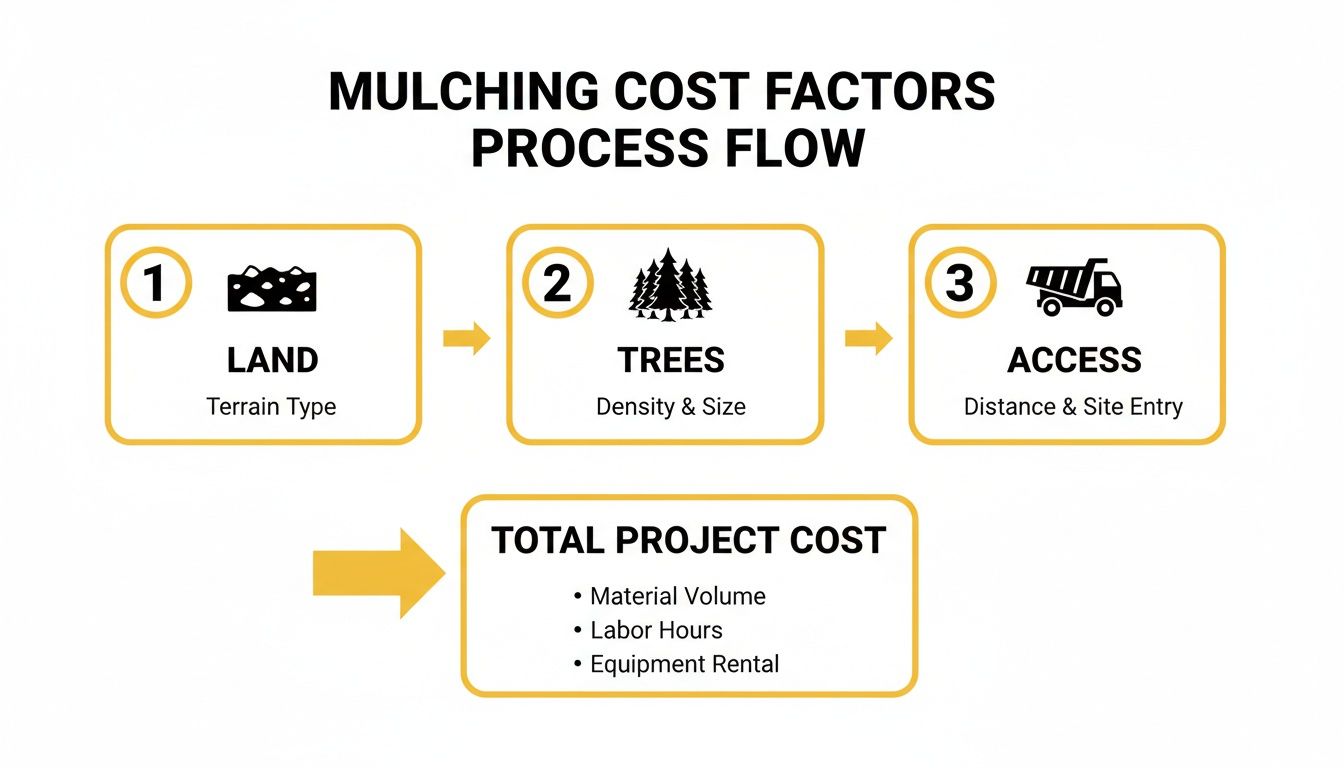
As you can see, rocky ground, dense trees, and tricky access are the big three that can slow a project down and rack up the hours.
Real-World Florida Project Scenarios
Let's walk through three common land-clearing jobs right here in Central Florida. These examples show how the same simple formula works for very different projects.
Scenario 1: The Overgrown Residential Lot
The Job: A half-acre lot in a Kissimmee suburb, completely overrun with thick palmettos and invasive Brazilian pepper trees. Access is tight because of fences and a neighbor's shed.
The Challenge: The brush is dense but not huge, making a mid-size skid steer perfect for the job. But the tight squeeze means the operator has to be slow and careful.
The Estimate: The contractor quotes $195 per hour. Because of the dense growth and the need for careful maneuvering, they figure it will take a full 8-hour day.
Calculation: (8 hours × $195/hour) = $1,560
Scenario 2: Prepping Land for Development
The Job: A three-acre parcel near a new development in Polk County. The land has scattered pine trees (4-6" diameter) and a moderate amount of undergrowth.
The Challenge: It's a larger area with bigger trees, so it demands a more powerful track loader. The good news is the land is open and flat, which means a much faster production rate.
The Estimate: The contractor brings in a bigger machine at $225 per hour. They estimate they can clear about one acre every 3.5 hours.
Calculation: (3 acres × 3.5 hours/acre) = 10.5 hours (10.5 hours × $225/hour) = $2,362.50
Scenario 3: Cutting a Rural Fence Line
The Job: Clearing a path one mile long and 15 feet wide for a new fence on a cattle ranch in Osceola County. The path has light brush and just a few small saplings.
The Challenge: This job isn't about clearing a big square plot but a long, narrow strip. A mile is 5,280 feet, so the total area is only about 1.8 acres (5,280 ft × 15 ft). The work itself is pretty straightforward.
The Estimate: A fast skid-steer at $175 per hour is the right tool here. With such light vegetation, the operator can move quickly and estimates the job will take about 6 hours.
Calculation: (6 hours × $175/hour) = $1,050
Watch for Other Potential Costs
While the hourly rate makes up the bulk of your cost, a couple of other items might pop up on your quote. Knowing about them ahead of time means no surprises when you get the final bill.
Mobilization Fee: This covers the time and fuel it takes to haul heavy equipment to your property and back. It might be a flat fee of $100-$300 for jobs nearby or a per-mile charge if you're further out.
Daily Minimum: Many contractors have a half-day (4 hours) or full-day (8 hours) minimum. This just ensures that loading up and transporting thousands of pounds of machinery is worthwhile, even for a small job that might only take an hour or two.
Choosing Between Hourly Rates and Per-Acre Pricing
So, should you pay by the hour or by the acre? It’s one of the most common questions we get, and the honest answer is: it really depends on the story your property tells. There’s no single right answer, but understanding the pros and cons of each model is the key to getting the best value for your project.
Think of it this way: paying an hourly rate for forestry mulching is like taking a taxi through unpredictable city traffic. It's the perfect choice for short, complex jobs or when you need a delicate, selective touch. A per-acre price, on the other hand, is like a flat-rate airport shuttle—it gives you budget certainty for large, uniform tracts of land.
The Case for Hourly Rates
The forestry mulching cost per hour model is all about transparency and flexibility. You’re paying for the exact time the machine is running on your land, which makes it a fantastic fit for projects where the scope isn't perfectly defined or requires a careful, surgical approach.
This model usually works best for:
Small or Irregular Lots: If you have a half-acre residential lot, a per-acre price might not make sense due to contractor minimums. An hourly rate ensures you only pay for the few hours it actually takes to get the job done.
Selective Clearing: Maybe you want to clear out all the underbrush but keep every single mature oak tree. An hourly rate allows the operator to take their time, maneuvering with the precision needed to protect your prized trees.
Complex Terrain: When you’re dealing with rocky ground, steep slopes, or swampy patches, the work naturally slows down. An hourly rate is a fair way to compensate the contractor for the added difficulty and risk.
An hourly rate directly reflects the on-the-ground reality of your project. It’s a fair exchange for the operator’s time and skill, especially when a job requires more finesse than raw speed.
When Per-Acre Pricing Makes Sense
Per-acre pricing offers one huge advantage: predictability. You know the exact cost for clearing a specific area before the work even starts, which makes budgeting a breeze and removes any anxiety about how long the job might take. It’s the go-to model for larger, more straightforward projects.
You should lean toward a per-acre quote if you have:
Large, Open Tracts: For clearing five acres or more of consistent vegetation, a per-acre price often delivers better value because contractors can work at peak efficiency without stopping and starting.
Simple, Uniform Vegetation: If your land is covered in a consistent density of palmettos or small pines, it’s easy for a contractor to estimate their production rate and give you a confident per-acre bid.
Strict Budgetary Needs: For developers or landowners who need to lock in a final cost upfront, this model eliminates the variables and provides complete financial clarity from day one.
Generally, per-acre pricing for forestry mulching falls between $1,000 and $2,500 per acre. Here in Central Florida, we find that most projects with moderate vegetation land squarely in the $1,200 to $2,000 range—a sweet spot for both residential and development work. This pricing scales beautifully for bigger jobs; a 5-acre parcel might cost between $5,000 and $10,000. The math works out because powerful mulchers can clear anywhere from 0.2 to almost an acre per hour on the right terrain.
Hourly vs. Per-Acre Pricing: Which Is Right for You?
Still on the fence? This table breaks down the core differences to help you see which model aligns best with your specific land clearing needs.
Pricing Aspect | Hourly Rate | Per-Acre Rate |
|---|---|---|
Best For | Small lots, selective clearing, tricky terrain | Large, open tracts with uniform vegetation |
Cost Structure | Pay for the exact time the machine is working | Fixed price for a defined area |
Budgeting | Final cost can vary based on job complexity | Predictable, fixed cost known upfront |
Flexibility | High. Easy to adjust scope during the project | Low. Scope is locked in with the quote |
Transparency | Very transparent; you see time spent on each task | Transparent on total cost, not on time per acre |
Example Project | Clearing underbrush around mature trees on 1 acre | Clearing 10 acres of dense, overgrown pasture |
Ultimately, the best choice depends on balancing your need for budget certainty with the unique challenges of your property.
To dive deeper into this, our guide explaining the nuances of forestry mulching cost per acre provides even more context, especially for those planning larger projects.
The Hidden Value Beyond the Initial Mulch
When you’re clearing land, the real cost isn’t just the number on the final invoice. It's about the problems you either sidestep or unknowingly create for the future. Looking past the immediate forestry mulching cost per hour reveals the deeper, long-term value that modern methods bring to your property's health, safety, and potential.
Old-school clearing methods, like using a dozer, often come with a long list of hidden headaches. What seems like a bargain upfront can quickly turn into a money pit once you account for the damage and extra work left behind.
The Real Cost of Old-School Clearing
Traditional land clearing is a brutal, multi-step process that can leave you with more problems than you started with. That initial quote rarely paints the full picture.
Think about these common "hidden costs" that come with bulldozing:
Soil Erosion and Compaction: Bulldozers scrape away the crucial topsoil and mash the ground down hard. This makes it tough for anything new to grow and sets you up for serious erosion problems during Florida's notorious downpours.
Expensive Debris Removal: Once the dozer rolls off your property, you're left staring at giant piles of stumps, logs, and brush. Hauling that mess away can cost thousands of dollars—a hefty expense that's almost never included in the clearing price.
Permitting and Burning Hassles: Decide to burn the piles instead? Get ready to wrestle with local burn bans and permit requirements. It's a time-consuming hassle, and there’s no guarantee you’ll even get approval.
Long-Term Soil Damage: By tearing out every last bit of organic matter, bulldozing strips the soil of its nutrients. You’re left with barren ground that might need expensive treatments just to become productive again.
Mulching as a Long-Term Investment
Forestry mulching completely changes the game. It turns a simple expense into a smart investment in your property's future. The process doesn't just clear the land; it actually improves it, delivering benefits that pay you back for years.
Turning unwanted brush and trees into a protective, nutrient-rich blanket does more than just tidy up. It kick-starts your land's ecological recovery. It’s a one-and-done solution that prevents future problems while making your property more valuable and usable right away.
With this approach, you're getting a lot more than just a clear patch of ground.
Value-Added Benefits of Modern Mulching
A professional mulching job is about building resilience and health right into your soil. It’s a practical approach with real, tangible returns.
Here’s where you’ll see that investment pay off:
Natural Wildfire Defense: The layer of mulch holds moisture and stays low to the ground, creating a natural firebreak. It can slow down ground fires and help protect your property, which is a massive advantage here in Florida.
Invasive Species Suppression: Mulching is a fantastic weapon against aggressive Florida invaders like Brazilian pepper. By grinding them up on the spot, you stop them from reseeding and make it much harder for them to grow back.
Free, High-Quality Soil Enrichment: That layer of mulch doesn't just sit there—it slowly breaks down, feeding vital nutrients back into the earth. It’s like a natural, slow-release fertilizer that improves your soil's structure and ability to hold water, saving you money on amendments down the road.
Ultimately, choosing forestry mulching is about seeing the bigger picture. You’re not just paying an hourly rate to get rid of some trees; you’re investing in the long-term health, safety, and vitality of your land.
How to Get a Reliable Forestry Mulching Quote

Alright, you've got a project in mind. The final hurdle before the machines start running is getting a solid, accurate quote. A trustworthy estimate is all about clear communication, and a little bit of prep work on your end can make a world of difference. It’s what separates a smooth project from one filled with last-minute financial surprises.
Before you even pick up the phone, spending a few minutes to get your ducks in a row will pay off. When you can clearly explain what you need, a contractor can give you a quote that actually reflects the real scope of work. It sets a professional tone right from the start.
Your Pre-Consultation Checklist
Take a walk around your property. Get a good feel for exactly what you want to accomplish. This simple groundwork makes the entire quoting process faster and more accurate for everyone.
Define Your Project Goals: What's the endgame here? Are you clearing a small patch for a future home, cutting in a firebreak to protect your property, or just trying to reclaim your land from years of stubborn overgrowth? Knowing your objective helps the contractor suggest the best path forward.
Mark Property Lines and Key Areas: Grab some flags or brightly colored tape and mark your property boundaries. It's also incredibly helpful to flag any specific trees you want to keep or obstacles like old wells, stumps, or septic tanks that need to be avoided.
Document the Site: Snap some photos and even a quick video of the area from a few different angles. This gives the contractor a visual cheat sheet before they even step foot on your land, making that first conversation way more productive.
Having clear goals and marked boundaries removes all the guesswork. It lets a contractor focus on the how—the right equipment, the best technique, and the time it'll take—instead of the where. The result is a much sharper initial estimate.
Questions to Ask Every Contractor
Once you're ready to start talking to the pros, having a few smart questions prepared will help you quickly gauge their experience and how they do business. If you're still in the process of finding the right fit, our guide on finding forestry mulching services near you is a fantastic place to start.
When you get a potential contractor on the phone, make sure to ask these critical questions:
Are you fully licensed and insured for this kind of work in Florida?
Based on my project, what equipment do you think is the right choice, and why?
Is your mobilization or travel fee built into the hourly rate, or is that a separate charge?
Do you have a daily or hourly minimum for jobs?
It's also a good idea to ask how they handle scheduling. Many professional outfits now use an online booking system for small businesses to manage appointments and quote requests, which can make the whole process feel a lot smoother.
Still Have Questions About Forestry Mulching Costs?
Even after you've crunched the numbers, a few questions are bound to pop up. It’s completely normal. Let's walk through some of the most common things landowners ask, so you can feel confident you’re making the right call for your property.
Is an Hourly Rate Always the Best Deal for Small Jobs?
More often than not, yes. If you’re clearing a small residential lot—say, under an acre—the forestry mulching cost per hour is usually your most wallet-friendly option. Think about it: per-acre pricing often includes a minimum fee to cover the hassle of getting the machine out to you, which can make a small project feel surprisingly expensive. An hourly rate keeps it simple and fair, ensuring you only pay for the time the mulcher is actually working.
Does the Type of Mulcher Head Really Change the Price?
It absolutely can, even if the hourly rate stays the same. The choice between the two main types of mulcher heads—drum and disc—can have a real impact on your final bill.
Drum Mulchers: These are the finishers. They create a finer, more uniform mulch and are great for grinding stumps down close to the soil. They are a bit more methodical and take longer, which can mean more hours on the clock.
Disc Mulchers: These are the powerhouses. They chew through dense brush and trees incredibly fast. The trade-off is a rougher-looking result with more noticeable stumps left behind.
A smart contractor might bring in a disc mulcher for a large, overgrown property. Even at the same hourly rate, the speed of the disc mulcher could shave hours off the job, saving you a good chunk of money in the end.
Why Do So Many Companies Have a Minimum Charge?
You'll notice most professional outfits have a minimum charge, often for a half-day (4 hours). This isn't just an arbitrary fee; it covers the very real costs of getting the job started. We're talking about loading a machine that can weigh over 20,000 pounds, hauling it to your property, carefully unloading it, and then doing it all in reverse when the work is done. It's a significant investment in time, fuel, and labor.
Think of the minimum charge as the baseline cost to get a highly specialized, six-figure piece of equipment and a skilled operator to your doorstep. It’s what makes it feasible for a contractor to take on even the smallest jobs.
This charge protects their operational costs, ensuring they can show up ready to deliver top-notch service, whether your project takes one hour or ten.
Can I Really Save Money by Prepping the Area Myself?
Yes, and it’s one of the best things you can do to lower your total cost. Before the crew arrives, take a walk through the area and remove old fence wire, scrap metal, big rocks, or any other junk that isn't vegetation. Every minute an operator has to stop the machine, hop out, and clear an obstacle is another minute you're paying for. A clean site lets the mulcher run without interruption, and that efficiency translates directly into savings on your final bill.
Ready to transform your overgrown property into a clean, usable space? The experts at Palm State Clear Cut are here to help. We provide transparent quotes and use the right equipment to get your Central Florida land clearing project done efficiently and affordably. Get Your Free Quote Today