
Best Trees for a Privacy Fence: Florida Privacy Screen Picks
- Jan 22
- 13 min read
Creating a secluded outdoor sanctuary starts with a well-chosen natural barrier. While a traditional fence offers immediate structure, the best trees for a privacy fence provide a living, breathing screen that enhances your property's beauty, value, and ecological health. This guide moves beyond generic recommendations, offering a detailed analysis of nine exceptional tree species perfectly suited for Central Florida's unique climate and soil conditions.
We will break down the essential details for each species, including its growth rate, mature size, and maintenance needs, ensuring you can select a tree that aligns with your timeline and lifestyle. You'll also find practical, actionable advice on root invasiveness, ideal spacing between trees, and recommended setbacks from property lines and existing fences. While natural green barriers offer unique aesthetic and ecological benefits, for a comprehensive understanding of property division, you might also explore a complete guide to the best types of fences available.
Furthermore, we'll address crucial real-world considerations like salt and drought tolerance, navigating HOA regulations, and how professional site preparation from Palm State Clear Cut can ensure your new living fence thrives from day one. This curated list is your blueprint for transforming an exposed yard into a private, green oasis.
1. Emerald Green Arborvitae (Thuja occidentalis 'Emerald Green')
The Emerald Green Arborvitae is a top choice for creating a living privacy fence, prized for its dense, narrow, and columnar growth habit. This evergreen maintains a vibrant green color all year without the winter bronzing common in other varieties, making it visually appealing in every season. Its slow to moderate growth rate ensures it remains manageable, while its slim profile is perfect for properties where space is a premium.
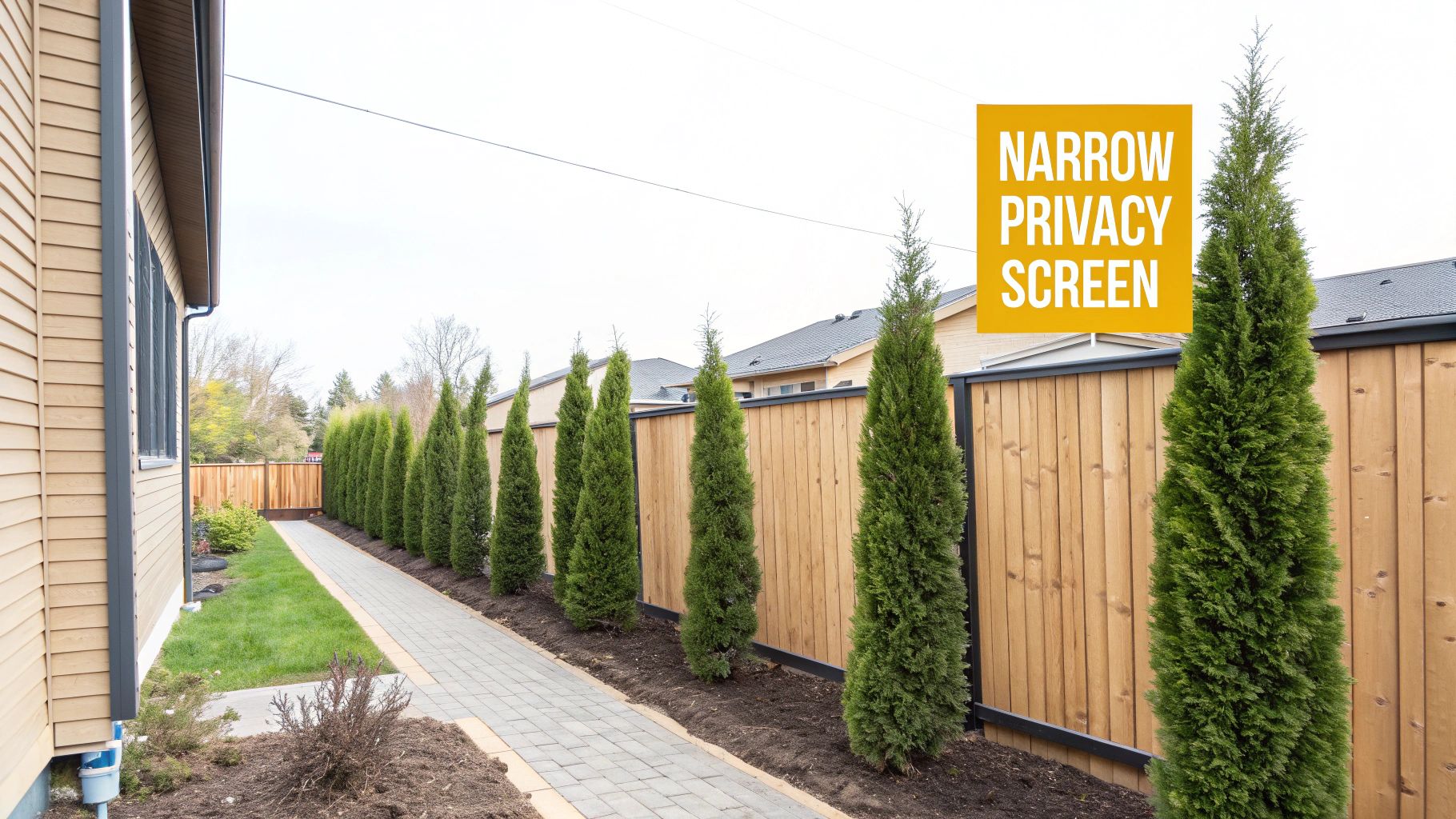
This cultivar’s compact form makes it one of the best trees for a privacy fence, especially in residential settings like Brevard County neighborhoods or along the perimeter of HOA communities in Seminole County.
Key Characteristics & Planting Tips
Mature Size: 10-15 feet tall, 3-4 feet wide.
Growth Rate: Slow to moderate (6-9 inches per year).
Spacing: Plant trees 3-4 feet apart (center to center) for a dense, seamless screen. A wider spacing of 5 feet allows each tree to maintain its individual shape.
Soil & Sun: Thrives in full sun to partial shade and prefers well-drained soil. In Central Florida's sandy soil, amend the planting area with rich organic compost.
Maintenance: Water deeply twice weekly during the first growing season to establish a strong root system. Apply a 3-inch layer of mulch to retain moisture and suppress weeds. Pruning is minimal; only light shaping is needed in early spring.
Before planting, ensure your property line is free of competing vegetation. Professional fence line clearing services can create the ideal environment for these trees to flourish, removing overgrowth and preparing the soil for a healthy start.
2. Leyland Cypress (Cupressocyparis leylandii)
For property owners seeking rapid privacy, the Leyland Cypress is an unbeatable choice. This fast-growing evergreen hybrid is renowned for its vigorous growth, quickly forming a tall, dense screen. Its soft, feathery foliage creates an elegant yet solid barrier, making it one of the most popular and best trees for a privacy fence when speed is a top priority.
This tree’s ability to establish a screen within just a few years makes it ideal for new residential developments in Indian River County or for creating wind and dust barriers on large equestrian properties in Osceola County.
Key Characteristics & Planting Tips
Mature Size: 40-60 feet tall, 10-15 feet wide.
Growth Rate: Very fast (3-4 feet per year).
Spacing: Plant trees 4-5 feet apart (center to center) for a quick, interlocking hedge. For better air circulation in humid Central Florida climates, consider spacing them 6 feet apart.
Soil & Sun: Prefers full sun and requires well-drained soil to prevent root rot. Before planting, ensure the site has excellent drainage, amending heavy soils if necessary.
Maintenance: Water deeply twice a week during the first 18 months to establish a robust root system. Scout regularly for signs of canker, a common disease, and prune away affected branches immediately.
Applying a thick, 4-inch layer of mulch is crucial for maintaining consistent soil moisture and protecting the tree's shallow roots from Florida's intense sun. Proper mulching techniques are key to the long-term health of your living fence. You can find expert advice on how to mulch along a fence line to ensure a perfect and healthy border.
3. Green Giant Arborvitae (Thuja standishii × plicata 'Green Giant')
For property owners needing a robust and fast-growing screen, the Green Giant Arborvitae is an exceptional solution. This vigorous hybrid combines the best traits of its parent species, resulting in rapid growth, impressive size, and strong resistance to pests and diseases. Its lush, feathery foliage forms a dense wall of green that serves as an excellent visual barrier and windbreak, making it one of the best trees for a privacy fence on larger properties.
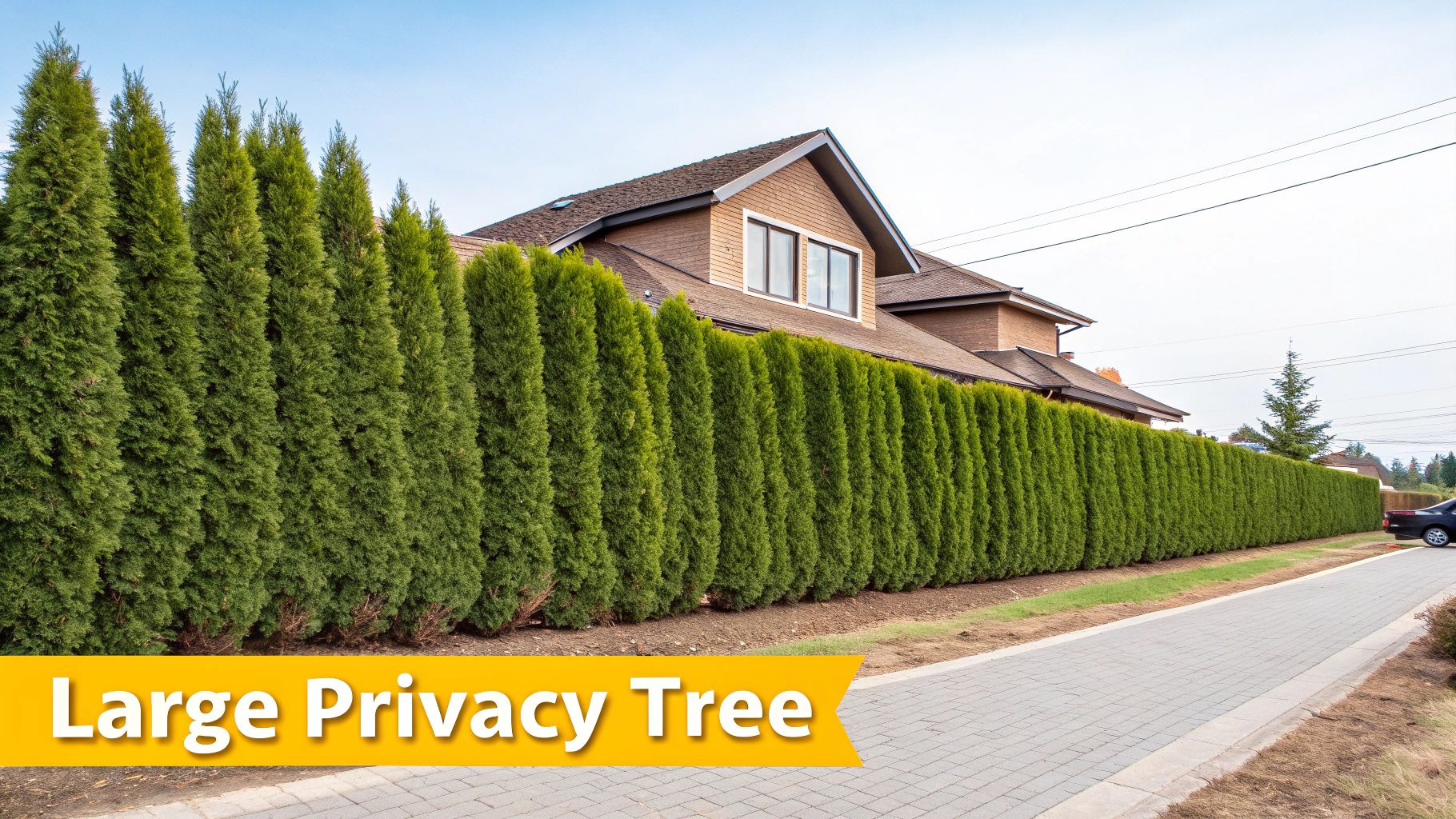
The Green Giant’s impressive scale is ideal for large residential lots in Lake County or commercial developments in Polk County that require substantial, low-maintenance perimeter screening. Its resilience in Central Florida's humid climate makes it a reliable and long-lasting choice for creating privacy.
Key Characteristics & Planting Tips
Mature Size: 40-60 feet tall, 12-15 feet wide.
Growth Rate: Fast (3-4 feet per year).
Spacing: Plant 5-6 feet apart for a dense hedge or 8-10 feet apart to allow each tree to develop its natural pyramidal shape.
Soil & Sun: Prefers full sun for optimal growth but tolerates partial shade. It adapts to various soils but thrives when Central Florida’s sandy soil is amended with 2-3 inches of rich compost to retain moisture.
Maintenance: Water deeply twice a week during the first two years to establish a strong root system. Apply a 4-inch layer of mulch to maintain soil moisture and suppress weeds. Once established, it is highly drought-tolerant and requires minimal care. Pruning is generally unnecessary, but you can explore proper limb trimming methods if you need to control its width or shape in early spring.
4. Nellie R. Stevens Holly (Ilex × 'Nellie R. Stevens')
The Nellie R. Stevens Holly is a classic choice for a durable and elegant living fence, offering a dense, pyramidal shape that requires minimal pruning to maintain. This robust hybrid holly features glossy, dark green leaves and produces vibrant red berries in the fall and winter, providing seasonal interest. It is exceptionally well-suited to Central Florida's climate, tolerating both heat and humidity with ease.
Its substantial size and naturally full form make it one of the best trees for a privacy fence on larger properties, such as estate homes in Lake County or high-end residential communities throughout Orange County, where it creates a stately and impenetrable screen.
Key Characteristics & Planting Tips
Mature Size: 15-25 feet tall, 8-10 feet wide.
Growth Rate: Moderate (1-2 feet per year once established).
Spacing: Plant trees 4-6 feet apart (center to center). The wider spacing is suitable due to its broad base and moderate growth.
Soil & Sun: Prefers full sun to partial shade and well-drained, slightly acidic soil (pH 6.0-6.5). Amending sandy soil with organic matter will help it thrive.
Maintenance: Water regularly after planting to establish its root system; mature plants are quite drought-tolerant. Apply a 3-4 inch layer of mulch to conserve moisture. Only light shaping is needed in the spring, as this holly maintains its attractive form naturally. Avoid heavy pruning.
5. Wax Myrtle (Myrica cerifera)
The Wax Myrtle is a stellar native choice for a functional and ecological privacy screen. This fast-growing, multi-stemmed shrub or small tree creates a dense, evergreen barrier that supports local wildlife while demanding minimal maintenance. Its aromatic foliage and waxy gray berries add unique seasonal interest, making it one of the best trees for a privacy fence that blends seamlessly into the natural Florida landscape.
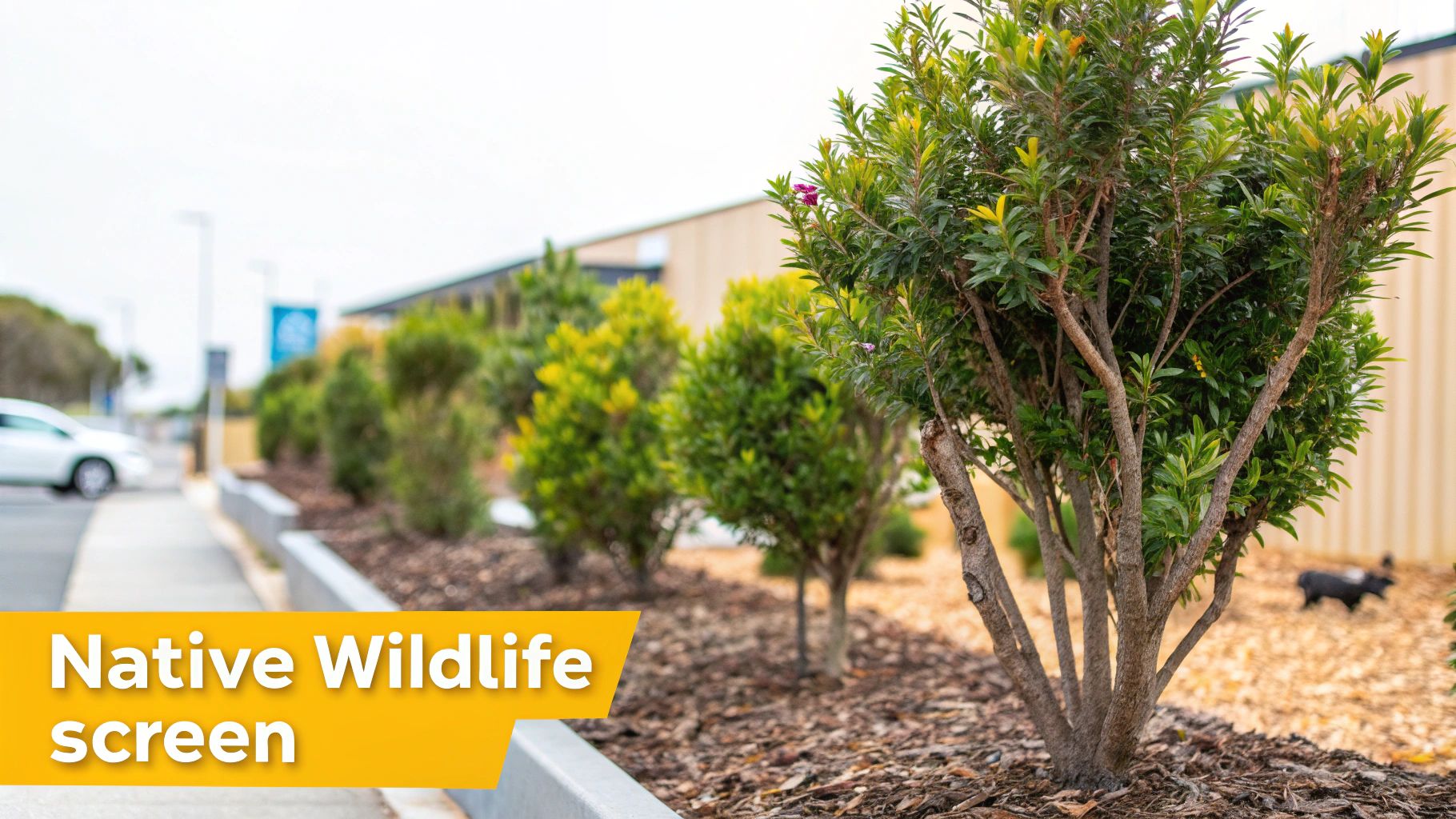
Its resilience makes it perfect for agricultural properties in Polk County seeking wildlife-friendly windbreaks or for residential lots in Brevard and Indian River Counties that prioritize native plant restoration after land clearing. It is exceptionally adaptable to both wet and dry sites once established.
Key Characteristics & Planting Tips
Mature Size: 10-20 feet tall, 8-12 feet wide.
Growth Rate: Fast (24+ inches per year).
Spacing: Plant trees 5-6 feet apart (center to center) to allow their natural forms to interlock and create a dense screen quickly.
Soil & Sun: Thrives in full sun to partial shade and is highly adaptable to various soil types, including Central Florida's sandy and moist conditions.
Maintenance: Once established, Wax Myrtle is extremely drought-tolerant and rarely needs irrigation. No fertilizer is required, as it is perfectly adapted to native soils. Pruning is minimal; allow its natural shape to develop, only removing dead branches as needed.
This species is an excellent choice for recently cleared properties where the goal is a low-maintenance, ecologically valuable privacy screen. After professional site preparation removes invasive species and overgrowth, planting Wax Myrtles helps restore the native habitat and create a robust, self-sustaining fence line.
6. Italian Cypress (Cupressus sempervirens)
The Italian Cypress offers a touch of Mediterranean drama, prized for its exceptionally narrow, columnar form that creates a striking vertical accent. This evergreen provides a formal, elegant screen with a minimal footprint, making it an architectural statement piece. While more challenging in Florida's humidity compared to drier climates, disease-resistant cultivars can thrive in Central Florida with precise site selection and attentive care, delivering unparalleled visual impact.
This tree's dramatic silhouette makes it one of the best trees for a privacy fence on high-end residential properties in Brevard County or along the grand entrances of Mediterranean-style estates in Orange County, where its unique form justifies the extra attention required.
Key Characteristics & Planting Tips
Mature Size: 30-40 feet tall, 3-5 feet wide.
Growth Rate: Moderate (1-2 feet per year).
Spacing: Plant trees at least 4-5 feet apart (center to center) to ensure excellent air circulation, which is critical for disease prevention.
Soil & Sun: Demands full sun and exceptionally well-drained soil. Avoid planting in low spots or areas with standing water. Amend sandy Central Florida soil with grit or pine fines to improve drainage.
Maintenance: Water during establishment but avoid overwatering once mature. Select only canker-resistant cultivars like 'Glauca'. Regularly scout for signs of canker (dark lesions, branch dieback) and prune affected branches immediately. Its high-maintenance nature makes it a choice for dedicated gardeners.
Due to its specific needs, Italian Cypress is best used in smaller groupings or as specimen plants rather than for extensive fence lines. Proper site preparation, including ensuring the planting area has excellent airflow and is free from competing vegetation, is crucial for its long-term health and success.
7. Podocarpus or Japanese Yew (Podocarpus gracilior)
Known for its elegant, fine-textured foliage, the Podocarpus (or Japanese Yew) creates a graceful and naturally dense privacy screen. This evergreen has soft, dark green leaves that give it a feathery appearance, providing a more sophisticated visual texture than many other screening plants. Its upright, columnar growth habit makes it an excellent choice for creating tall, narrow hedges that offer substantial privacy without consuming excessive yard space.
The Podocarpus is one of the best trees for a privacy fence in Central Florida because it thrives in the region's heat and humidity. It is a common sight in upscale residential communities in Orange and Seminole Counties, where it is used to create sophisticated and low-maintenance living fences.
Key Characteristics & Planting Tips
Mature Size: 30-40 feet tall, 8-10 feet wide (can be kept smaller with pruning).
Growth Rate: Moderate (12-24 inches per year).
Spacing: Plant 4-5 feet apart (center to center) for a dense hedge that fills in quickly.
Soil & Sun: Prefers well-drained soil and performs well in full sun to partial shade, making it ideal for properties in Lake County with scattered tree coverage.
Maintenance: Water deeply and regularly during the first growing season to establish its roots. Once established, it is quite drought-tolerant. Apply a 3-inch layer of mulch to conserve moisture. Pruning is minimal; a light shearing in the spring is sufficient to maintain its desired shape and size.
For a successful Podocarpus screen, starting with a well-prepared site is crucial. Services like fence line clearing remove competing roots and vegetation, ensuring your new trees have the resources they need to establish quickly and grow into a lush, private barrier.
8. Viburnum (Viburnum suspensum or V. odoratissimum)
Viburnums are handsome evergreen shrubs that create dense, attractive privacy screens with the added benefit of fragrant flowers and seasonal interest. Their multi-stemmed growth habit forms a thick, impenetrable barrier, offering excellent screening combined with ornamental value. Growing quickly to a manageable height, they are a versatile choice for homeowners looking for both function and beauty.
Two species are particularly well-suited for Central Florida: the fragrant Sweet Viburnum (V. odoratissimum) and the more compact Sandankwa Viburnum (V. suspensum). Their robust nature makes them a top contender for the best trees for a privacy fence, especially on recently cleared properties in Osceola County or along perimeters in Indian River County communities.
Key Characteristics & Planting Tips
Mature Size: 8-20 feet tall, 6-15 feet wide (species dependent). V. odoratissimum is larger, while V. suspensum is more compact.
Growth Rate: Fast (24+ inches per year).
Spacing: Plant 4-5 feet apart (center to center). This spacing allows the shrubs to grow together into a solid hedge while giving each plant enough room.
Soil & Sun: Prefers full sun to partial shade and well-drained soil. Viburnums are adaptable to Florida's sandy soils but benefit from initial soil amendment.
Maintenance: Water deeply during the first growing season to establish roots; mature plants are moderately drought-tolerant. A light shearing in the spring after flowering maintains a neat shape without sacrificing density. Apply a 3-4 inch layer of mulch to conserve moisture.
For a resilient and ecologically diverse screen, consider mixing Viburnum with other species like hollies or Wax Myrtle. This layered approach creates a more natural look and is an excellent way to add aesthetic appeal to a newly prepared fence line.
9. Privet (Ligustrum species - Sunshine Privet or Waxleaf Privet)
Privet is a classic, fast-growing shrub that creates dense, formally-trimmed privacy screens. Varieties like Sunshine Privet (Ligustrum sinense) and Waxleaf Privet (Ligustrum japonicum) are popular choices for their resilience and ability to be shaped into a solid green wall. While more traditional, a well-managed Privet hedge remains an effective and economical option for creating privacy quickly.
This plant’s dense form and rapid growth make it one of the best trees for a privacy fence where a formal, manicured look is desired, such as along property lines in older Central Florida neighborhoods or for cost-effective screening around commercial properties in Orange County.
Key Characteristics & Planting Tips
Mature Size: 8-15 feet tall, 6-8 feet wide (can be kept smaller with pruning).
Growth Rate: Fast (24+ inches per year).
Spacing: Plant 2-3 feet apart (center to center) for a tight, formal hedge. Wider spacing will create a more informal screen.
Soil & Sun: Adaptable to a wide range of soils but prefers full sun to partial shade for the densest growth. It is highly drought-tolerant once established.
Maintenance: This is a high-maintenance option requiring a commitment to regular pruning. Plan to shear the hedge 2-3 times annually to maintain its formal shape and density. Monitor for common pests like scale and whiteflies, and ensure good air circulation to prevent disease. Because some Privet species can become invasive, manage flowering and seed production to prevent unwanted spread.
Top 9 Privacy Fence Trees Comparison
Plant | 🔄 Implementation Complexity | ⚡ Resource Requirements | 📊 Expected Outcomes | 💡 Ideal Use Cases | ⭐ Key Advantages |
|---|---|---|---|---|---|
Emerald Green Arborvitae (Thuja occidentalis 'Emerald Green') | Low — straightforward planting; monitor pests (bagworms, mites) | Moderate — regular watering first 2 years; staking in exposed sites; available at nurseries | Dense narrow privacy within 2–3 years; 40–60 ft tall, 3–4 ft wide | Narrow property lines, fast visual screens for residential/commercial | Dense year‑round foliage; rapid establishment; low‑moderate maintenance |
Leyland Cypress (Cupressocyparis leylandii) | Moderate — easy to plant but requires disease (canker) monitoring | High — consistent moisture, good drainage, possible disease management | Very rapid privacy (1–2 years for visual cover); 40–60 ft tall, 3–6 ft wide | Large properties needing fast screening or wind/dust barriers | Fastest growth; very dense and elegant appearance |
Green Giant Arborvitae (Thuja standishii × plicata 'Green Giant') | Low–Moderate — needs space planning and soil amendment | Moderate — larger spacing, soil amendment recommended; higher initial cost | Fast, wide barrier (3–4 ft/yr) achieving substantial wind/visual screen; 40–60 ft × 12–15 ft | Large yards, windbreaks, low‑maintenance perimeter screens | Strong disease resistance; low maintenance once established; broad coverage per plant |
Nellie R. Stevens Holly (Ilex × 'Nellie R. Stevens') | Low — minimal pruning; slower establishment | Moderate — deep watering at establishment; male/female plants for berries | Dense pyramidal screen in 3–4+ years; 15–25 ft tall, 8–10 ft wide; seasonal berries | Elegant residential screens, wildlife‑friendly hedges, long‑lived plantings | Year‑round glossy foliage, red berries, high heat/humidity tolerance |
Wax Myrtle (Myrica cerifera) | Very Low — native, low‑maintenance planting | Low — once established rarely needs irrigation; tolerates poor soils | Semi‑evergreen 10–15 ft screen in 3–4 years; supports wildlife | Native restorations, ecological screens, low‑maintenance properties | Native species; minimal inputs; excellent wildlife value and adaptability |
Italian Cypress (Cupressus sempervirens) | High — careful site selection and active disease monitoring | High — excellent drainage, ongoing disease surveillance, costlier specimens | Dramatic ultra‑narrow vertical screen (30–40 ft tall) but high failure risk in humid sites | High‑visibility formal landscapes or specimen plantings in well‑drained microclimates | Unmatched formal, vertical aesthetics with minimal footprint |
Podocarpus / Japanese Yew (Podocarpus gracilior) | Low — adaptable, tolerates part shade; minimal pruning | Moderate — moderate water during establishment; specialty availability | Elegant dense screens in 4–5 years; 30–40 ft tall, 8–10 ft wide | Shaded or sophisticated landscapes seeking refined screening | Shade tolerance, disease resistance, refined soft‑foliage appearance |
Viburnum (V. suspensum / V. odoratissimum) | Low–Moderate — occasional pruning; manageable pests | Moderate — water during establishment; moderate spacing | Dense ornamental screen (8–12 ft) in 3–4 years with fragrant blooms | Mixed shrub screens, transition plantings after clearing, wildlife gardens | Fragrant flowers, wildlife attraction, ornamental value plus screening |
Privet (Ligustrum spp. — Sunshine/Waxleaf) | High — requires regular pruning and maintenance | Low (cheap plants) but labor‑intensive ongoing pruning; invasive risk | Rapid formal hedge in 2–3 years; 8–15 ft tall when maintained | Formal manicured hedges, budget screening where maintenance is guaranteed | Most economical per plant and fastest establishment for formal hedges |
Your Path to a Private, Lush Landscape
Choosing the best trees for a privacy fence is more than a horticultural decision; it's an investment in your property's security, tranquility, and aesthetic appeal. Throughout this guide, we've explored a curated selection of Central Florida's most reliable privacy screen champions, from the columnar elegance of the Italian Cypress to the dense, native hardiness of the Wax Myrtle. Each species offers a unique combination of growth rate, maintenance needs, and mature form, empowering you to select the perfect living wall for your specific landscape goals.
The journey from a bare property line to a thriving, green enclosure involves careful planning. You now have the critical knowledge to assess factors like root invasiveness, fence setbacks, and ideal spacing, ensuring your natural fence doesn't create future problems with foundations or property lines. Mastering these details is the difference between a privacy screen that flourishes for decades and one that becomes a maintenance headache.
From Blueprint to Blooming Border
Your next steps involve translating this knowledge into action. The key takeaways from our guide are your blueprint for success:
Assess Your Site: Before purchasing a single plant, analyze your soil, sunlight exposure, and drainage. Is your area prone to drought or salt spray? This initial assessment will narrow your choices to the most resilient candidates.
Define Your Goal: Are you seeking a formal, manicured hedge like Privet or a more natural, feathered screen like the Green Giant Arborvitae? Your desired aesthetic will heavily influence your selection and long-term pruning strategy.
Plan for Maturity: Always plant with the tree's mature height and spread in mind. This prevents overcrowding, which can lead to disease, pest issues, and an unhealthy competition for resources.
Prepare the Foundation: Proper site preparation is non-negotiable. This means clearing existing overgrowth, removing invasive species, and eliminating stumps that could obstruct root growth. A clean slate is essential for healthy establishment. For real-world inspiration on achieving a secluded haven, explore comprehensive projects such as the Private Macungie Backyard Makeover.
Ultimately, creating a natural privacy fence is a deeply rewarding process that enhances your daily life by transforming your yard into a secluded sanctuary. It reconnects your outdoor space with nature while providing the functional barrier you need. By investing time in proper selection and site preparation, you are not just planting trees; you are cultivating a lasting legacy of beauty and solitude.
Ready to prepare the perfect foundation for your living privacy fence? Palm State Clear Cut specializes in professional land clearing, invasive species control, stump grinding, and mulching to create a clean, healthy, and optimized planting area. Ensure your investment thrives from day one by contacting us for a consultation.

Comments