
A Landowner's Guide to Brush Cutting Services in Central Florida
- Jan 19
- 17 min read
Are you looking at an overgrown lot here in Central Florida and seeing nothing but a headache? You’re not alone. So many landowners just see a tangled mess of palmettos, invasive vines, and scrub oaks. What they should be seeing is potential. Professional brush cutting services are the key to unlocking that hidden value and turning an unusable space into a safe, beautiful, and functional property.
Reclaim Your Florida Property with Brush Cutting
An overgrown property is more than just an eyesore—it’s a real liability. That dense undergrowth can become a haven for pests, a serious fire hazard, and it completely prevents you from using your land the way you want. Whether you're in Brevard County getting ready to build your dream home or a rancher out in Polk County trying to protect your assets, clearing the land is always the first, most crucial step. This guide will walk you through everything you need to know.
Think of brush cutting as much more than just tearing stuff out. It's about creating a clean slate for whatever you have planned next and instantly boosting your property’s value and usability. The job requires specialized equipment and smart techniques to tackle everything from thick brush and small trees to stubborn stumps, effectively turning a wild jungle back into a managed landscape.
Unlocking Your Land’s True Potential
The benefits of professional clearing go way beyond just making the place look better. When you remove all that overgrown vegetation, you’re creating a safer environment, dramatically reducing wildfire risk, and laying a solid foundation for construction or landscaping. For countless Central Florida landowners, it's the single step that turns a neglected parcel into a genuine asset. It really boils down to this: clearing the brush unlocks potential in three main ways.
By methodically clearing overgrown vegetation, landowners can significantly mitigate wildfire risks. The Florida Forest Service notes that creating defensible space is one of the most effective strategies for protecting homes and property, especially in rural and suburban areas prone to dry conditions.
This image really helps visualize how reclaiming your land through brush cutting services unlocks its potential for beauty, safety, and increased value.
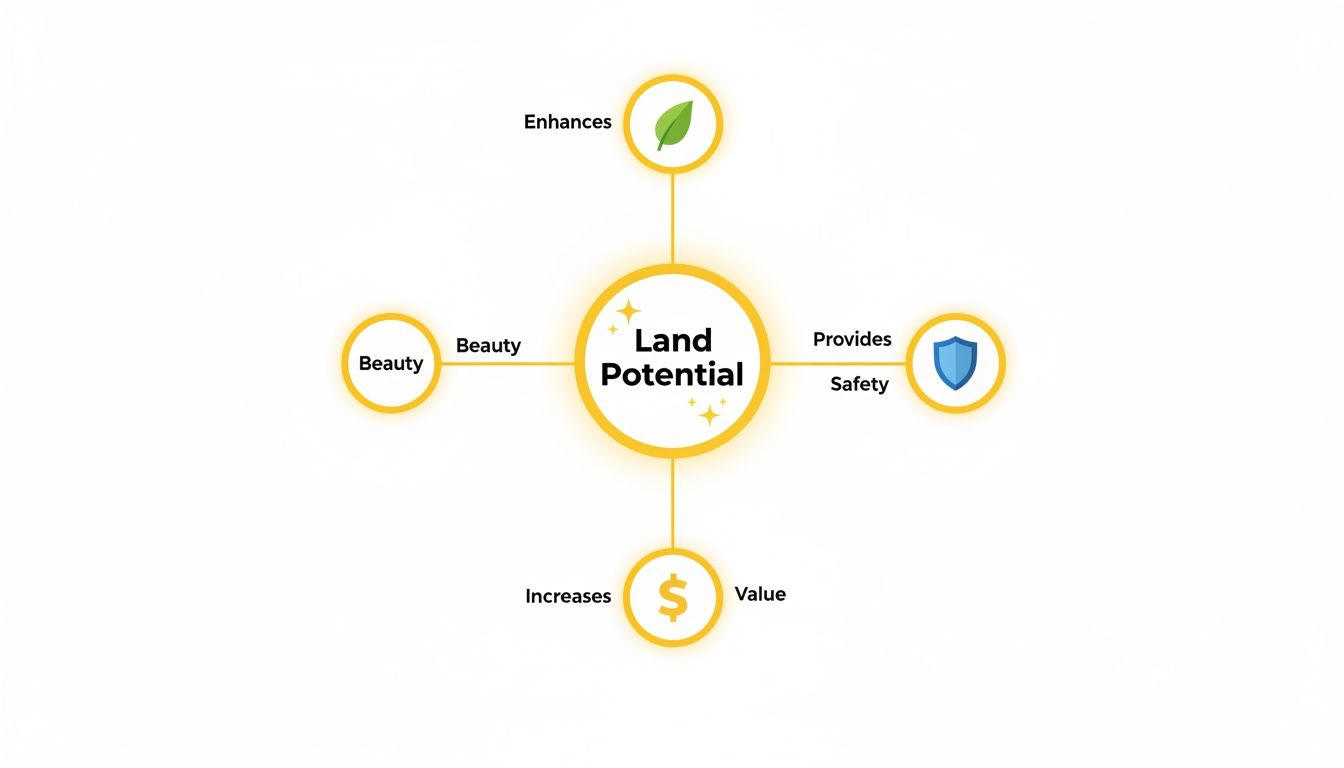
As you can see, these outcomes are all connected. Improving one area often has a positive knock-on effect on the others, maximizing how much you can enjoy and use your property.
More Than Just Mowing
It’s really important to understand that professional brush cutting services are in a completely different league from your standard lawn care. This isn't a job you can tackle with a push mower from the garage. We're talking about heavy-duty machinery built to handle dense, woody vegetation that would destroy residential equipment in minutes.
Here are the key differences:
Equipment Power: Professionals bring in powerful machines like forestry mulchers and heavy-duty brush hogs that can shred small trees and thick undergrowth with ease.
Scope of Work: The focus isn't on routine trimming; it's on total land transformation. We're preparing sites for new construction, carving out essential firebreaks, or reclaiming agricultural fields.
Safety and Expertise: Trained operators know how to handle tough terrain and unpredictable vegetation safely and efficiently. They get the job done right without causing unintended damage to your property.
In the next sections, we'll dig into the specific methods professionals use—from mulching and mechanical cutting to stump grinding—and help you figure out the best approach for your Central Florida property. It’s time to stop seeing that overwhelming jungle and start seeing the possibilities. Let’s get started.
Exploring Professional Brush Cutting Methods
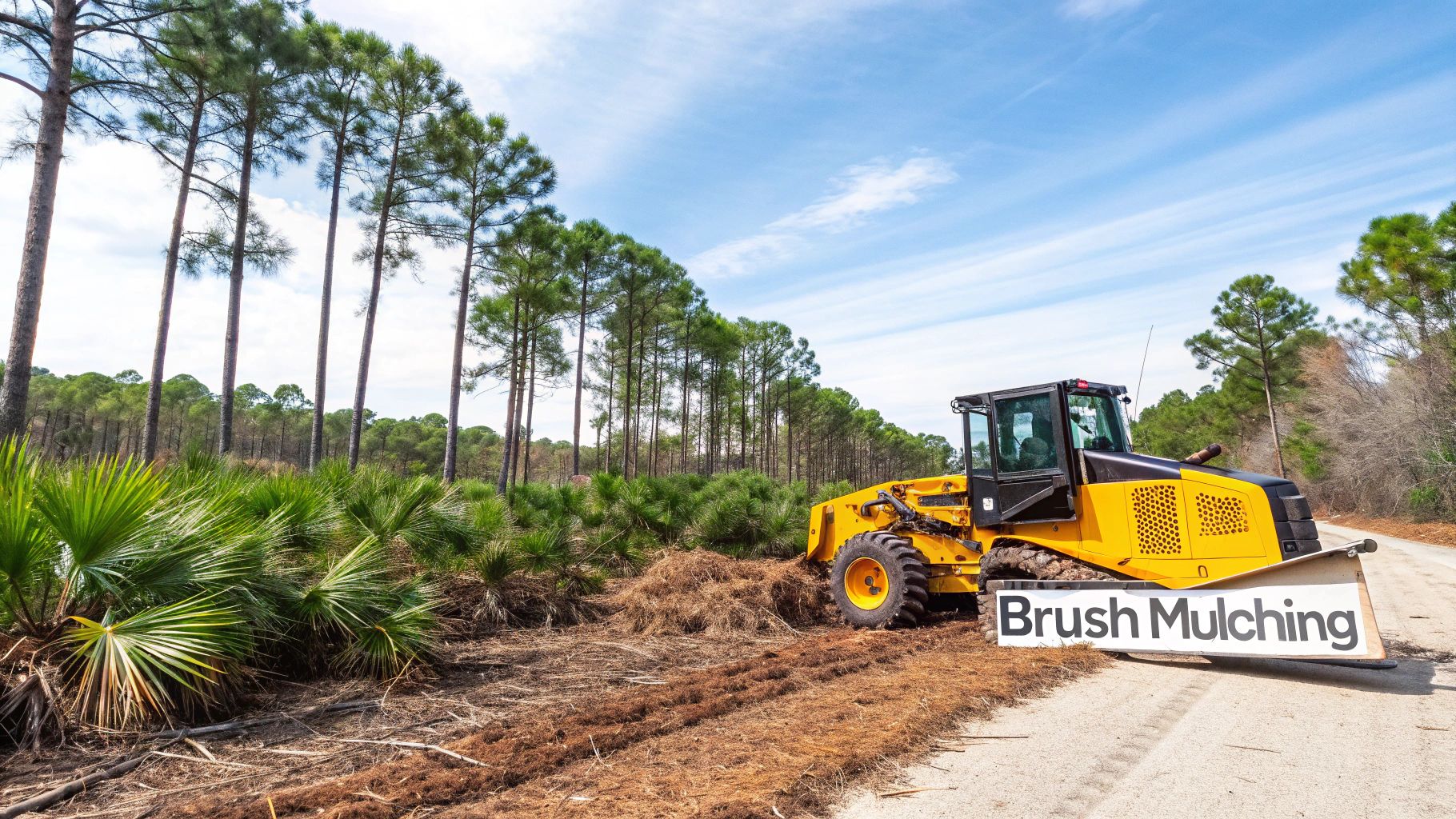
When it's time to reclaim overgrown land, there’s no single magic bullet. Professional brush cutting services have a whole toolbox of specialized techniques, each one dialed in for specific terrain and goals. Getting a handle on these methods is the first real step to figuring out the right game plan for your Central Florida property. It's how you ensure the job gets done right—efficiently, safely, and with the best possible results.
Don't think of these as competing options. Instead, see them as different tools for different stages of the job. A seasoned contractor often blends these techniques, starting with the heavy-duty clearing and moving into the finer finishing work to match a client's vision.
Let's break down the four primary methods the pros use to turn unruly landscapes into valuable, usable land.
Forestry Mulching: The Eco-Friendly Powerhouse
Forestry mulching is easily one of the most effective and earth-friendly methods out there. It all happens with a single, powerful machine that grinds up trees, thick brush, and undergrowth right where it stands. Think of it as a high-powered recycling program for your property.
Instead of creating massive burn piles or hauling away debris, this process turns unwanted vegetation into a natural, nutrient-rich layer of mulch. This blanket of mulch brings some serious benefits:
Boosts Soil Health: As it breaks down, it returns vital organic matter to the soil.
Controls Erosion: The mulch layer is a fantastic shield, protecting topsoil from wind and rain—a big deal in Florida's sandy ground.
Holds Moisture: It helps the soil retain water, which is great news for the desirable trees you want to keep.
Forestry mulching is a clean, one-step process. It gets rid of the need for a whole fleet of machines like bulldozers, excavators, and chippers. This means minimal ground disturbance, preserving the delicate topsoil and root systems of your keeper trees. It's the clear winner for selective clearing and any environmentally sensitive project.
This approach is perfect for land choked with dense vegetation and small-to-medium-sized trees, especially when you need to protect the integrity of your soil. It leaves behind a clean, almost manicured look without the collateral damage of older, rougher methods.
Mechanical Cutting: Taming Wide Open Spaces
Also known as brush hogging, mechanical cutting is the go-to for clearing big, relatively flat areas of lighter growth. We're talking tall grasses, thick weeds, and small brush. Picture a lawnmower on steroids, and you've got the right idea. A tractor pulls these heavy-duty mowers, and they can make incredibly quick work of large fields or pastures.
This method is super efficient for maintaining fence lines, clearing pastureland for livestock, or managing large tracts of land where a perfectly polished finish isn't the main goal. It won't chop up woody material as finely as a mulcher, but it's an unbeatable choice for cost-effective, large-scale vegetation control. The demand for these powerful tools reflects a broader trend. The global brush cutter market reached approximately USD 3.5 billion in 2023 and is projected to hit USD 5.2 billion by 2029, driven by innovations in equipment efficiency. You can find more insights about this growing market over on BusinessWire.
Herbicide Application And Stump Grinding: The Finishing Touches
Getting the brush down is often just round one. A couple of additional services provide the finishing touches, making sure your land stays clear and becomes truly usable.
Strategic Herbicide Application: After clearing, some aggressive or invasive plants will try to make a comeback. A targeted, professional herbicide application can stop this regrowth in its tracks, saving you headaches and money down the road. Pros use specific, low-impact formulas to knock out unwanted plants without harming the surrounding ecosystem.
Stump Grinding: Both mulching and mechanical cutting can leave tree stumps behind. Stump grinding brings in a specialized machine to shred those stumps into wood chips, taking them down below ground level. This final step is key to creating a smooth, hazard-free surface that’s ready for building, landscaping, or just easy mowing.
Every piece of land has its own unique challenges. The key is knowing which tool—or combination of tools—is right for the job. Below is a quick comparison to help you see how these methods stack up against each other.
Choosing The Right Brush Cutting Method for Your Project
Method | Best For | Equipment Used | Resulting Landscape |
|---|---|---|---|
Forestry Mulching | Selective clearing, dense undergrowth, environmentally sensitive areas, creating a clean look. | Skid-steer or excavator with a mulching head attachment. | A protective layer of natural mulch covers the ground, promoting soil health and preventing erosion. |
Mechanical Cutting | Large, open, and relatively flat areas with grasses, weeds, and light brush. | Tractor with a brush hog or rotary cutter attachment. | Vegetation is cut down close to the ground, but not mulched. Good for basic maintenance and access. |
Herbicide Application | Preventing regrowth of invasive or stubborn plant species after initial clearing. | Backpack sprayers or vehicle-mounted spray systems. | A clear landscape where unwanted plants are controlled, preventing them from taking over again. |
Stump Grinding | Removing leftover tree stumps to create a smooth, usable, and hazard-free surface. | Self-propelled or tow-behind stump grinder with a high-speed cutting wheel. | Stumps are gone, leaving behind a pile of wood chips and a level surface ready for new use. |
Understanding these options helps you have a more productive conversation with a land-clearing contractor. You'll be better equipped to explain your goals and work with them to develop a plan that transforms your property exactly the way you envision it.
How Brush Cutting Unlocks Your Land's Potential
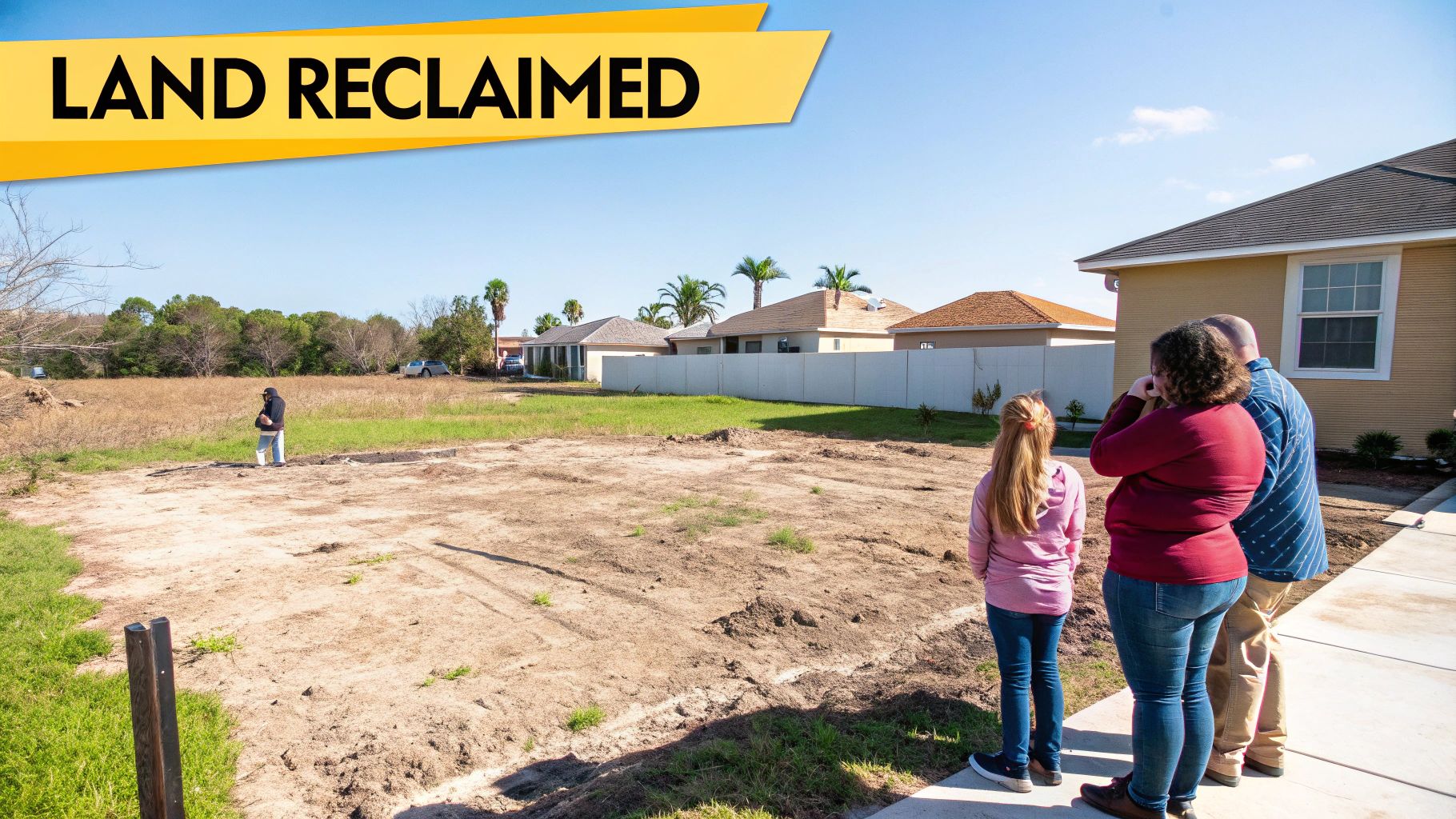
It’s one thing to understand the how of brush cutting, but the real lightbulb moment comes when you see what it actually does for a piece of property. These services aren't just about machinery; they're about solving real-world problems for landowners all across Central Florida.
Whether it’s a small suburban lot or a huge rural ranch, clearing out that overgrown mess is always the first real step. It’s the gateway to making your land safer, more productive, and finally usable. This is about more than just yanking out unwanted plants—it’s about reclaiming a space that was previously inaccessible or even dangerous.
Preparing Residential Lots for a Fresh Start
Picture this: a family in an Orange County suburb buys a gorgeous, wooded lot. The dream is there, but the reality is a nightmare of tangled palmettos, invasive Brazilian pepper trees, and a thicket of underbrush you can’t even walk through. How do you even start planning a home build?
This is exactly where we come in. By combining forestry mulching with some selective tree removal, a professional crew can turn that impenetrable jungle into a clean, ready-to-build canvas.
For new homeowners, this initial clearing is a total game-changer. It gets the site ready for surveyors and builders, but just as importantly, it lets you see the true shape and features of your land. Suddenly, you can actually visualize where your future home and yard will be.
Once the big stuff is gone, we bring in the stump grinders to create a smooth, safe surface. No more tripping hazards. The ground is now perfectly prepped for foundation work, which makes every single step of construction afterward faster and safer. After the brush is gone, your land is ready for anything, even transformative island landscaping ideas.
Creating Critical Firebreaks for Property Protection
Now, let's head out to a more rural part of Volusia County. A rancher there faces the constant threat of wildfire during the dry season. His home, barn, and livestock are surrounded by acres of dense, dry scrub—basically, a tinderbox waiting for a spark. For him, brush cutting isn't about looks; it's about survival.
Using mechanical cutting or forestry mulching, a contractor can carve out wide, strategic firebreaks. Think of these as buffer zones around buildings and property lines, designed to stop a wildfire dead in its tracks or at least slow it down.
Perimeter Clearing: We cut a wide, clear path around the entire property to establish a defensive line.
Structural Protection: We create a "defensible space" by clearing everything within 30 to 100 feet of homes and barns.
Fuel Reduction: We also thin out the vegetation across the rest of the property to lower the overall fuel load. A less intense fire is an easier fire to control.
This is, without a doubt, one of the most effective ways to protect your property and your family in Florida's fire-prone regions.
Maintaining Right-of-Way and Utility Easements
Think for a moment about the massive network of power lines and pipelines that run all over Central Florida. Utility companies need clear, easy access to that infrastructure for routine maintenance and emergency repairs. When vegetation gets out of control in these right-of-way (ROW) corridors, it becomes a huge problem.
Professional brush cutting is the only solution. Crews use specialized equipment to clear trees and brush that threaten to fall on power lines, block access roads, or mess with underground pipelines. This work is what keeps the lights on for entire communities and allows for quick repairs when storms hit.
Improving Agricultural Land for Better Yields
Let’s travel down to Polk County, where a farmer is trying to expand her pasture. Over the years, invasive plants and thick brush have crept in, stealing valuable grazing land from her cattle. For her, brush cutting is a direct investment in her business.
By using heavy-duty brush hogging and forestry mulching, we can efficiently reclaim that lost acreage. When we remove the junk growth, the native grasses can finally thrive again, giving the livestock more room to graze. It’s a move that doesn’t just improve the land for today—it boosts its long-term health and value for years to come.
Navigating Florida's Environmental Regulations
Clearing land in Central Florida is about more than just bringing in heavy machinery. It demands a genuine respect for our state's one-of-a-kind, and often fragile, ecosystem. Out here, you have to partner with nature, not try to overpower it. A truly professional land clearing contractor understands this responsibility goes far beyond your property lines.
This commitment starts with a sharp eye for Florida's native wildlife. Before the first machine ever starts, a conscientious crew will walk the site, looking for any signs of protected species. The biggest one on our radar is the gopher tortoise—their burrows are legally protected, and disturbing one without the right permits and relocation plan can bring your project to a screeching halt with some hefty fines.
Protecting Waterways and Wetlands
You can't talk about Florida's landscape without talking about water. From sprawling wetlands to the smallest streams and ponds, these areas are the lifeblood of our environment. They’re also heavily regulated by agencies like the Florida Department of Environmental Protection (FDEP) and our regional Water Management Districts.
That's why professional brush cutting services use specific methods designed to keep these sensitive zones safe. It’s not just about getting the job done, but getting it done right.
Key practices include:
Maintaining Setbacks: Crews know to respect the mandatory buffer zones, leaving a natural strip of vegetation untouched along the edges of wetlands and waterways.
Preventing Runoff: This is where forestry mulching really shines. It creates a natural blanket over the soil, stopping loose dirt from washing into the water and harming aquatic life.
Avoiding Contamination: All equipment is meticulously maintained. The last thing anyone wants is a fuel or hydraulic fluid leak that could contaminate the ground and our water supply.
A core principle of responsible land clearing is minimal soil disturbance. Unlike old-school bulldozing that scrapes the earth bare, modern techniques like forestry mulching are designed to keep the topsoil and root structures of desirable trees intact. This dramatically reduces the risk of soil erosion.
This careful, thoughtful approach lets you move forward with your project without causing unintended ecological damage. It’s all about achieving your goals while being a good steward of the land.
Understanding Local Permitting Requirements
"So, do I need a permit for this?" It's probably the most common question we hear. The honest answer is: it depends. Your project's location, its size, and how close it is to protected areas all play a role. Clearing a small, isolated patch of overgrown brush on your suburban lot might not raise any flags, but the rules change quickly from there.
Larger projects, any work near designated wetlands, or on properties known to be habitats for protected species will almost certainly require a green light from county or state officials. This is where an experienced local contractor is worth their weight in gold. They know the specific regulations in counties like Brevard, Orange, and Polk and can guide you through the maze, making sure every 'i' is dotted and 't' is crossed. Tackling invasive plants is a huge part of this, and knowing the rules is critical. For a deeper dive, check out this practical guide on how to control invasive species for Central FL landowners.
Hiring a pro who puts environmental compliance first gives you priceless peace of mind. You can rest easy knowing your project won't just transform your property but will also be completed responsibly, legally, and with the full respect Florida's natural heritage deserves.
What Factors Determine Brush Cutting Costs?
When you're ready to improve your property, the first question on your mind is usually, "What's this going to cost?" It would be nice if there were a simple, flat-rate price, but the reality is that every brush cutting project is completely different. The final quote you receive is a careful calculation based on a few key variables that directly affect the time, labor, and machinery needed to get the job done right.
Think of it like hiring a moving company. The cost to move a small studio apartment across town is worlds apart from moving a five-bedroom house across the state. The same logic applies here—the size and complexity of the job dictate the price. Understanding these factors will give you a clear picture of what goes into a professional quote and why an on-site visit is the only way to get a truly accurate number.
Acreage and Site Accessibility
The most obvious factor, of course, is the size of the area you need cleared. A bigger property with more acreage is naturally going to take more time and fuel to complete. A ten-acre parcel will be a much larger investment than a one-acre residential lot.
But size is only half the story. Site accessibility is just as critical. Our crew needs to get heavy equipment to the work area, and how easy or hard that is makes a big difference.
Just imagine these two scenarios:
Easy Access: A flat, open piece of land right off a paved road. We can get set up and start working almost immediately.
Challenging Access: A remote property with narrow gates, a steep and winding driveway, or soft, sandy ground that could bog down our machines. This requires more planning, more careful maneuvering, and sometimes specialized equipment, all of which adds to the cost.
Vegetation Density and Type
Next, we have to look at what we're actually clearing. The density and type of vegetation are huge drivers of the final cost. A field of tall grass and light, wispy brush is one thing. A forest choked with mature trees and thorny, invasive vines is another job entirely.
The type of growth on your land determines the machinery we bring. We can tackle light brush with a brush hog, but clearing dense stands of 6-inch diameter trees requires a powerful forestry mulcher—a much more specialized and expensive machine to operate.
A good contractor will walk the property to assess not just how thick the growth is, but also the average size of the trees and brush. Heavier, woodier material takes longer to process, is harder on the equipment, and requires more horsepower, all of which is factored into the price.
Terrain and Ground Conditions
The lay of the land itself plays a massive role. A flat, dry, and even field is the perfect canvas for a land clearing project. It allows our operators to work quickly and safely at a steady, efficient pace.
But here in Central Florida, the terrain is often a bit more complicated. Slopes, hills, and uneven ground demand more skill and caution from our machine operators to prevent rollovers and ensure a clean, even cut. On top of that, wet or marshy conditions can seriously slow down progress or even require us to bring in specialized low-ground-pressure equipment to avoid getting stuck. These kinds of challenging conditions simply require more time and expertise, which influences the cost.
Specific Services and Project Scope
Finally, the total price is shaped by the specific services you need to reach your goal. A basic brush cutting job might be all you need, but a more comprehensive land clearing project often involves several steps, each with its own cost.
For instance, your project might include a few different phases:
Initial Clearing: Using a forestry mulcher or brush hog to knock down the bulk of the overgrowth.
Stump Grinding: Coming in afterward to grind down stumps below the surface for a smooth, ready-to-use finish.
Debris Hauling: If there's material that can't be mulched on-site (like old fence posts or construction waste), we'll need to haul it away.
Grading: Leveling the land after clearing to get it perfectly prepped for building.
Each one of these services adds to the total investment. For a more detailed breakdown of how these factors apply specifically to mulching projects, feel free to check out our complete guide to forestry mulching cost per acre.
Choosing the Right Brush Cutting Contractor

Your property is a huge asset, so picking the right team for brush cutting is one of the most important calls you'll make. The contractor you hire needs to be a trusted partner, not just the name with the lowest number on the quote. A rushed decision can easily lead to damaged property, liability nightmares, or a shoddy job that you'll just have to pay someone else to fix.
Think of it like hiring someone to build your house. You wouldn’t just go with the cheapest bid; you’d want someone with a rock-solid reputation, the proper tools, and a real understanding of the local landscape. Putting in the time to vet your options now will pay you back tenfold in quality work and total peace of mind.
Your Non-Negotiable Checklist
Before you even start comparing prices, there are a few absolute must-haves. These are the non-negotiables that shield you and your property from any headaches down the road.
First, confirm they are fully Licensed and Insured. This is your number one defense. Don't be shy—ask to see proof of their general liability insurance and workers' compensation. If they can’t provide it, walk away. Without that coverage, any accident or injury on your land could become your financial problem.
Next, you need a team with deep Experience and Local Knowledge. A crew that gets Central Florida’s unique mix of sandy soil, aggressive vegetation, and unpredictable weather is going to deliver a much better result. They’ll know how to work smart without tearing up your land and causing erosion. For a deeper dive, our guide on choosing land clearing companies in Central Florida has some great pointers.
Assessing Their Capabilities and Reputation
Once the basics check out, it's time to look at what they bring to the table. A contractor is only as good as their gear. Take a look at their Equipment and Capabilities to make sure they have modern, well-maintained machinery that’s right for your project.
A company with a diverse fleet—from heavy-duty forestry mulchers to precision stump grinders—is better equipped to handle the unique challenges of your property. Mismatched or outdated equipment can lead to longer job times and subpar results.
Finally, do your homework. Check out Customer Reviews and ask for References. Honest feedback from past clients is one of the best signs you’ve found a reliable, professional company. Look for reviews on Google or their website that talk about their communication, how they stick to a schedule, and the quality of the final product.
Vetting a contractor is a crucial step, no matter the trade. While it’s written for a different service, this excellent guide on how to hire the right hardscape contractor offers universal advice that applies perfectly here. This checklist will help you look past the price tag and find a true partner who will get the job done right the first time.
Got Questions About Brush Cutting? We've Got Answers.
Even after you’ve explored the methods, costs, and benefits, it's natural to have a few more questions before kicking off a project. Getting clear, straightforward answers is the best way to move forward with total confidence.
Let's dive into some of the most common questions we hear from landowners right here in Central Florida about professional brush cutting services.
How Long Will My Land Clearing Project Actually Take?
The timeline for a project can vary quite a bit. A pretty standard half-acre residential lot with moderate overgrowth might only take a single day to clear and mulch. On the other hand, a large, multi-acre property choked with dense, mature trees could easily take a week or even longer.
A few key things really influence the schedule:
Property Size: The total acreage is always the biggest factor.
Vegetation Density: It just takes more time to chew through thick undergrowth and bigger trees than it does to clear light brush.
Equipment on Site: A forestry mulcher is a beast in dense areas and often works faster, while a brush hog can make quick work of more open fields.
Weather: Let's face it, this is Florida. Heavy rain can turn a site into a mud pit, which can slow things down or even pause the work for safety reasons.
Any professional contractor worth their salt will give you a solid time estimate after they've walked your property. That way, you know exactly what to expect from day one.
Is Forestry Mulching Really Better for the Environment Than Bulldozing?
Yes, without a doubt. Forestry mulching is widely considered a much more eco-friendly way to clear land compared to old-school bulldozing. The difference in environmental impact isn't small—it's huge.
Bulldozing often involves scraping away the precious topsoil and creating massive piles of debris that have to be burned or hauled off. This process can trigger serious soil erosion and releases a lot of carbon into the atmosphere.
Forestry mulching, in contrast, is all about restoring the land. By grinding up vegetation right where it stands, it puts valuable organic material back into the earth. This fresh layer of mulch protects the topsoil, helps it hold onto moisture, and enriches the ground as it breaks down—all without any burn piles.
This makes mulching the clear winner for landowners who want to clear their property responsibly and think about its long-term health.
Do I Have to Be There While the Crew Is Working?
You're always welcome to watch the magic happen, but it’s definitely not a requirement for a professional crew. The most important part is the initial consultation and walkthrough.
Before a single machine starts up, a good contractor will meet you on-site. You'll walk the property lines together, mark any "keeper" trees or sensitive spots, and lock in the full scope of the job. Once you’re both on the same page, you can trust the team to handle it.
They’ll keep you in the loop with updates as the project moves along. This ensures your vision for the property comes to life exactly as you planned, whether you’re there in person or not.
Ready to see what's possible for your property? The team at Palm State Clear Cut is here to provide a clear, no-obligation assessment and a free quote for your project. Visit us online to learn more and schedule your consultation at https://palmstateclearcut.com.

Comments