An ASV forestry mulcher is a serious piece of equipment, but it’s really a combination of two things: a powerful ASV Posi-Track loader and a specialized forestry mulching head. This team doesn’t just cut down vegetation—it pulverizes trees, stumps, and thick brush right where they stand, turning everything into a useful layer of mulch.
How an ASV Forestry Mulcher Actually Works
It helps to think of an ASV forestry mulcher less as a single machine and more as a powerful partnership. On one side, you have the ASV Posi-Track loader, a tough, nimble base that delivers both incredible mobility and massive hydraulic power. On the other, you have the forestry mulching head, an attachment built for one purpose: demolishing vegetation.
The whole process is a symphony of mechanical force. The ASV loader’s engine powers a high-flow hydraulic system, which is the heart of the operation. This system pumps pressurized fluid to the mulching attachment, spinning its heavy-duty drum at blistering speeds—often thousands of RPMs.
This spinning drum is covered in dozens of hardened steel or carbide teeth. When an operator moves the mulcher into a tree or a dense thicket of brush, these teeth don’t just slice like a saw; they aggressively shatter, shred, and grind the material into small pieces. It’s the difference between cutting a piece of wood and completely disintegrating it.
The Power of On-Site Processing
What makes this system so ridiculously effective is its efficiency. Everything happens in a single pass, right where the vegetation is. Small trees, stubborn stumps, and tangled undergrowth are instantly processed into a coarse, nutrient-rich mulch.
This one-step process cuts out several expensive and labor-intensive steps you’d find in traditional land clearing. There’s no need for bulldozing, piling up debris, or dealing with burn permits and crews.
This method doesn’t just save a ton of time and money; it’s also better for the land. That layer of mulch serves several key purposes that are crucial for healthy land management, especially here in Central Florida. To get a better feel for the entire process, you can learn more in our practical explainer on what forestry mulching is.
The Synergy of Machine and Attachment
The real magic of an ASV forestry mulcher is how the loader and the head work together seamlessly. The ASV loader doesn’t just carry the attachment; it’s engineered from the ground up to power it perfectly. Here’s what makes that partnership so strong:
- Exceptional Hydraulic Flow: ASV loaders, especially beasts like the RT-135F, are famous for their industry-leading hydraulic flow rates (up to 50 GPM). This guarantees the mulching head gets constant, relentless power to keep the drum spinning fast, even when chewing through dense Florida hardwoods.
- Superior Traction and Mobility: The Posi-Track undercarriage lets the machine crawl over soft, muddy, or uneven ground without bogging down. This ensures the mulching head can get to every last corner of a property.
- Advanced Cooling Systems: Mulching creates an incredible amount of heat. ASV’s heavy-duty cooling systems are designed to handle it, keeping the machine from overheating and allowing our operators to work for hours on end without losing performance.
Why ASV Loaders Dominate in Tough Mulching Conditions
What really makes an ASV forestry mulcher the king of the hill in the demanding world of land clearing? It’s not just one shiny feature. It’s a smart combination of engineering choices built from the ground up for the toughest environments imaginable.
Three things put ASV loaders in a class of their own: their legendary Posi-Track undercarriage, relentless hydraulic power, and a design philosophy that puts the operator first.
This setup, combining a powerful ASV loader with a specialized mulching head, is the key to its incredible performance.
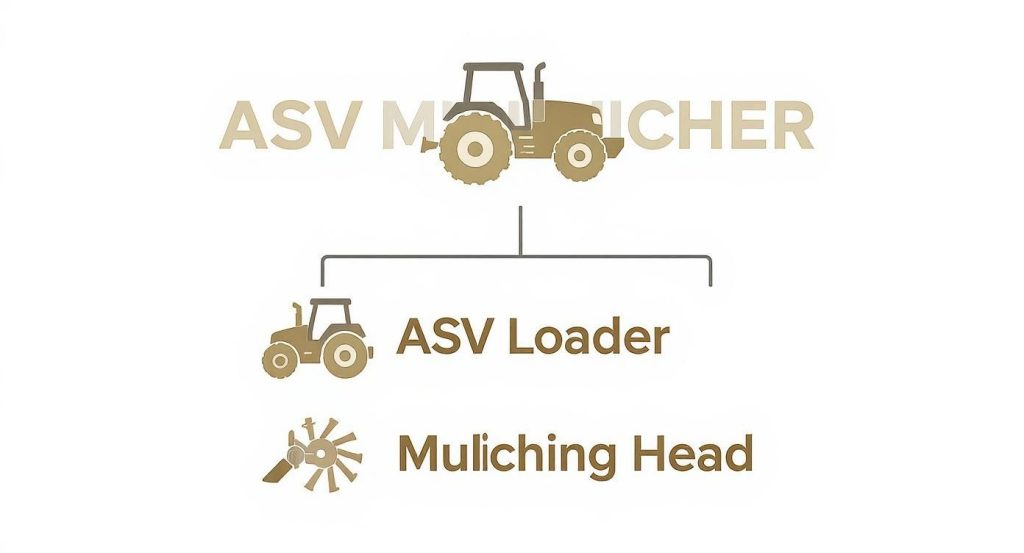
You can see how the two components work in synergy—the loader brings the power and mobility, while the attachment does the specialized work. It’s this pairing that makes the whole system so effective.
The Posi-Track Advantage: Low Ground Pressure
The single biggest edge an ASV loader has is its Posi-Track undercarriage. Think about trying to walk through deep mud. In work boots, you’d sink right in. But with snowshoes on, you float on top because your weight is spread out. That’s exactly what the Posi-Track system does for a heavy machine.
ASV’s wide, flexible rubber tracks distribute the machine’s entire weight across a huge surface area. The result is shockingly low ground pressure—on some models, it’s as low as 3.2 psi. That’s less pressure than the average human footprint.
This means an ASV can glide over soft, saturated, or delicate ground that would swallow a wheeled skid steer or even a heavier steel-tracked machine. For the often-soggy conditions we see here in Central Florida, that means more working days and far less damage to the property.
To put it into perspective, here’s a direct comparison of how ASV’s unique features stack up against a standard skid steer for mulching work.
ASV Mulching Advantage Breakdown
| Feature | ASV Posi-Track Loader Advantage | Benefit in Forestry Mulching |
|---|---|---|
| Undercarriage | Wide, flexible rubber tracks | Floats over soft ground, mud, and sensitive terrain without getting stuck or causing deep ruts. |
| Ground Pressure | As low as 3.2 psi | Minimizes soil compaction and landscape damage, allowing work in wet conditions. |
| Hydraulic Flow | Up to 50 GPM on high-flow models | Delivers consistent, overwhelming power to the mulching head, preventing stalls in dense vegetation. |
| Cooling System | Oversized, heavy-duty cooling | Prevents overheating during long, hot Florida workdays, ensuring steady performance. |
| Operator Cab | Pressurized, climate-controlled, and reinforced | Keeps the operator safe, cool, and focused, which boosts both productivity and job quality. |
This table highlights that every core feature of an ASV loader is engineered to solve a specific, real-world challenge faced in forestry mulching, giving it a clear advantage where it matters most.
Relentless Hydraulic Power
If the Posi-Track system gives the machine its legs, the hydraulic system is its heart. Mulching heads are incredibly power-hungry. They need a massive, uninterrupted flow of hydraulic fluid to keep their cutting drum spinning at full speed through thick brush and hardwood.
This is where ASV truly excels. The flagship ASV RT-135F, for instance, delivers an industry-leading 50 gallons per minute (GPM) from its high-flow hydraulic system. That’s not just a number on a spec sheet; it’s the raw muscle that keeps the mulcher from bogging down when it bites into a tough oak tree.
Consistent, high-volume hydraulic flow directly translates to faster clearing times and a finer, more uniform mulch. It ensures the machine works efficiently, turning dense thickets into a clean, finished product in a single pass.
All that power is backed by an oversized cooling system built to handle the intense heat generated during long hours of mulching. This prevents performance loss and protects critical components from burnout. As you explore different types of equipment, you can see how various systems compare in our detailed guide to underbrush clearing machines.
Built for Operator Endurance and Safety
Forestry mulching is a marathon, not a sprint. An operator might be in that cab for eight hours or more, and their focus is absolutely critical for both safety and quality. ASV gets this, engineering its machines with the operator’s well-being as a top priority.
The cabs are pressurized to keep dust and debris out and feature powerful climate control to beat the Florida heat. More importantly, they’re heavily reinforced with forestry-grade guarding and impact-resistant polycarbonate doors to protect the operator from flying debris—a constant threat in this line of work.
This focus on the human in the machine provides a few key benefits:
- Reduced Fatigue: A comfortable, cool, and quiet cab helps an operator stay alert all day, which leads to better, more precise work.
- Enhanced Safety: Superior visibility and heavy-duty protection give operators the confidence to work efficiently even in the toughest spots.
- Increased Productivity: An operator who isn’t fighting the heat or worrying about a branch coming through the glass can focus 100% on the job.
Ultimately, ASV’s dominance comes from a complete package. The Posi-Track system gets the machine into places others can’t go, the hydraulic system provides the brute force to get the work done, and the operator-focused cab ensures the person in control can perform at their best, all day long.
Real-World Forestry Mulching Applications
An ASV forestry mulcher is a whole lot more than just another piece of heavy machinery for clearing land. Think of it less like a bulldozer and more like a surgical tool, built to solve very specific environmental and development challenges. You really see its value when it’s on the ground, turning what looks like an impossible job into a straightforward project, especially here in the unique landscapes of Central Florida.
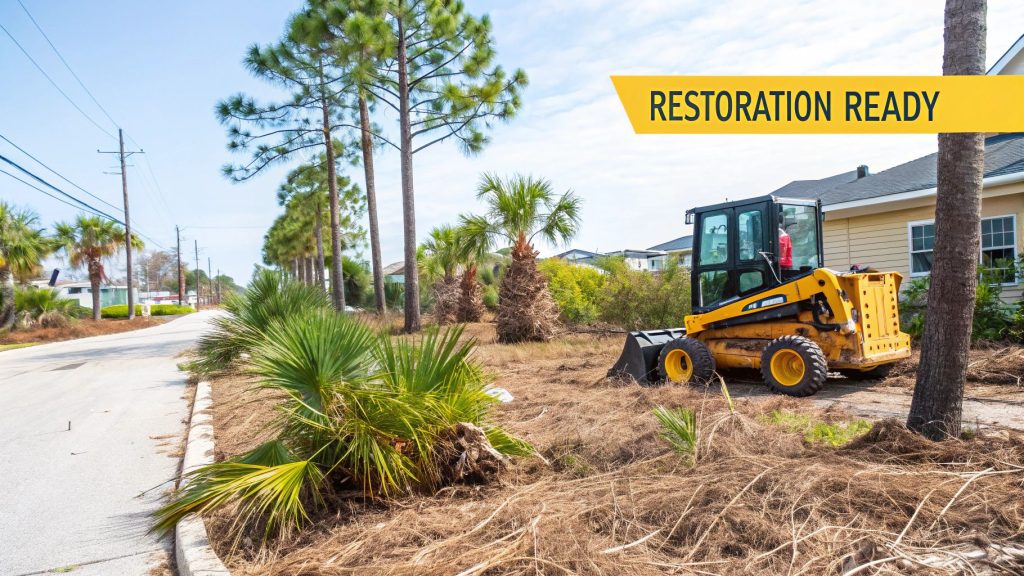
Instead of just scraping everything down to the dirt, this equipment lets us take a targeted, thoughtful approach. Let’s get past the general descriptions and look at the real impact these machines have.
Site Preparation for New Construction
Picture a lot here in Central Florida slated for a new home. Chances are, it’s a tangled mess of invasive Brazilian Pepper trees and palmetto thickets so dense you can’t walk through them. The old way was to just bulldoze the whole thing flat, scraping away the topsoil and leaving a barren patch of sand. An ASV forestry mulcher gives us a much smarter, more ecological way to work.
The machine can move through the property with precision, only taking out the unwanted vegetation. It grinds up the invasive plants and thick brush into a fine mulch, leaving those beautiful, mature oak and pine trees completely untouched. This doesn’t just clear the space for the foundation; it actually enriches the ground, laying down a nutrient-rich base for future landscaping.
This selective clearing method preserves the natural character and value of the property. Instead of starting from a blank, dusty slate, homeowners are left with a build-ready site that retains its mature, native trees and healthy soil structure.
Creating Critical Wildfire Defenses
In Florida, wildfire prevention isn’t an optional extra—it’s a flat-out necessity. Overgrown lots packed with dry underbrush are basically fuel dumps waiting for a spark, posing a huge threat to homes and neighborhoods. This is where an ASV forestry mulcher becomes a frontline tool for creating effective firebreaks.
A firebreak is simply a gap in vegetation designed to slow or stop a wildfire in its tracks. The mulcher is perfect for carving out these defensive lines around a property’s edge or between a community and wildlands. By grinding all that flammable brush right down to the soil, it eliminates the fuel a fire needs to keep moving, dramatically cutting down the risk.
Here’s why mulched firebreaks are so effective:
- Speed and Efficiency: A professional crew can create huge firebreaks in just a fraction of the time it would take to do by hand.
- No Debris Piles: Unlike bulldozing, mulching doesn’t leave behind big, flammable piles of dead vegetation that can become a fire hazard on their own.
- Improved Access: These cleared paths also double as critical access roads for firefighters and emergency vehicles if a fire ever does break out.
Reclaiming and Maintaining Agricultural Land
For ranchers and farmers, overgrown land is lost money. Pastures get choked out by tough brush, saplings, and invasive plants, shrinking the acreage available for cattle to graze or for planting crops. Bringing in an ASV forestry mulcher is like hitting the reset button.
The machine chews through years of overgrowth in a single pass, turning it back into organic matter that breathes new life into the soil. It’s a fast and clean way to reclaim valuable pastureland, letting ranchers expand their herds and improve the quality of their grazing areas without the soil compaction and damage caused by heavier equipment.
It’s also the perfect tool for keeping fence lines and access trails clear—a constant battle for anyone managing a large piece of property.
Managing Utility Right-of-Ways
Power lines, pipelines, and the roads alongside them have to stay clear of vegetation. It’s a matter of safety and preventing service outages. When trees and brush start creeping in, they can damage infrastructure and create serious hazards. For this kind of maintenance, an ASV forestry mulcher is the ideal solution.
Because of its low ground pressure, it can work in wet or sensitive areas without tearing up the landscape. It clears the right-of-way with surgical precision, leaving a neat, manageable path while preserving the ecosystem on either side. It’s a far more environmentally sound approach than spraying herbicides everywhere or bringing in the bulldozers.
Mulching Versus Traditional Land Clearing Methods
When you need to clear a piece of land, you’re standing at a fork in the road. It’s a big decision, one that will shape the property’s health, value, and future for years to come. For a long time, the only real option was the old-school way: bring in the dozers, scrape the earth bare, and set fire to the mountains of debris left behind. It was brute force, plain and simple.
But today, we have a much smarter, more surgical approach: the ASV forestry mulcher. It offers a way to work with the land, not against it.
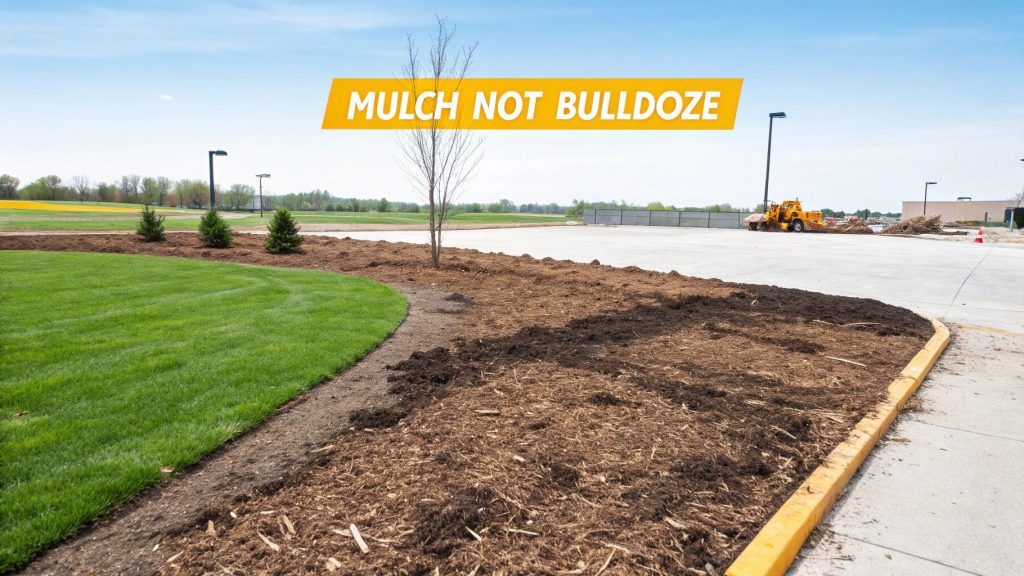
This isn’t just about using a different machine. It’s a completely different philosophy of land management. Let’s break down the real-world differences between modern forestry mulching and those older, more destructive methods.
The Environmental Impact: A Clear Difference
The biggest dividing line between mulching and traditional clearing is how they treat the soil. A bulldozer is all about brute strength—it rips out every tree and bush, roots and all, and scrapes away the nutrient-rich topsoil that took nature centuries to build. What’s left is compacted, barren ground that’s wide open to erosion, especially with Florida’s heavy downpours.
An ASV forestry mulcher, on the other hand, is a tool of preservation. It’s designed to selectively take down unwanted growth while leaving the precious soil and the root systems of the trees you want to keep completely untouched.
By grinding up vegetation right where it stands, a forestry mulcher lays down a protective blanket of organic material. This natural mulch layer shields the topsoil from washing away, helps it hold onto moisture during dry spells, and slowly breaks down to feed vital nutrients back into the ground.
It’s a closed-loop system. The machine recycles the vegetation on-site, making the land healthier instead of stripping it bare. You’re left with a sustainable foundation that promotes a thriving ecosystem for years.
Comparing Costs and Project Efficiency
At first glance, hiring a bulldozer might seem like the cheaper route, but that initial quote is rarely the final bill. Traditional land clearing is a messy, multi-stage process where the costs just keep piling up.
- Debris Management: Once the dozer is done, you’re stuck with massive piles of trees, stumps, and brush. You either have to pay to have it all hauled away—which means extra costs for trucks and disposal fees—or you have to burn it.
- Permitting and Labor: Burning isn’t free. You have to deal with local regulations, get expensive burn permits, and pay for the extra labor needed to safely manage the fires for days on end.
- Site Restoration: After all that, you’re often left with a scarred landscape. Fixing the damage means bringing in new topsoil and paying for extensive grading work.
Forestry mulching with an ASV machine rolls all of those steps into one clean, efficient operation. The mulcher clears, processes, and spreads the mulch in a single pass. There’s no hauling, no burning, and no need for site restoration. This all-in-one approach slashes labor hours, fuel costs, and all the other hidden expenses that come with traditional projects.
The Long-Term Land Value Proposition
Your choice here has lasting consequences. A bulldozed lot can struggle for years with poor soil health and erosion issues. It’s a hard reset that can seriously diminish the land’s value, whether for farming or just for looks.
Mulching, by contrast, is an investment in your property’s future. By keeping the topsoil intact and enriching it with organic matter, you’re creating the perfect conditions for healthy new growth, whether you’re planning to build a home, create a pasture, or restore a natural habitat.
The industry is taking notice. The forestry mulching machine market is on track to hit $2.5 billion in 2025, a boom driven by the growing demand for methods that are better for both productivity and the environment. You can dig deeper into these market trends in this detailed industry report.
When you get right down to it, an ASV forestry mulcher provides a solution that isn’t just faster and more cost-effective—it’s fundamentally better for the land. It transforms unwanted vegetation into a valuable resource, leaving your property healthier and more resilient than when you started.
Essential Safety and Environmental Practices
Let’s be clear: wielding the immense power of an ASV forestry mulcher isn’t just about knocking down trees and brush. It’s about doing the job responsibly. Operating this kind of machinery comes with a serious duty of care, both for the people on-site and for the beautiful Central Florida environment we work in.
Following strict, non-negotiable safety protocols is what separates a professional, sustainable land clearing operation from a reckless, damaging one. This responsibility doesn’t start when the engine fires up; it begins long before with deep operator training and a true understanding of what these machines can—and can’t—do. A good day on the job is a safe day, period.
The Foundation of a Safe Work Zone
The biggest hazard in forestry mulching, without a doubt, is flying debris. That mulching head spins at incredible speeds, and it can launch rocks, wood fragments, and even broken mulcher teeth hundreds of feet with enough force to cause serious damage. The first and most critical step is creating a secure work zone to contain that risk.
Any professional service will set up a clearly marked perimeter, often 300 feet or more, around the active mulching area. This is a hard-and-fast rule: no one who isn’t essential to the operation should ever step inside this zone. Before we even start, we’re also identifying and accounting for any nearby homes, roads, or power lines that could be in the line of fire.
Before every single shift, a thorough walk-around inspection is non-negotiable. This isn’t just a quick glance; it’s a detailed check of the machine’s vitals:
- Mulcher Teeth: We’re looking for any loose, cracked, or missing teeth. A single one of those coming loose at high speed becomes a dangerous projectile.
- Hydraulic Hoses: We inspect every hose for leaks, bulges, or wear that could signal a system failure waiting to happen under thousands of pounds of pressure.
- Safety Guards: All the protective shields and guards have to be securely in place and undamaged. They’re there for a reason.
- Operator Cab: The polycarbonate door and windows are the operator’s shield. We check them for any cracks that might compromise their strength.
This daily diligence is what prevents small mechanical issues from turning into catastrophic failures.
Personal Protective Equipment (PPE) is the last line of defense. This means a hard hat, eye and ear protection, steel-toed boots, and often fire-resistant clothing. But for the person in the driver’s seat, the most important piece of PPE is the machine’s reinforced cab itself.
Environmental Stewardship in Practice
While the machine is a beast, we use it with a light touch, guided by a commitment to the health of the land. When used correctly, an ASV forestry mulcher is a tool for restoration, not just destruction. The whole process is designed to work with the land, not against it.
The most obvious environmental win is how we prevent soil erosion. Bulldozing scrapes the earth bare, tearing away the precious topsoil. Mulching, on the other hand, leaves the soil structure and crucial root systems completely intact. The layer of mulch we create acts like a protective blanket, shielding the ground from Florida’s heavy downpours and stopping that valuable topsoil from washing away.
Better yet, that mulch layer gets right to work enriching the ground. As it decomposes, it returns organic matter and vital nutrients back into the soil. It’s a natural fertilization process that improves soil health over time, helping native grasses and plants to regrow while naturally suppressing invasive species.
This approach also completely eliminates the need for pile burning. That old-school method of land clearing pumps a huge amount of carbon dioxide and other pollutants into our air. By processing all the vegetation right on-site, forestry mulching offers a cleaner, more sustainable path forward—turning a powerful clearing tool into an instrument of responsible land stewardship.
How to Hire a Professional Mulching Service
While the thought of getting behind the controls of an ASV forestry mulcher is definitely appealing, the reality is that getting professional, safe, and efficient results almost always means hiring an expert. For most landowners, it’s simply the smartest and most cost-effective way to go.
When you hire a pro, you’re not just getting a machine. You’re getting a highly skilled operator, comprehensive insurance coverage, and the real-world experience needed to tackle your property’s specific challenges. But picking the right contractor takes a little homework. You’re not just hiring a machine; you’re trusting someone with the safety and long-term health of your land.
Vetting Your Mulching Contractor
Your vetting process should start with the non-negotiables. First and foremost, don’t be shy about asking for proof of both general liability insurance and workers’ compensation. This is your shield, protecting you from any liability if an accident were to happen on your property.
Next, you’ll want to dig into their actual experience. Ask to see a portfolio of past projects, especially ones in the Central Florida area that look similar to your own. This will give you a real sense of their work quality. A seasoned contractor can size up an overgrown lot and know exactly what it’s going to take to clear it the right way.
The immense value a professional service provides is a truly turn-key solution. You get access to expertly maintained machinery, highly skilled operators who maximize efficiency, and peace of mind knowing the job will be done right.
Key Questions to Ask a Potential Service
Once you’ve covered the basics, it’s time to find out more about their operational know-how. The answers to these questions will quickly separate the amateurs from the true professionals.
- What specific equipment will you use for my job? Ask about their ASV forestry mulcher models and the types of mulching heads they run. An expert will know how to match the right machine to your land’s vegetation and terrain.
- How much experience does your operator have? A skilled operator can clear land faster, create a finer, more uniform mulch layer, and navigate obstacles with minimal impact on the surrounding environment. This isn’t a job for a beginner.
- Can you walk me through your safety protocols? They should be able to clearly explain how they set up a safe work zone, manage flying debris, and perform daily equipment checks.
The Palm State Clear Cut Advantage
At Palm State Clear Cut, we love these questions because we’re proud of our high standards. We run a fleet of modern, meticulously maintained ASV equipment, and our operators are seasoned pros with years of hands-on experience in Central Florida’s unique ecosystems.
We believe in transparent, site-specific quotes, so you know exactly what you’re paying for—no surprises. For a deeper dive into pricing, check out our guide on forestry mulching cost per acre.
The demand for professional land clearing services is on the rise, right alongside the equipment rental market, which was valued at an impressive $197.7 million in 2023. As this market grows, choosing a proven expert becomes more important than ever.
Ready to transform your property the right way? Contact Palm State Clear Cut today for a professional consultation and a free, no-obligation quote for your land clearing project.
Your Top ASV Mulching Questions, Answered
Even after getting the big picture, you’ve probably got some practical questions buzzing around. That’s perfectly normal. Getting straight-up answers is the best way to feel confident about tackling your land clearing project. We’ve put together some of the most common questions we hear from landowners just like you.
Think of this as a quick-reference guide to what you can really expect when this beast of a machine gets to work on your property.
How Much Land Can Be Cleared in One Day?
This is the million-dollar question, and the honest answer is: it completely depends on your property. If we’re looking at land with light brush, scattered palmetto thickets, and some small saplings, an experienced operator can make incredible progress, often clearing several acres in a single day. The machine just eats that kind of stuff up.
But, if we’re staring down a dense, overgrown forest choked with mature hardwoods and stubborn stumps, things naturally slow down. In those tough, demanding conditions, you might be looking at closer to one acre per day. The only real way to know is to have a pro walk the land and give you a realistic timeline based on what they see.
Is Forestry Mulching Really Better Than Bulldozing?
For almost any land clearing job you can think of, the answer is a hard yes. Forestry mulching is a surgical, low-impact approach. It shreds the unwanted growth right where it stands, leaving your valuable topsoil and the root systems of the trees you want to keep completely untouched. This method actually prevents erosion and gives the ground a natural dose of fertilizer.
Bulldozing, on the other hand, is pure brute force. It scrapes away essential topsoil, compacts the ground into a hardpan, and leaves you with massive piles of debris that have to be hauled away or burned—both costly, time-consuming hassles. Mulching improves the land; bulldozing often leaves it scarred and in need of expensive repairs.
What Happens to All the Mulch Left Behind?
That layer of fresh mulch covering the ground isn’t just a byproduct; it’s one of the biggest benefits of bringing in an ASV forestry mulcher. This organic blanket gets right to work, doing several critical things to boost the long-term health of your property.
Here’s a quick rundown of what that mulch does for you:
- Erosion Control: It acts like a natural shield, stopping wind and rain from carrying away your precious topsoil.
- Moisture Retention: The mulch is like a sponge, helping the soil hang onto water—a huge advantage during Florida’s long dry seasons.
- Weed Suppression: It smothers the ground, preventing pesky weeds and invasive plants from sprouting back up.
- Soil Enrichment: As the mulch breaks down over time, it slowly releases vital nutrients back into the earth, making your soil richer and more fertile.
Can an ASV Mulcher Actually Work on Wet Ground?
You bet it can—and this is where ASV machines truly shine. The genius of the Posi-Track undercarriage is how it spreads the machine’s weight over a massive surface area. This creates incredibly low ground pressure, allowing it to practically “float” over soft, muddy, and even swampy terrain that would swallow a wheeled machine whole.
This unique ability means an ASV forestry mulcher can keep working in the wet, saturated conditions so common here in Central Florida. It translates to more productive days on the job and minimal damage to sensitive ground.
Ready to see what an ASV forestry mulcher can do for your property? The team at Palm State Clear Cut has the expertise and equipment to handle your land clearing needs efficiently and responsibly.