
A Homeowner's Guide to Pruning Tall Trees Safely
- Jan 6
- 17 min read
Pruning a tall tree isn’t just about making it look nice; it’s a critical safety measure, especially for those of us living in Florida. This is about selectively removing specific branches to help a tree stand strong against storm winds, prevent property damage from falling limbs, and keep it healthy for the long haul. Think of it as a necessary checkup for the biggest plants on your property.
Why Pruning Tall Trees Is Non-Negotiable
Towering oaks, pines, and palms are incredible assets to any Central Florida property, but they also represent a huge liability if you let them go. An overgrown or structurally weak tree is just an accident waiting to happen, particularly when hurricane season starts brewing. Pruning is hands-down your best defense against a potential disaster.
And this isn't about just hacking away at branches. It’s a science. When done correctly, it actually improves the tree’s structural integrity and overall life force. The benefits of a regular pruning schedule are crystal clear:
Enhanced Safety: Getting rid of dead, damaged, or weakly attached branches—we often call them "widow-makers"—drastically cuts down the risk of them falling on your home, car, or a person.
Storm Resistance: By thinning the canopy, you're letting high winds pass through the tree instead of pushing against it like a giant sail. This one move significantly lowers the chances of the tree uprooting in a nasty storm.
Improved Tree Health: Making proper cuts encourages healthy new growth and stops decay from spreading out from diseased limbs. It also prevents crossing branches from rubbing against each other and creating wounds that are an open invitation for pests.
Better Clearance and Aesthetics: Raising the canopy can give you much-needed clearance over walkways and driveways and improve sightlines, making your property look open and well-cared-for.
Timing Your Pruning in Central Florida
When you prune is just as important as how you do it. For most of the deciduous trees we see in Brevard or Osceola county, the best time is during the dormant season in late winter. Once the leaves are gone, it's way easier to see the tree's structure and make smart, strategic cuts. Pruning then also minimizes stress on the tree and lowers the risk of pests getting into the fresh wounds.
There are exceptions, of course. Flowering trees that put on a big show in the spring should be pruned right after they finish blooming. If you do it earlier, you'll be cutting off the buds for next year's display. And for palm trees, a Florida icon, you can generally prune them any time of year, but you should only remove the brown, dead fronds.
An Optimal Pruning Calendar For Central Florida Trees
To help you plan, here's a seasonal guide for some of the most common tall trees you'll find around Central Florida. Timing is everything for maintaining tree health and getting the best results.
Tree Type | Primary Pruning Season | Reasoning | Notes & Cautions |
|---|---|---|---|
Oak Trees (Live, Laurel) | Late Winter (Jan-Feb) | Dormant season allows for clear visibility of branch structure and minimizes stress. Reduces risk of Oak Wilt disease. | Avoid heavy pruning in late spring/early summer. Sterilize tools between trees to prevent disease spread. |
Pine Trees (Slash, Longleaf) | Late Winter / Early Spring | Pruning before the spring growth spurt helps the tree recover quickly. | Focus on removing dead or broken branches. Avoid "topping" at all costs as it can be fatal to the tree. |
Palm Trees (Sabal, Queen) | Any Time of Year | Palms don't have a dormant season like other trees. Pruning is for aesthetics and safety. | Only remove brown, dead fronds. Never cut green fronds, as this can severely weaken the palm. |
Crape Myrtles | Late Winter (Jan-Feb) | Pruning while dormant encourages vigorous new growth and abundant summer blooms. | Be cautious of "crape murder"—severe topping that ruins the tree's natural shape. Thinning is better. |
Magnolias | After Flowering (Late Spring) | Pruning after blooms fade ensures you don't remove the buds for the current season's flowers. | Magnolias require minimal pruning. Focus on shaping and removing dead or crossing branches. |
This calendar is a solid starting point, but always consider the specific health and location of your tree. When in doubt, it's best to consult with a professional.
Understanding Basic Pruning Types
If you can get a handle on a few key terms, you'll have a much better idea of what your trees need and can talk intelligently with a professional about the job.
Crown Thinning: This is all about selectively removing smaller branches throughout the tree's canopy to cut down on density. The idea is to let more light and air get through, which strengthens the whole structure without changing the tree's overall size or shape.
Crown Raising: Exactly what it sounds like. We do this by removing the lowest branches of a tree, usually to create clearance for people, cars, or buildings underneath.
Crown Reduction: This is the responsible alternative to "topping." It reduces the tree's height and spread by pruning back main branches to smaller, lateral ones that are strong enough to take over.
The tree trimming services industry is a big deal in property maintenance, with revenues expected to hit $39.5 billion by 2025. Here in Central Florida, that demand is even higher thanks to the constant need to manage overgrown lots and get ready for storm season. In fact, proper utility-related tree trimming is credited with preventing up to 70% of power outages caused by falling branches during storms—a statistic every homeowner in this state should know.
You can see some great examples of professional tree thinning and site preparation in our project gallery.
The Right Gear And Safety Rules for Tree Work
Before you even think about cutting a single branch, remember this: success and safety are decided on the ground. Having the right equipment isn't just a good idea; it’s the absolute bare minimum for protecting yourself from life-altering injuries. Trying to prune a tall tree without the proper gear is a gamble no homeowner should ever take.
This goes way beyond just having a ladder and a saw. It's about a whole system for safety, and it starts with what you wear. Personal Protective Equipment (PPE) is your first and most important line of defense against falling debris, razor-sharp tools, and those split-second accidents you never see coming.
Think of it as your personal safety uniform. Every single piece has a vital job, and skipping just one can lead to disaster.
Hard Hat: A falling branch can weigh hundreds of pounds. This is completely non-negotiable.
Safety Glasses or Goggles: Sawdust, wood chips, and tiny twigs can fly everywhere and cause permanent eye damage. Protect your vision.
Sturdy Work Gloves: These give you a solid grip on your tools and save your hands from cuts, splinters, and blisters.
Hearing Protection: If you're firing up a chainsaw, you need this. The noise can cause long-term hearing loss faster than you'd think.
Chainsaw Chaps: Anyone using a chainsaw needs these. The material is designed to stop a moving chain on contact, preventing a catastrophic leg injury.
Steel-Toed Boots: Protects your feet from falling limbs and gives you solid footing on uneven ground.
Choosing The Right Tools For The Job
Using the right tool doesn't just make the job easier—it makes it safer. Trying to force a tool to do something it wasn't designed for is just asking for trouble. The tools for pruning tall trees range from simple hand-held clippers to powerful machines, and each one has its place.
There's a reason the global market for tree trimmers is valued at $2,286 million in 2024—specialized equipment is in high demand. We're seeing more innovations like cordless, battery-powered tools, which now make up 40% of new sales. This shift is largely driven by noise regulations in residential areas, where fines can hit $10,000. These newer tools allow for quieter, more efficient work. You can dig into more of these market trends over on IntelMarketResearch.com.
Here’s a quick rundown of what to use and when:
Hand Pruners: Perfect for small, easy-to-reach branches up to about ¾-inch thick.
Loppers: The long handles give you the leverage you need to cut through branches up to 2 inches in diameter.
Pole Saws: This is your best friend for reaching higher branches from the safety of the ground. It extends your reach without needing a ladder.
Chainsaws: These are for the big stuff—limbs over 3 inches thick. They demand extensive training and a healthy respect for their power.
A sharp tool is a safe tool. When a blade is dull, you have to use more force, which dramatically increases the chance of slipping or making an uncontrolled cut. Always inspect and sharpen your tools before you start a project.
Critical On-Site Safety Procedures
Beyond your gear and tools, what you do on-site is what truly keeps you safe. Following a few key procedures is the most important part of pruning tall trees, especially when there are hazards nearby.
One of the most overlooked—and deadliest—risks is electricity. If you have power lines running through or even near your trees, that area is an absolute no-go zone for DIY work.
Never, ever attempt to prune any branch that is within 10 feet of a power line. Electricity can arc from the line to your tool or your body without you ever making direct contact. This is a job that is exclusively for professionals who are trained and certified to work around utility lines.
Establishing A Safe Work Zone
Before that first cut, you have to secure the area. That means creating a drop zone—a clearly marked area where you expect branches to fall. Use cones or caution tape to block it off so no person or pet can wander into danger.
If you're using a ladder, always maintain three points of contact. That means two hands and one foot, or two feet and one hand, on the ladder at all times. Make sure the ladder is on firm, level ground and never lean out to reach a branch. It's always safer to climb down and move the ladder.
For the really big jobs, professionals bring in heavy-duty equipment like bucket trucks and aerial lifts. These machines provide a stable, secure platform for arborists to work from, allowing them to access high canopies safely. Their use really underscores the complexity and danger of pruning tall trees and makes it clear why some jobs are just best left to those with the right training and machinery.
Mastering Professional Pruning Techniques
Knowing why and when to prune is one thing, but the how is where the real skill and safety come into play. Professional arborists use specific methods not just for appearances, but to make sure the tree heals quickly and stays structurally sound. Once you understand these techniques, you start to see the difference between a quick trim and a professional job.
The absolute cornerstone of removing any significant limb is the three-cut method. This isn't just a friendly suggestion; it's a non-negotiable process that stops heavy branches from tearing a long strip of bark off the trunk as they fall. A clean cut lets the tree properly seal the wound, which is its natural defense against pests and rot.
A sloppy, single cut can create a huge, jagged wound that a tree might never fully recover from. This is probably the most common—and most damaging—mistake we see in DIY tree pruning, and it can leave the tree vulnerable for years.
Executing The Perfect Three-Cut Method
This technique is all about controlling the branch's weight before you make that final, precise cut. It’s a smart combination of physics and biology.
The Notch Cut: Start about one to two feet out from the trunk. Your first cut goes on the underside of the branch, cutting about a third of the way through. This is your safety cut—it's what prevents the bark from ripping down the trunk.
The Relief Cut: Next, move an inch or two further out from your first cut and start sawing from the topside of the branch. As you cut, the branch's own weight will cause it to snap cleanly between your two cuts, falling away without tearing the trunk.
The Final Cut: You’re left with a much more manageable stub. Make your last cut just outside the branch collar—that slightly swollen area where the branch joins the trunk. You never want to cut flush with the trunk, because the collar contains specialized cells that are essential for healing over the wound.
This meticulous approach is what separates professional pruning from a quick hack job. It’s all about working with the tree’s natural healing process, not against it.
Strategic Pruning for Florida Scenarios
Beyond just making a good cut, professional pruning is always guided by a clear goal, especially here in Florida. That usually means prepping for hurricane season and managing how trees grow around our homes and power lines.
Crown Thinning for Hurricane Readiness: Picture a dense, overgrown Live Oak. In a hurricane, that thick canopy acts like a giant sail, catching the wind and putting incredible stress on the trunk and roots. Crown thinning involves selectively removing smaller, interior branches to open it up. This lets the wind pass through the canopy instead of pushing against it, dramatically lowering the risk of the tree coming down in a storm.
Crown Raising for Practical Clearance: Ever had to duck under low-hanging branches just to walk down the sidewalk or pull into your driveway? Crown raising is the fix. We simply remove the lowest limbs to create more vertical space. It’s not just for convenience—it improves sightlines and lets more sunlight hit the ground below, which can be great for your lawn.
Crown Reduction as a Responsible Alternative: When a tree gets too big for its spot, many people's first instinct is to "top" it. Topping—indiscriminately chopping off the main vertical stems—is one of the worst things you can do to a tree. It creates weak, fast-growing sprouts and leaves massive wounds that invite rot. The professional alternative is crown reduction, where we carefully shorten branches back to smaller, lateral limbs that can take over as the new leader. This reduces the tree's size while keeping its natural shape and structural integrity.
This graphic shows the absolute minimum safety gear you should have on before trying any of this, even if you’re working from the ground.
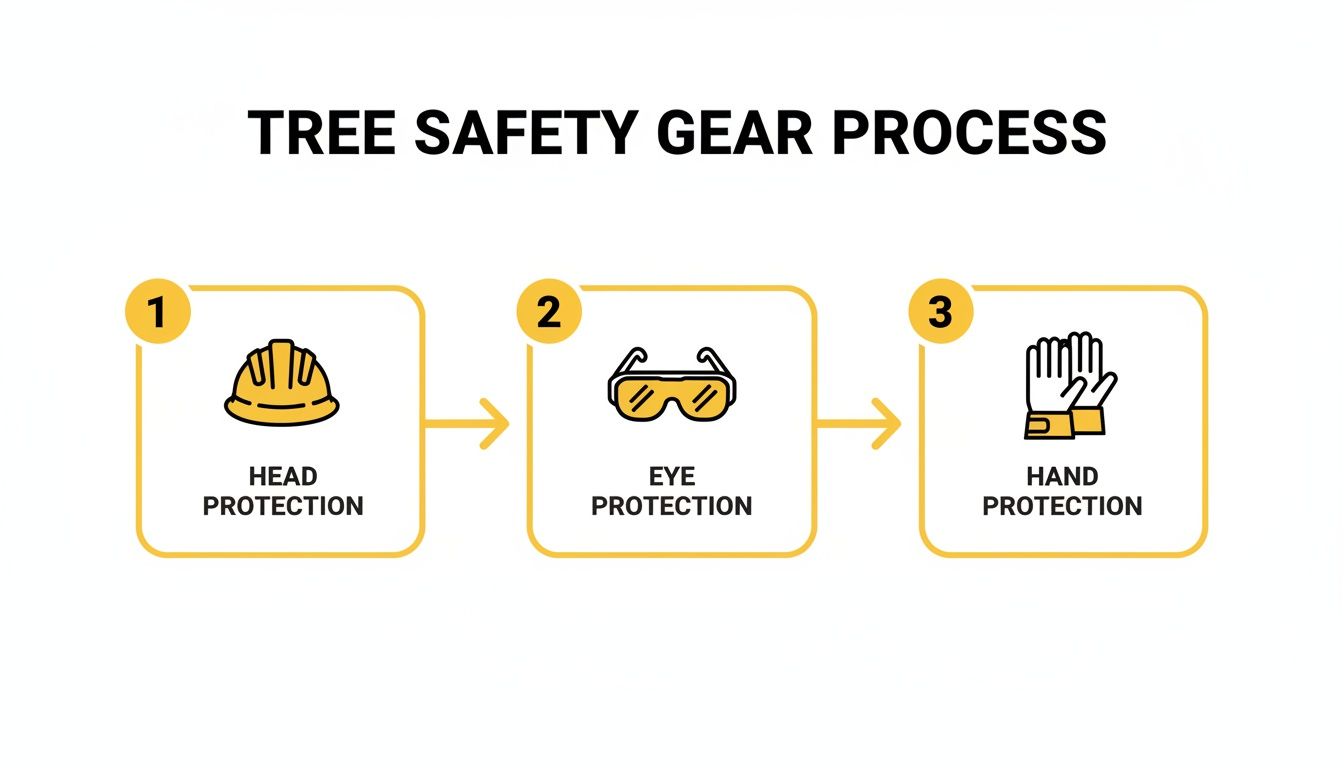
It’s a simple top-to-bottom check: protect your head, eyes, and hands from the most common hazards in tree work.
Pruning is an investment in your property's future. A single well-placed cut can add years to a tree’s life and prevent thousands of dollars in potential damage. Conversely, a bad cut can start a slow decline that ends in costly removal.
The Aftermath: Debris Management
A professional job isn't over when the last branch hits the ground. Figuring out what to do with all the debris is a huge part of the process. Piles of branches and leaves aren't just an eyesore; they can attract pests if they're left sitting around.
Professionals will either haul all the debris away or, in many cases, process it right on-site. That leftover organic material can be incredibly useful. For anyone interested in sustainable land management, you can learn more about how forestry mulching turns this "waste" into a protective layer that actually enriches your soil. It’s a great way to clean up the site while improving the health of your entire property.
Understanding Florida's Rules And Pruning Costs
Tackling a tall tree in Central Florida involves more than just a saw and a steady hand. You've got to navigate a web of local rules and, of course, figure out the budget. Before a single branch comes down, it's smart to get a handle on the regulations to avoid a surprise fine and make sure you're investing wisely in your property.
A lot of folks in Orange or Seminole counties don't realize they can't just take down or drastically prune any tree on their property. Many cities and counties protect certain trees—often called "heritage," "specimen," or "protected" trees—because of their species, size, or age. Felling one without getting the right permit first can lead to some seriously steep penalties.
And it’s not just about complete removal. If you're planning an aggressive trim that takes off more than 25% of the canopy, you might need a permit for that, too. The absolute best first move is to call your local city or county's planning and zoning department. A quick conversation can clear up any confusion and save you a massive headache down the road.
Decoding The Cost Of Professional Pruning
Once you know you're clear on the rules, the next big question is always about the price tag. Bringing in a pro to prune a tall tree is a real investment, and costs can swing wildly depending on a few key things. Knowing what drives the price helps you understand why quotes differ and what a fair deal really looks like.
The tree's height is the most obvious factor, of course. A towering 70-foot oak is a completely different ballgame than a 30-foot crape myrtle, demanding more equipment, time, and risk. But other variables are just as important.
Accessibility: Is the tree right by the street where a bucket truck can easily pull up? Or is it tucked away in a tight backyard, requiring a skilled climber and complex rigging to get the job done? Tough access will always drive up the labor cost.
Tree Health: A tree riddled with deadwood or showing signs of structural weakness is a lot more dangerous to work on. That calls for extra caution and specialized techniques, which naturally adds to the price.
Proximity to Hazards: When branches hang over your house, garage, or power lines, the work becomes surgical. Every cut piece has to be carefully roped and lowered to avoid disaster, which adds a significant amount of time and complexity.
A professional crew will give you a detailed quote. It shouldn't just be a number—it should break down the work, from the specific pruning methods they'll use to how they'll handle debris removal, and always include proof of liability insurance.
What To Expect For Pricing in Central Florida
For a pretty standard job on a medium-sized tree (30-60 feet) with easy access, you could be looking at a range of $400 to $800. When you get into the big leagues with trees over 60 feet or those posing serious hazards, the cost can easily jump to $1,000 to $2,000, sometimes even more. While every area is a bit different, looking at a general a tree pruning cost guide can give you a solid ballpark idea of what to expect.
Just remember, the cheapest bid is rarely the best deal. Uninsured or inexperienced crews often cut corners on safety and proper pruning techniques, which can end up damaging your property or slowly killing your tree. Paying for real expertise isn't just a cost—it's an investment in getting the job done right the first time.
Knowing When To Call An Arborist
While having the right gear is important, the most crucial skill in tree work is honestly knowing your own limits. Let's be real—some jobs are just too big, too complex, or flat-out too dangerous for even the most ambitious weekend warrior.
Recognizing when it's time to call in a professional arborist isn't admitting defeat. It's making a smart call that protects you, your property, and the health of the tree itself.
The simplest rule I tell people is this: if your feet have to leave the ground, you should probably be on the phone with a pro. Once you're working at height, whether on a ladder or climbing, you've entered a whole new world of risk that requires specialized training and fall-arrest systems. A fall from just 10 feet can change your life.
Unmistakable Signs It's Time For A Professional
Beyond just height, there are a few scenarios that should immediately stop you in your tracks and have you reaching for the phone. These are situations where the potential for disaster is just too high to ignore.
Keep an eye out for these massive red flags:
Proximity to Power Lines: This is a non-negotiable. Never, ever attempt to prune a branch that is within 10 feet of a utility line. Electricity can arc across that gap to you or your tools, leading to fatal electrocution. This work is legally reserved for certified utility line clearance arborists for a very good reason.
Large, Dead, or Hanging Branches: Those massive dead limbs hanging in the canopy have a grim nickname: "widow-makers." They can weigh hundreds of pounds and break free without any warning, making them incredibly dangerous to work under or remove without professional rigging.
Signs of Disease or Decay: If you spot big cracks in the trunk, mushrooms growing at the base, or hollow sections, the tree’s structural integrity could be seriously compromised. An arborist needs to assess the risk to see if the tree is even safe to work on at all.
DIY vs Professional Tree Pruning Decision Matrix
Deciding whether to tackle a pruning job yourself or call in the experts can be tough. This quick-reference table is designed to help you make a safe, informed choice based on the specific risks involved.
Scenario | Recommended Action | Primary Reason |
|---|---|---|
Pruning small shrubs or branches from the ground | DIY-Friendly | Low risk of falling; manageable branch size. |
Tree requires you to use a ladder | Call a Pro | Significant fall risk, especially with tools. |
Any branches are within 10 feet of a power line | Call a Pro | Extreme electrocution hazard. |
Tree shows signs of decay, rot, or major cracks | Call a Pro | Compromised stability; unpredictable risk. |
Branches are over your house, car, or fence | Call a Pro | Requires specialized rigging to prevent property damage. |
Removing large, heavy, or dead "widow-maker" limbs | Call a Pro | High risk of the limb falling uncontrollably. |
Tree is over 30 feet tall | Call a Pro | Standard equipment is inadequate and unsafe. |
Ultimately, if you have even a sliver of doubt, making the call is always the right move. The risks of property damage or serious injury are simply not worth the savings.
The True Value of an Arborist
Hiring a certified arborist or a trusted company gives you more than just someone with a bigger chainsaw. You're paying for expertise that protects your investment. They understand how a specific tree species will react to certain cuts, ensuring its long-term health instead of just a quick fix.
They also show up with the right equipment for pruning tall trees safely and efficiently. An arborist with a bucket truck and advanced rigging gear can precisely dismantle and lower massive limbs over your home—a task that's impossible and reckless to attempt from a ladder.
The demand for this skill is growing. The tree services market is on track to hit $2.51 billion by 2029, partly due to increased storm frequency and local regulations. In fact, many cities now require pruning for 85% of urban trees over 40 feet to prevent power outages. You can see more on these market drivers on ResearchAndMarkets.com.
If you’ve spotted any of these red flags on your property, don't wait. You can easily schedule a professional assessment with Palm State Clear Cut to get a clear, expert opinion on the safest way forward for your tall trees.
Common Questions About Pruning Tall Trees
Even after getting the hang of the techniques and safety gear, most Florida property owners still have a few lingering questions about the practical side of pruning tall trees. Getting straight answers can make all the difference in keeping your property safe and your trees healthy. Let's dig into some of the most common questions we hear from homeowners.
The first thing almost everyone asks is about timing: how often does this really need to be done? There's no magic number here. The right schedule really depends on the tree's species, its age, and its current health.
As a good rule of thumb, a mature, established tree should get a professional pruning every 3 to 5 years.
Younger trees, on the other hand, usually need a bit more attention—think every 2 to 3 years. This helps them grow a strong, resilient structure from the start, which prevents bigger problems like weak branch unions down the road. And of course, after any big storm or hurricane, an immediate inspection is always a smart move, no matter where you are on the schedule.
Is Topping A Tree An Option?
Another question that comes up a lot is about tree height. People often ask, "Can I just 'top' my tree to make it shorter?" The answer is always a firm, absolute no. Topping a tree is one of the most damaging things you can possibly do to it.
This harmful practice involves just lopping off the main vertical stems, which leaves behind large, open wounds the tree can't properly heal. Those wounds become wide-open doors for pests and diseases, often leading to widespread decay inside the tree.
Topping doesn't make a tree safer; it actually makes it significantly more dangerous. The weak, rapid growth that sprouts from those cuts is poorly attached and far more likely to break off in a storm than the original, healthy branches ever were.
A proper crown reduction, which we covered earlier, is the professional and responsible way to go. It’s a technique that respects the tree's natural structure while still achieving the goal of reducing its overall size.
Handling The Cleanup Process
Finally, homeowners always want to know what happens to the mountain of branches and leaves once the job is done. This is a huge differentiator between a professional service and a guy with a chainsaw. A complete, professional job always includes managing all the debris, leaving your property clean and clear.
This cleanup process can look a couple of different ways:
Complete Haul-Away: We load up every branch, log, and leaf and remove it from your property, leaving no trace behind.
On-Site Mulching: Larger branches are fed into a chipper, and sometimes a forestry mulcher is used to turn the debris into beneficial ground cover. This fresh mulch can then be spread around your garden beds to help retain soil moisture and keep weeds down.
Taking care of the aftermath is a critical part of the service. It ensures your property is not only safer from falling limbs but is also immediately usable and looks great the moment we're finished. It’s the final, crucial step in comprehensive tree care.
At Palm State Clear Cut, we handle the entire process for you, from selective tree thinning and expert pruning to complete debris removal and site preparation. Visit our website to schedule your free quote and let our professionals manage your tall trees safely and effectively.


Comments